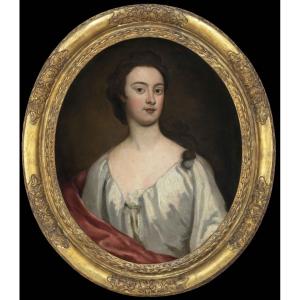


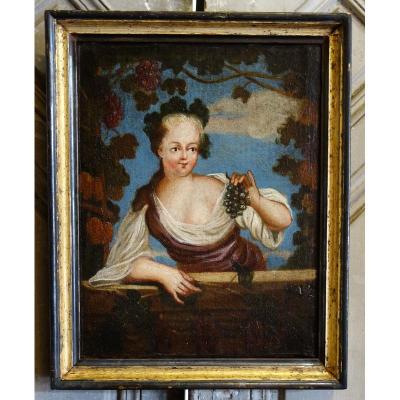
"Portrait Of A Lady In A White Dress C.1730-1740, Oil On Canvas Painting, Jeremiah Davison"
Portrait of a Young Lady, probably British, c. 1730–1740Attributed to Jeremiah Davison (c. 1695–1745)
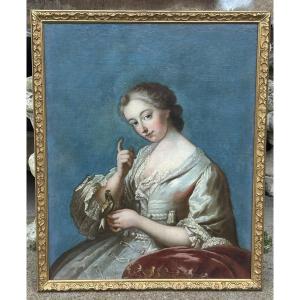
What makes this portrait immediately compelling is its directness: the sitter’s steady, intelligent gaze meets the viewer without theatricality, yet the painting never feels plain. The artist balances an intimate, domestic mode—softly arranged hair, an “undress” neckline, and a deliberate absence of showy jewellery—with a quietly assured elegance. The warm, subdued ground pushes the head forward, while the luminous whites and the restrained crimson drapery create a refined harmony of tone and colour. It is a portrait made for close looking: the calm authority of the face, the slight tension and individuality of the mouth, and the painter’s assured handling of satin and shadow combine to give the work an unusually vivid sense of presence.
The sitter is presented in the fashionable idiom of early Georgian “undress” portraiture, a mode prized precisely because it could signal refinement without the stiffness of court display. She wears a pale silk or satin gown of wrapper or “nightgown” type—terms which in the first half of the eighteenth century described a spectrum of less-formal dress rather than literal sleepwear. The neckline is wide and low, softened by the suggestion of the chemise beneath, and the bodice is drawn together at the centre front with a ribbon-tie or lacing. The effect is intentionally artful: a cultivated informality associated with private rooms and polite sociability, transposed into paint as a statement of taste. Draped across her arm is a deep crimson mantle or studio drapery, a long-standing portrait convention that both warms the palette and adds a discreet note of status; rich reds remained culturally legible as costly and fashionable, even when used with restraint.
Her hair reinforces the same message. Instead of the more elaborate, formally dressed arrangements often seen in court portraiture, it is worn long and softly styled, with a fall over one shoulder. That looseness—carefully composed to appear natural—was part of the period’s visual vocabulary for youth, beauty, and ease. It also suggests a sitter at a transitional moment: the age and presentation align with the common reasons portraits were commissioned for women of the gentry and professional elite, above all marriage, coming of age, or the establishment of a new household.
At present, the sitter cannot be responsibly named – but what can be said with confidence is that this is the portrait of a gentlewoman of means. The scale, the ambitious oval format, and the quality implied by the costume and frame point toward the gentry world—families whose lives were structured by household management, social visiting, letter-writing, reading, music, and the careful cultivation of networks through which property, influence, and marriage were negotiated. In that milieu, portraiture was not simply decoration. It was a social instrument: an image that could affirm credibility, display cultivated taste, commemorate a marriage alliance, or fix a family likeness for descendants.
The likely dating of the costume and the portrait’s mode places it in the early Georgian decades, broadly around the 1730s and into the early 1740s. Britain in those years was experiencing both political consolidation and an accelerating culture of consumption. London’s dominance as a centre of finance, luxury goods, and art patronage encouraged portrait production on an expanding scale, while provincial patrons increasingly adopted metropolitan visual languages. The portrait market responded to this demand with a spectrum of practitioners—from elite London names to highly competent artists working between London and the regions—and with workshop systems that could deliver fashionable likenesses efficiently. In this context, “undress” portraits of women became especially desirable: they performed a subtle balancing act, projecting intimacy and natural beauty while still functioning as a marker of status and belonging.
A particularly telling object-history detail is the stamp on the stretcher: “F. Leedham / Liner.” This refers to a London picture liner and restorer active in the mid-nineteenth century. The stamp does not date the painting’s creation, but it does supply a valuable waypoint: by the Victorian period the portrait was already considered worthy of professional relining and studio restoration. That kind of intervention was usually reserved for pictures of perceived quality or value, and it implies sustained private ownership and regard over generations in a British context.
The most plausible attribution remains to Jeremiah Davison (also encountered as Davison/Davidson), a portrait painter who belongs squarely to the professional world that produced refined, fashionable likenesses for the early Georgian gentry. Davison was London-born to Scottish parents, trained and active first in London, and then—crucially—encouraged by aristocratic patronage to establish himself in Edinburgh in the later 1730s. That move matters, because it places him at exactly the junction where Scottish elite and landowning families sought portraits that looked fully “London-current,” but commissioned through an artist able to work between capitals and networks. His career pattern is revealing: a painter formed in the metropolis, carried north by high-level patronage, then returning to London—precisely the sort of mobility that helped spread metropolitan portrait style across Britain.
In technical terms, Davison’s biography aligns neatly with what this painting does best. Early writers noted his study of the models of Sir Peter Lely and, importantly, his association with Joseph van Aken—the era’s most celebrated specialist in draperies—under whom he was said to have acquired a particular facility for painting satin. This is not incidental. In the 1720s–40s, the ability to make pale silk read as expensive, to balance cool shadows against light-catching highlights without turning the fabric chalky or leaden, was a prized workshop skill. Here the gown is not merely described; it is constructed through cool grey-blue shadows over a pale ground, with confident directional strokes that register both the weight and sheen of the textile. The paint handling suggests an artist trained to make luxury materials communicate quickly and convincingly—exactly the kind of training Davison is associated with.
The face supports the attribution as strongly as the dress. The artist prioritises legibility and likeness—patrons demanded recognisability first—but achieves it with economy rather than hardness. The large, lucid eyes are firmly set, the transitions in the cheeks are softly blended, and the mouth is treated with a characteristic combination of definition and warmth: a darker upper lip line and a fuller, rosier lower lip, giving the sitter a tangible, living presence rather than a generalized “type.” The background remains deliberately simple and warm-dark, functioning as a flattering foil for the complexion and the pale dress. Taken together, these choices sit comfortably with Davison’s period and purpose: portraits made to read at a distance on the wall, yet rewarding at close range with controlled nuance.
This portrait is “Attributed to Jeremiah Davison,” as Davison offers a particularly coherent fit: correct early Georgian costume language, technical confidence in satin, and a professional context that matches a portrait of this type—refined, expensive-looking, but not ostentatiously courtly.
The frame deserves emphasis as part of the object’s original meaning. This is not a later, generic surround but a richly carved and gilded oval with scrolling foliage and emphatic ornament, the sort of frame that turned a private likeness into a public statement within a domestic interior. Oval portrait formats were prized for their decorative presence and their sense of immediacy—almost cameo-like—while still allowing a commanding scale. The survival of an early carved gilt frame in strong condition is itself a mark of importance, and it preserves the way the portrait was meant to be encountered: as an elegant, finished ensemble, not simply an image.
What ultimately sets this portrait apart is the successful fusion of intimacy and authority. Many early Georgian portraits of women lean either toward emblematic display or toward generalized prettiness. Here, the sitter’s individuality registers clearly—composed, intelligent, quietly self-possessed—while the painter’s restraint in costume and setting makes the psychological presence feel closer, more real. The sophistication of the “undress” mode, the handling of white satin against warm ground, the rich counterpoint of crimson drapery, the survival of the carved gilt oval frame, and the tangible Victorian conservation trace together create a portrait that reads not as a mere period formula, but as a life: a young gentlewoman at a pivotal moment, inhabiting the social and cultural currents of early Georgian Britain, preserved with uncommon immediacy and poise.
Measurements:Height 95cm, Width 83cm framed (Height 37.5”, Width 32.75” framed)










 Le Magazine de PROANTIC
 TRÉSORS Magazine
 Rivista Artiquariato