
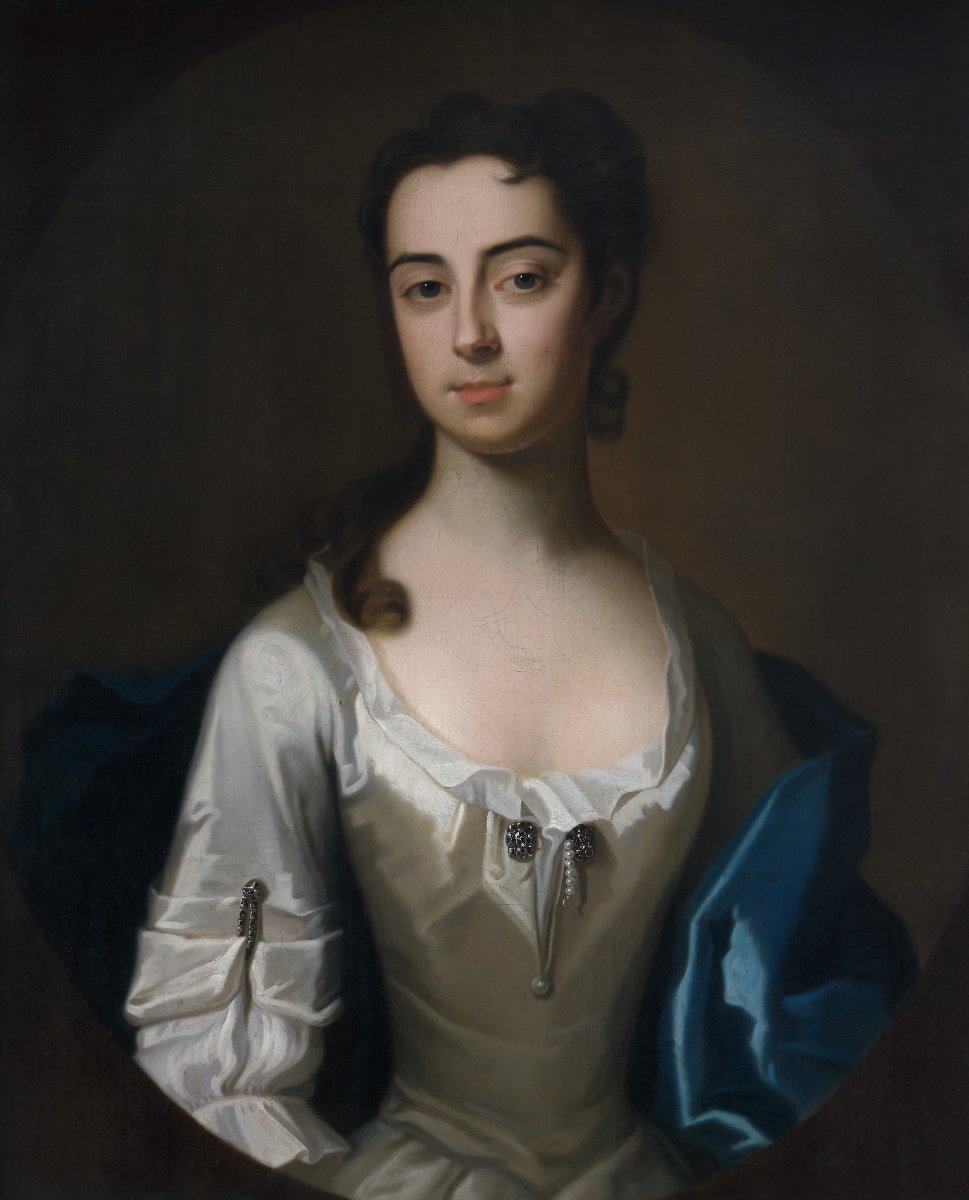


Portrait Of Jane Harris (later Mrs Bigg) In A White Dress And Blue Mantle C.1731; Enoch Seeman
Artist: Enoch Seeman (c.1694–1745)
This exquisite portrait remained for nearly 300 years in the possession of the sitter’s descendants, preserved among the Bigg-Wither family portraits at their magnificent stately manor Manydown Park in Hampshire.
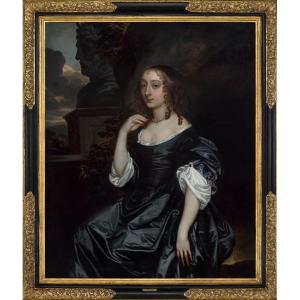
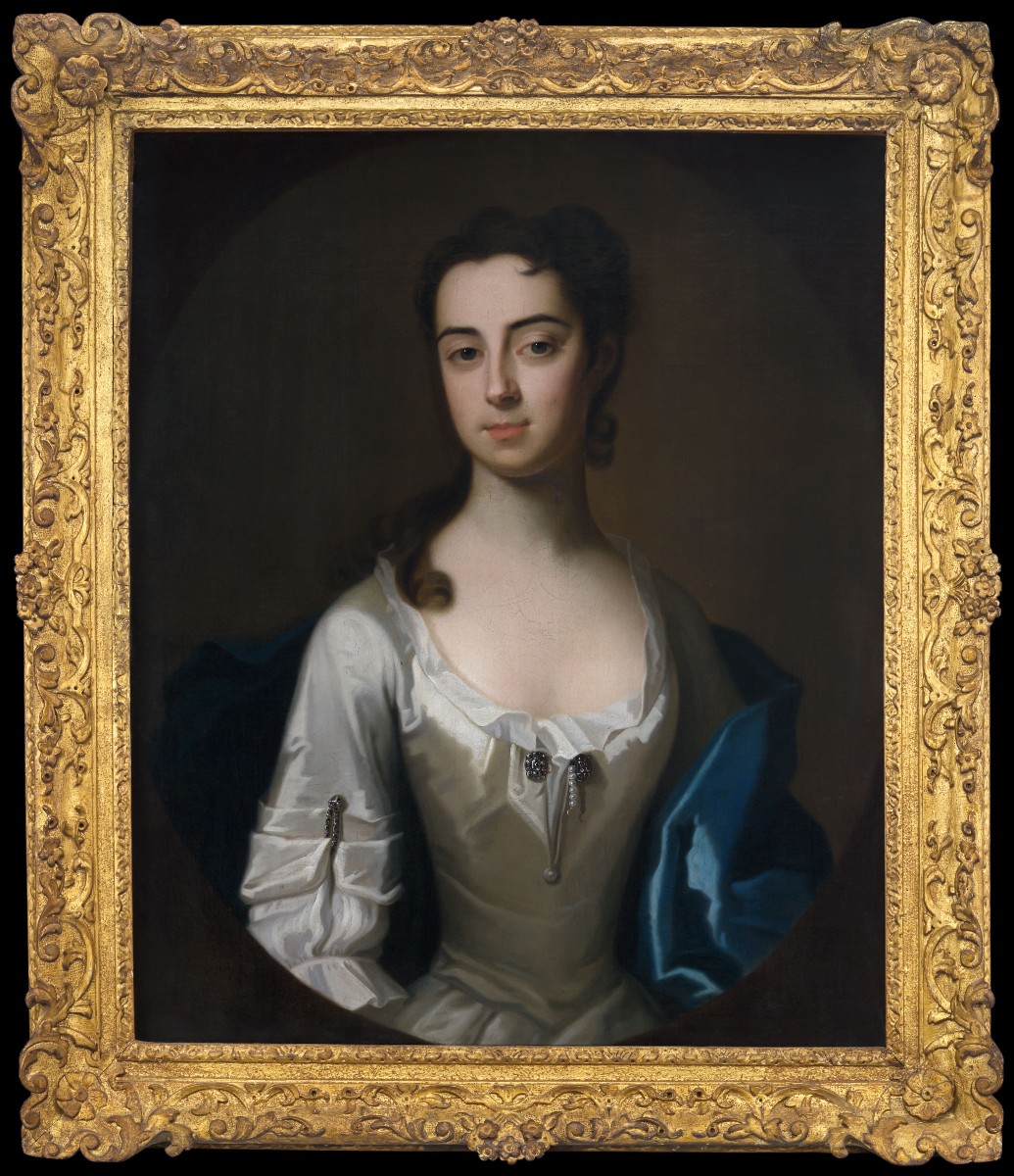
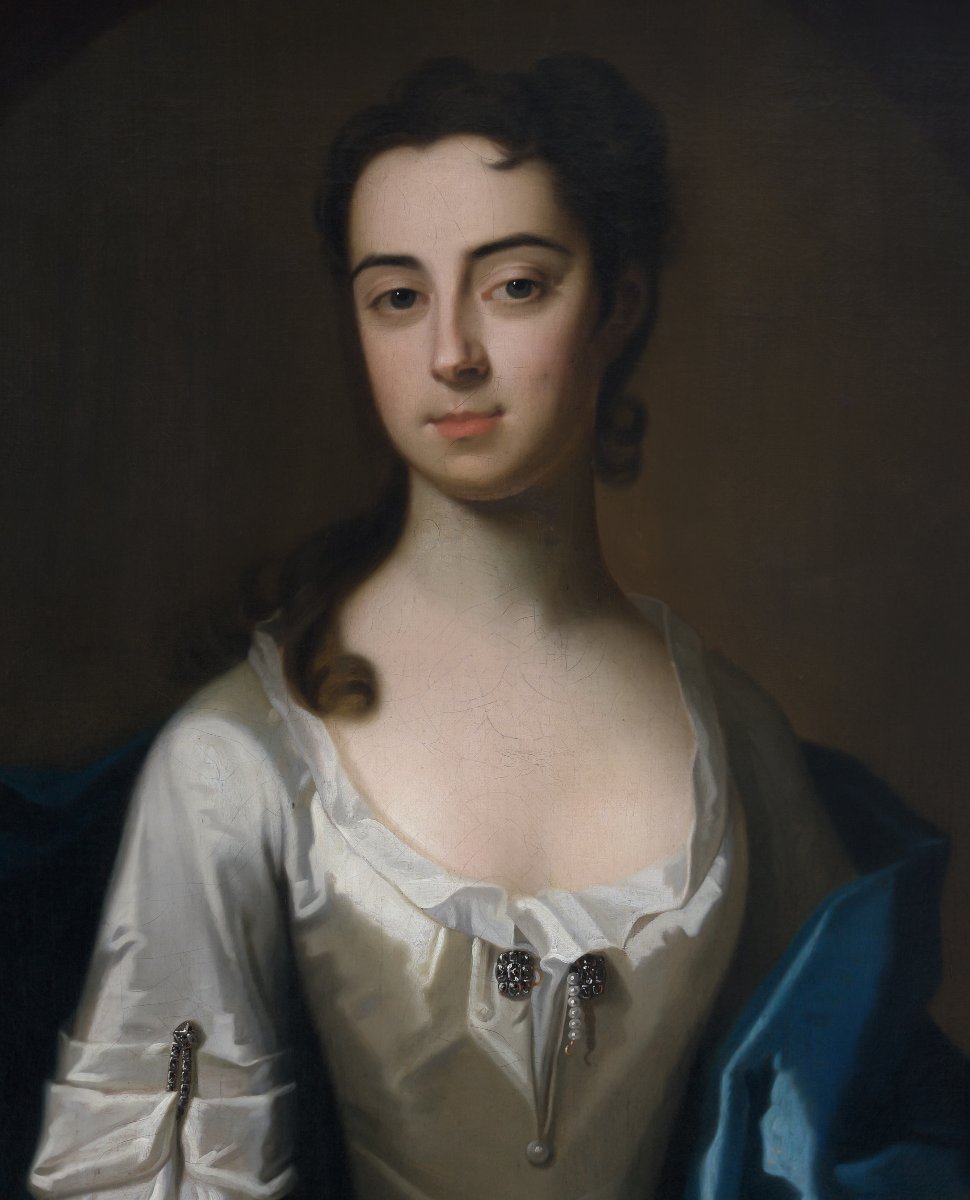
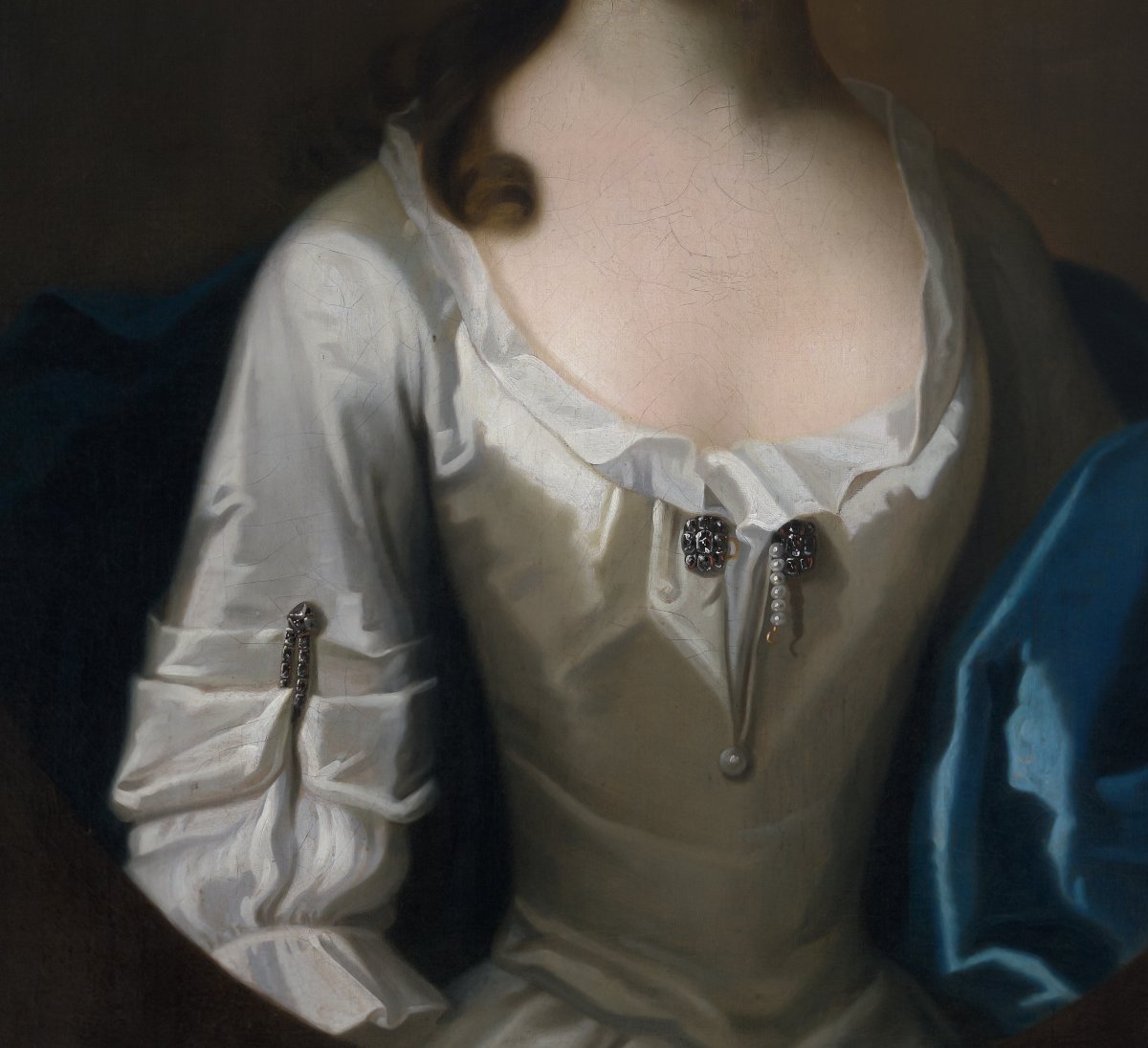
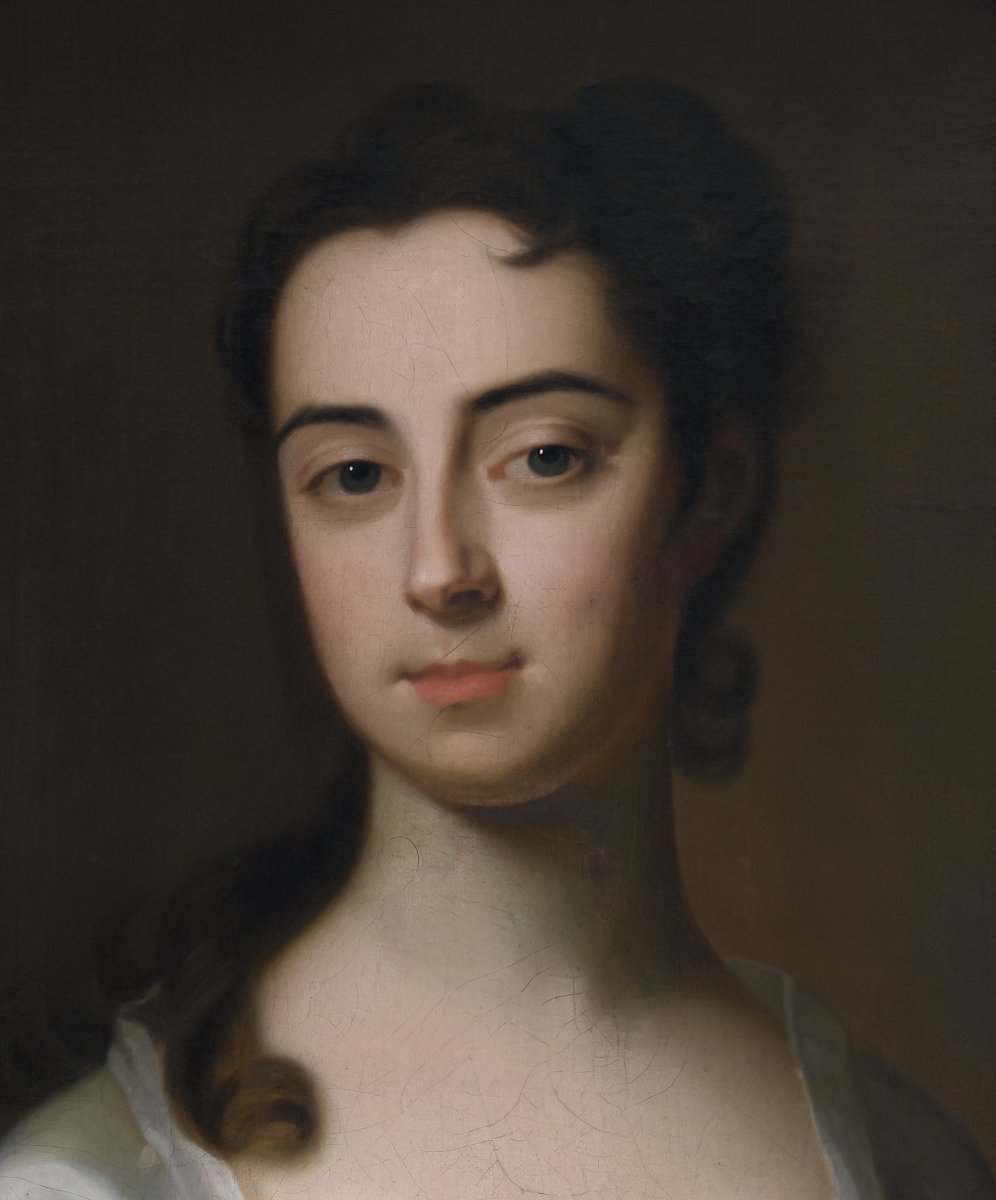
This elegant portrait of Jane Harris (later Mrs. Walter Bigg), painted circa 1731 by Enoch Seeman the Younger, captures the young gentlewoman in the prime of life, shortly before her marriage into the Bigg family. Jane Harris is depicted at half-length within a feigned oval stone frame, wearing a draped blue silk mantle over a satin gown, her gaze directed toward the viewer with a serene yet engaging expression. The refined brushwork and sophisticated colour palette are characteristic of Seeman’s early Georgian style, aligning closely with his portraits of courtiers and ladies of the 1720s–30s. The composition exudes an air of poised gentility, appropriate to the sitter’s status and the era’s taste for restrained baroque elegance. Notably, this painting should not be confused with another Bigg-Wither family portrait of a lady sold in recent years – a bust-length oval portrait catalogued as “Circle of Enoch Seeman” – which is an entirely different work and not a variant or replica of the present portrait. The portrait offered here stands on its own as an original work by Seeman, distinguished by its superior quality and the personal significance of its subject.
Jane Harris (1705–1759) came from a learned clerical family and married into the Biggs, a connection that would later merge with the Wither family of Manydown. She was the only daughter and heiress of Dr John Harris, the rector of Chiddingfold, and his wife Jane (née Young). Through her mother, Jane Harris was the granddaughter of Dr Edward Young, the distinguished poet and Dean of Salisbury famed for Night Thoughts. Such an intellectual pedigree suggests that Jane would have been well-educated and cultured. In 1734 she married Rev. Walter Bigg (1701–1772), a younger son of Lovelace Bigg of Chilton Foliat and Dorothy Wither of Manydown. This union allied Jane to a family of considerable antiquity and property: the Biggs had roots in Berkshire and the Wither family were long-time lords of Manydown in Hampshire. Jane and Walter’s marriage is commemorated by a surviving impaled coat-of-arms (Bigg quartering Wither impaling Harris), which confirms the 1734 wedding date and testifies to the importance of this alliance. The present portrait was likely painted in the early 1730s, shortly before Jane’s marriage in 1734, showing her at about 25 or 26 years old. It may well have been commissioned by her father, Rev. Dr John Harris, to mark her entry into adult society or a forthcoming engagement. The artist Enoch Seeman was at the height of his career in the early 1730s, making him a fitting choice for portraying a new bride of social standing. Indeed, the graceful rendering of Jane’s features – the soft modelling of her face and the fashionable hair styled in curls – is entirely consistent with Seeman’s known work from this period and supports the circa 1731 dating.
As an artist, Enoch Seeman (c.1689–1745) was a prominent portraitist of the Georgian era, and the attribution of this painting to him is a compelling one. Seeman’s hand is evident in the silky handling of fabrics (note the lustrous blue drapery and the delicate sheen on the sitter’s sleeve) and the balanced, formal pose that still conveys warmth. Comparisons may be drawn with Seeman’s portraits of other court ladies in the late 1720s, which likewise feature oval architectural settings and a polished elegance. The facial type – with large, dark, almond-shaped eyes and a composed mouth – can be seen in authenticated Seeman works, and the overall execution here is of the high calibre one expects from the artist himself, rather than a follower. It is worth emphasising that this portrait of Jane Harris is a full half-length fine quality one, unquestionably painted from life to commemorate her role as a new matriarch of the Bigg-Wither line. Its authenticity and direct provenance from the family make it an invaluable historic document as well as a work of art.
Our portrait has descended through her family for nearly three centuries, which accounts for its remarkable state of preservation. After Jane’s death in 1759, the painting passed to her son Lovelace Bigg (1741–1813) – later Rev. Lovelace Bigg-Wither – who inherited Manydown Park and appended the Wither name in 1789. Thereafter the portrait remained at Manydown Park and with the Bigg-Wither family by direct descent. On the back of the canvas, one finds historic inscriptions attesting to this lineage: an old handwritten note identifies the sitter (“Jane Harris, mother of Lovelace Bigg-Wither”) and the initials “E.S.B.W.” are visible, presumably referring to a later family curator or owner. These initials likely stand for Edward Sealy Bigg-Wither (or a similar namesake in the 19th/20th century), indicating that a Bigg-Wither descendant with those initials once took custody of or catalogued the painting – a fascinating trace of its passage through the generations. Also on the verso is a small notation documenting a mid-20th century restoration: the painting was conserved and double-lined by M. Knoedler & Co. (London) in 1954, a testament to the care bestowed on it by the family. This professional relining has ensured the canvas’s stability without compromising the surface. As a result, the condition of the portrait is exceptional for its age. The paint surface is original and vibrant. Jane’s figure retains crisp detail in her eyes and costume, and the rich glazes in the background oval remain intact. There is no significant paint loss or abrasion; the fine craquelure is stable and consistent with 18th-century oil on canvas. In short, the work survives in outstanding condition, with a strong, sound surface and beautiful preservation that is truly impressive for an oil portrait of circa 1731. Collectors will appreciate not only the painting’s historical importance but also the fact that it is ready to grace a collection in the same splendid state it has long enjoyed in the family seat.
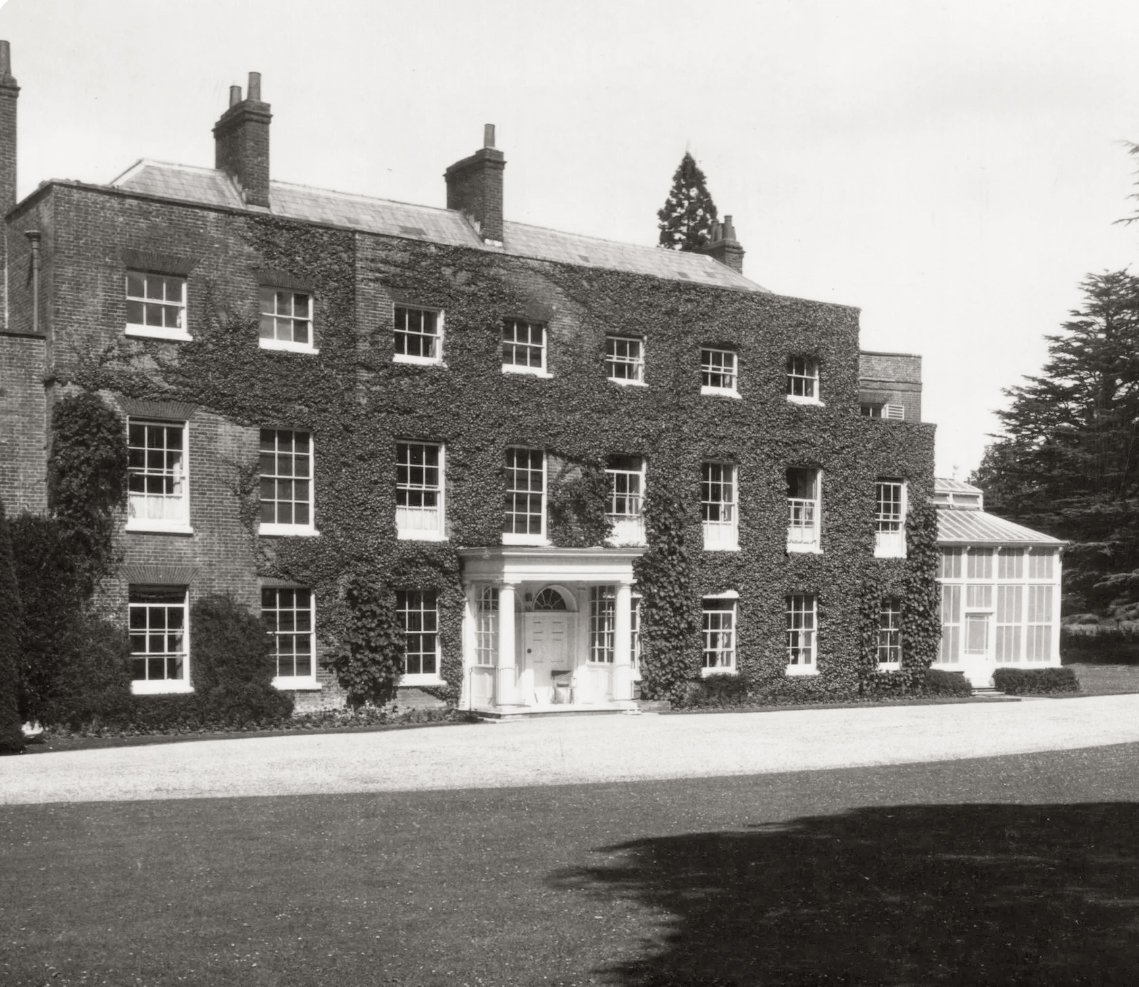
The longstanding residence of this portrait was Manydown Park in Hampshire, the ancestral home of the Wither (and later Bigg-Wither) family for over 400 years. Manydown was an ancient English manor – a rambling Tudor and Stuart-era great house, parts of which dated back to the 14th century. It was the Wither family’s principal seat from 1449 until the late 18th century, at which point Jane Harris’s son Lovelace Bigg inherited it and took the surname Bigg-Wither. In the Jane Austen era, Manydown gained a special literary renown. The celebrated novelist was a close friend of the Bigg sisters who lived there, and Jane Austen was a frequent guest at Manydown between 1799 and 1806. In fact, Austen received and accepted (only to later retract) her only marriage proposal in the drawing room of Manydown Park in December 1802, when Harris Bigg-Wither – Jane Harris’s own grandson – asked for her hand. This intriguing connection places Jane Harris’s portrait in the periphery of England’s literary history: the matriarch portrayed here was the grandmother of the suitor who (briefly) won Jane Austen’s acceptance. The social life at Manydown, with its balls and family gatherings, left imprints on Austen’s writings, and one can easily imagine this very portrait of “Grandmother Jane” hanging in the hall as Austen walked by. Manydown Park itself enjoyed centuries of prominence but, like many country estates, it could not survive the 20th century intact – after passing out of the family, the once-grand house was ultimately demolished in 1965. Only archival photos and a few surviving outbuildings testify to its former grandeur. Thus, the survival of this portrait from Manydown assumes even greater poignancy: it is a tangible relic of the world Austen knew, preserved when the house that sheltered it is gone. The painting brings with it the aura of Manydown’s rich history – architectural, familial, and literary – and will confer that same sense of heritage to its new home.
Beyond its fascinating provenance, the artistic merit of Enoch Seeman’s portrait of Jane Harris stands on its own. This is a striking example of early Georgian portraiture, uniting technical finesse with historical resonance. The sitter’s identity and noble connections, the documented attribution to a court painter, and the painting’s extraordinary condition all contribute to its rarity. It is increasingly uncommon to find 18th-century portraits of known sitters that have remained in one family from commission to present day. Here we have exactly that: a direct heirloom piece, painted by a notable artist for an aristocratic family and kept in that family for nearly 300 years.
Enoch Seeman the Younger was one of the most distinctive and successful portrait painters working in London during the second quarter of the eighteenth century. Born around 1694, probably into a family of Dutch or German origin, he established himself in England at a moment when demand for portraiture among the professional and provincial gentry was expanding rapidly. Seeman’s career flourished during the transitional period between the dominance of Sir Godfrey Kneller and the rise of a new generation of native-born British portraitists, and his work occupies an important position in this evolving artistic landscape.
Seeman is documented in London by the early 1720s and was active throughout the 1730s and early 1740s. He quickly developed a recognisable and highly marketable style, characterised by bust-length portraits, often set within painted ovals, executed with restraint, elegance, and a refined sense of colour. His sitters were drawn largely from the gentry, clergy, professional classes, and minor aristocracy—clients who sought fashionable likenesses aligned with metropolitan taste but without the theatricality or expense associated with full court portraiture.
Stylistically, Seeman’s work is marked by smooth, enamel-like handling of flesh, softly idealised but individualised features, and a calm, direct engagement between sitter and viewer. His palette favours pale silks, cool whites, and muted blues, frequently enlivened by restrained jewellery and carefully balanced drapery. The overall effect is one of dignity and composure rather than ostentation, qualities that appealed strongly to provincial patrons with London connections. These characteristics are consistently visible in his female portraits of the 1730s and early 1740s, which form the core of his surviving oeuvre.
Although Seeman never achieved the institutional prestige of some of his contemporaries, his work was widely admired and imitated during his lifetime. His success led to a degree of repetition in format and composition, and he appears to have worked with assistants or contemporaries who adopted his visual language closely. This has resulted in a substantial body of portraits today attributed to him or his immediate circle, reflecting the popularity and recognisability of his style in early Georgian England.
Seeman’s career came to an abrupt end with his death in 1745. By that time, changing tastes and the emergence of artists such as Thomas Hudson were beginning to reshape the portrait market. Nevertheless, Seeman’s work remains an important expression of early Georgian sensibility, bridging the formality of late Stuart portraiture and the more expansive naturalism of mid-century British painting.
Today, Seeman’s portraits are held in public and private collections in Britain and abroad, valued for their refinement, period authenticity, and insight into the social aspirations of the eighteenth-century gentry. His best works, particularly those securely attributed to his hand, are recognised as among the most elegant and representative portraits of their time.
Sources:
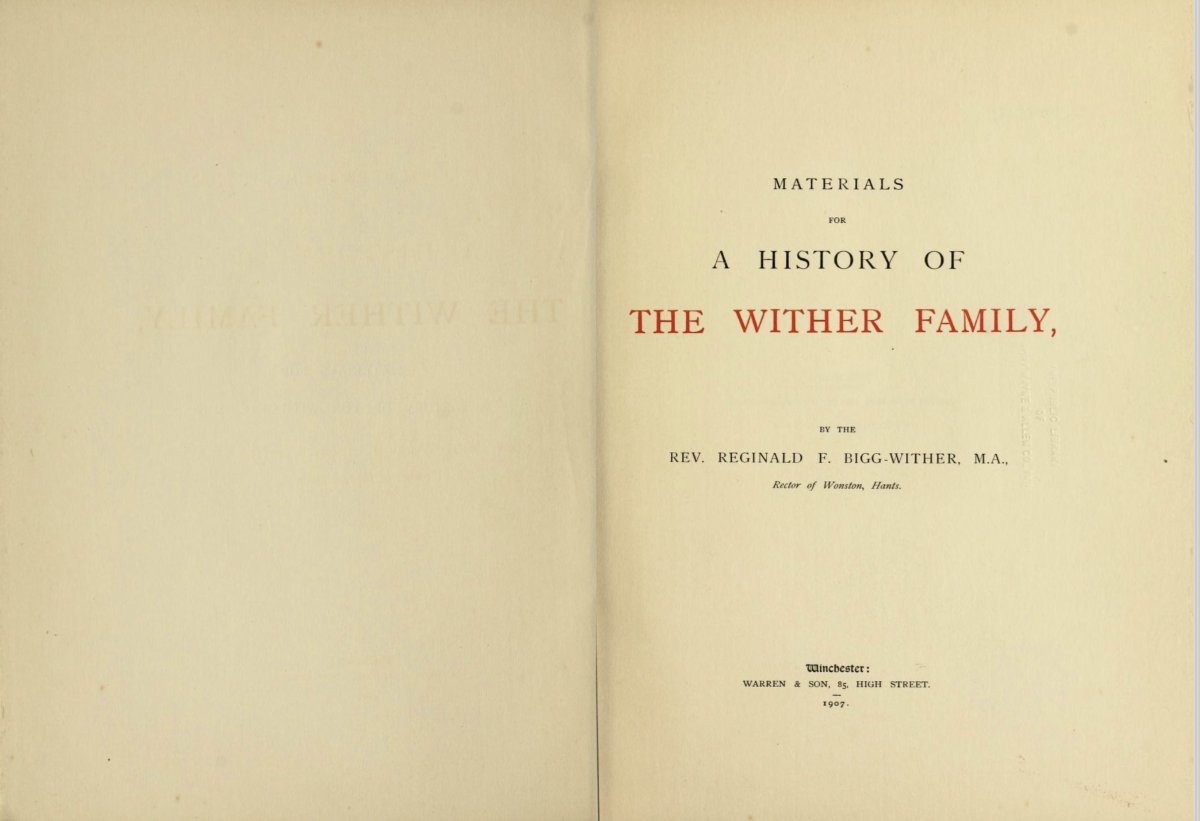
Rev. Reginald F. Bigg-Wither, Materials for a History of the Wither Family (Warren & Son, Winchester, 1907), esp. pp. 46–47, 109, 145–147, and family letters and records quoted therein
Provenance:
Measurements:
Height 93cm, Width 79cm framed (Height 36.5”, Width 31” framed)
This elegant portrait of Jane Harris (later Mrs. Walter Bigg), painted circa 1731 by Enoch Seeman the Younger, captures the young gentlewoman in the prime of life, shortly before her marriage into the Bigg family. Jane Harris is depicted at half-length within a feigned oval stone frame, wearing a draped blue silk mantle over a satin gown, her gaze directed toward the viewer with a serene yet engaging expression. The refined brushwork and sophisticated colour palette are characteristic of Seeman’s early Georgian style, aligning closely with his portraits of courtiers and ladies of the 1720s–30s. The composition exudes an air of poised gentility, appropriate to the sitter’s status and the era’s taste for restrained baroque elegance. Notably, this painting should not be confused with another Bigg-Wither family portrait of a lady sold in recent years – a bust-length oval portrait catalogued as “Circle of Enoch Seeman” – which is an entirely different work and not a variant or replica of the present portrait. The portrait offered here stands on its own as an original work by Seeman, distinguished by its superior quality and the personal significance of its subject.
Jane Harris (1705–1759) came from a learned clerical family and married into the Biggs, a connection that would later merge with the Wither family of Manydown. She was the only daughter and heiress of Dr John Harris, the rector of Chiddingfold, and his wife Jane (née Young). Through her mother, Jane Harris was the granddaughter of Dr Edward Young, the distinguished poet and Dean of Salisbury famed for Night Thoughts. Such an intellectual pedigree suggests that Jane would have been well-educated and cultured. In 1734 she married Rev. Walter Bigg (1701–1772), a younger son of Lovelace Bigg of Chilton Foliat and Dorothy Wither of Manydown. This union allied Jane to a family of considerable antiquity and property: the Biggs had roots in Berkshire and the Wither family were long-time lords of Manydown in Hampshire. Jane and Walter’s marriage is commemorated by a surviving impaled coat-of-arms (Bigg quartering Wither impaling Harris), which confirms the 1734 wedding date and testifies to the importance of this alliance. The present portrait was likely painted in the early 1730s, shortly before Jane’s marriage in 1734, showing her at about 25 or 26 years old. It may well have been commissioned by her father, Rev. Dr John Harris, to mark her entry into adult society or a forthcoming engagement. The artist Enoch Seeman was at the height of his career in the early 1730s, making him a fitting choice for portraying a new bride of social standing. Indeed, the graceful rendering of Jane’s features – the soft modelling of her face and the fashionable hair styled in curls – is entirely consistent with Seeman’s known work from this period and supports the circa 1731 dating.
As an artist, Enoch Seeman (c.1689–1745) was a prominent portraitist of the Georgian era, and the attribution of this painting to him is a compelling one. Seeman’s hand is evident in the silky handling of fabrics (note the lustrous blue drapery and the delicate sheen on the sitter’s sleeve) and the balanced, formal pose that still conveys warmth. Comparisons may be drawn with Seeman’s portraits of other court ladies in the late 1720s, which likewise feature oval architectural settings and a polished elegance. The facial type – with large, dark, almond-shaped eyes and a composed mouth – can be seen in authenticated Seeman works, and the overall execution here is of the high calibre one expects from the artist himself, rather than a follower. It is worth emphasising that this portrait of Jane Harris is a full half-length fine quality one, unquestionably painted from life to commemorate her role as a new matriarch of the Bigg-Wither line. Its authenticity and direct provenance from the family make it an invaluable historic document as well as a work of art.
Our portrait has descended through her family for nearly three centuries, which accounts for its remarkable state of preservation. After Jane’s death in 1759, the painting passed to her son Lovelace Bigg (1741–1813) – later Rev. Lovelace Bigg-Wither – who inherited Manydown Park and appended the Wither name in 1789. Thereafter the portrait remained at Manydown Park and with the Bigg-Wither family by direct descent. On the back of the canvas, one finds historic inscriptions attesting to this lineage: an old handwritten note identifies the sitter (“Jane Harris, mother of Lovelace Bigg-Wither”) and the initials “E.S.B.W.” are visible, presumably referring to a later family curator or owner. These initials likely stand for Edward Sealy Bigg-Wither (or a similar namesake in the 19th/20th century), indicating that a Bigg-Wither descendant with those initials once took custody of or catalogued the painting – a fascinating trace of its passage through the generations. Also on the verso is a small notation documenting a mid-20th century restoration: the painting was conserved and double-lined by M. Knoedler & Co. (London) in 1954, a testament to the care bestowed on it by the family. This professional relining has ensured the canvas’s stability without compromising the surface. As a result, the condition of the portrait is exceptional for its age. The paint surface is original and vibrant. Jane’s figure retains crisp detail in her eyes and costume, and the rich glazes in the background oval remain intact. There is no significant paint loss or abrasion; the fine craquelure is stable and consistent with 18th-century oil on canvas. In short, the work survives in outstanding condition, with a strong, sound surface and beautiful preservation that is truly impressive for an oil portrait of circa 1731. Collectors will appreciate not only the painting’s historical importance but also the fact that it is ready to grace a collection in the same splendid state it has long enjoyed in the family seat.
The longstanding residence of this portrait was Manydown Park in Hampshire, the ancestral home of the Wither (and later Bigg-Wither) family for over 400 years. Manydown was an ancient English manor – a rambling Tudor and Stuart-era great house, parts of which dated back to the 14th century. It was the Wither family’s principal seat from 1449 until the late 18th century, at which point Jane Harris’s son Lovelace Bigg inherited it and took the surname Bigg-Wither. In the Jane Austen era, Manydown gained a special literary renown. The celebrated novelist was a close friend of the Bigg sisters who lived there, and Jane Austen was a frequent guest at Manydown between 1799 and 1806. In fact, Austen received and accepted (only to later retract) her only marriage proposal in the drawing room of Manydown Park in December 1802, when Harris Bigg-Wither – Jane Harris’s own grandson – asked for her hand. This intriguing connection places Jane Harris’s portrait in the periphery of England’s literary history: the matriarch portrayed here was the grandmother of the suitor who (briefly) won Jane Austen’s acceptance. The social life at Manydown, with its balls and family gatherings, left imprints on Austen’s writings, and one can easily imagine this very portrait of “Grandmother Jane” hanging in the hall as Austen walked by. Manydown Park itself enjoyed centuries of prominence but, like many country estates, it could not survive the 20th century intact – after passing out of the family, the once-grand house was ultimately demolished in 1965. Only archival photos and a few surviving outbuildings testify to its former grandeur. Thus, the survival of this portrait from Manydown assumes even greater poignancy: it is a tangible relic of the world Austen knew, preserved when the house that sheltered it is gone. The painting brings with it the aura of Manydown’s rich history – architectural, familial, and literary – and will confer that same sense of heritage to its new home.
Beyond its fascinating provenance, the artistic merit of Enoch Seeman’s portrait of Jane Harris stands on its own. This is a striking example of early Georgian portraiture, uniting technical finesse with historical resonance. The sitter’s identity and noble connections, the documented attribution to a court painter, and the painting’s extraordinary condition all contribute to its rarity. It is increasingly uncommon to find 18th-century portraits of known sitters that have remained in one family from commission to present day. Here we have exactly that: a direct heirloom piece, painted by a notable artist for an aristocratic family and kept in that family for nearly 300 years.
Enoch Seeman the Younger was one of the most distinctive and successful portrait painters working in London during the second quarter of the eighteenth century. Born around 1694, probably into a family of Dutch or German origin, he established himself in England at a moment when demand for portraiture among the professional and provincial gentry was expanding rapidly. Seeman’s career flourished during the transitional period between the dominance of Sir Godfrey Kneller and the rise of a new generation of native-born British portraitists, and his work occupies an important position in this evolving artistic landscape.
Seeman is documented in London by the early 1720s and was active throughout the 1730s and early 1740s. He quickly developed a recognisable and highly marketable style, characterised by bust-length portraits, often set within painted ovals, executed with restraint, elegance, and a refined sense of colour. His sitters were drawn largely from the gentry, clergy, professional classes, and minor aristocracy—clients who sought fashionable likenesses aligned with metropolitan taste but without the theatricality or expense associated with full court portraiture.
Stylistically, Seeman’s work is marked by smooth, enamel-like handling of flesh, softly idealised but individualised features, and a calm, direct engagement between sitter and viewer. His palette favours pale silks, cool whites, and muted blues, frequently enlivened by restrained jewellery and carefully balanced drapery. The overall effect is one of dignity and composure rather than ostentation, qualities that appealed strongly to provincial patrons with London connections. These characteristics are consistently visible in his female portraits of the 1730s and early 1740s, which form the core of his surviving oeuvre.
Although Seeman never achieved the institutional prestige of some of his contemporaries, his work was widely admired and imitated during his lifetime. His success led to a degree of repetition in format and composition, and he appears to have worked with assistants or contemporaries who adopted his visual language closely. This has resulted in a substantial body of portraits today attributed to him or his immediate circle, reflecting the popularity and recognisability of his style in early Georgian England.
Seeman’s career came to an abrupt end with his death in 1745. By that time, changing tastes and the emergence of artists such as Thomas Hudson were beginning to reshape the portrait market. Nevertheless, Seeman’s work remains an important expression of early Georgian sensibility, bridging the formality of late Stuart portraiture and the more expansive naturalism of mid-century British painting.
Today, Seeman’s portraits are held in public and private collections in Britain and abroad, valued for their refinement, period authenticity, and insight into the social aspirations of the eighteenth-century gentry. His best works, particularly those securely attributed to his hand, are recognised as among the most elegant and representative portraits of their time.
Sources:
Rev. Reginald F. Bigg-Wither, Materials for a History of the Wither Family (Warren & Son, Winchester, 1907), esp. pp. 46–47, 109, 145–147, and family letters and records quoted therein
Provenance:
- (Possibly) commissioned by Dr John Harris for the sitter, thence to his daughter Jane;
- By inheritance to her husband Rev. Walter Bigg;
- By descent to their son Rev. Lovelace Bigg (later Bigg-Wither) of Manydown Park;
- By descent in the Bigg-Wither family until 2025, where acquired by Titan Fine Art
Measurements:
Height 93cm, Width 79cm framed (Height 36.5”, Width 31” framed)
9 150 €
Period: 18th century
Style: Louis 15th - Transition
Condition: Excellent condition
Material: Oil painting
Width: 79
Height: 93
Depth: 5
Reference (ID): 1699520
Availability: In stock
Print