


18th-century Triptych - The Celestial Queen And The Royal Child
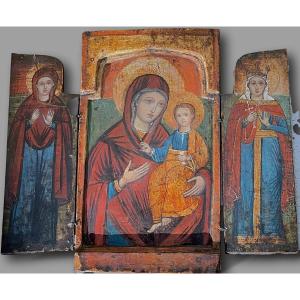
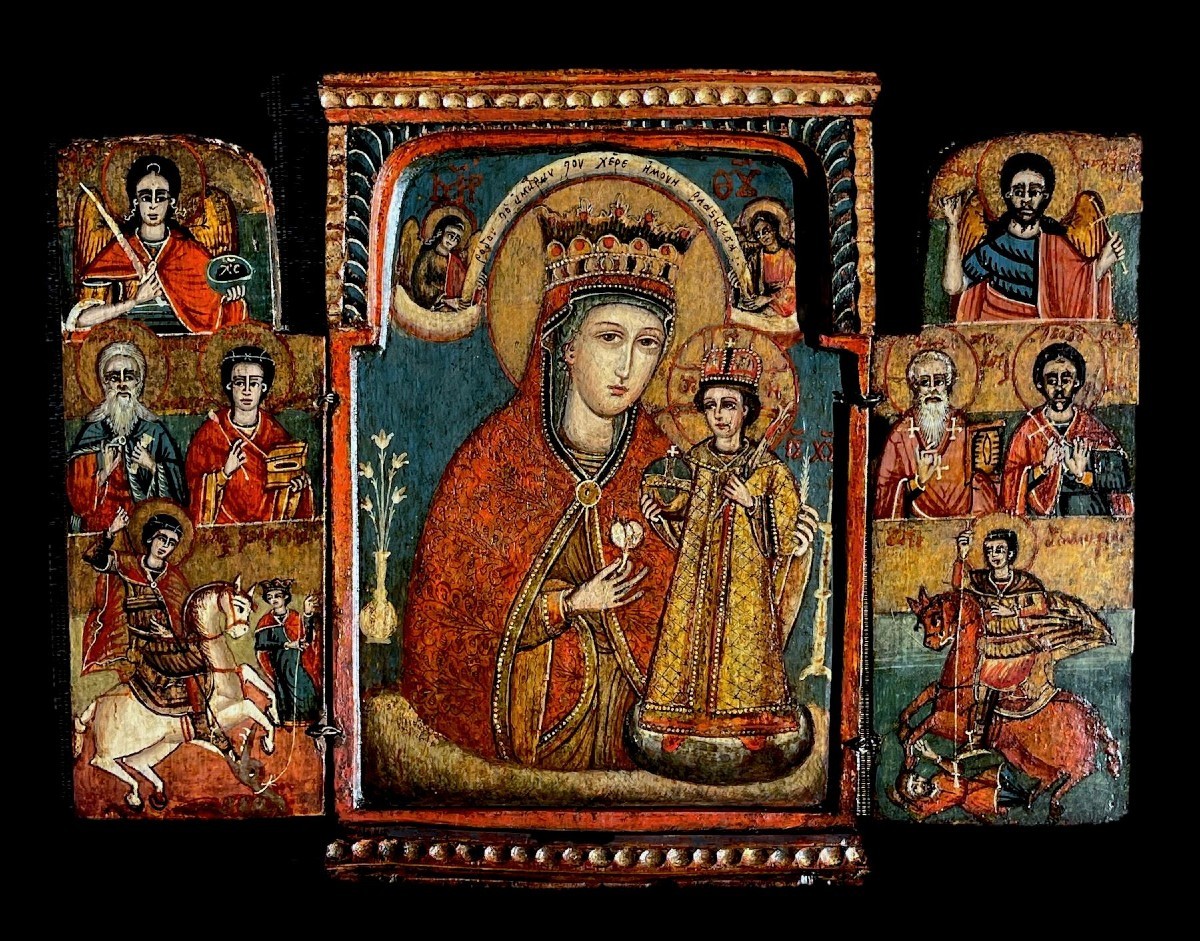
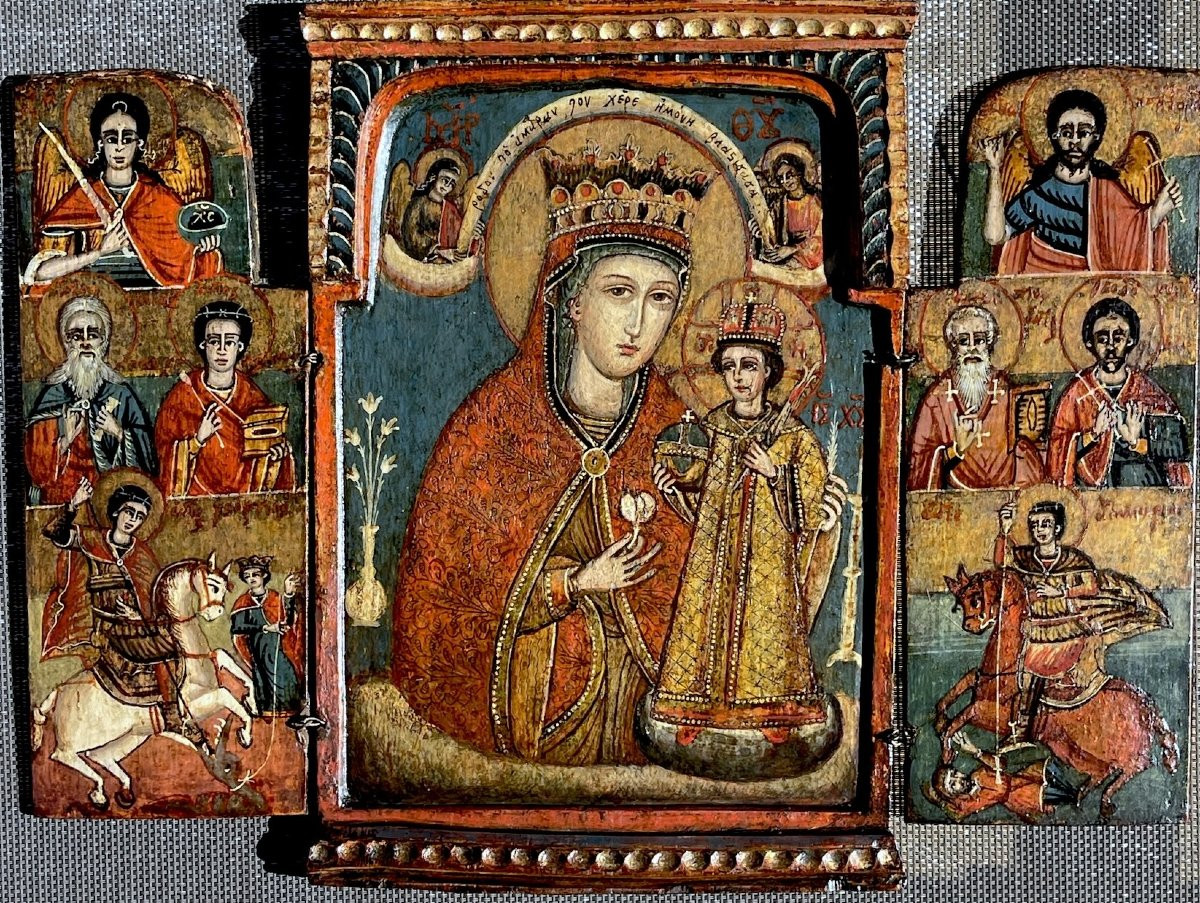
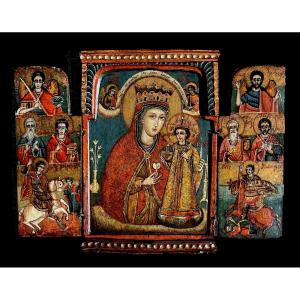
Superb portable devotional triptych, painted in tempera on a wooden panel, depicting the crowned Virgin and Child in the center, surrounded by angelic figures and patron saints. This work probably originates from a Balkan workshop (Romania, Serbia, or Greece) in the late 18th century.
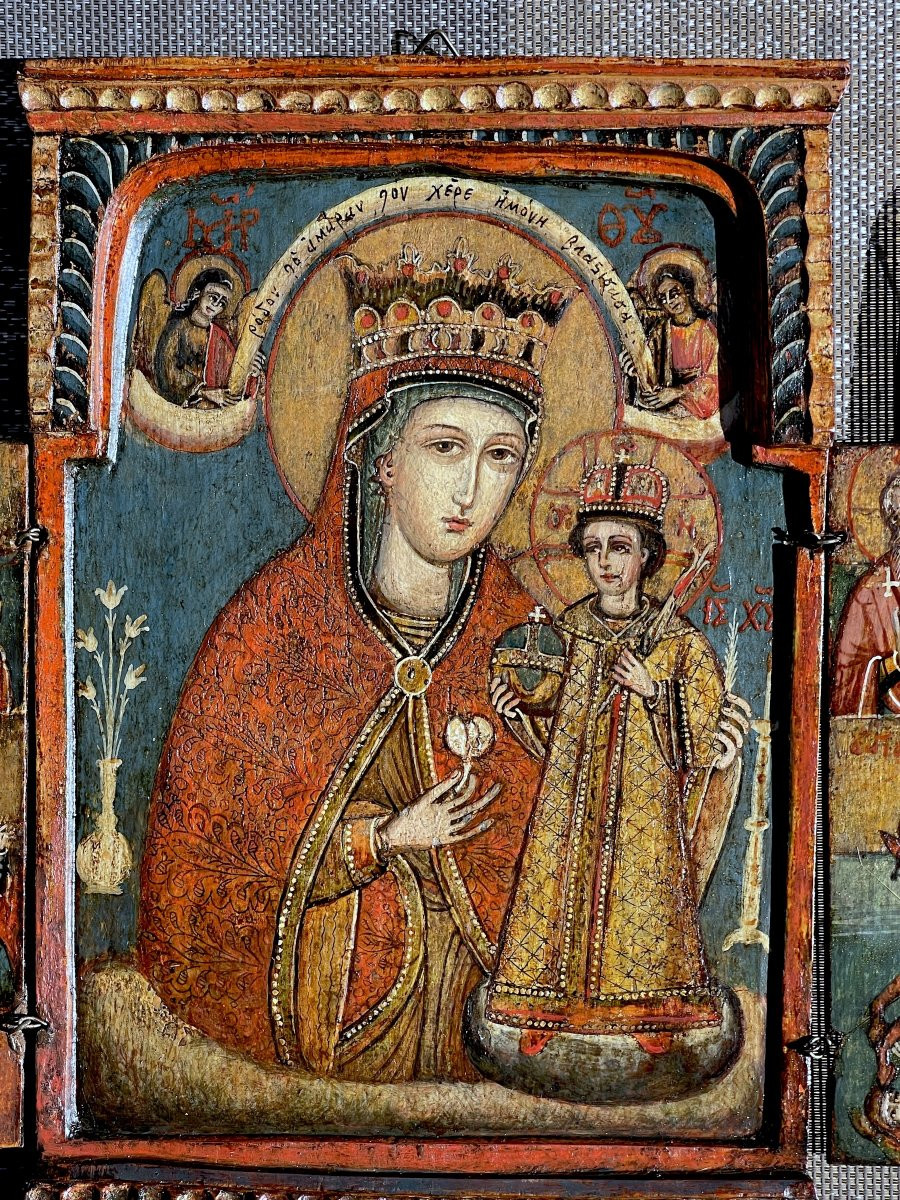
The Virgin is depicted frontally, bust-length, wearing a red maphorion embroidered with gold, holding a fleur-de-lis (a Marian symbol of purity and intercession) in her right hand and supporting the crowned Child in her left. Christ blesses with his right hand while holding the Book of the Gospels. Both figures are crowned, recalling the title "Regina Coeli" applied to Mary in the post-Tridentine tradition, but here transposed into Orthodox vocabulary. Two angels lean down from the upper registers to frame the scene. The two sacred figures are highlighted by a deep blue background.
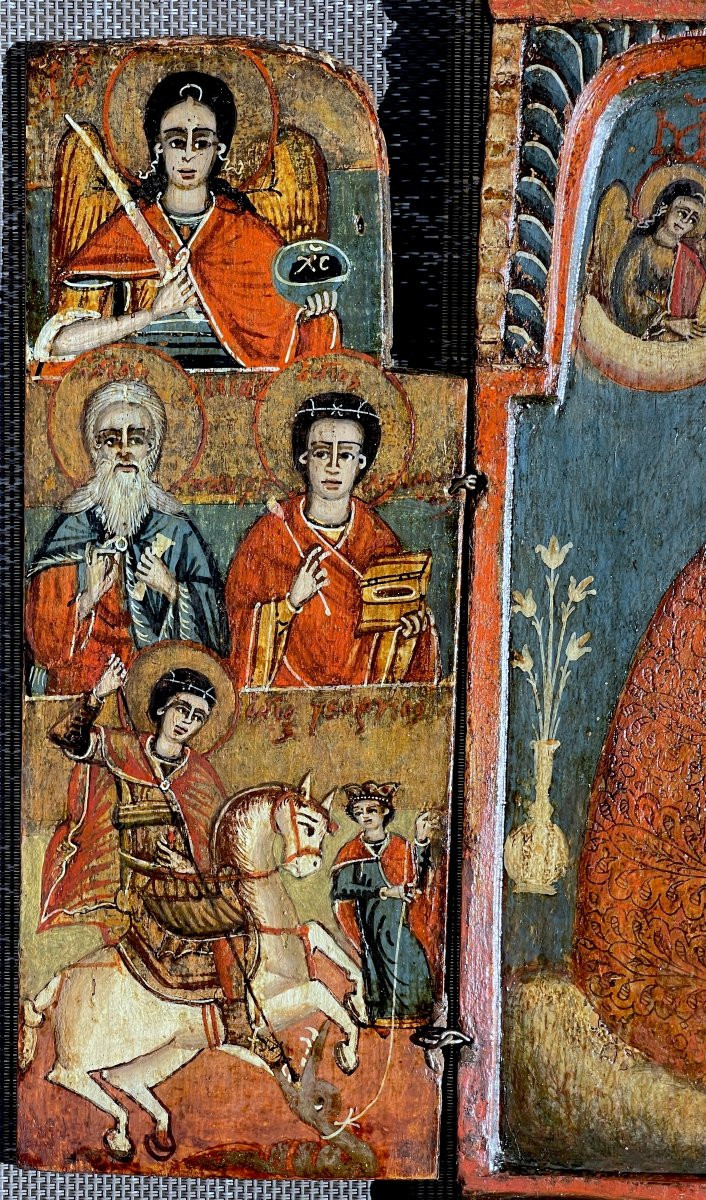
Left panel
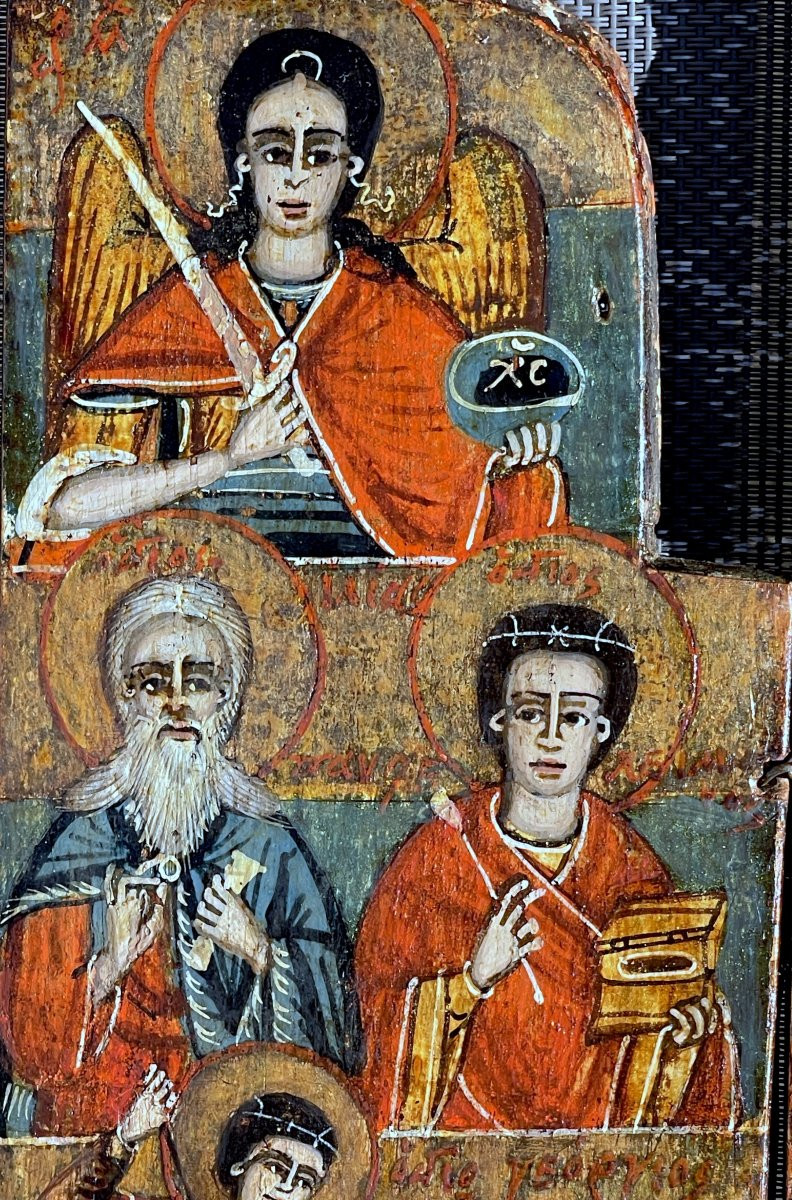
Upper register: Archangel Michael, in armor, holding a sword.
Middle register: Two figures of ascetics or prophets (probably Elijah and Elisha).
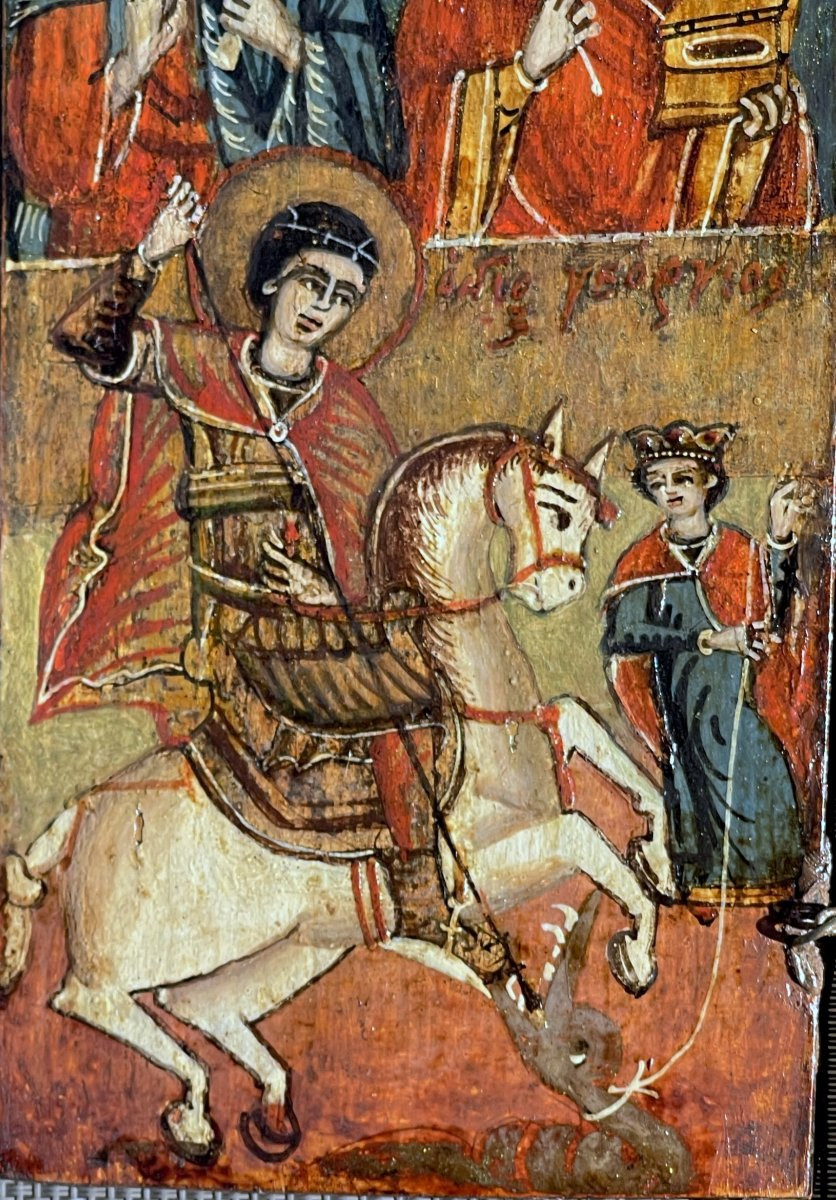
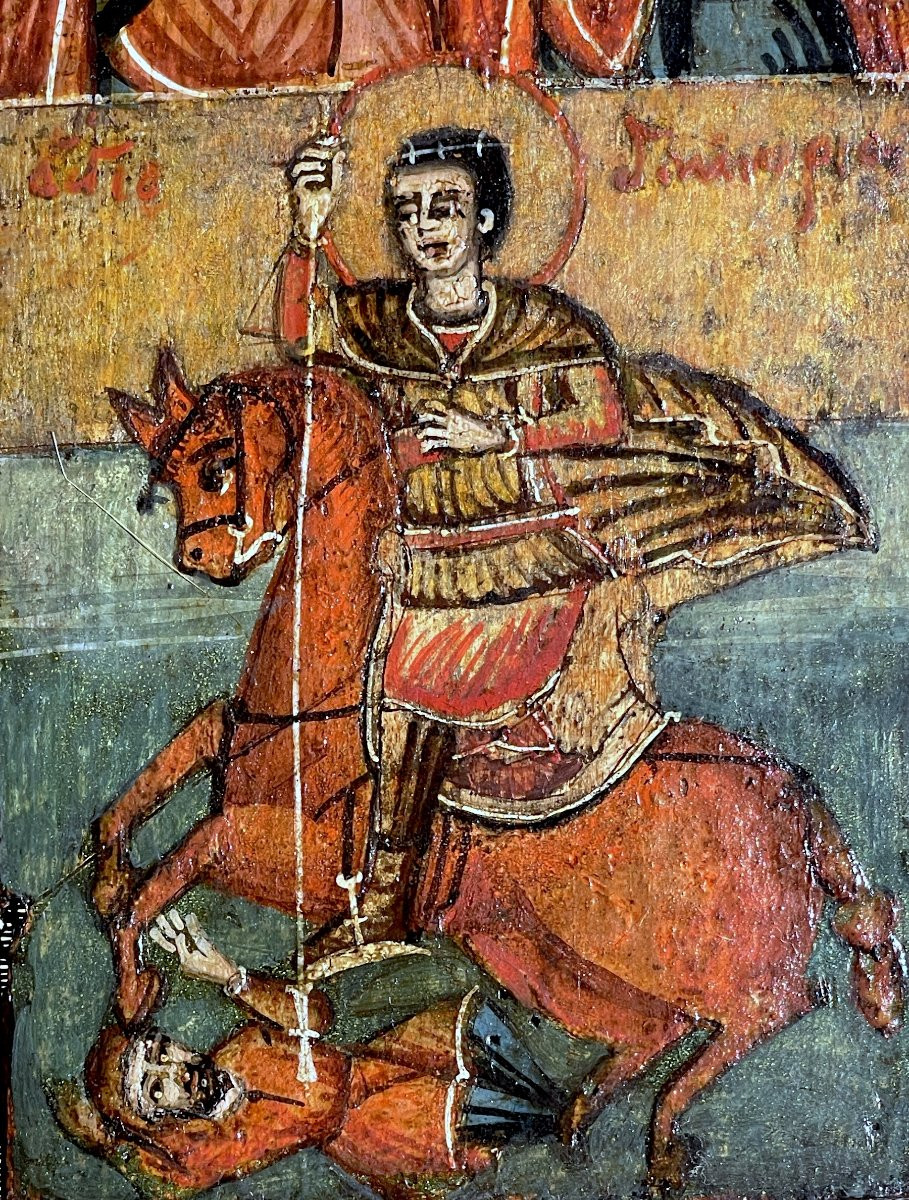
Lower register: Saint George on horseback, slaying the dragon.
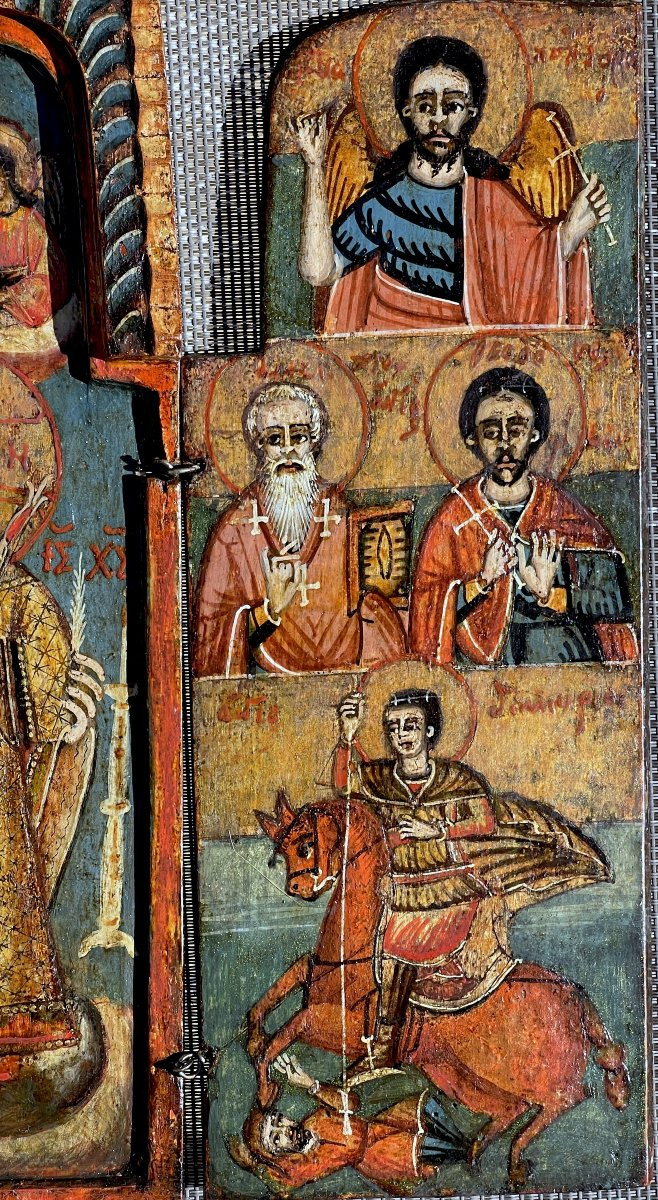
Right panel
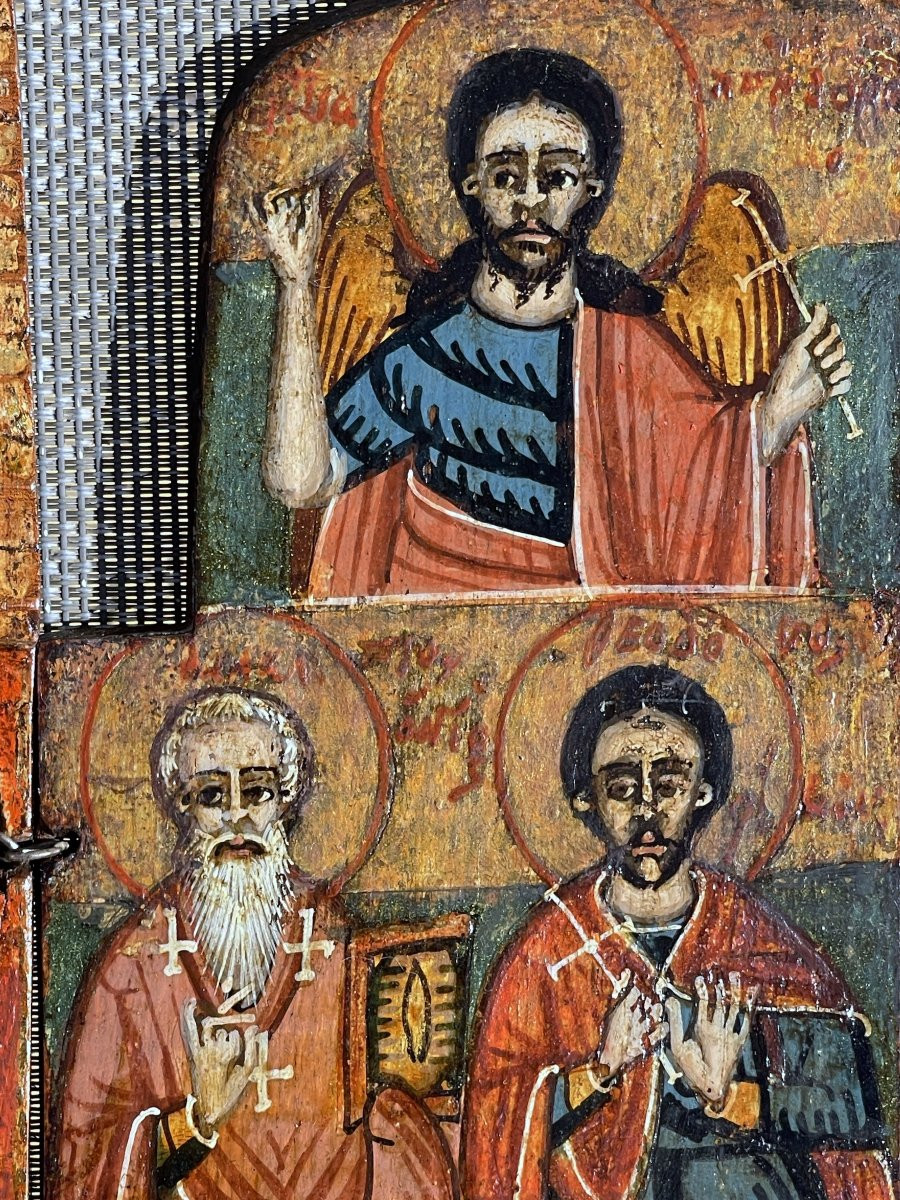
Upper register: Saint John the Baptist, recognizable by his camel's hair garment and his prophetic scroll.
Middle register: Two holy bishops blessing (probably Basil the Great and Nicholas).
Lower register: Saint Demetrius on horseback, stabbing an adversary, a military representation of protection.
Stylistic analysis and comparisons
The pictorial style is characterized by:
Elongated, hieratic faces with large almond-shaped eyes surrounded by black lines.
Bold chromatic areas: azure blue (probably azurite), cinnabar red, ochre, and white highlights. The garments are decorated with geometric and gilded plant motifs, typical of Balkan Orthodox workshops in the modern era.
The presence of Greek inscriptions confirms its roots in the Byzantine Orthodox tradition. The iconography of the triptych is part of a typology widely used in 18th-century Greco-Romanian art, particularly in Wallachia and Moldavia, where portable triptychs were intended for domestic use.
Possible comparisons:
Triptychs preserved at the Museum of Religious Art in Bucharest (inv. 18th century) depicting a crowned Virgin surrounded by military saints. Similar works from Macedonian workshops are documented in:
M. Chatzidakis, L’art post-byzantin, Athens, 1982.
G. Millet, Recherches sur l’iconographie post-byzantine, Paris, 1960.
Scenography: The iconographer chose a hierarchical layout, with the Virgin in Majesty occupying the entire central section, framed by the patron saints. The palette combines deep reds, golden ochres, luminous blues, and lightly patinated whites, creating a colorful harmony of great spiritual intensity.
Style and School: The use of tempera, Greek inscriptions, hieratic frontality, and decorative richness all refer to the post-Byzantine schools, particularly active in the Balkans and Romania in the 18th century. The naive yet expressive style evokes a monastic or regional workshop, likely intended for private or domestic devotional use.
Medium: Egg tempera on prepared wooden panel (levkas)
Dimensions: Height 31 cm × Width 40 cm (unfolded)
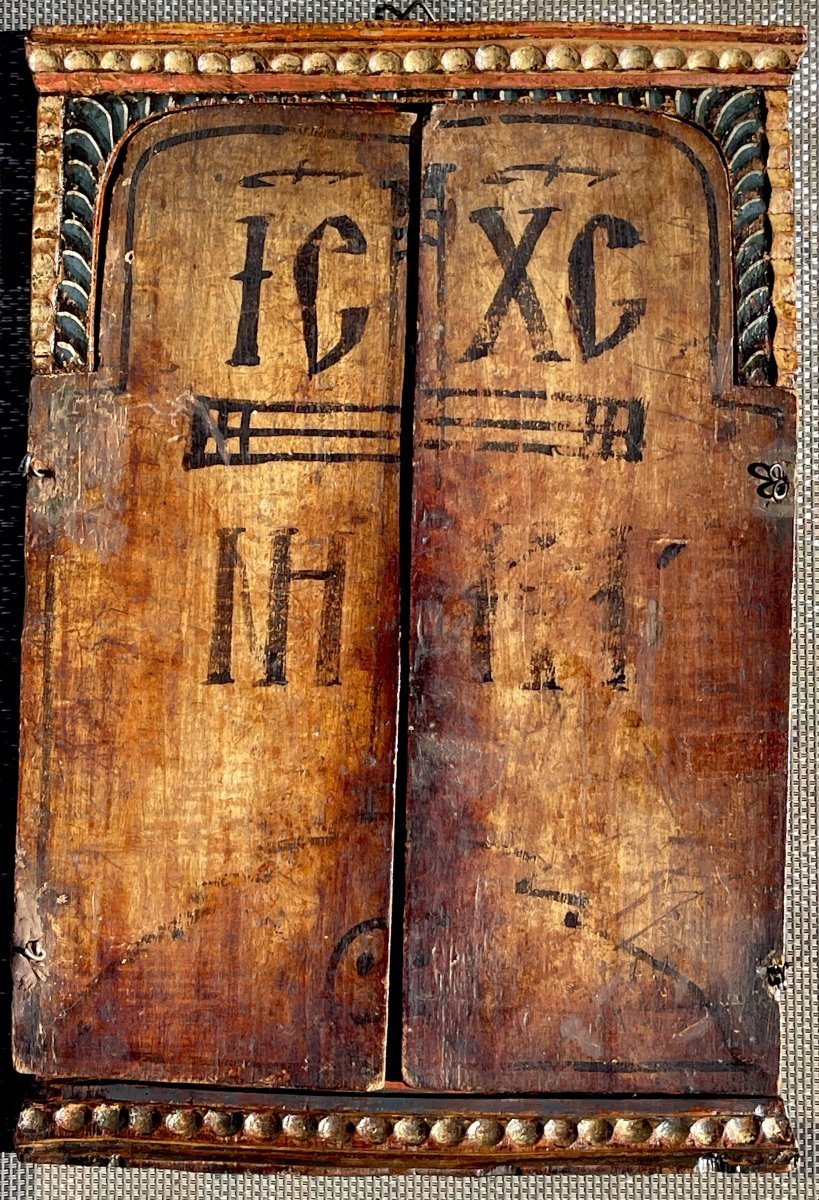
Structure: Portable triptych with flaps, with carved and painted frame
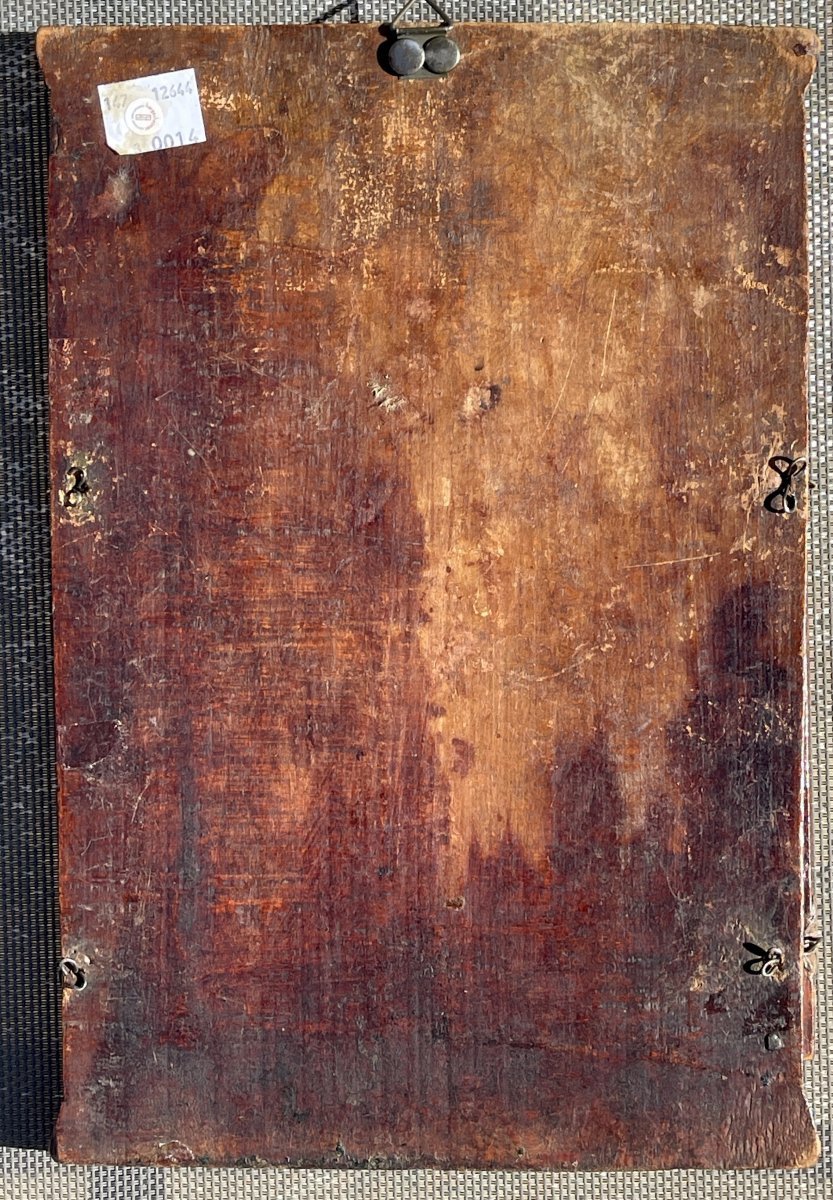
Condition: Wear from use, small gaps in the paint layer, uniform patina, consistent with age and devotional use.
This type of portable triptych, widespread in the Orthodox world in the 18th century, was used for the private devotion of the faithful. The composition, centered on the Virgin Queen of Heaven, reflects Eastern spirituality and the strong presence of Marian worship. The abundance of military saints (Saint George, Saint Demetrius) illustrates the icon's protective function for its owner. The work testifies to the continuity of the Byzantine tradition in Balkan art, at a time when Orthodox religious painting was passed down from generation to generation in monastic workshops.
Chatzidakis, M., L’art post-byzantin, Athens, 1982.
Millet, G., Recherches sur l’iconographie post-byzantine, Paris, 1960.
Cormack, R., Painting the Soul: Icons, Death Masks and Shrouds, London, 1997.
#AncientIcon #Triptych #TemperaOnPanel #SacredArt #VirginAndChild #SaintGeorge #SaintDemetrius #BalkanIcon #PostByzantineSchool #OrthodoxIcon #ChristianArt #ArtCollection #Proantic
https://www.artecollection.fr/boutique-1-01765537496--triptyque-de-devotion-a-la-vierge-a-l-enfant-balkans-18eme-tempera-sur-panneau-.html
The Virgin is depicted frontally, bust-length, wearing a red maphorion embroidered with gold, holding a fleur-de-lis (a Marian symbol of purity and intercession) in her right hand and supporting the crowned Child in her left. Christ blesses with his right hand while holding the Book of the Gospels. Both figures are crowned, recalling the title "Regina Coeli" applied to Mary in the post-Tridentine tradition, but here transposed into Orthodox vocabulary. Two angels lean down from the upper registers to frame the scene. The two sacred figures are highlighted by a deep blue background.
Left panel
Upper register: Archangel Michael, in armor, holding a sword.
Middle register: Two figures of ascetics or prophets (probably Elijah and Elisha).
Lower register: Saint George on horseback, slaying the dragon.
Right panel
Upper register: Saint John the Baptist, recognizable by his camel's hair garment and his prophetic scroll.
Middle register: Two holy bishops blessing (probably Basil the Great and Nicholas).
Lower register: Saint Demetrius on horseback, stabbing an adversary, a military representation of protection.
Stylistic analysis and comparisons
The pictorial style is characterized by:
Elongated, hieratic faces with large almond-shaped eyes surrounded by black lines.
Bold chromatic areas: azure blue (probably azurite), cinnabar red, ochre, and white highlights. The garments are decorated with geometric and gilded plant motifs, typical of Balkan Orthodox workshops in the modern era.
The presence of Greek inscriptions confirms its roots in the Byzantine Orthodox tradition. The iconography of the triptych is part of a typology widely used in 18th-century Greco-Romanian art, particularly in Wallachia and Moldavia, where portable triptychs were intended for domestic use.
Possible comparisons:
Triptychs preserved at the Museum of Religious Art in Bucharest (inv. 18th century) depicting a crowned Virgin surrounded by military saints. Similar works from Macedonian workshops are documented in:
M. Chatzidakis, L’art post-byzantin, Athens, 1982.
G. Millet, Recherches sur l’iconographie post-byzantine, Paris, 1960.
Scenography: The iconographer chose a hierarchical layout, with the Virgin in Majesty occupying the entire central section, framed by the patron saints. The palette combines deep reds, golden ochres, luminous blues, and lightly patinated whites, creating a colorful harmony of great spiritual intensity.
Style and School: The use of tempera, Greek inscriptions, hieratic frontality, and decorative richness all refer to the post-Byzantine schools, particularly active in the Balkans and Romania in the 18th century. The naive yet expressive style evokes a monastic or regional workshop, likely intended for private or domestic devotional use.
Medium: Egg tempera on prepared wooden panel (levkas)
Dimensions: Height 31 cm × Width 40 cm (unfolded)
Structure: Portable triptych with flaps, with carved and painted frame
Condition: Wear from use, small gaps in the paint layer, uniform patina, consistent with age and devotional use.
This type of portable triptych, widespread in the Orthodox world in the 18th century, was used for the private devotion of the faithful. The composition, centered on the Virgin Queen of Heaven, reflects Eastern spirituality and the strong presence of Marian worship. The abundance of military saints (Saint George, Saint Demetrius) illustrates the icon's protective function for its owner. The work testifies to the continuity of the Byzantine tradition in Balkan art, at a time when Orthodox religious painting was passed down from generation to generation in monastic workshops.
Chatzidakis, M., L’art post-byzantin, Athens, 1982.
Millet, G., Recherches sur l’iconographie post-byzantine, Paris, 1960.
Cormack, R., Painting the Soul: Icons, Death Masks and Shrouds, London, 1997.
Informations sur l’expédition et l’assurance :
Le conditionnement de tous nos colis est confié à la société MBE (Mail Boxes Etc.) Narbonne, garante d’un emballage soigné et parfaitement sécurisé.
L’acheminement est ensuite assuré par UPS, ou FedEx, ou GLS permettant une livraison fiable et suivie dans le monde entier.
Pour tout achat supérieur à 4 000 €, un contrat d’assurance ad valorem est systématiquement souscrit auprès de la société Trans-Pass, offrant ainsi une couverture optimale de votre acquisition durant l’intégralité de son transport.
#AncientIcon #Triptych #TemperaOnPanel #SacredArt #VirginAndChild #SaintGeorge #SaintDemetrius #BalkanIcon #PostByzantineSchool #OrthodoxIcon #ChristianArt #ArtCollection #Proantic
https://www.artecollection.fr/boutique-1-01765537496--triptyque-de-devotion-a-la-vierge-a-l-enfant-balkans-18eme-tempera-sur-panneau-.html
2 850 €
Period: 18th century
Style: Renaissance, Louis 13th
Condition: Excellent condition
Material: Other
Width: 40 cm ouvert, 20 cm fermé
Height: 31 cm
Reference (ID): 1696197
Availability: In stock
Print