THIS OBJECT WAS SOLD
Carlo Grossi (carpi 1857 – Milan 1931), “the Four Seasons"

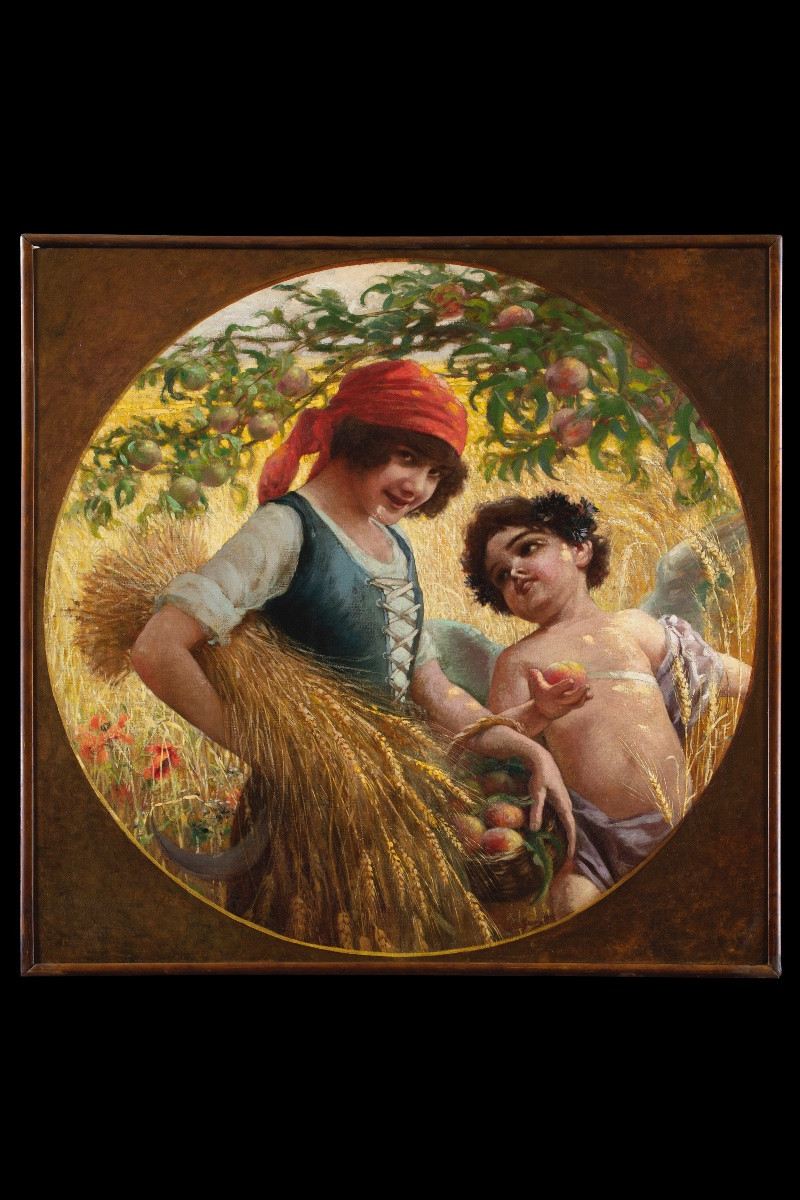
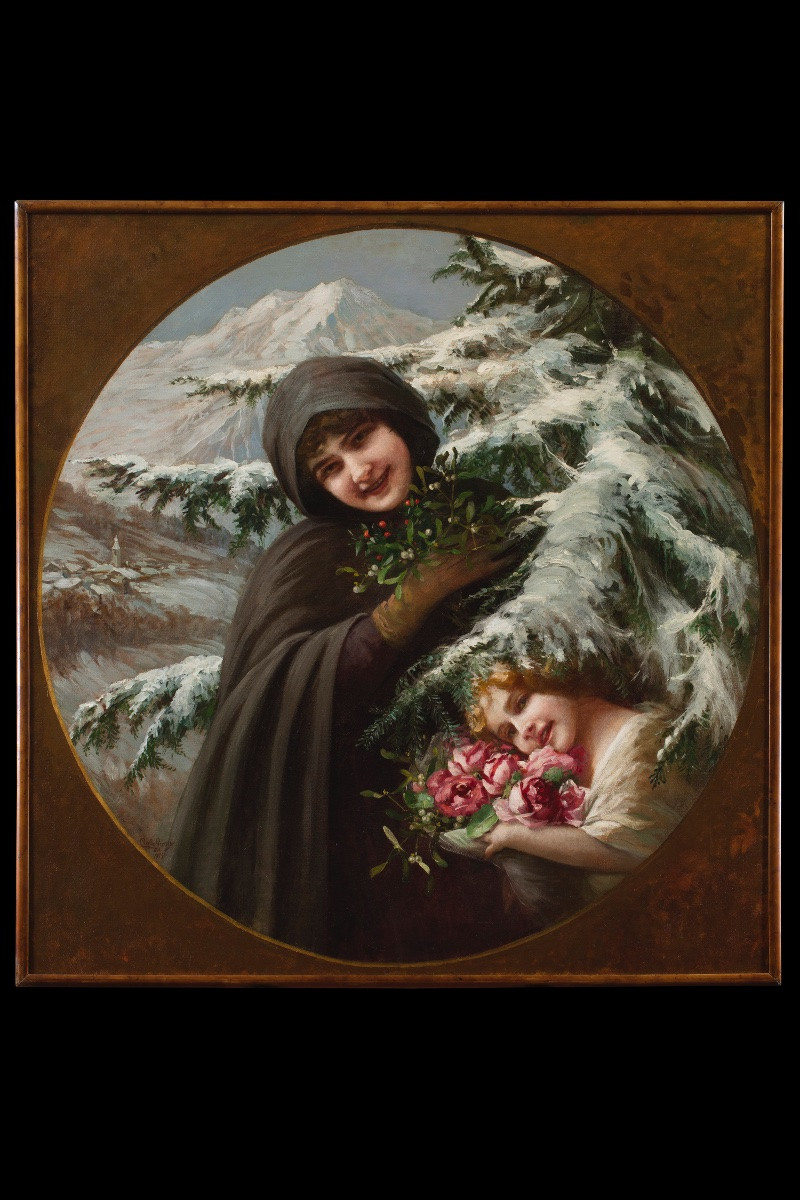
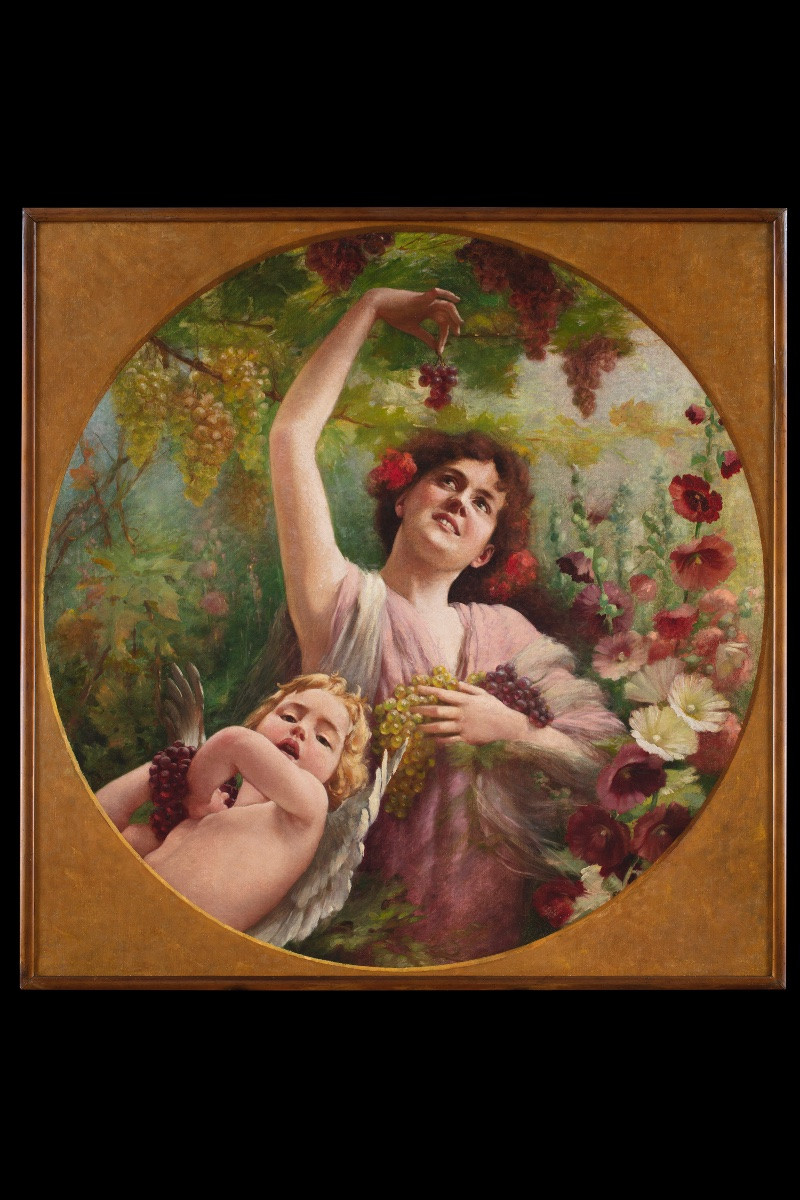
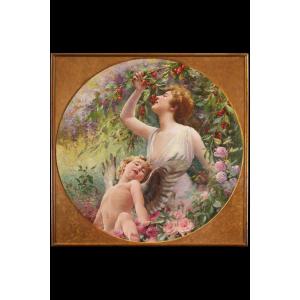


Carlo Grossi (Carpi 1857 – Milan 1931), “The Four Seasons,” 1919.
Oil on canvas, 106 x 107 cm
Signed “Carlo Grossi/1919” lower left.
This series of four paintings is one of the finest and best-known works by the Carpi painter Carlo Grossi, originally intended for Casa Lugli, on Via S. Francesco in Carpi. The canvases, all identical in size, depict four female figures as allegories of the four seasons; the figures are framed in circles and embellished with a gold background.
Spring, represented by a young woman with blond hair, appears awakened from a sweet torpor; the figure is portrayed in three-quarters, in the act of raising a bunch of ripe black cherries to her lips; behind the fruit branches, we can glimpse a cascade of wisteria flowers. The base of the tondo is decorated with roses and buds, while a cupid with golden hair seems to look down on us. The composition is characterized by light, luminous tones, such as pink and lilac; the lush nature is defined by a pale green, in a low-contrast palette.
Summer, on the other hand, is pervaded by the golden yellow of ripe wheat, its color merging with the sky. A young girl dressed as a peasant smiles shyly at the viewer, while a plump cherub seems to be conversing with her, perhaps regarding the fruit in their hands. The girl has just picked some peaches from the tree on the right, delicately placing them in a wicker basket; under her left arm she carries a sickle and freshly harvested ears of corn. The warm color temperature reflects the summer heat.
In Autumn, the tones darken, taking on shades of purple. A woman with the attributes of a Bacchante gazes spellbound at some grapes, holding them above her head in a gesture of mixed joy and wonder. Beside her, a distracted cupid carries a large, ripe bunch of grapes on his shoulder. The two figures are immersed in a vine so dense and dense it resembles a forest; on the right, we can see the large white and purple flowers of the Alcea rosea.
Winter is personified by a hooded figure, partially hidden by the branches of a whitewashed fir tree. She is a young woman with dark hair, covered in a coarse woolen cloak. She clutches sprigs of mistletoe in her gloved hands, while, in the lower left, a dressed putto peeks out with a bouquet of holly and winter roses. In the background is a snow-capped mountain with a village visible on its slopes, perhaps the Frignano area in the Tuscan-Emilian Apennines. White and brown tones cool the composition's color temperature, creating continuity and visual harmony, interrupted only by red and pink flecks of fruit and flowers.
The pictorial cycle displays a strong influence of floralism, typical of the Art Nouveau advertising posters that spread throughout Europe with Alfons Mucha. Grossi introduces genre subjects to the fortuitous intermingling of girl and nature, drawing on Modenese colleagues such as Eugenio Zampighi and especially Gaetano Bellei, whose direct references can be seen in the young women's faces and Winter's sly smile. Grossi's extensive knowledge of botany is also evident; as we know, he was highly regarded in his time for his still lifes.
The four canvases have been featured in several exhibitions, including the first monographic exhibition on Carlo Grossi at the Carpi Museum in 1966 and subsequently in the 2002 exhibition "Carlo Grossi: Art Nouveau painter between Emilia and Lombardy," organized by the Palazzo Pio Museums. The works are published on p. 55 of the catalogue edited by G. Martinelli Braglia and P. Borsari.
BIOGRAPHY
Carlo Grossi was born in Carpi in 1857 to a family of relatively affluent means, as his father was a high school principal. Grossi was introduced to painting at an early age, attending the Drawing School run by the Rossi family, local artists, at the age of twelve. In 1872, he enrolled at the Academy of Fine Arts in Modena and during this period began to devote himself to theater set design under the guidance of the artist Ferdinando Manzini. He produced a sketch for Verdi's Aida, staged at the Teatro Comunale di Modena during the 1880/1881 season. After completing his training in Emilia, Grossi moved to Milan in 1885. In the Lombardy capital, he discovered a more cosmopolitan decorative style, furthering his artistic career. There, he devoted himself to decorating, favoring fresco commissions from both public and private sectors. His painting was highly regarded by his colleagues, who named him an honorary member of the Brera Academy. His strong connection with the intellectual and artistic circle that revolved around the Società della Permanente allowed him to sell his paintings to foreign clients as well. In 1893, he produced several sketches for the decoration of the Teatro Regio "Dona Amélia" in Lisbon, completed the following year and hosting international actresses such as Eleonora Duse and Sarah Bernhardt. Two years later, he received a commission from Cavaliere Foresti for his Palazzo (now Palazzo Severi), for which he painted the panels "The Phases of Day and Night," the four overdoors "Allegories of the Elements," and several frescoes, reflecting the influence of the new Symbolist aesthetic.
In 1900, he won the competition to decorate the Church of San Giovanni in Busto Arsizio, where he continued to work for the next ten years with collaborators Bottaro and Caremi. In 1902, again in Busto Arsizio, he decorated the chapel of the poorhouse. In 1913, he created an altarpiece for the Church of the Visitation in São Paulo, Brazil.
Alongside his religious commissions, he produced a substantial body of work for a bourgeois audience, as evidenced by portraits imbued with illustrative realism, including Portrait of Lieutenant Luigi Marchi (1920) and Portrait of his Son Giannino (1920, now at the GAM in Milan), as well as various still lifes. In 1919, he painted one of his most famous works, the series "The Four Seasons," four paintings intended for the Lugli house on Via San Francesco in Carpi. The canvases, characterized by a more subdued symbolism than the works in Palazzo Foresti, represent a moment of full stylistic maturity: the allegorical figures embody the cycle of the seasons through a naturalistic and familiar style, verging on neo-academicism. His work, oscillating between academic painting and Art Nouveau fascinations, reflects the figurative culture of early 20th-century Northern Italy: an elegant and restrained art, attentive to bourgeois taste and ornamental function, yet imbued with an intimate poetics and capable of narrative lyricism. Grossi worked until his death in Milan in 1931. Many of his works are now preserved at the Civic Museum of Carpi, donated by the artist himself during his lifetime and by his descendants.
Explore similar pieces and discover your ideal find:
Other Paintings