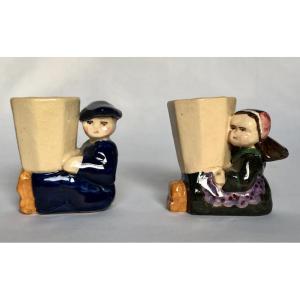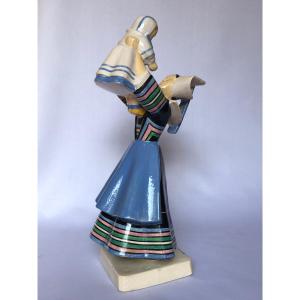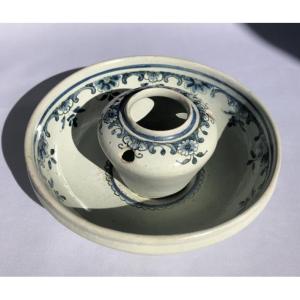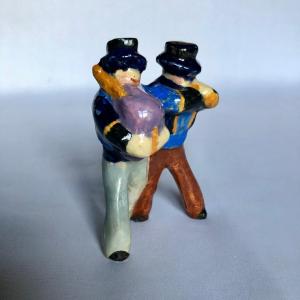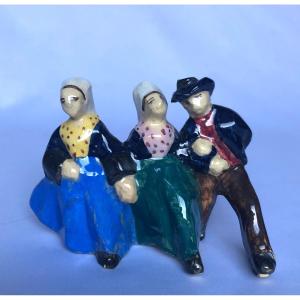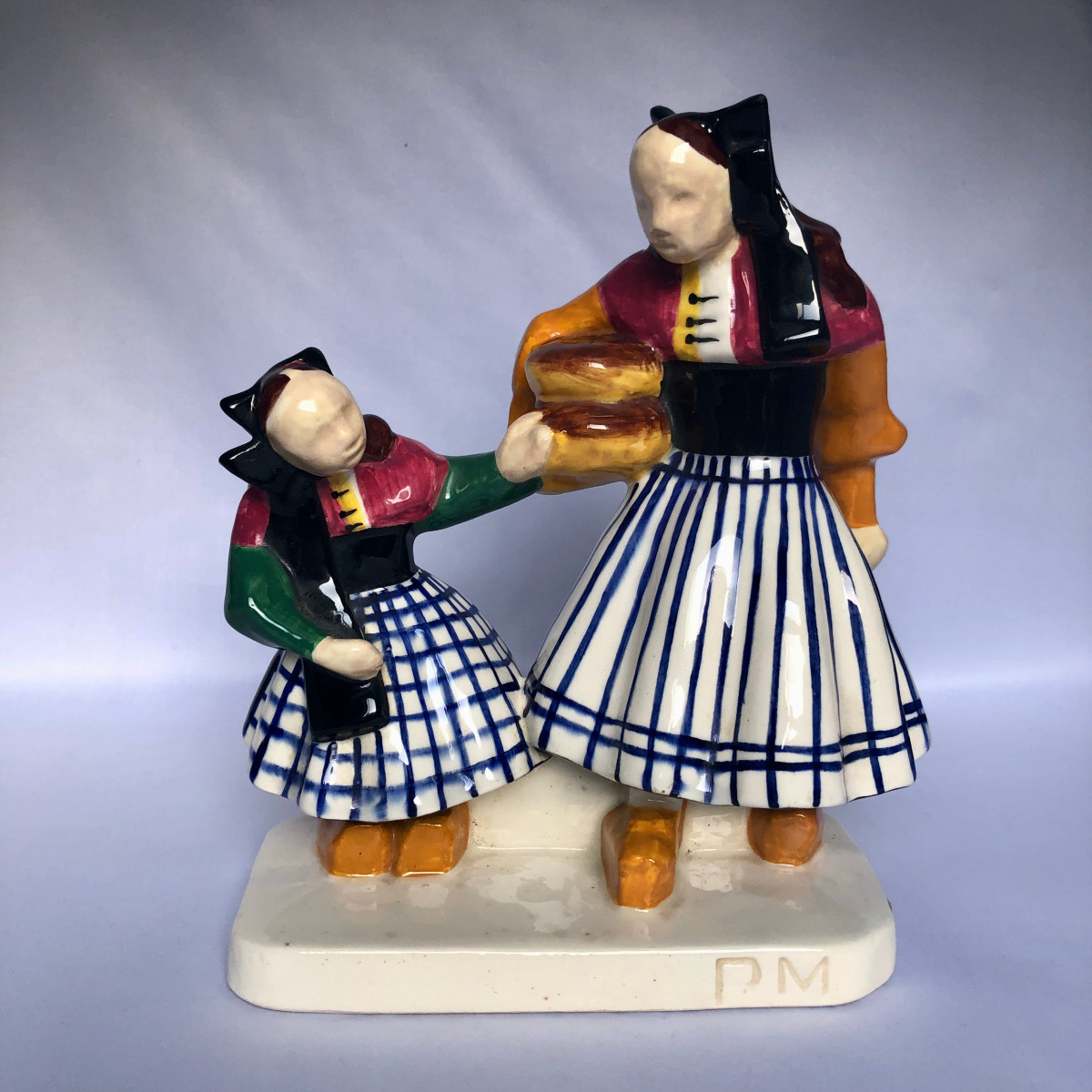

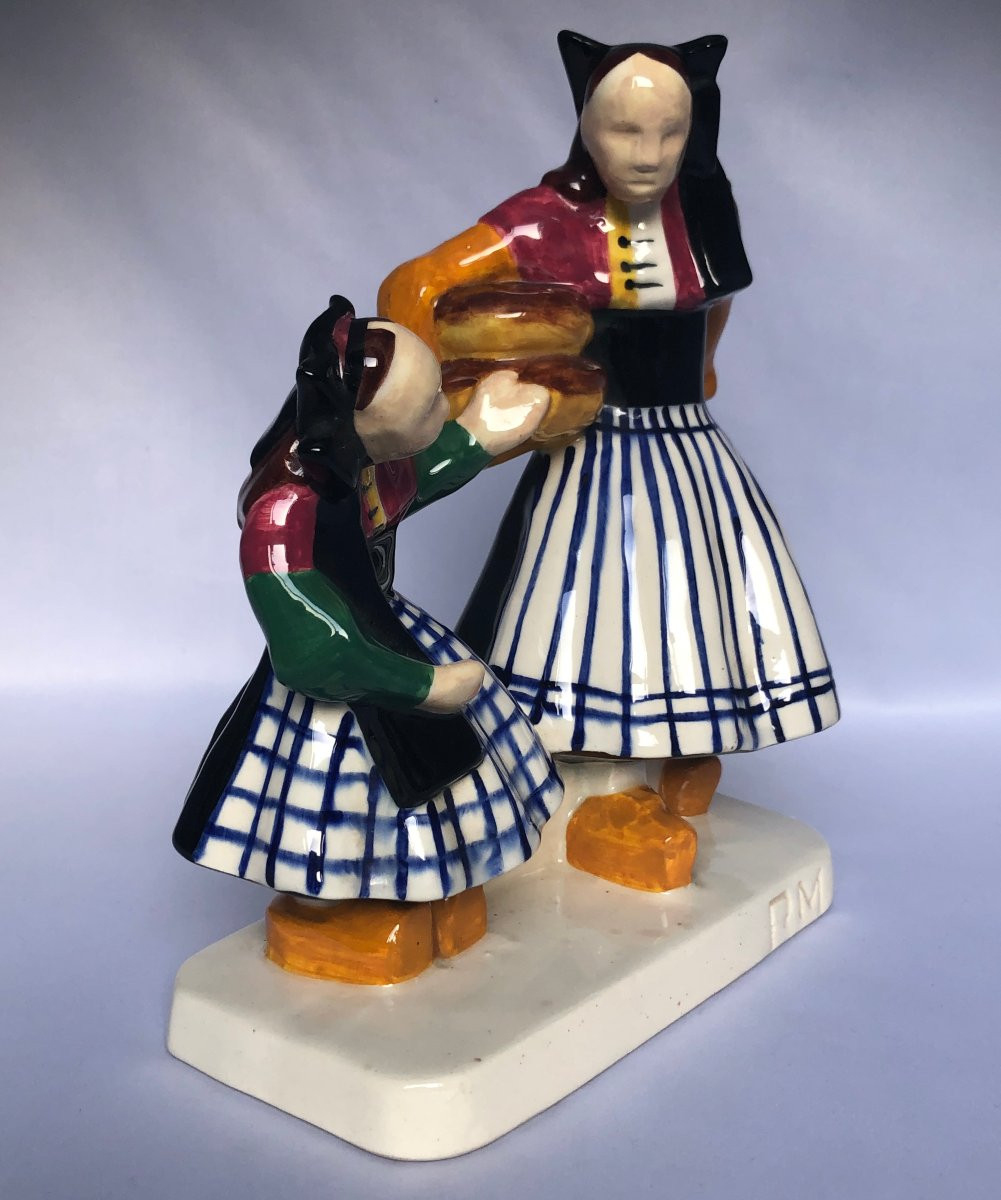


Ouessant Women With Loaves Of Bread - Robert Micheau-vernez - Henriot Factory - Brittany
Artist: Robert Micheau-vernez
Manufacture Henriot. Very rare polychrome earthenware piece, circa 1930.
Robert Micheau Vernez (1907-1989):
Son of a naval officer, Robert Micheau studied at the Collège Saint-Louis in Brest, where he attended evening classes at the School of Fine Arts alongside the painter Charles Lautrou. From October 1926 to June 1928, he studied at the Regional School of Fine Arts in Nantes in the studio of the painter Emile Simon, where he received a medal in June 1927. He was then admitted to the École des Beaux-Arts in Paris in the studio of the painter Lucien Simon. His studies continued until June 1930. At the same time, he enrolled in the Sacred Art Workshops of Maurice Denis. In December 1932, he married Lysa-Mina Vernez, herself a recipient of a medal from the Nantes School of Fine Arts in June 1929. From then on, he signed his works under the double surname "Micheau-Vernez." In 1930, René-Yves Creston asked him to join the Seiz-Breur movement, which aimed to create a contemporary Breton art. He joined out of solidarity but participated little in their activities and resigned in June 1946. In November 1930, at the Galerie Saluden in Brest, he exhibited eighteen earthenware pieces, including thirteen plates in collaboration with the Henriot pottery factory in Quimper. Their immediate success led to a thirty-year collaboration with the factory, resulting in the creation of one hundred and forty sculptures, including several plates. His earthenware works brought Micheau-Vernez considerable fame. Quickly becoming the brand image of the Henriot pottery works in Quimper, his pieces graced the covers of the factory's catalogs. This completely overshadowed his pictorial work. A large decorative tile panel, created in 1950, can be seen in the hall of the Quimper SNCF train station. A large piece depicting a Breton woman in traditional costume was presented to General de Gaulle by the inhabitants of the Île de Sein during his visit on June 12, 1949. It remained in his office until 1958. The art critic André Parinaud, director of the monthly magazine Galerie des Arts, wrote of him: "Few lives are more discreet, more secretive in their simplicity than that of this artist, and few works are more vibrant with color, sunlight, and youthful energy. The former student of Maurice Denis has retained the lesson of the Nabis: the intangible purity of the artistic gesture, and modesty as the guiding principle of his approach."
Robert Micheau Vernez (1907-1989):
Son of a naval officer, Robert Micheau studied at the Collège Saint-Louis in Brest, where he attended evening classes at the School of Fine Arts alongside the painter Charles Lautrou. From October 1926 to June 1928, he studied at the Regional School of Fine Arts in Nantes in the studio of the painter Emile Simon, where he received a medal in June 1927. He was then admitted to the École des Beaux-Arts in Paris in the studio of the painter Lucien Simon. His studies continued until June 1930. At the same time, he enrolled in the Sacred Art Workshops of Maurice Denis. In December 1932, he married Lysa-Mina Vernez, herself a recipient of a medal from the Nantes School of Fine Arts in June 1929. From then on, he signed his works under the double surname "Micheau-Vernez." In 1930, René-Yves Creston asked him to join the Seiz-Breur movement, which aimed to create a contemporary Breton art. He joined out of solidarity but participated little in their activities and resigned in June 1946. In November 1930, at the Galerie Saluden in Brest, he exhibited eighteen earthenware pieces, including thirteen plates in collaboration with the Henriot pottery factory in Quimper. Their immediate success led to a thirty-year collaboration with the factory, resulting in the creation of one hundred and forty sculptures, including several plates. His earthenware works brought Micheau-Vernez considerable fame. Quickly becoming the brand image of the Henriot pottery works in Quimper, his pieces graced the covers of the factory's catalogs. This completely overshadowed his pictorial work. A large decorative tile panel, created in 1950, can be seen in the hall of the Quimper SNCF train station. A large piece depicting a Breton woman in traditional costume was presented to General de Gaulle by the inhabitants of the Île de Sein during his visit on June 12, 1949. It remained in his office until 1958. The art critic André Parinaud, director of the monthly magazine Galerie des Arts, wrote of him: "Few lives are more discreet, more secretive in their simplicity than that of this artist, and few works are more vibrant with color, sunlight, and youthful energy. The former student of Maurice Denis has retained the lesson of the Nabis: the intangible purity of the artistic gesture, and modesty as the guiding principle of his approach."
4 400 €
Period: 20th century
Style: Art Deco
Condition: Excellent condition
Material: Earthenware
Width: 19 cm
Height: 23 cm
Reference (ID): 1693460
Availability: In stock
Print