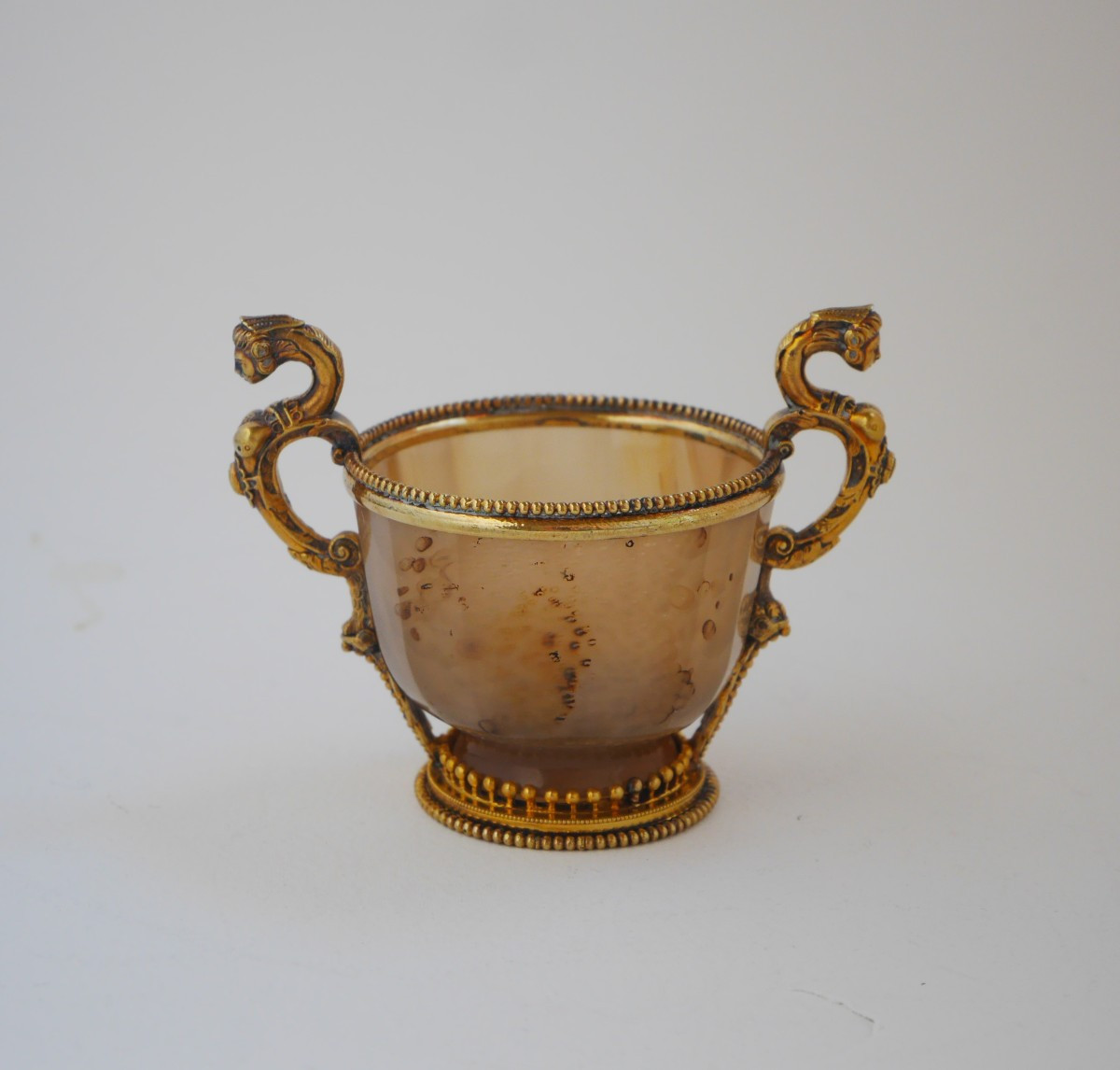

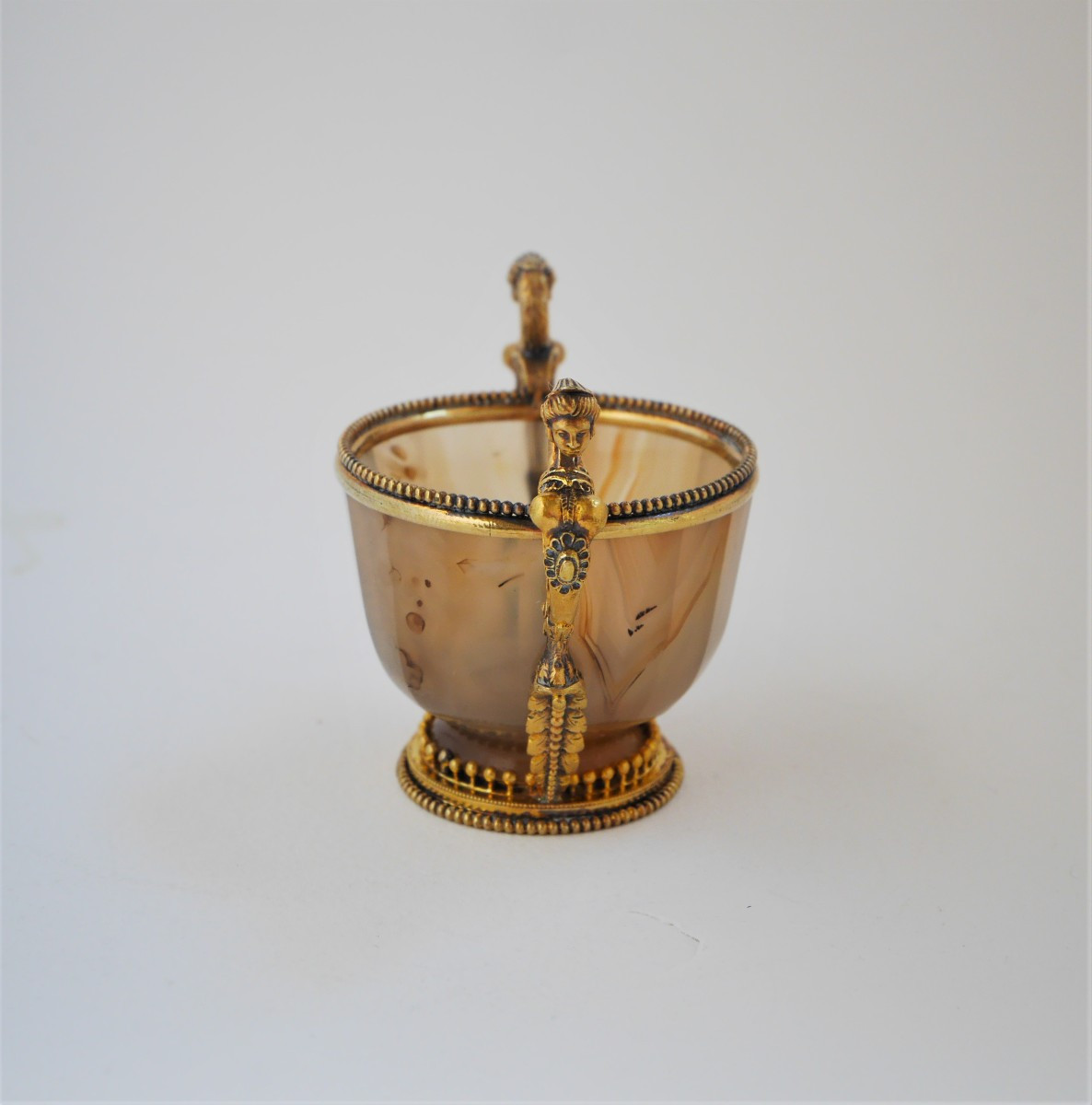

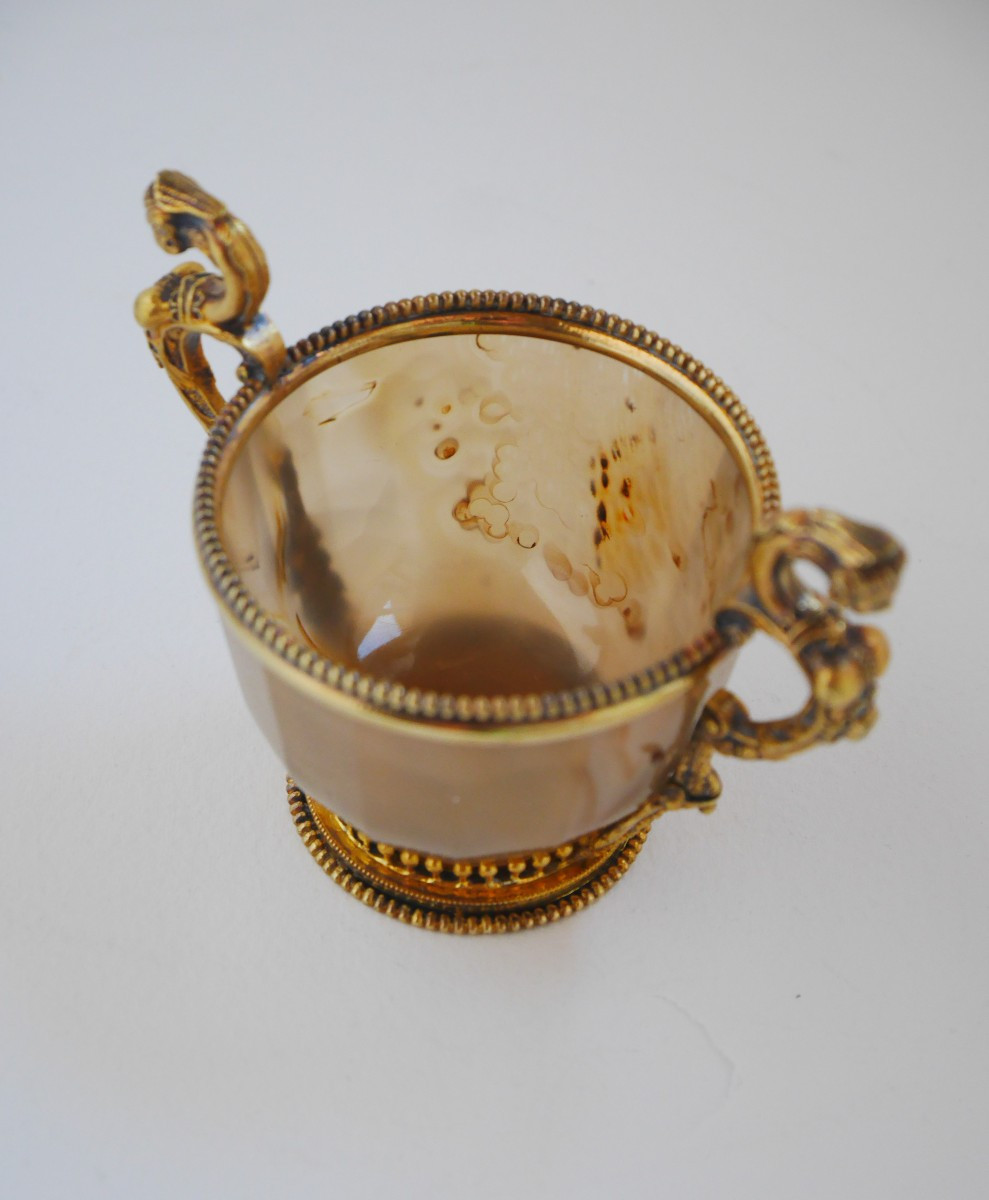


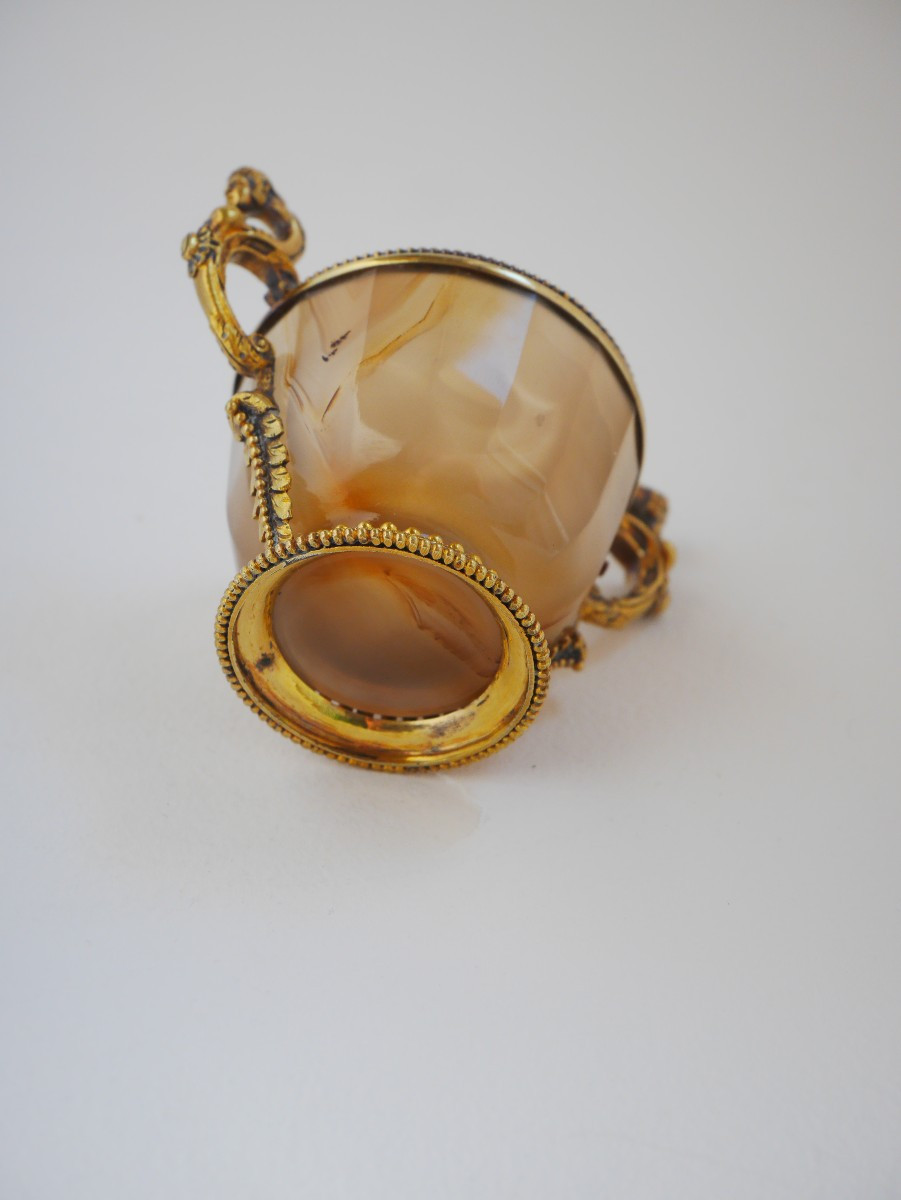
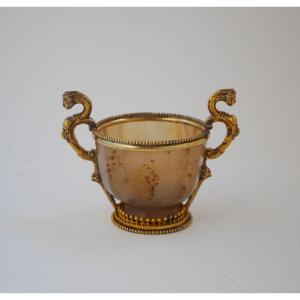


Cup With Agate Handles And A Silver-gilt Mount, Germany (augsburg?), Circa 1700
- Goblet with handles
- Gilt silver, cast, chased, and agate (translucent)
- Augsburg (?), circa 1700
- Height: 69mm; diameters: 42mm (foot) & 58mm (rim)
- Excellent condition
- Provenance: private collection
- Goblet in slightly faceted agate, with a gilt silver rim formed by two sphinx handles in a bracket shape, linking the rim, bordered with a row of pearls, to the foot. The mount is secured with pins.
- This goblet is part of a "cabaret" set with a goblet and saucer from the Thiers collection in the Louvre Museum in Paris, a second from the Cochet collection (Fraysse sale, February 8, 2012, lot 22), and a third in a private collection. They form a set of four goblets, a standard number for such services, an example of which can be found at the Kassel Museum (Seling): four goblets with their saucers, two candlesticks, four spoons, a tea caddy, two spice racks, and a snuffer (Inv.B II126,173,198a,b, 199-210). The Kassel set, made in the workshops of Tobias Baur, a goldsmith specializing in such settings, in Augsburg between 1695 and 1706, corresponds to this production of Augsburg workshops at the end of the 17th century, reflecting a demand from collectors wishing to combine precious materials, hard stones—rock crystal, carnelian, agate, or jasper—with gold or silver-gilt mounts in usuals objects. More collector's items than practical objects, examples can be found in the sales catalogs of the late M. de Villemandi's collection of March 3, 1788, lot no. 384 and following, and in the collection of the Duchess of Mazarin at her sale of July 27, 1783, lot no. 2, "A breakfast set, consisting of a goblet and two flasks, placed on a shaped rock crystal tray; all trimmed in gold" (sic). The typology of the sphinx-shaped handles is inspired by grotesques and their Nordic interpretation by painters such as Lucas van Leyden or Theodore de Bry, whose recalls the production of the late German Renaissance style.
- Hallmarks: no hallmarks; the goblets in the Louvre and the Cochet collection bear a census mark from 1819-1838 on their saucers, probably following a (re)sale in the trade during that period. The goblets attributed to the workshop of Tobias Baur never bear hallmarks or control marks. The absence of hallmarks on the goblets, combined with pin-jointed construction, effectively rules out a 19th-century French (and Parisian) production.
- Ref.: [1] Seling, Helmut: "Die kunst der Augsburger Goldschmiede, 1529-1868", 3 volumes, Verlag CH Beck; [2] Chastel, André: "La grottesque", Aux éditions Fayard, 1988; [3] Philippe Morel: "Les grotesques", Flammarion "Idées et Recherches", 1997; [4] Micio, Paul: "Les collection de Monsieur, frère de Louis XIV", Somogy, 2014
- Gilt silver, cast, chased, and agate (translucent)
- Augsburg (?), circa 1700
- Height: 69mm; diameters: 42mm (foot) & 58mm (rim)
- Excellent condition
- Provenance: private collection
- Goblet in slightly faceted agate, with a gilt silver rim formed by two sphinx handles in a bracket shape, linking the rim, bordered with a row of pearls, to the foot. The mount is secured with pins.
- This goblet is part of a "cabaret" set with a goblet and saucer from the Thiers collection in the Louvre Museum in Paris, a second from the Cochet collection (Fraysse sale, February 8, 2012, lot 22), and a third in a private collection. They form a set of four goblets, a standard number for such services, an example of which can be found at the Kassel Museum (Seling): four goblets with their saucers, two candlesticks, four spoons, a tea caddy, two spice racks, and a snuffer (Inv.B II126,173,198a,b, 199-210). The Kassel set, made in the workshops of Tobias Baur, a goldsmith specializing in such settings, in Augsburg between 1695 and 1706, corresponds to this production of Augsburg workshops at the end of the 17th century, reflecting a demand from collectors wishing to combine precious materials, hard stones—rock crystal, carnelian, agate, or jasper—with gold or silver-gilt mounts in usuals objects. More collector's items than practical objects, examples can be found in the sales catalogs of the late M. de Villemandi's collection of March 3, 1788, lot no. 384 and following, and in the collection of the Duchess of Mazarin at her sale of July 27, 1783, lot no. 2, "A breakfast set, consisting of a goblet and two flasks, placed on a shaped rock crystal tray; all trimmed in gold" (sic). The typology of the sphinx-shaped handles is inspired by grotesques and their Nordic interpretation by painters such as Lucas van Leyden or Theodore de Bry, whose recalls the production of the late German Renaissance style.
- Hallmarks: no hallmarks; the goblets in the Louvre and the Cochet collection bear a census mark from 1819-1838 on their saucers, probably following a (re)sale in the trade during that period. The goblets attributed to the workshop of Tobias Baur never bear hallmarks or control marks. The absence of hallmarks on the goblets, combined with pin-jointed construction, effectively rules out a 19th-century French (and Parisian) production.
- Ref.: [1] Seling, Helmut: "Die kunst der Augsburger Goldschmiede, 1529-1868", 3 volumes, Verlag CH Beck; [2] Chastel, André: "La grottesque", Aux éditions Fayard, 1988; [3] Philippe Morel: "Les grotesques", Flammarion "Idées et Recherches", 1997; [4] Micio, Paul: "Les collection de Monsieur, frère de Louis XIV", Somogy, 2014
2 480 €
Period: 18th century
Style: Renaissance, Louis 13th
Condition: Perfect condition
Diameter: 42 mm
Height: 69 mm
Reference (ID): 1693362
Availability: In stock
Print