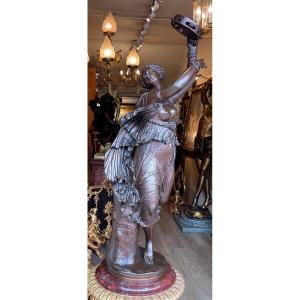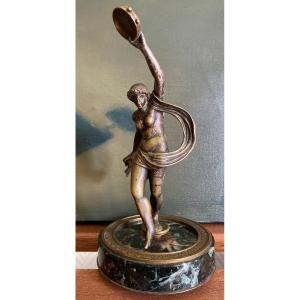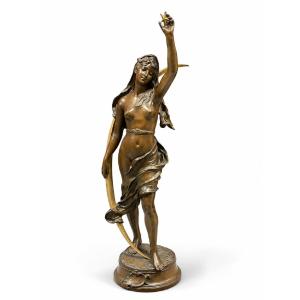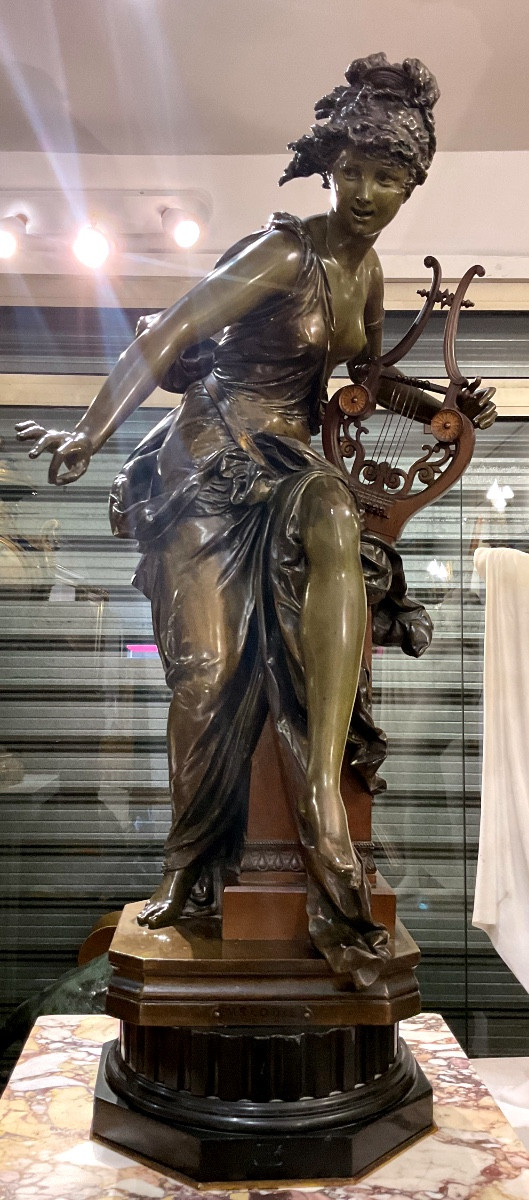
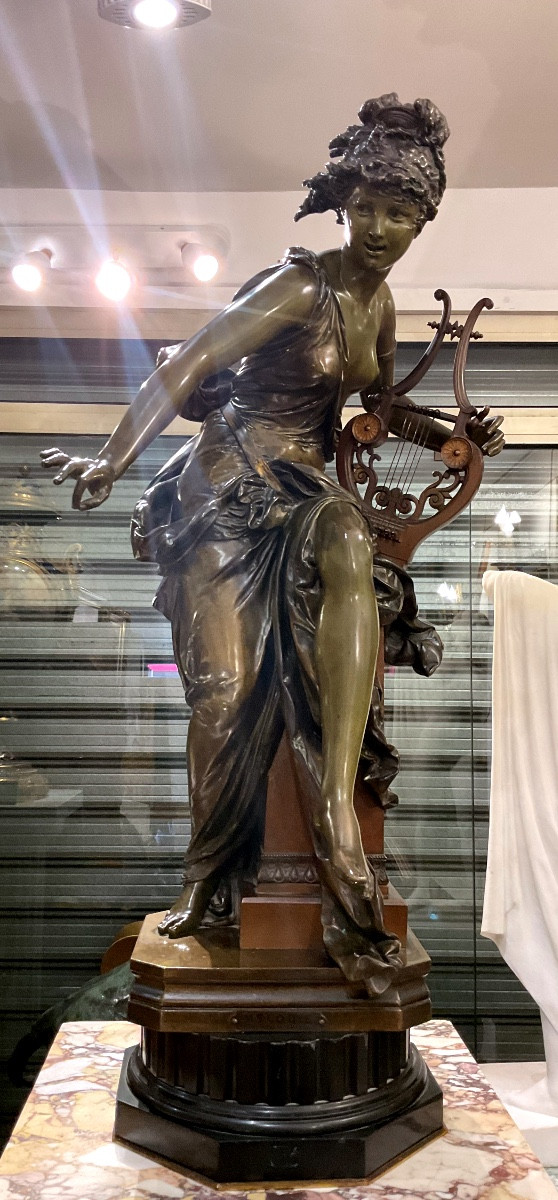


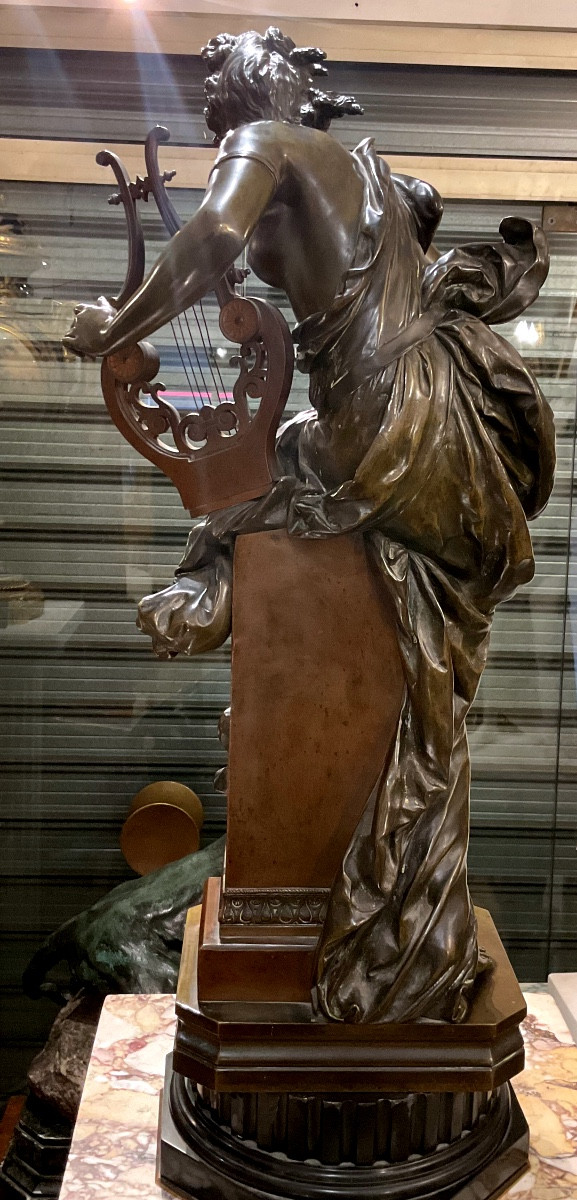


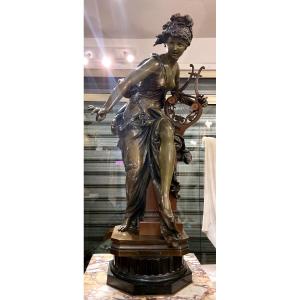


Large Bronze By Albert Carrier-belleuse (1824-1887) “melody”
- Louis-Robert Carrier-Belleuse (1848-1913), son fils.
- Pierre Carrier-Belleuse (1851-1932), son second fils.
- Joseph Chéret (1838-1894), son beau-fils.
- Alexandre Falguière (1831-1900).
- Luca Madrassi (1848-1919).
- Gustave Obiols (1858-?).
- Josep Reynés (1850-1926), sculpteur espagnol, élève de Carrier-Belleuse vers 1873[18].
- Auguste Rodin (1840-1917).
- Article
- Talk
- Read
- Edit
- View history
- Small Standard Large
- Standard Wide
- Automatic Light Dark
Find sources: "Albert-Ernest Carrier-Belleuse" – news ·newspapers · books · scholar · JSTOR (January 2021)(Learn how and when to remove this message)Albert-Ernest Carrier-BelleuseCarrier-Belleuse, c. 1870Born12 June 1824
Anizy-le-Château, Aisne, FranceDied4 June 1887 (aged 62)
Sevres, FranceKnown forSculpture
Albert-Ernest Carrier-Belleuse(French pronunciation: [albɛʁ ɛʁnɛstkaʁje bɛløz]; born Albert-Ernest Carrier de Belleuse; 12 June 1824 – 4 June 1887) was a French sculptor. He was one of the founding members of the Société Nationale des Beaux-Arts, and was made an officer of the Legion of Honour.
Early lifeCarrier-Belleuse was born on 12 June 1824 at Anizy-le-Château, Aisne, France. He began his training as a goldsmith's apprentice.[1]Carrier-Belleuse was a student of David d'Angers and briefly studied at the École des Beaux-Arts. His career is distinguished by his versatility and his work outside France: in England between 1850 and 1855[1] (working for Mintons), and in Brussels around 1871. His name is perhaps best known because Auguste Rodinworked as his assistant between 1864 and 1870. The two travelled to Brussels in 1871,[2] and by some accounts Rodin assisted Carrier-Belleuse's architectural sculpture for the Brussels Stock Exchange.
Career La Bacchante, 1863, Musée d'OrsayCarrier-Belleuse made many terra cotta pieces, the most famous of which may be The Abduction of Hippodameia depicting the Greek mythological scene of a centaur kidnapping Hippodameia on her wedding day. He was made artistic director at the Manufacture nationale de Sèvres in 1876.
Société Nationale des Beaux-ArtsIn 1862 Carrier-Belleuse was one of the founding members of the Société Nationale des Beaux-Arts, and was made an officer of the Légion d'honneur. The bronzes he executed prior to 1868 were always signed "Carrier" or "A. Carrier", but after 1868 his signature was changed to "Carrier-Belleuse".
Artistic styleHis work encompassed all manner of sculptural subjects and materials, and his naturalism incorporated a breadth of styles: unembellished Realism, neo-Baroque exuberance, and Rococoelegance.[1]
FamilyHis sons were the painters Louis-Robert Carrier-Belleuse (1848-1913) and Pierre Carrier-Belleuse (1851-1932).[1]
Death and legacyCarrier-Belleuse died on 4 June 1887 at Sèvres, France.
Works of art Monument to André MassénaNice, 1869 Hebe asleep, 1869
Paris, Musée d'Orsay
- Pediment sculpture of Abundance, Pavillon de Flore, South façade of the Great Galerie, Louvre palace, Paris, circa 1863
- Caryatids themed on the four seasons, Vichy Opera, for architect Charles Badger, 1865
- Architectural sculpture for the Tribunal de commerce de Paris (Commercial Court of Paris), on the Île de la Cité, for architect Antoine-Nicolas Bailly, completed 1865
- A silvered bronze chimney-piece for the Hôtel de la Païva, Paris, 1866[3]
- Monument to André Masséna, Nice, 1869
- Architectural work at the Brussels Stock Exchange, Brussels, circa 1870
- Mary Queen of Scots, Private Collection, ca. 1870
- Two elaborate multifigure torchères for the base of grand staircase, Palais Garnier (Paris Opera), Pairs, 1873[4]
- Tomb of Belgian photographer Louis Ghémar, Laeken Cemetery, Brussels, 1873[5]
- Architectural work for the Théâtre de la Renaissance, Paris, for architect Charles de Lalande, 1873[3]
- Sea Nymph for the fountain at the Place du Theâtre-Français, Paris, for architect Gabriel Davioud, 1874
- Bust of Aimée-Olympe Desclée for her tomb, 1874
- Four Seasons fountain, Hotel de Ville, Fleurance
- Mausoleum of José de San Martín, Buenos Aires Metropolitan Cathedral, Buenos Aires
- Equestrian statue of Mihai Viteazul, University Square, Bucharest, Romania
- Equestrian statue of Manuel Belgrano, Plaza de Mayo Square, Buenos Aires, Argentina
- Equestrian statue of Bernardo O'Higgins, Alameda, Santiago de Chile, Chile
- Statue for the victims of the La Compañía fire, originally at the place of the fire, today in front of the General Cemetery in Santiago de Chile, Chile
- Bust of Carrier-Belleuse by Auguste Rodin
- Equestrian statue of Mihai Viteazul in Bucharest
- Marie Carrier-Belleuse, 1859, Musée d'Orsay
- Bust of a Woman with a Diadem, c. 1860–1870, Musée d'Orsay
- Harmony, Museum of Fine Arts, Ghent
- Hebe asleep, c. 1869, Musée d'Orsay
- Leda and the Swan, c. 1870, Metropolitan Museum of Art
Period: 19th century
Style: Napoleon 3rd
Condition: Perfect condition
Material: Bronze
Diameter: 30 cm
Height: 92 cm avec socle et 82 cm sans socle
Reference (ID): 1689482
Availability: In stock