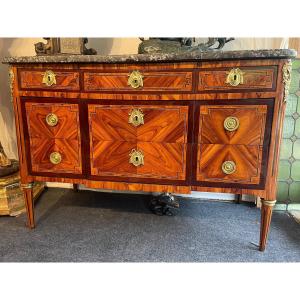
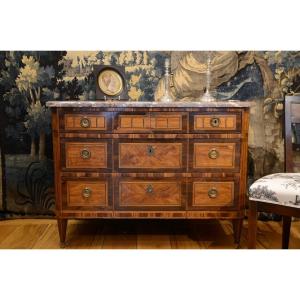
Louis XVI Period Half-moon Commode
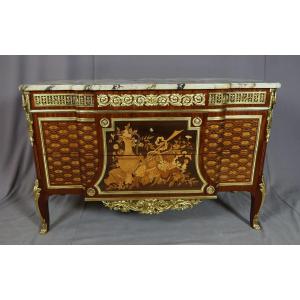
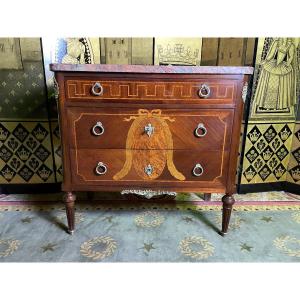
Half-moon commode in marquetry of rosewood, kingwood and amaranth. With a slightly projecting central section, it opens with two drawers without a crosspiece, three narrow drawers in the frieze, and sides fitted with a pivoting drawer and a door. It stands on four tapered, fluted legs. Decorated with geometric motifs in stringing, the central panel featuring a mythological scene.
The façade is adorned with a Neoclassical scene depicting Neptune on a fountain animated with shells, with the Pyramid of Caius Cestius at Ostia, the port of Rome, in the background. Richly ornamented with finely chased and gilt bronze mounts: foliate friezes, water-leaf mouldings, branches, drops with ram’s heads, fluting and asparagus-tip motifs.
Campan ribboned marble top.
Louis XVI period
Usual restorations
Height: 88 cm – Width: 144 cm – Depth: 58 cm
Our commode should be closely compared with another commode stamped RVLC and bearing a crowned “C”, of identical dimensions and with a similar decorative scheme, both in its marquetry and its gilt bronzes. That example appeared at auction in December 2012 at Drouot, Europ Auction (ref.: former Sichel collection).
The crowned “C” probably points to a French royal commission and to an inventory from a royal residence in Germany.
This unrecorded mark resembles known French royal marks. To date, we are aware of only two commodes bearing a similar hot-iron stamp: one mahogany commode marked with the Garde-Meuble Royal stamp under the Restoration, and another by J. F. Oeben, also bearing an inventory number from the Garde-Meuble de la Couronne.
At present, only these two commodes bear this letter branded with a hot iron and can be clearly identified as belonging to the Garde-Meuble de la Couronne through their inventory numbers.
The commode presented here could therefore be the third example belonging to the Garde-Meuble de la Couronne, had the inventory number not been erased.
Our commode stands out through the richness of its frieze and apron, as well as by its more luxurious ribboned Campan marble top. Likewise, the gilt-bronze surrounds are more finely worked on our example.
Roger Vandercruse, known as RVLC, is among the most celebrated Parisian cabinetmakers of the 18th century.
He was the brother-in-law of Jean-François Oeben and a contemporary of J. F. Leleu and Riesener. He supplied the same clientele at Court and among the Parisian aristocracy. Between 1769 and 1774, he delivered numerous pieces of furniture to the Garde-Meuble de la Couronne.
Masterpieces by RVLC are well represented in major museum collections: the Musée du Louvre, the Musée des Arts Décoratifs, and the Musée Carnavalet in Paris; the Victoria and Albert Museum in London; the Frick Collection in New York; and the J. Paul Getty Museum in Malibu.
Furniture decorated with marquetry depicting scenes from classical antiquity is extremely rare. One may note, for comparison, the famous cylinder desk made for Pierre-Augustin Caron de Beaumarchais, executed by Riesener or Leleu.
The influence of engravings by Jean-Laurent Legeay (c. 1710–1786) and of the Fountain of the Four Rivers in Rome’s Piazza Navona may well lie at the origin of RVLC’s inspiration—or that of the marchand-mercier responsible for commissioning the commode presented here.
Of Flemish origin, this son of a master cabinetmaker, born in Paris in the Faubourg Saint-Antoine, quickly integrated into the professional community, forming numerous alliances—most notably with cabinetmakers Jean-François Oeben and Jean-Henri Riesener, who successively married his elder sister, Françoise-Marguerite. He was also a close friend of the marchand Pierre Migeon, for whom he produced many light pieces of furniture, as well as of the cabinetmaker Martin Carlin. He supplied dealers such as Poirier and Daguerre.
In 1755, following his father’s death, Lacroix decided to take over the family workshop on the rue du Faubourg Saint-Antoine. The exceptional quality of his work and his particularly prolific production quickly earned him a strong reputation. From 1769, through his colleague the marchand Gilles Joubert, he became responsible for all court commissions. He thus supplied numerous pieces of furniture to royal residences, notably for the Comtesse de Provence and Madame Victoire.
Within his professional community, Lacroix held a respected position: juror from 1768 to 1770, he later served successively as syndic and deputy in 1784.
A great specialist in fantasy furniture, Lacroix distinguished himself through highly homogeneous Louis XV furniture of outstanding quality and remarkable marquetry skill. His style is recognizable by its cross-hatched and quatrefoil marquetry, known as “à la reine”. He frequently embellished his works with nuanced mosaics and small pictorial panels in wood, bringing taste and imagination to their composition.
His early production in the Louis XV period evolved with the attributes of the Transition style. Toward the end of Louis XV’s reign, he was among the first to produce furniture in lemonwood inlaid with ebony. He also devised camaïeu decorations, featuring floral designs or Chinese subjects.
His commodes—almost all of them of the Transition type—most often consist of a rectangular carcass with cabriole legs and two main drawers surmounted by three frieze drawers adorned with gilt-bronze interlacing. The marquetry is arranged in three panels on the façade, framed by gilt-bronze surrounds cut away at the corners into square or circular shapes and decorated with gilt-bronze rosettes. The motifs are most often geometric patterns or flower vases.
He later produced Louis XVI models of great precision, marked by the introduction of a characteristic motif: the spiral rosette. Like Topino, Lacroix specialized in bonheurs-du-jour, which he liked to decorate in the Chinese taste, with marquetry depicting small flower vases or various utensils derived from motifs found on Chinese screens.
The cabinetmaker also produced numerous small tables, for which he used repeated motifs of interlocking circles or lozenges, grids with rosettes or fleurons, or vertical yellow and green striations imitating straw marquetry.
Lacroix ceased his activity during the French Revolution, leaving neither son nor wife to take over the workshop. His manufactory was sold after his death.
Period: 18th century
Style: Louis 16th, Directory
Condition: En l'etat
Material: Wood marquetry
Reference (ID): 1688047
Availability: In stock