


Madonna After Domenichino After Carracci, Italian Bolognese School By French Léopold Loustau
Artist: Léopold Loustau
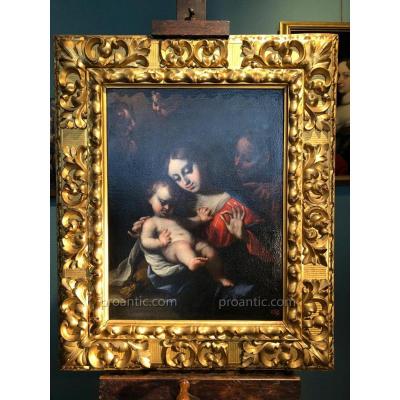
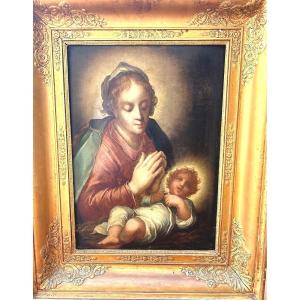
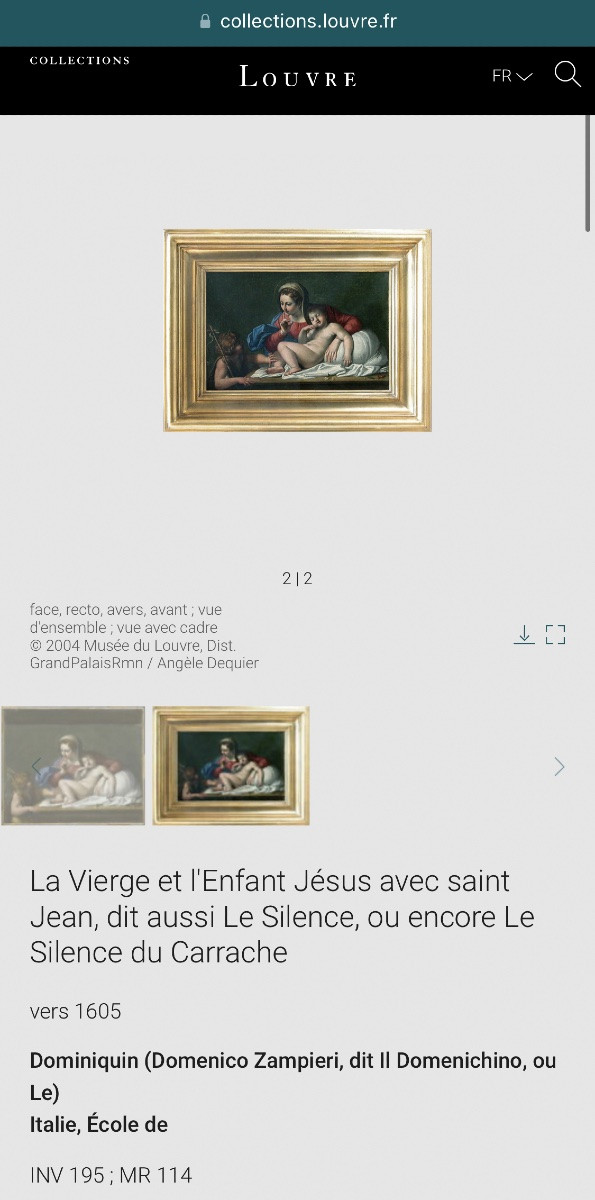
Madonna and child Jesus with Saint John, also known as The Silence, or The Silence of Carracci
by Jacques Léopold Loustau (1815–1894),
after Domenichino himself after Annibale Carracci.
Oil on canvas, 46 × 33 cm.
Frame: 57 × 44 cm.
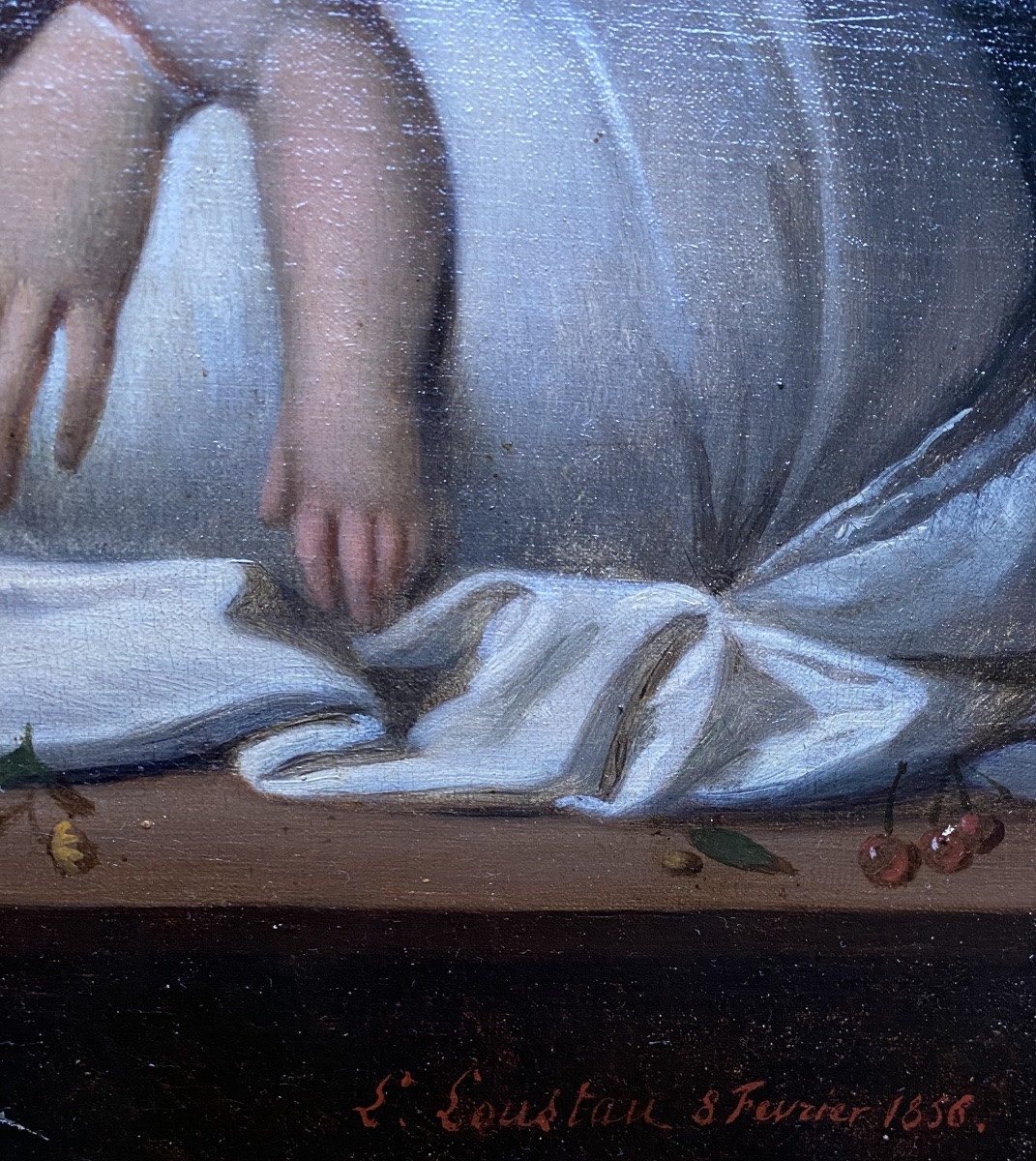
This work is a high-quality copy executed in the 19th century by Jacques Joseph Léopold Loustau, a French painter trained under Hersent and then Léon Cogniet, renowned for the finesse of his copies after the Old Masters.
The composition faithfully reproduces the famous model by Domenichino, held at the Louvre Museum, itself inspired by a work by Annibale Carracci, painted around 1605 and now in Hampton Court, in the British Royal Collection (see Posner, 1971, no. 122). This iconography, known as The Silence, depicts the Virgin Mary discreetly inviting contemplation with a gesture of her finger to her lips, while the Christ Child rests peacefully and the infant Saint John the Baptist gently approaches. The scene, imbued with a profound sense of intimacy and contemplation, is fully in keeping with the aesthetics of Bolognese classicism, characterized by harmonious forms, gentle expressions, and masterful use of chiaroscuro. The balanced composition, the softness of the expressions, and the subtle use of chiaroscuro reflect the aesthetics of Bolognese classicism, of which Carracci was one of the principal initiators, and which Domenichino helped to disseminate with great sensitivity.
Through this lineage, the work testifies to the transmission of the great Italian models of the 17th century to the French academic tradition of the 19th century.
Born in Saarlouis on May 26, 1815, and died in Paris on June 4, 1894, Jacques Joseph Léopold Loustau, a deaf painter, fully embraced this tradition where copying constituted an essential exercise in training and interpretation. His work is distinguished here by precise drawing, a measured palette, and a respectful fidelity to the spirit of his illustrious predecessors.
Presented in a classical-style giltwood frame, this painting offers a refined testimony to the reception and dissemination of Annibale Carracci's models in 19th-century French painting.
Condition: some minor stains and damage, abrasion on the edge; damage and retouching on the frame
références :
https://collections.louvre.fr/ark:/53355/cl010062404
by Jacques Léopold Loustau (1815–1894),
after Domenichino himself after Annibale Carracci.
Oil on canvas, 46 × 33 cm.
Frame: 57 × 44 cm.
This work is a high-quality copy executed in the 19th century by Jacques Joseph Léopold Loustau, a French painter trained under Hersent and then Léon Cogniet, renowned for the finesse of his copies after the Old Masters.
The composition faithfully reproduces the famous model by Domenichino, held at the Louvre Museum, itself inspired by a work by Annibale Carracci, painted around 1605 and now in Hampton Court, in the British Royal Collection (see Posner, 1971, no. 122). This iconography, known as The Silence, depicts the Virgin Mary discreetly inviting contemplation with a gesture of her finger to her lips, while the Christ Child rests peacefully and the infant Saint John the Baptist gently approaches. The scene, imbued with a profound sense of intimacy and contemplation, is fully in keeping with the aesthetics of Bolognese classicism, characterized by harmonious forms, gentle expressions, and masterful use of chiaroscuro. The balanced composition, the softness of the expressions, and the subtle use of chiaroscuro reflect the aesthetics of Bolognese classicism, of which Carracci was one of the principal initiators, and which Domenichino helped to disseminate with great sensitivity.
Through this lineage, the work testifies to the transmission of the great Italian models of the 17th century to the French academic tradition of the 19th century.
Born in Saarlouis on May 26, 1815, and died in Paris on June 4, 1894, Jacques Joseph Léopold Loustau, a deaf painter, fully embraced this tradition where copying constituted an essential exercise in training and interpretation. His work is distinguished here by precise drawing, a measured palette, and a respectful fidelity to the spirit of his illustrious predecessors.
Presented in a classical-style giltwood frame, this painting offers a refined testimony to the reception and dissemination of Annibale Carracci's models in 19th-century French painting.
Condition: some minor stains and damage, abrasion on the edge; damage and retouching on the frame
références :
https://collections.louvre.fr/ark:/53355/cl010062404
1 600 €
Period: 19th century
Style: Louis 14th, Regency
Condition: Good condition
Material: Oil painting
Length: 46
Width: 33
Reference (ID): 1683323
Availability: In stock
Print