THIS OBJECT WAS SOLD
Tokubei Ando (1842-1894) Known As Hiroshige III, Oyster Farming In Hiroshima, Japanese Print


Tokubei ANDO (1842-1894) known as HIROSHIGE III 三代目 歌川広重
Oyster Farming in Hiroshima
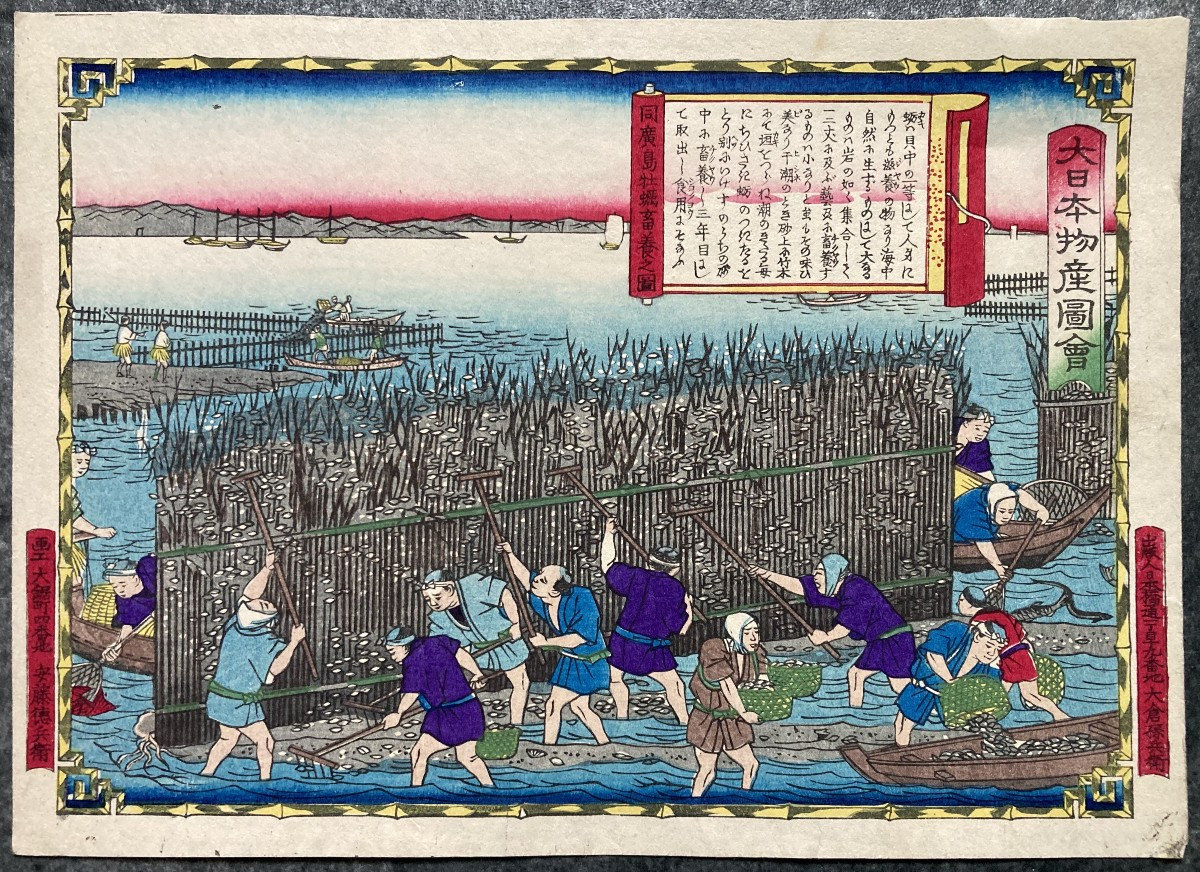
Japanese print from the collection Products of Greater Japan 大日本物産圖會, Occupations of the Japanese だいにっぽんぶっさんずえ Dai Nippon bussan zue
1877
Laid paper
Tokyo
Publisher: Ōkura Magobei 大倉孫兵衛
Dimensions: 24.8 x 17.8cm (Chūban)
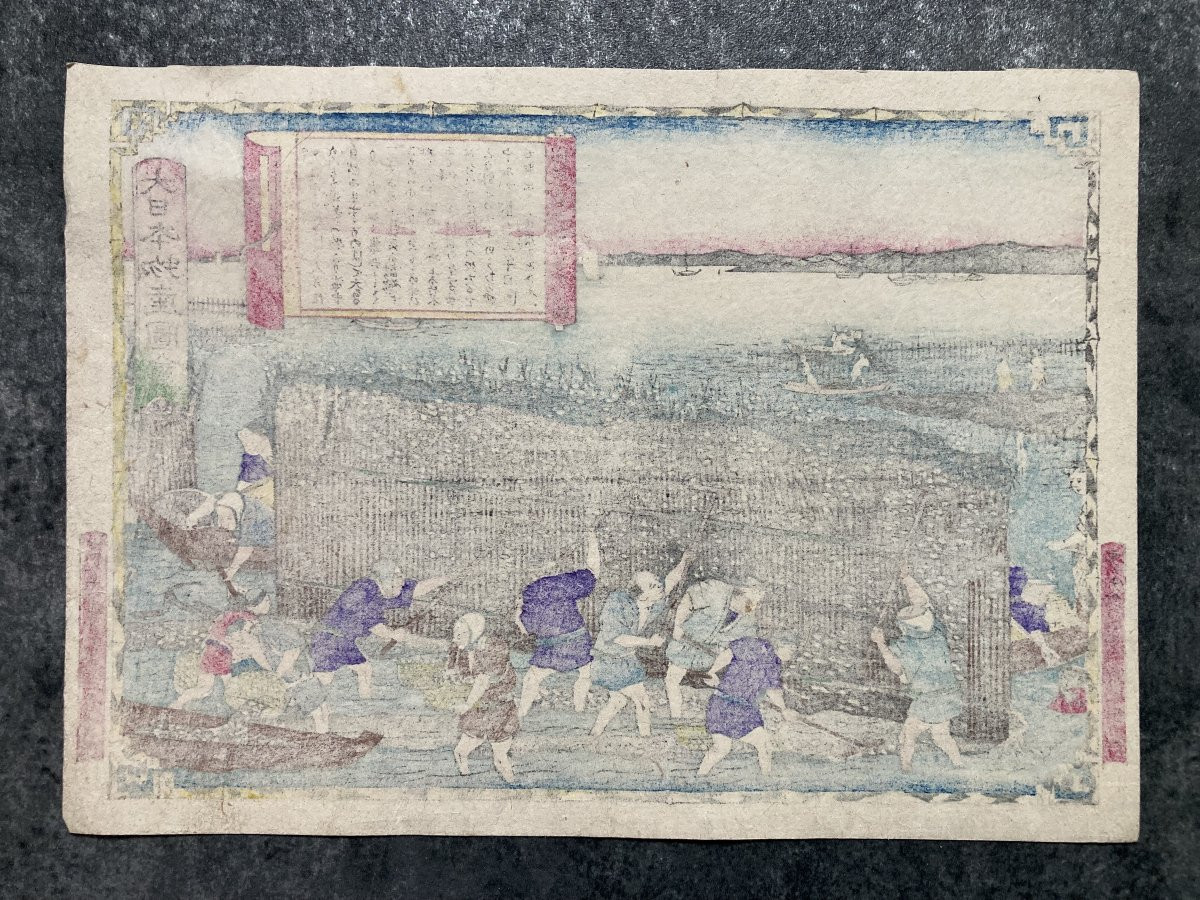
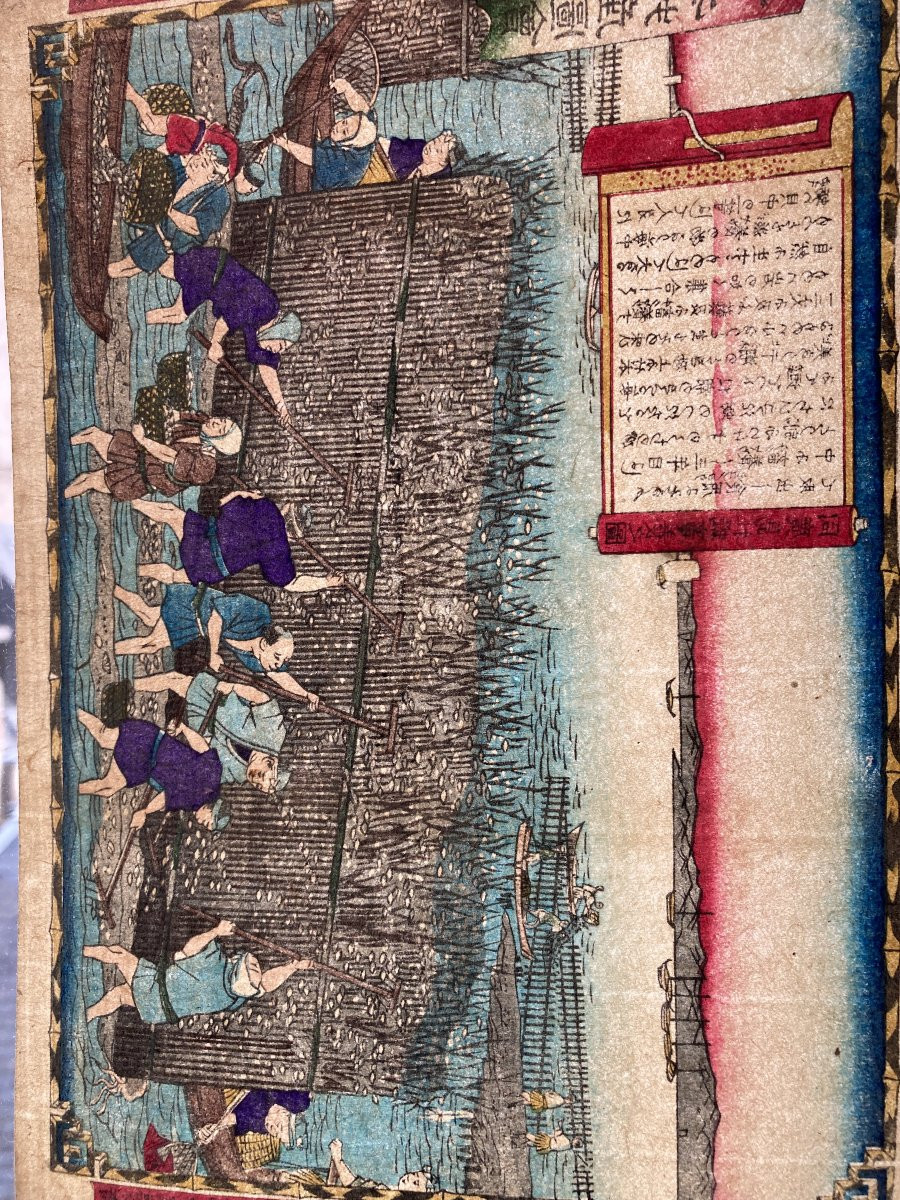
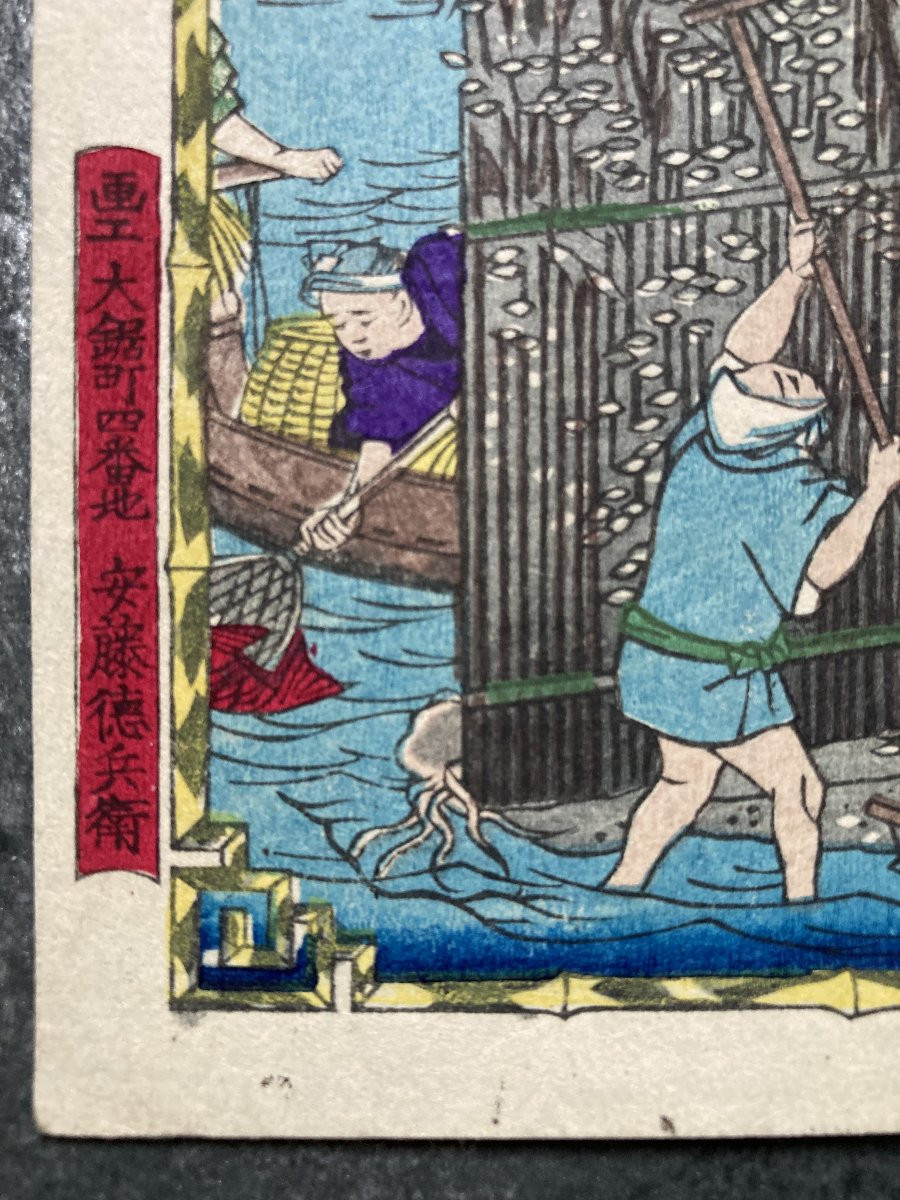
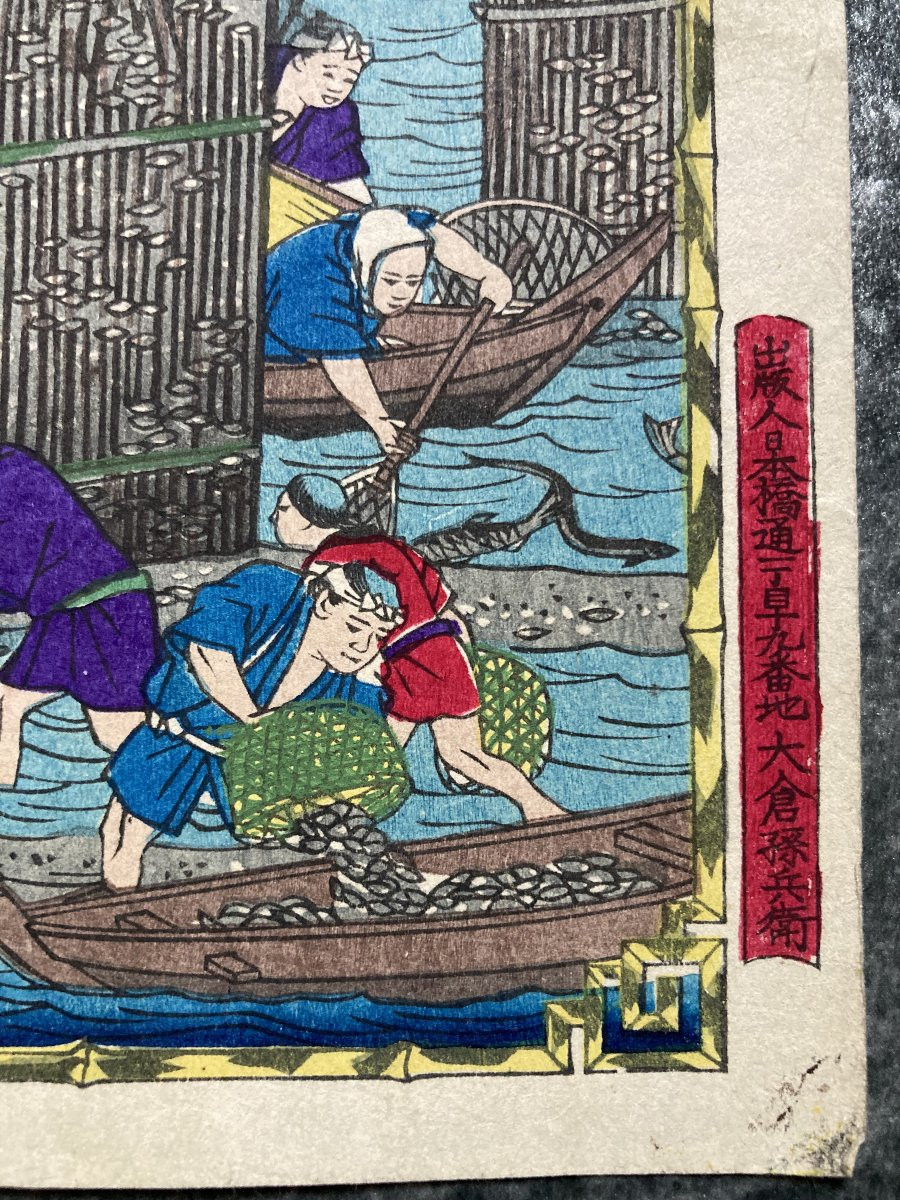
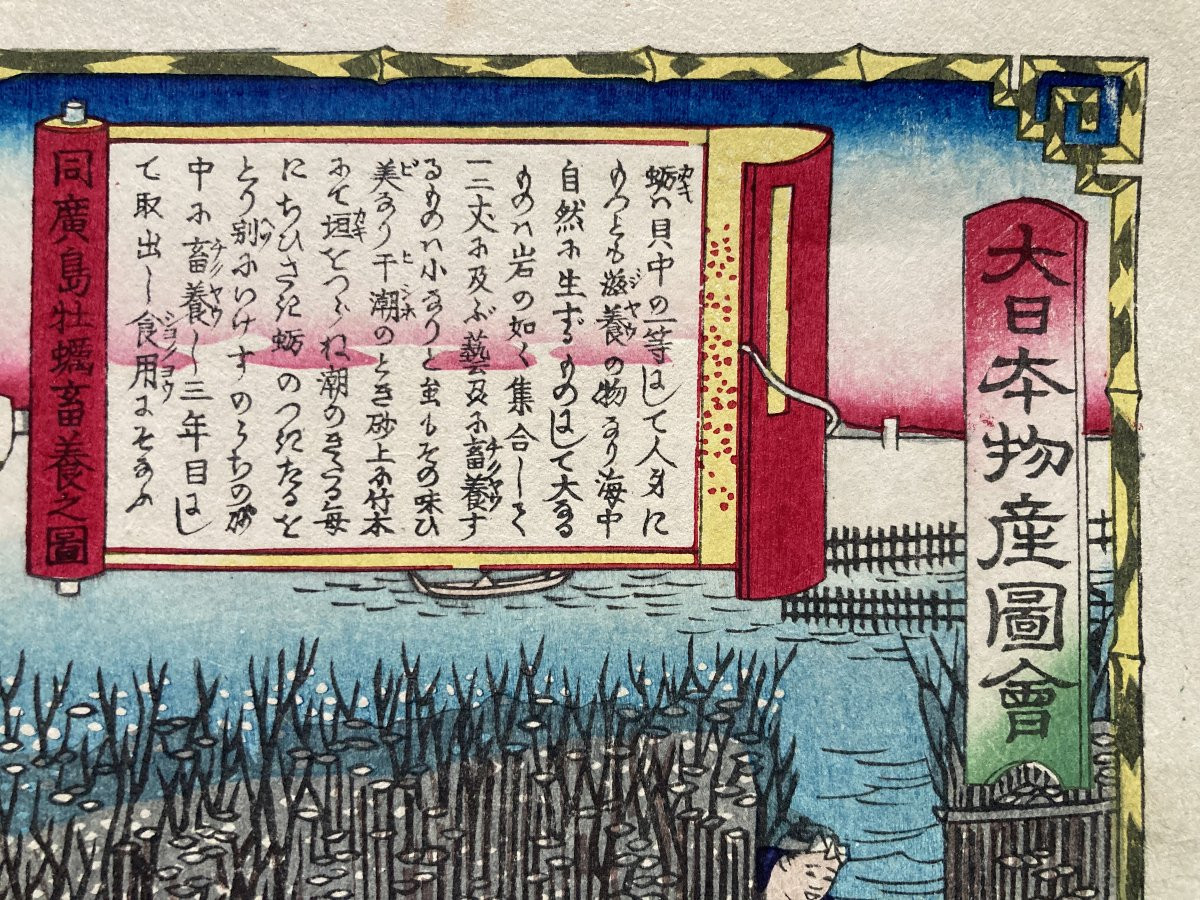
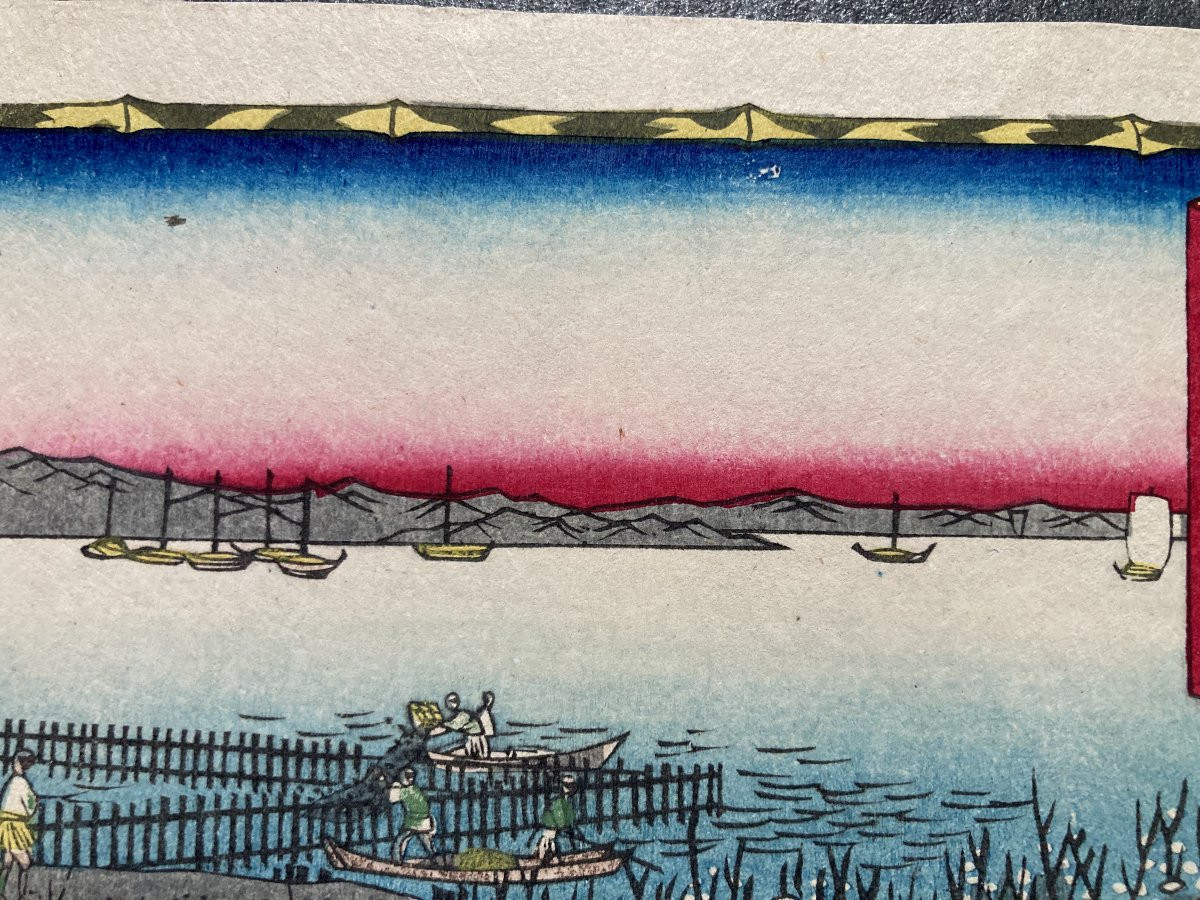
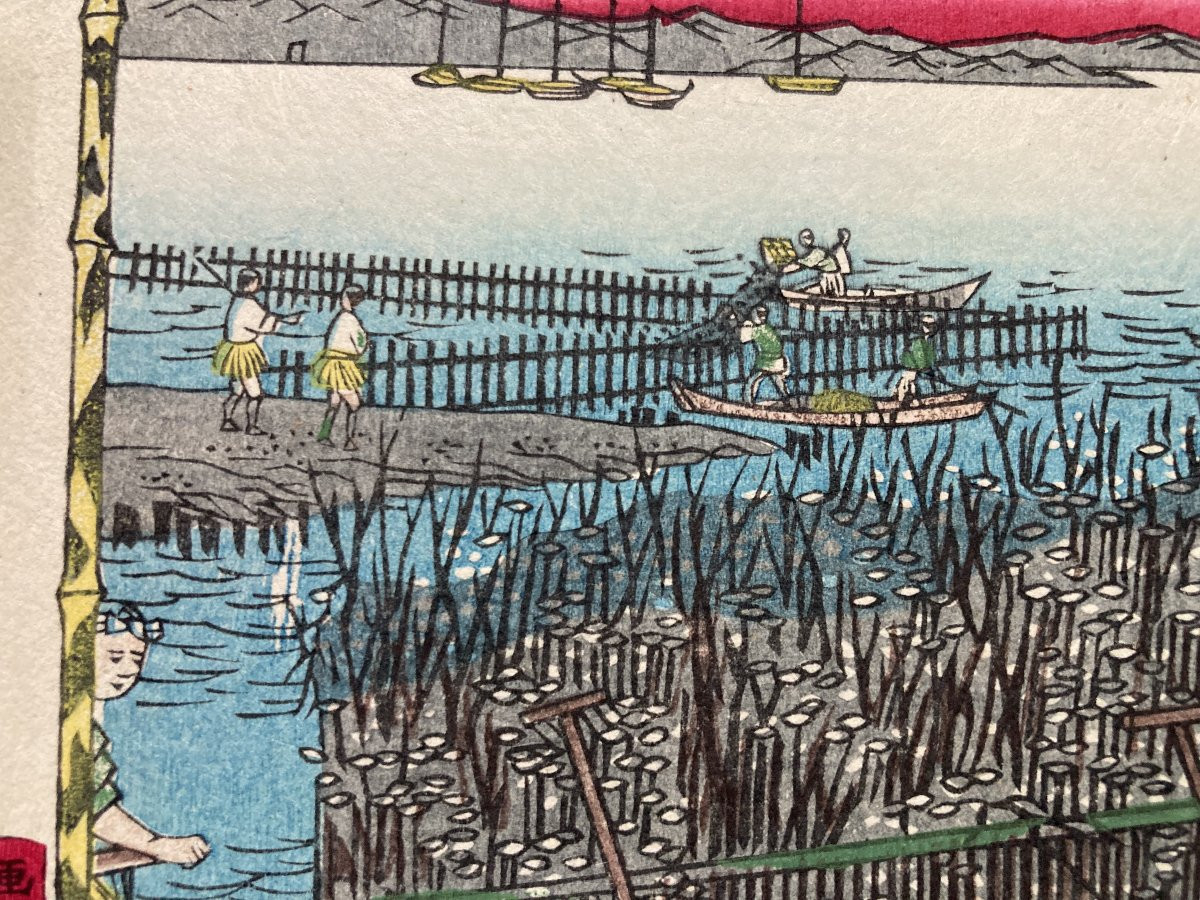
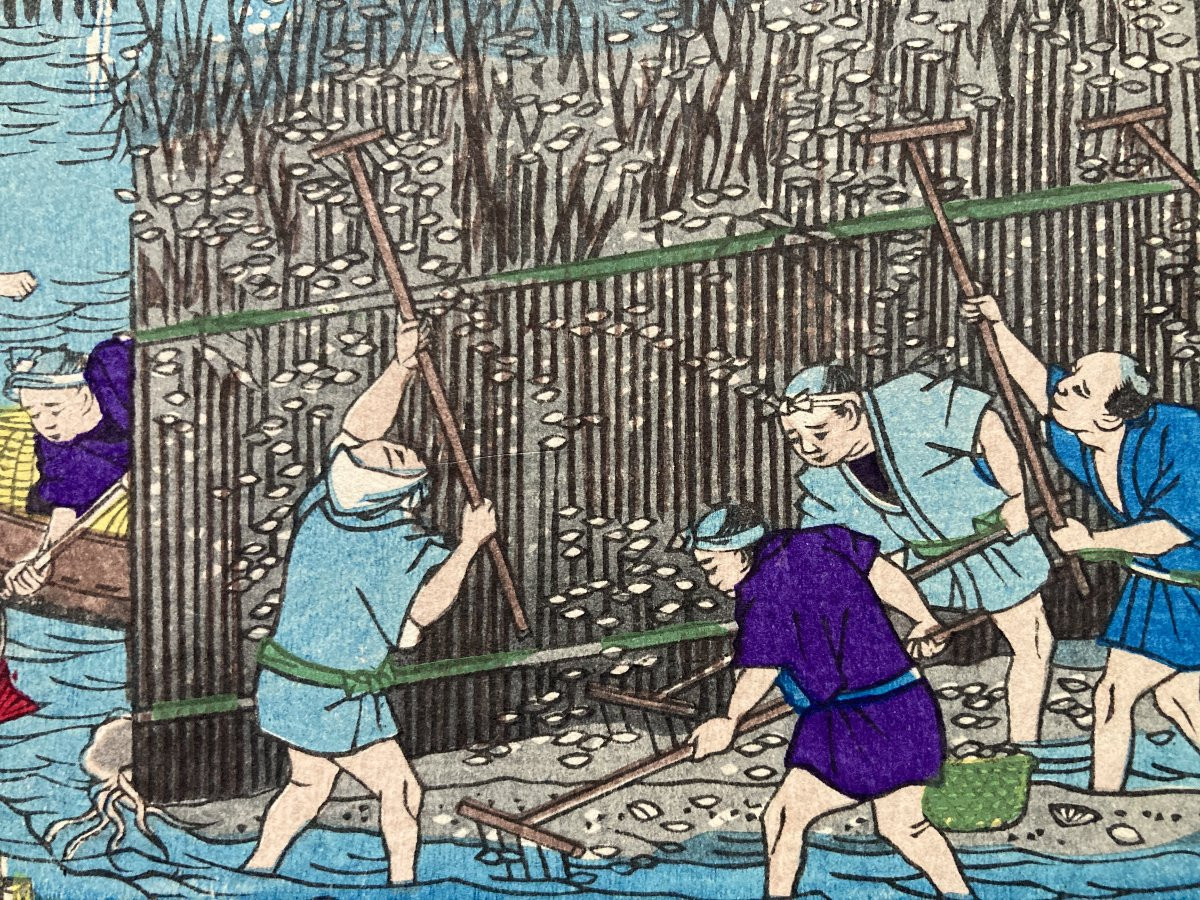
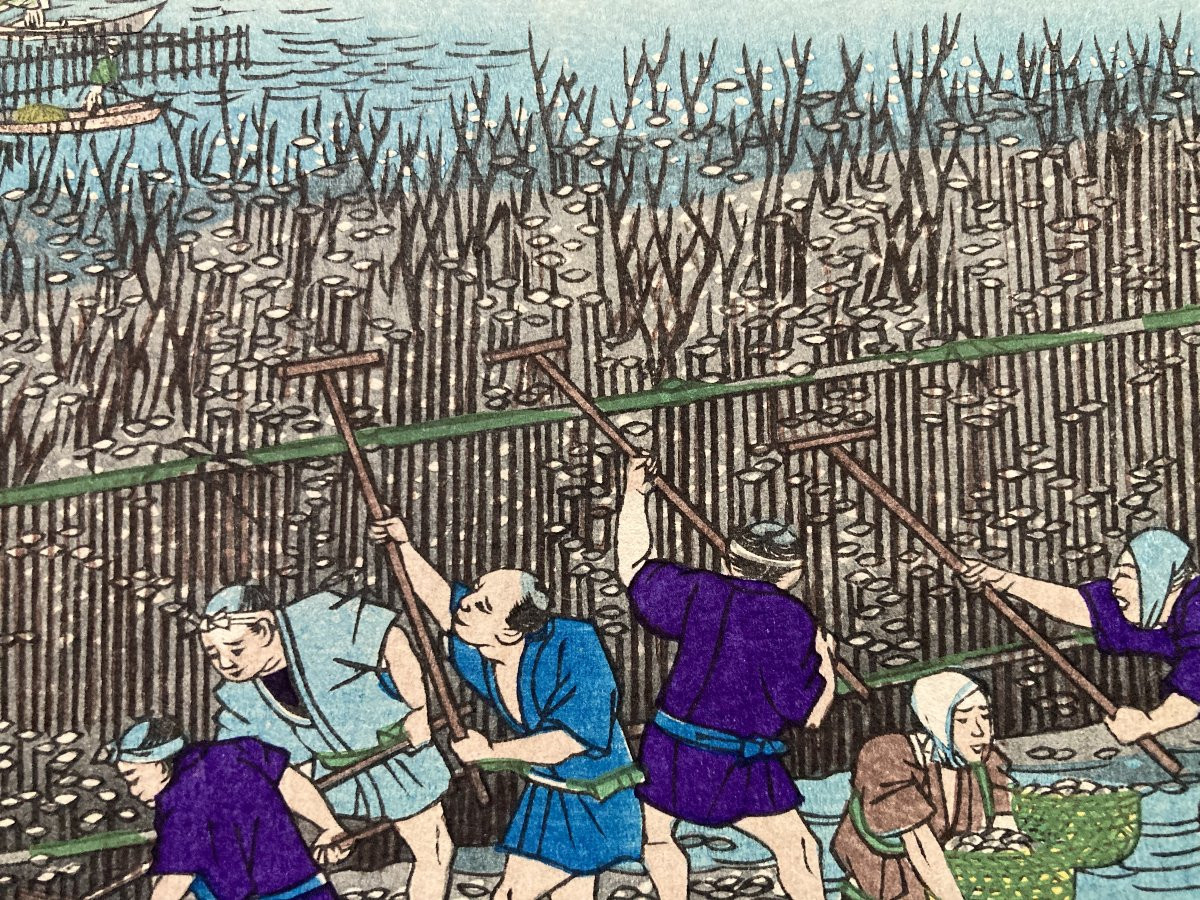
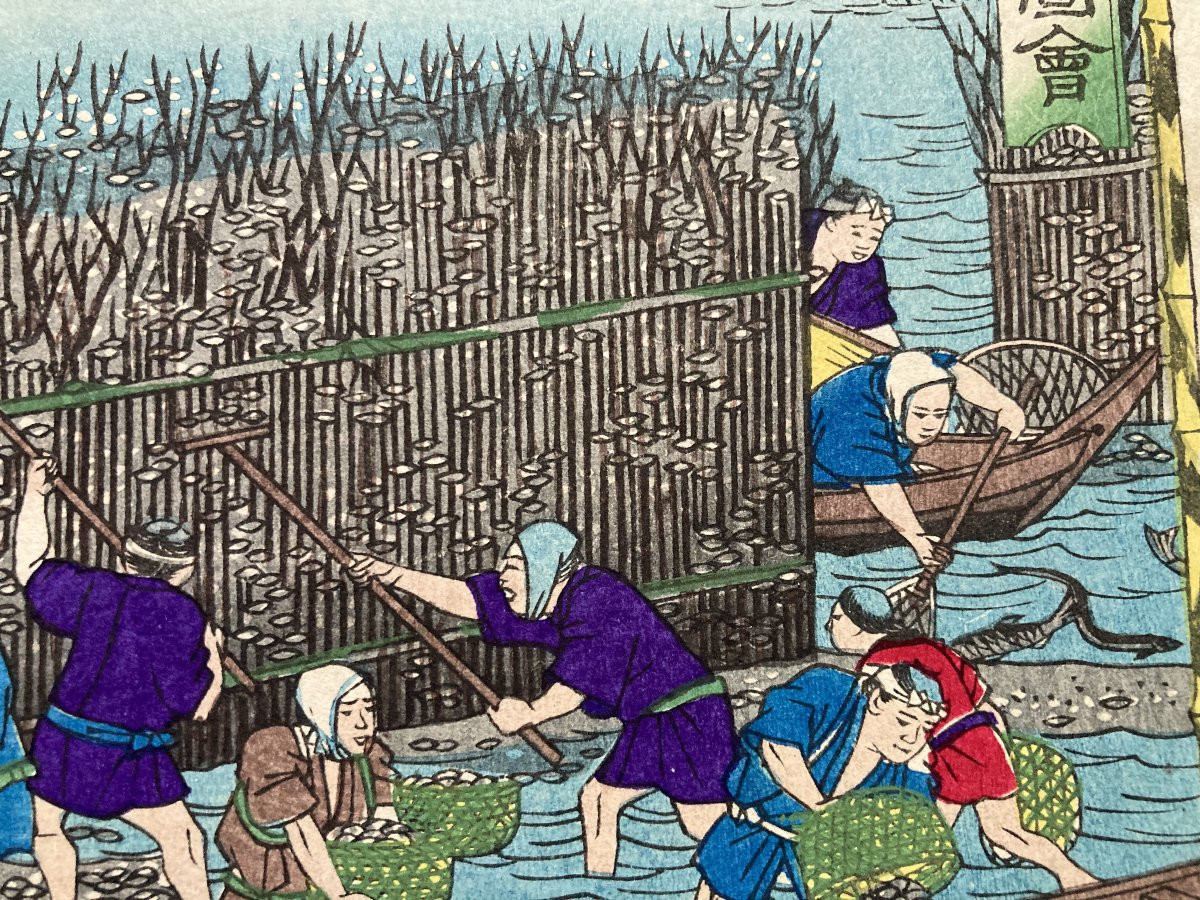
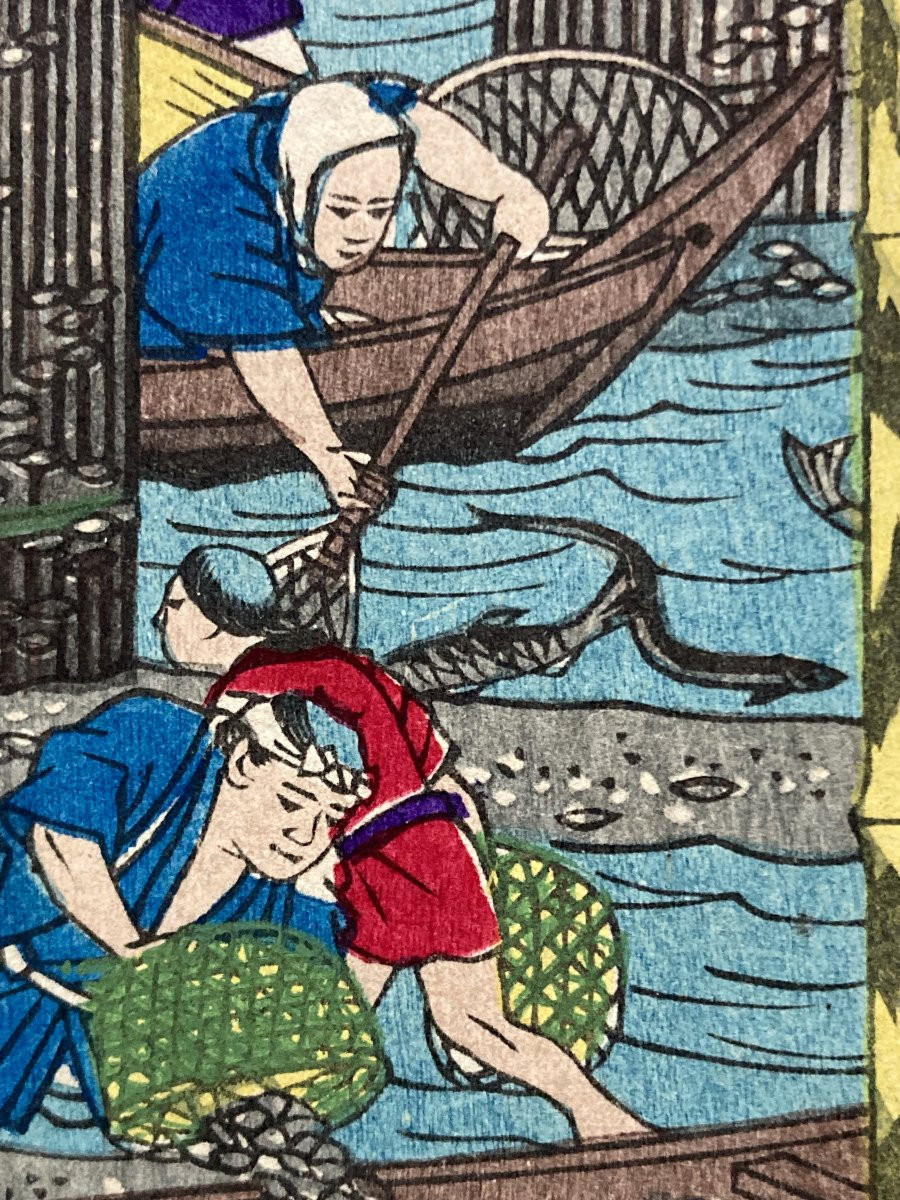
Superb Japanese print in bright colors and typical motifs of the work of Hiroshige III representing an oyster farming scene in the province of Aki (at Hiroshima) around 1870 in Japan. Certain amusing details, such as the fishing scenes with the fish on the right, or what appears to be an octopus in the lower left, also demonstrate the artist's skill and keen eye for detail. Note the very subtle bamboo-effect framing, which demonstrates the master's virtuosity in depicting textures and materials. The print is beautifully fresh with well-defined details; the only minor flaw is a slightly creased lower right corner.
The Bokashi technique, a specific technique of the great Japanese Ukiyo-e workshops, is magnificent in its rendering of the gradations in the sky and water.
"Oyster farming in the west and Nori seaweed farming in the east." Oyster farming began in Hiroshima Bay at the beginning of the Edo period. Since oysters grow naturally on the rocks along the coast of the Inland Sea in South China, someone had the idea of throwing stones into the sea to anchor them there. Later, the Hibitate method was developed: oysters are cultivated by attaching them to bamboo or tree branches placed in coastal mudflats, as illustrated in our print. By the mid-Edo period, oysters were shipped to Osaka on oyster-farming boats, and the region held a monopoly on their trade. Oyster boats would travel to Osaka in the autumn, with oyster farmers mooring their vessels at the foot of bridges on the Okawa and Dotonbori rivers to work either on board or in huts scattered along the banks.
Aki Province (安芸国 Aki no kuni) or Geishū (芸州) was a province in the Chūgoku region of western Honshū, encompassing the western part of present-day Hiroshima Prefecture.
Utagawa Hiroshige III (三代目 歌川 広重) was a 19th-century Japanese painter. Born in 1842 and dying relatively young in 1894, his origins are unknown, and a family connection to Hiroshige Andō and Hiroshige II is highly unlikely. He was not part of the Utagawa school and never used that name. A master of printmaking, disciple and successor of Hiroshige Andō, he took over his master's workshop in 1865. He was, in fact, part of the last generation of ukiyo-e artists, along with Hōen, Kuniteru, Sahahide, and Kunisada II, whose works were chosen by the shogunal government to be exhibited at the 1867 Universal Exposition in Paris.
These works—the famous Japanese prints—were sold locally after the exposition and thus contributed to the first wave of Japonisme in Europe, which was sparked by this event. Like his contemporaries, Hiroshige III enjoyed depicting the innovations of his time with aniline dyes in very pronounced tones. He was very interested in railways (one of the first lines built in Japan connected Tokyo to Yokohama), and in the foreigners who settled in Yokohama from 1868 onwards, and he enjoyed depicting them at leisure, particularly in restaurants.
A valuable document held at the Tokyo National Library and recently made available to scholars is significant: the official records relating to one hundred prints commissioned by the shogunal government for the 1867 Paris Exposition. Fifty of these prints, collected in two albums, depict female figures in various professions, intended to illustrate Japanese customs, while the other half consists of landscapes, primarily views of Edo.
The artists who shared this official commission, chosen from among the best of the time, all belonged to the last generation of ukiyo-e, including Hiroshige III, who created the collection from which our print is taken for this occasion.
Oyster Farming in Hiroshima
Japanese print from the collection Products of Greater Japan 大日本物産圖會, Occupations of the Japanese だいにっぽんぶっさんずえ Dai Nippon bussan zue
1877
Laid paper
Tokyo
Publisher: Ōkura Magobei 大倉孫兵衛
Dimensions: 24.8 x 17.8cm (Chūban)
Superb Japanese print in bright colors and typical motifs of the work of Hiroshige III representing an oyster farming scene in the province of Aki (at Hiroshima) around 1870 in Japan. Certain amusing details, such as the fishing scenes with the fish on the right, or what appears to be an octopus in the lower left, also demonstrate the artist's skill and keen eye for detail. Note the very subtle bamboo-effect framing, which demonstrates the master's virtuosity in depicting textures and materials. The print is beautifully fresh with well-defined details; the only minor flaw is a slightly creased lower right corner.
The Bokashi technique, a specific technique of the great Japanese Ukiyo-e workshops, is magnificent in its rendering of the gradations in the sky and water.
"Oyster farming in the west and Nori seaweed farming in the east." Oyster farming began in Hiroshima Bay at the beginning of the Edo period. Since oysters grow naturally on the rocks along the coast of the Inland Sea in South China, someone had the idea of throwing stones into the sea to anchor them there. Later, the Hibitate method was developed: oysters are cultivated by attaching them to bamboo or tree branches placed in coastal mudflats, as illustrated in our print. By the mid-Edo period, oysters were shipped to Osaka on oyster-farming boats, and the region held a monopoly on their trade. Oyster boats would travel to Osaka in the autumn, with oyster farmers mooring their vessels at the foot of bridges on the Okawa and Dotonbori rivers to work either on board or in huts scattered along the banks.
Aki Province (安芸国 Aki no kuni) or Geishū (芸州) was a province in the Chūgoku region of western Honshū, encompassing the western part of present-day Hiroshima Prefecture.
Utagawa Hiroshige III (三代目 歌川 広重) was a 19th-century Japanese painter. Born in 1842 and dying relatively young in 1894, his origins are unknown, and a family connection to Hiroshige Andō and Hiroshige II is highly unlikely. He was not part of the Utagawa school and never used that name. A master of printmaking, disciple and successor of Hiroshige Andō, he took over his master's workshop in 1865. He was, in fact, part of the last generation of ukiyo-e artists, along with Hōen, Kuniteru, Sahahide, and Kunisada II, whose works were chosen by the shogunal government to be exhibited at the 1867 Universal Exposition in Paris.
These works—the famous Japanese prints—were sold locally after the exposition and thus contributed to the first wave of Japonisme in Europe, which was sparked by this event. Like his contemporaries, Hiroshige III enjoyed depicting the innovations of his time with aniline dyes in very pronounced tones. He was very interested in railways (one of the first lines built in Japan connected Tokyo to Yokohama), and in the foreigners who settled in Yokohama from 1868 onwards, and he enjoyed depicting them at leisure, particularly in restaurants.
A valuable document held at the Tokyo National Library and recently made available to scholars is significant: the official records relating to one hundred prints commissioned by the shogunal government for the 1867 Paris Exposition. Fifty of these prints, collected in two albums, depict female figures in various professions, intended to illustrate Japanese customs, while the other half consists of landscapes, primarily views of Edo.
The artists who shared this official commission, chosen from among the best of the time, all belonged to the last generation of ukiyo-e, including Hiroshige III, who created the collection from which our print is taken for this occasion.
Explore similar pieces and discover your ideal find:
Prints (Relief, Intaglio)