THIS OBJECT WAS SOLD
Nakayama Sūgakudō (active 1850-1870), Woodpecker And Erythronium Japonicum, Japanese Print 1859


Nakayama SŪGAKUDŌ (active 1850-1870)
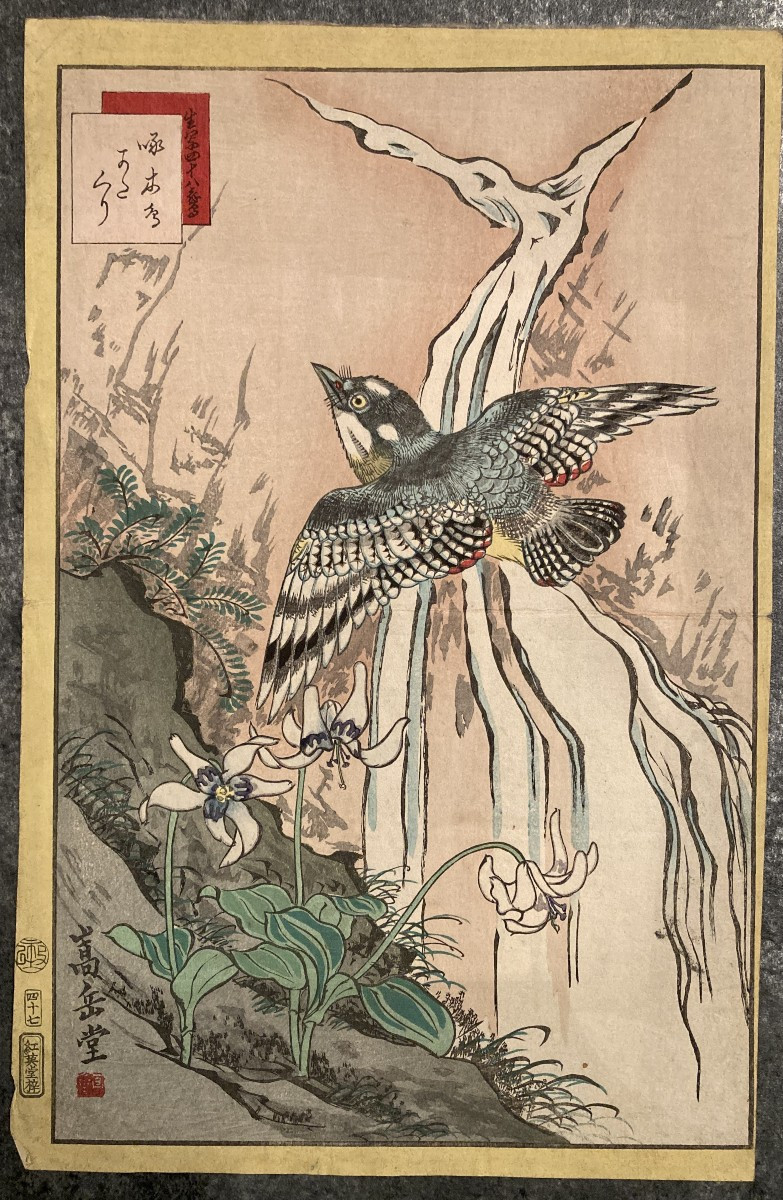
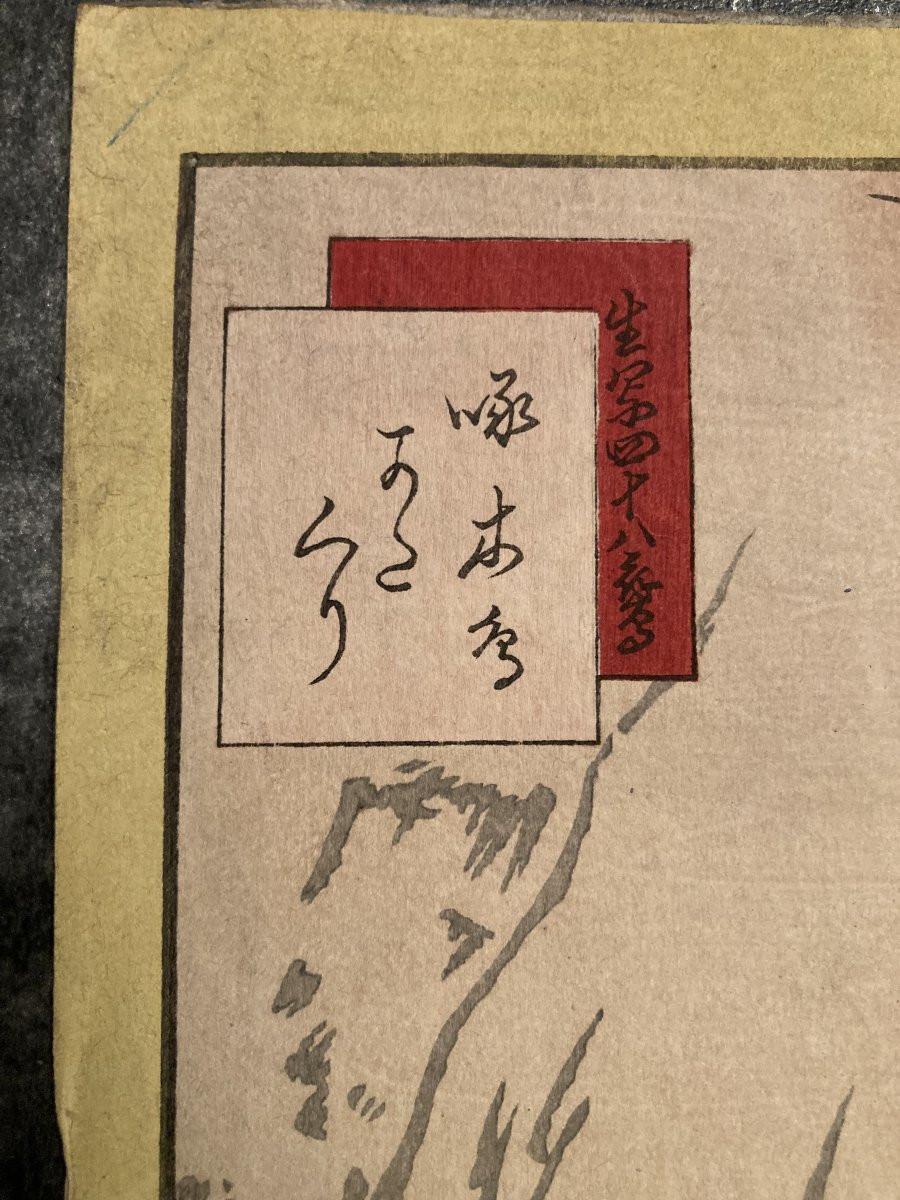
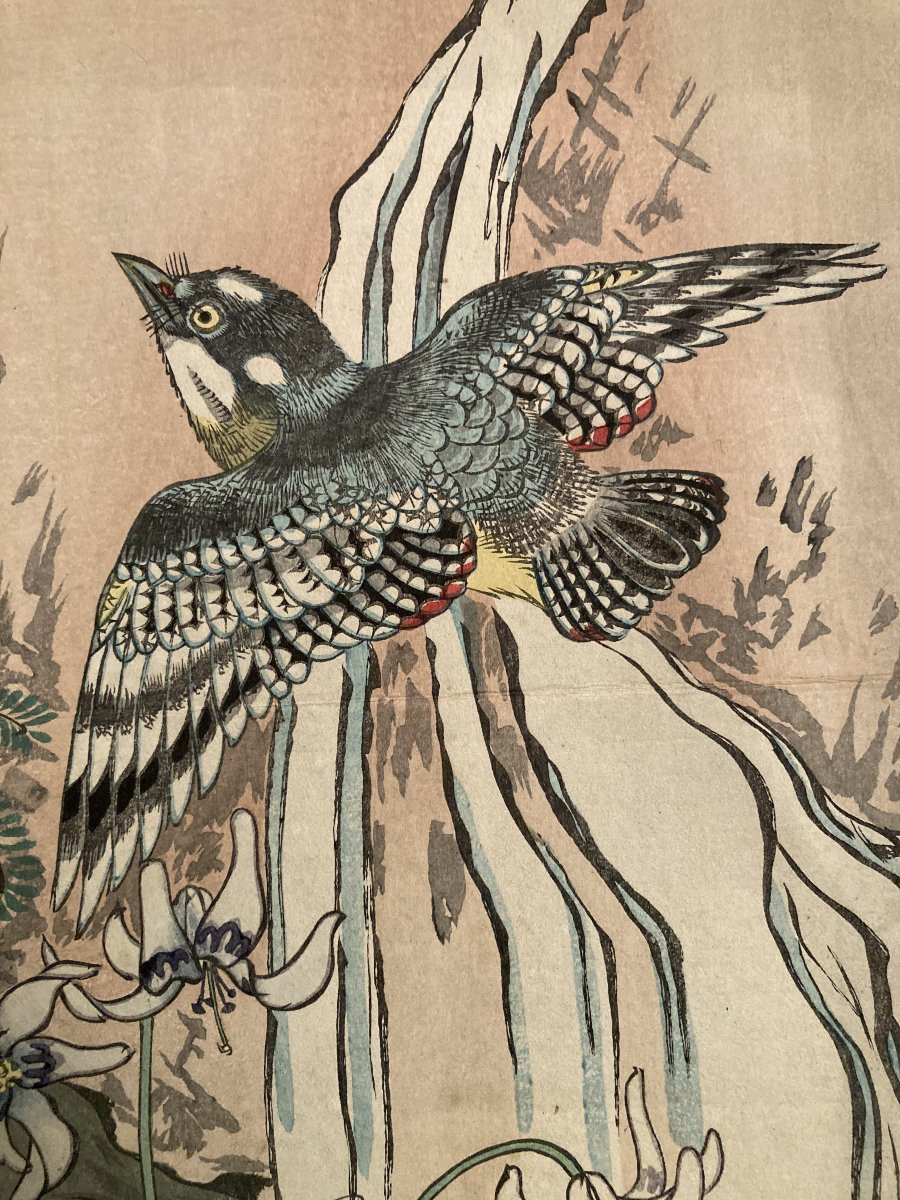
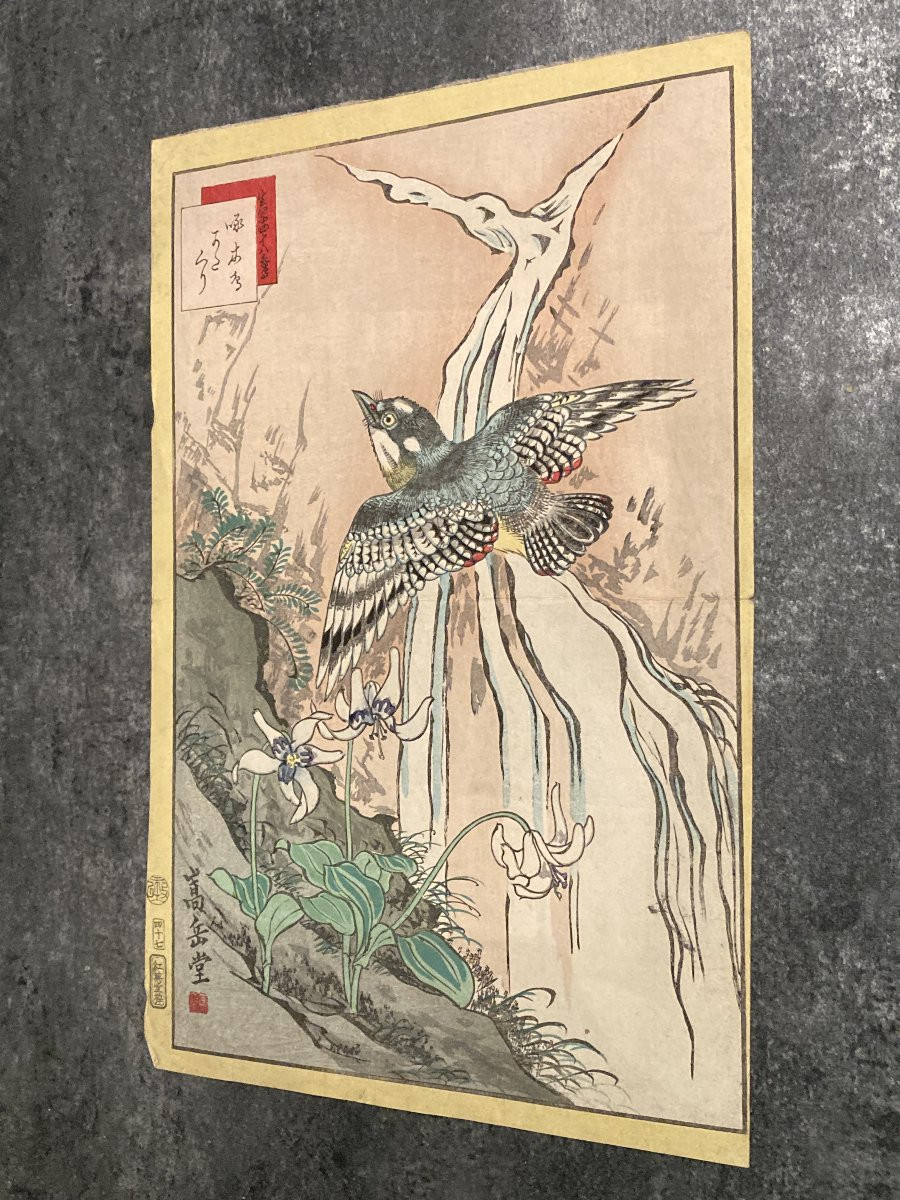
Woodpecker and Erythronium japonicum (Kitsutsuki katakuri)
Japanese woodblock print from the 1859 collection "Forty-Eight Birds Drawn from Nature"
1859
Laid Paper
Edo Period (Tokyo)
Publisher: Tsutaya Kichizō
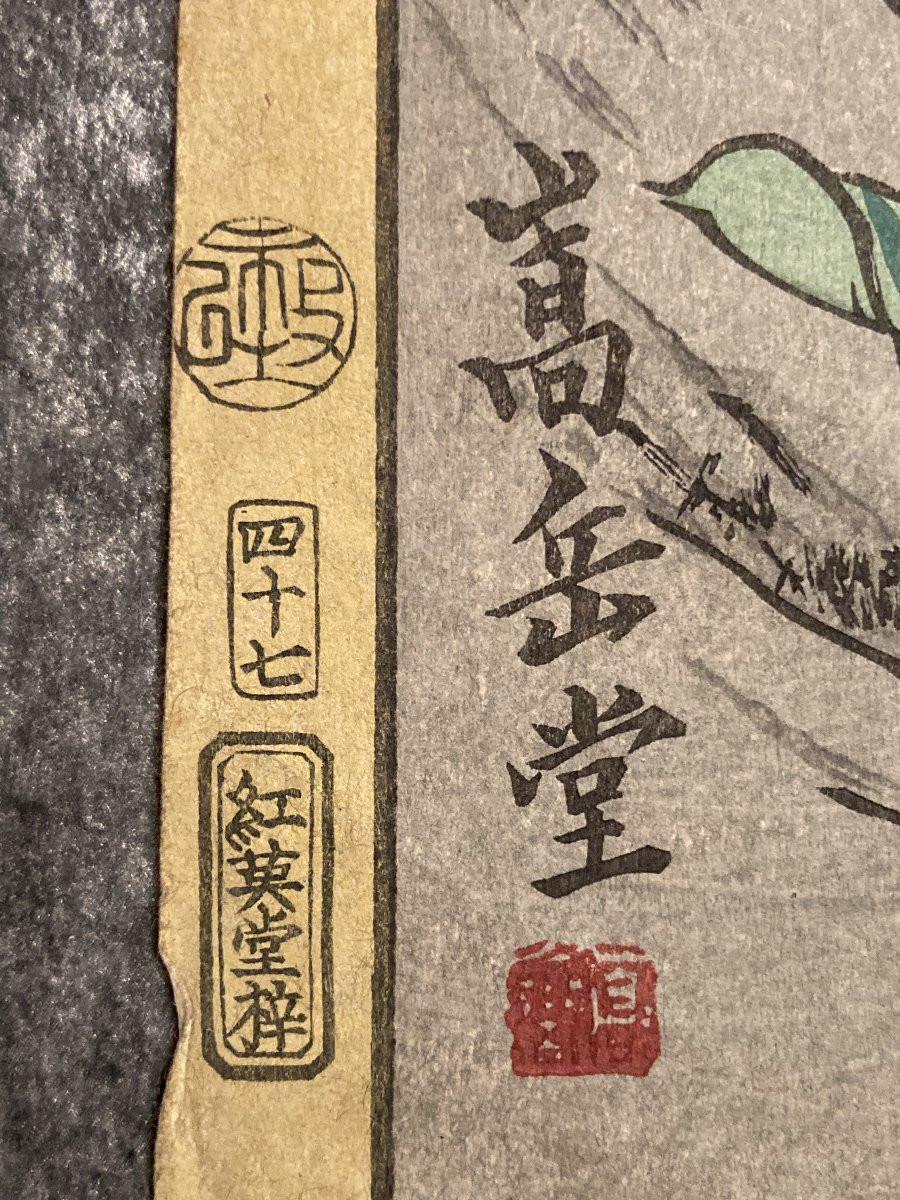
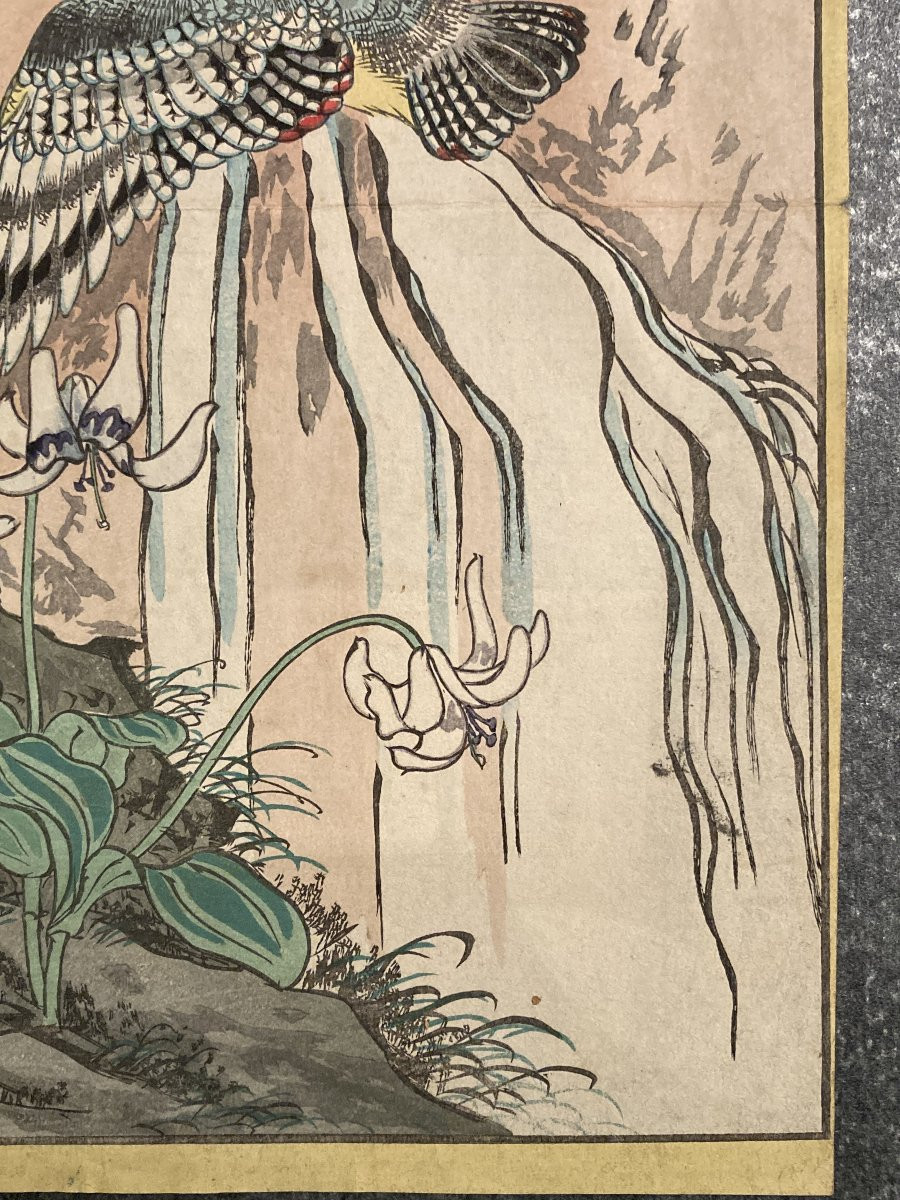
Publisher's Seal | Censor's Seal: Koeido Han | Aratame: Date seal in the lower left corner of the print
Dimensions: 37.5 x 23.4 cm (Ōban)
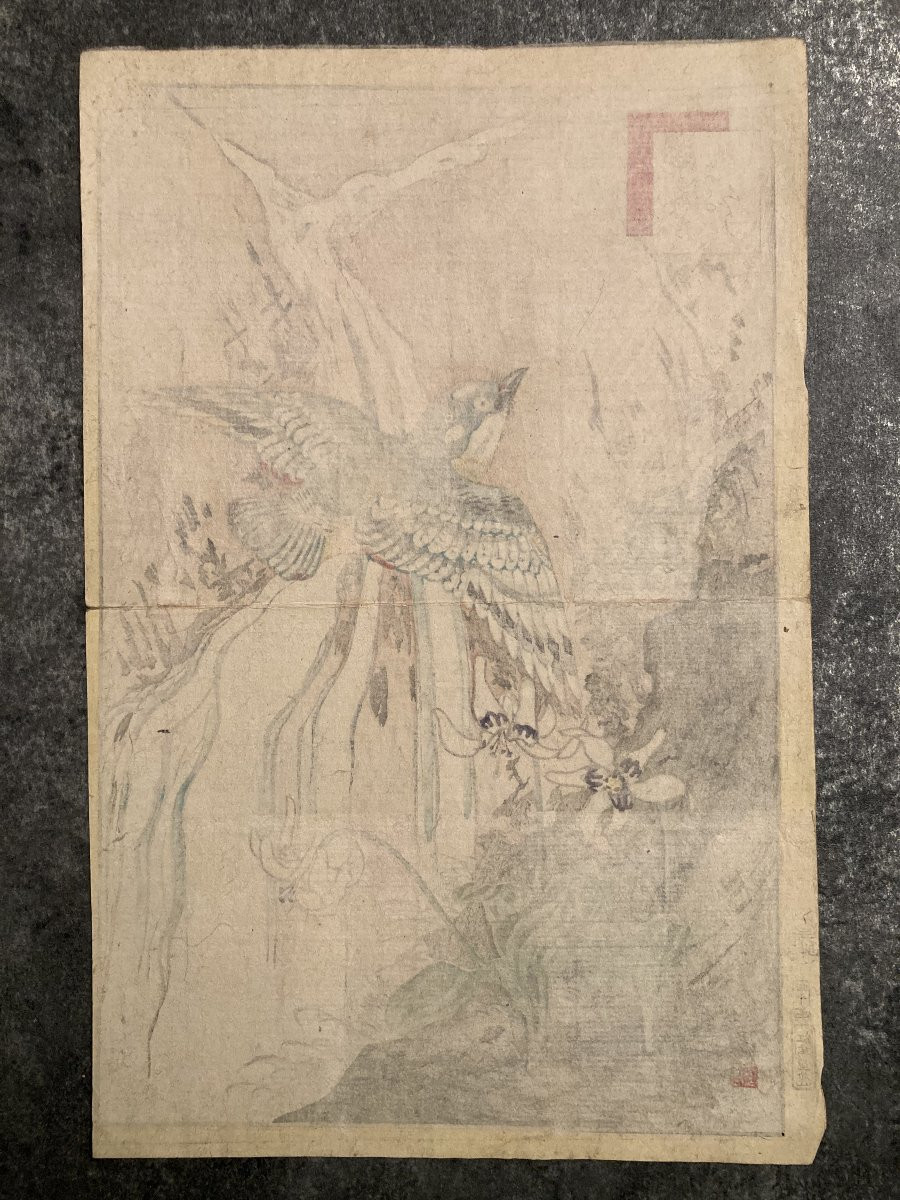
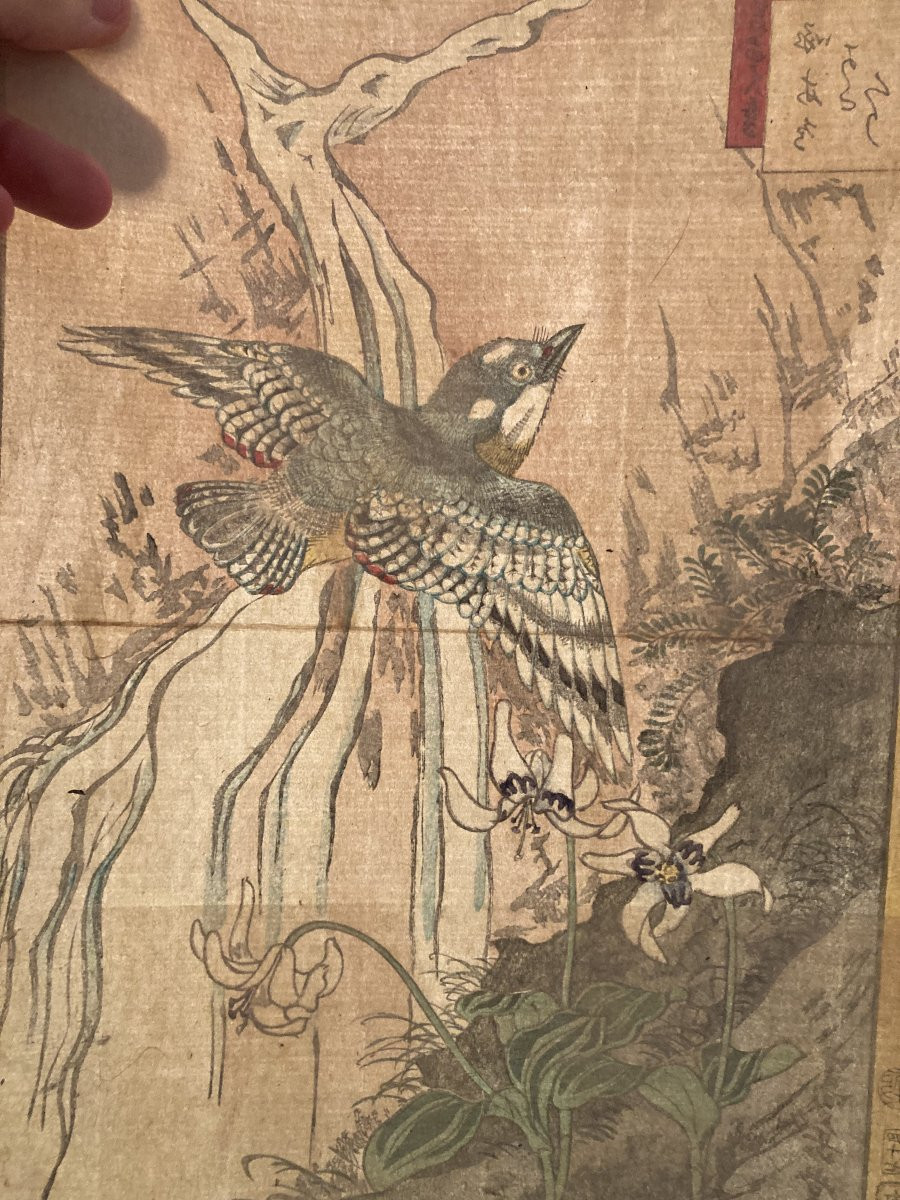
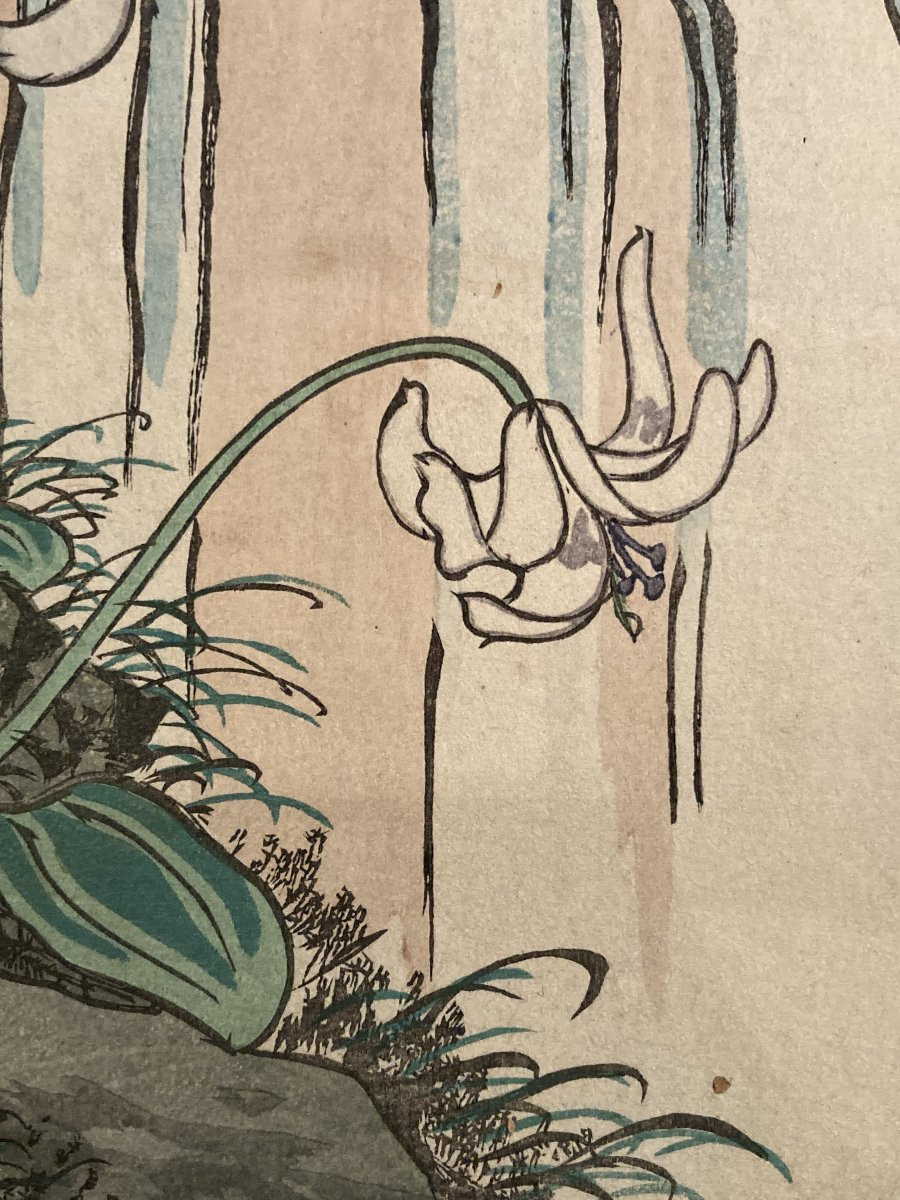
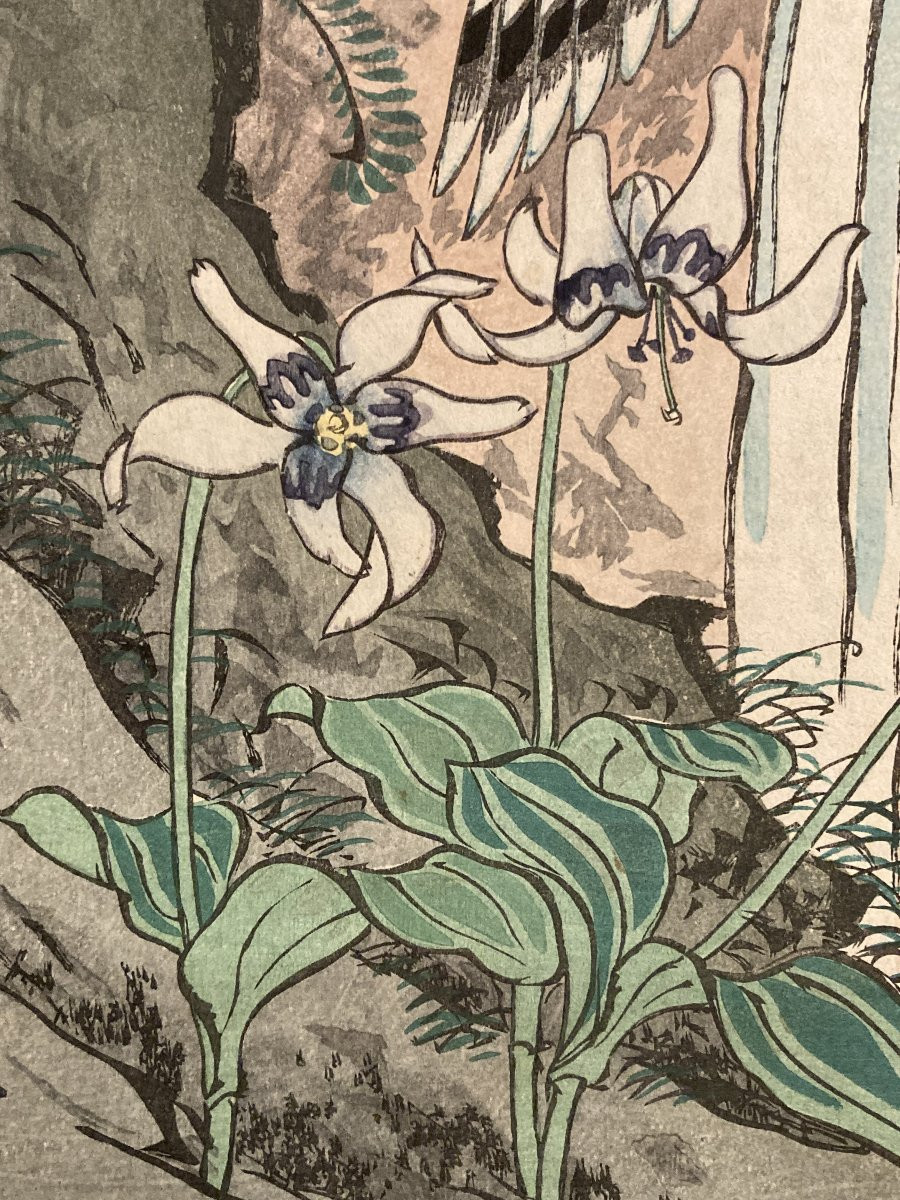
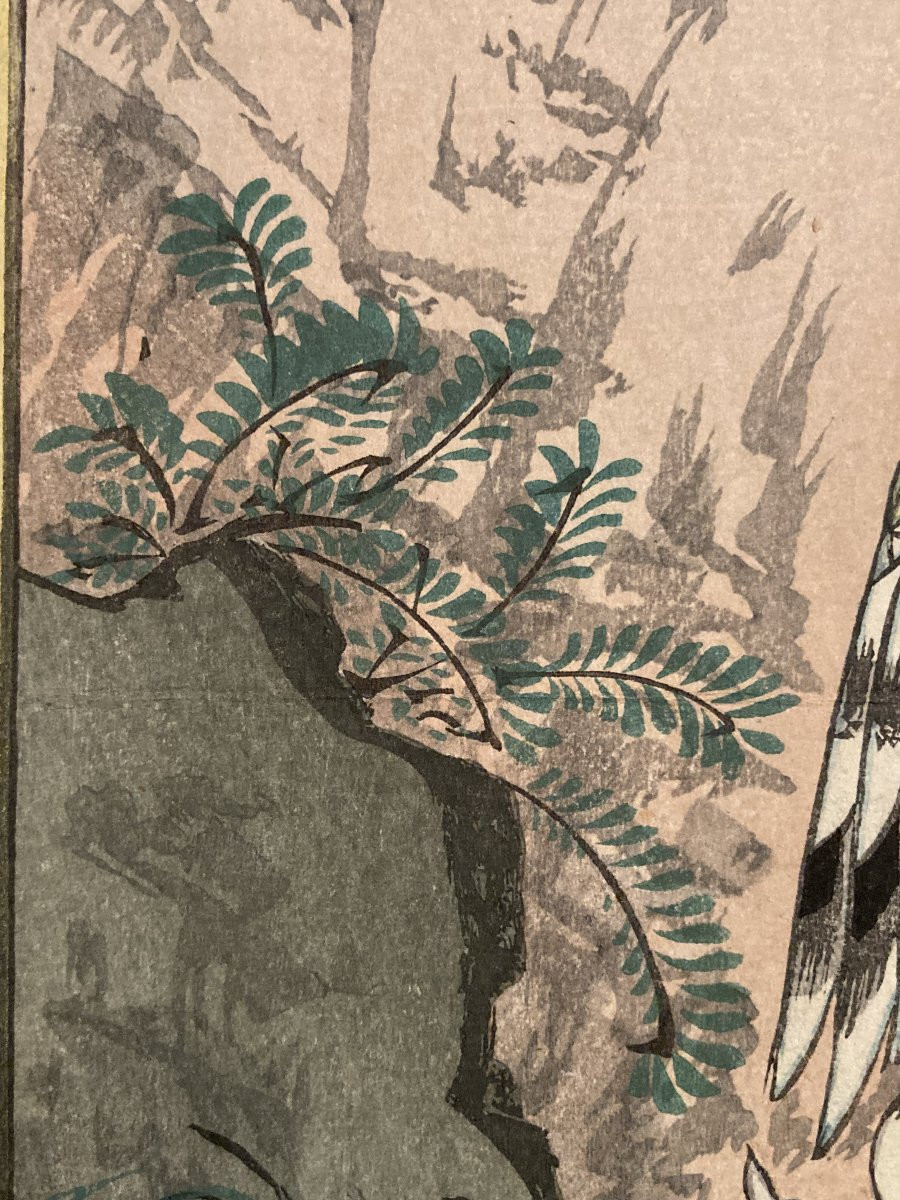
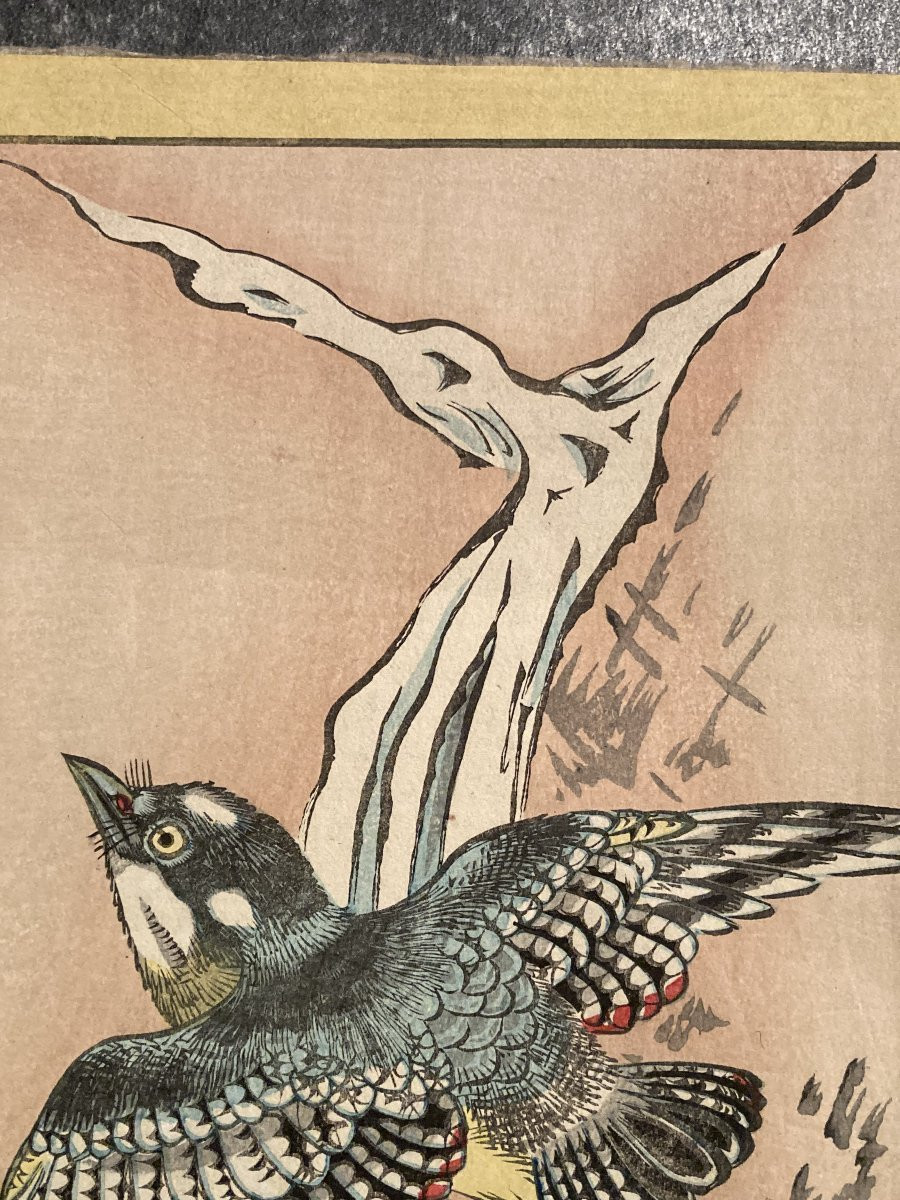
Superb Japanese print displaying all the beauty of Ukiyo-e art, with vibrant, still-fresh colors and an elegant motif of a woodpecker flying at the edge of a waterfall and above Katakuri or Japanese Dog's-Tooth (Erythronium Japonicum). It is in good condition despite a few minor details: the central crease, characteristic of this period; the lower left corner, which has some tiny losses and creases; and the right margin, which thins towards the bottom and is not trimmed straight.
We know very little about the artist Nakayama Sūgakudō, who was active in Tokyo between 1850 and 1870. His real name was Nakayama Akinao, and most essential biographical details, such as his birth and death dates, are unknown, adding to the mystery and legend surrounding the artist. He trained under the painter Tazaki Sōun, a member of the Nanga or Bunjinga school, a refined style of painting primarily focused on landscape and heavily influenced by ink painting, characterized by great freedom of line.
Tazaki Sōun was Nakayama Sūgakudō, himself a disciple of the renowned painter of this school, Tani Bunchō, produced most of his work in the 1850s and 1860s, a period coinciding with the rise of the great landscape painter Utagawa Hiroshige (1797-1858), whose heir he is considered to be. Hiroshige had captivated the public with his views of famous places (meisho) and other nature scenes.
Nakayama Sūgakudō specialized in the refined genre of kachō-e, that is, natural scenes featuring birds and flowers. His major work is considered to be the series of forty-eight bird prints titled Ikiutsushi shijūhachi taka (1859), published by Tsutaya Kichizō of the Kōeidō publishing house, where the influence of his teacher, Tazaki Sōun, is evident and perceptible.
Our print is part of this collection, a rare testimony of the period regarding the artistic and ornithological habits of Japan, and whose publication also proves the interest of such subjects for buyers, whether collectors, local enthusiasts, or even foreigners who facilitated its dissemination as far as France, as exemplified by our print.
Sūgakudō's main strength lies in the composition of his natural scenes depicting birds in relation to the vegetation that constitutes their habitat, as well as seasonal elements characteristic of each species. In this sense, the series is very varied—with scenes of spring, summer, autumn, and winter—and recognizable at first glance thanks to the characteristic yellow border.
Stylistically, he is a faithful disciple of Hiroshige, with well-constructed compositions, precise drawing, and intense yet harmonious colors. Although these prints are intended for contemplation, they could certainly be used for ornithological study, due to the precision with which the plumage and anatomical details of each specimen are depicted.
His work has not been particularly appreciated by critics, perhaps because it falls somewhere between the attractive kachō-e compositions of the ukiyo-e landscape painters of the Edo period (1603-1868), such as the aforementioned Hiroshige, and the more specialized naturalist painters of the Meiji era (1868-1912), such as Kōno Bairei (1844-1895), who published extensive albums, sparing no effort, for a more demanding public.
Woodpecker and Erythronium japonicum (Kitsutsuki katakuri)
Japanese woodblock print from the 1859 collection "Forty-Eight Birds Drawn from Nature"
1859
Laid Paper
Edo Period (Tokyo)
Publisher: Tsutaya Kichizō
Publisher's Seal | Censor's Seal: Koeido Han | Aratame: Date seal in the lower left corner of the print
Dimensions: 37.5 x 23.4 cm (Ōban)
Superb Japanese print displaying all the beauty of Ukiyo-e art, with vibrant, still-fresh colors and an elegant motif of a woodpecker flying at the edge of a waterfall and above Katakuri or Japanese Dog's-Tooth (Erythronium Japonicum). It is in good condition despite a few minor details: the central crease, characteristic of this period; the lower left corner, which has some tiny losses and creases; and the right margin, which thins towards the bottom and is not trimmed straight.
We know very little about the artist Nakayama Sūgakudō, who was active in Tokyo between 1850 and 1870. His real name was Nakayama Akinao, and most essential biographical details, such as his birth and death dates, are unknown, adding to the mystery and legend surrounding the artist. He trained under the painter Tazaki Sōun, a member of the Nanga or Bunjinga school, a refined style of painting primarily focused on landscape and heavily influenced by ink painting, characterized by great freedom of line.
Tazaki Sōun was Nakayama Sūgakudō, himself a disciple of the renowned painter of this school, Tani Bunchō, produced most of his work in the 1850s and 1860s, a period coinciding with the rise of the great landscape painter Utagawa Hiroshige (1797-1858), whose heir he is considered to be. Hiroshige had captivated the public with his views of famous places (meisho) and other nature scenes.
Nakayama Sūgakudō specialized in the refined genre of kachō-e, that is, natural scenes featuring birds and flowers. His major work is considered to be the series of forty-eight bird prints titled Ikiutsushi shijūhachi taka (1859), published by Tsutaya Kichizō of the Kōeidō publishing house, where the influence of his teacher, Tazaki Sōun, is evident and perceptible.
Our print is part of this collection, a rare testimony of the period regarding the artistic and ornithological habits of Japan, and whose publication also proves the interest of such subjects for buyers, whether collectors, local enthusiasts, or even foreigners who facilitated its dissemination as far as France, as exemplified by our print.
Sūgakudō's main strength lies in the composition of his natural scenes depicting birds in relation to the vegetation that constitutes their habitat, as well as seasonal elements characteristic of each species. In this sense, the series is very varied—with scenes of spring, summer, autumn, and winter—and recognizable at first glance thanks to the characteristic yellow border.
Stylistically, he is a faithful disciple of Hiroshige, with well-constructed compositions, precise drawing, and intense yet harmonious colors. Although these prints are intended for contemplation, they could certainly be used for ornithological study, due to the precision with which the plumage and anatomical details of each specimen are depicted.
His work has not been particularly appreciated by critics, perhaps because it falls somewhere between the attractive kachō-e compositions of the ukiyo-e landscape painters of the Edo period (1603-1868), such as the aforementioned Hiroshige, and the more specialized naturalist painters of the Meiji era (1868-1912), such as Kōno Bairei (1844-1895), who published extensive albums, sparing no effort, for a more demanding public.
Explore similar pieces and discover your ideal find:
Prints (Relief, Intaglio)