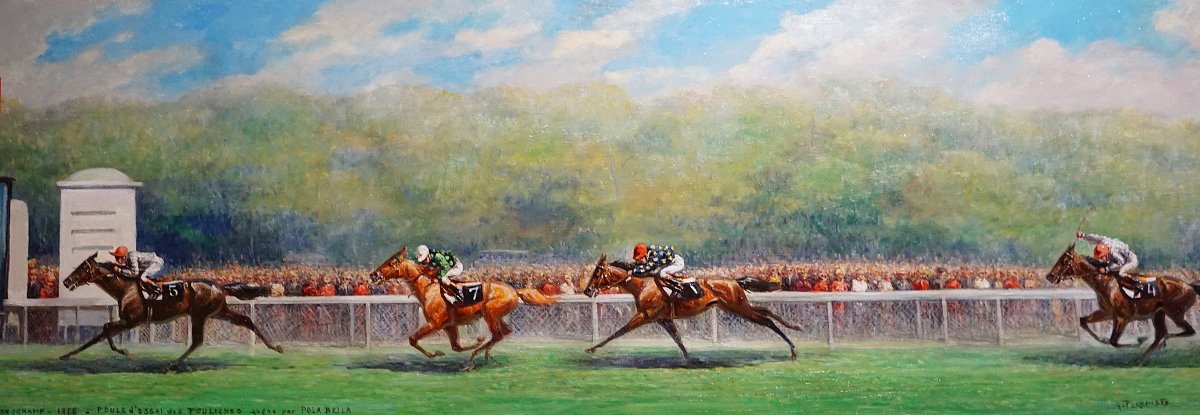
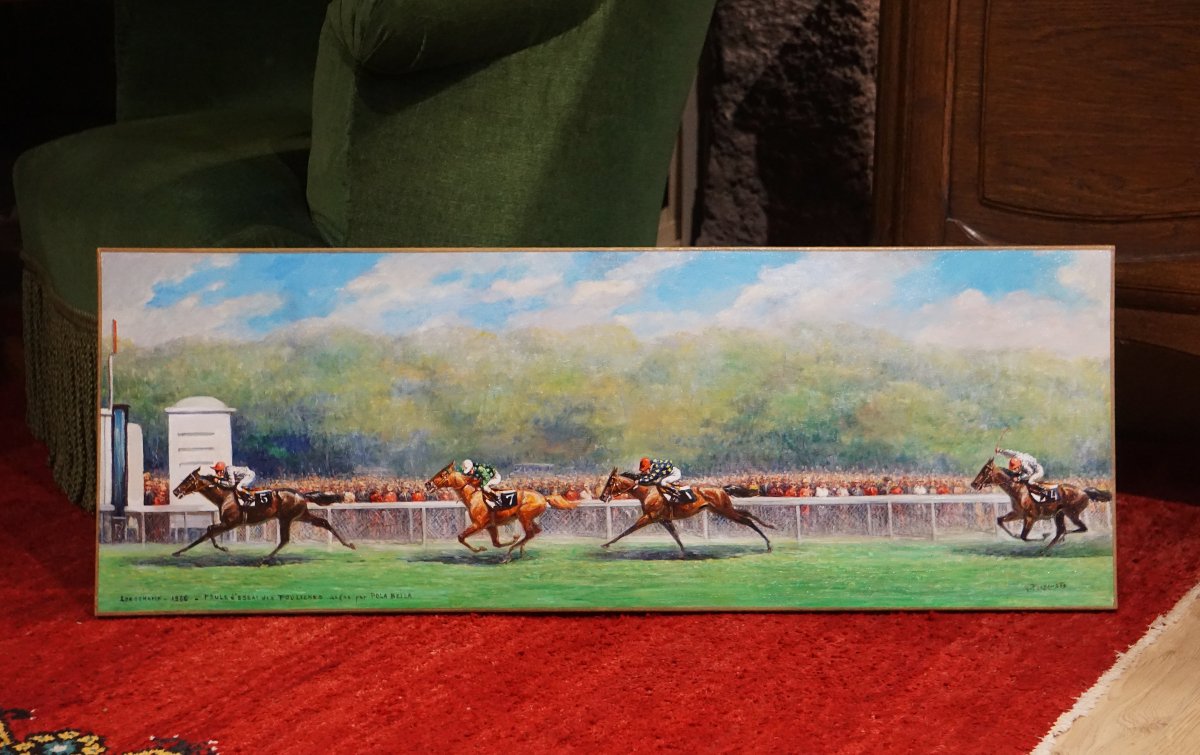
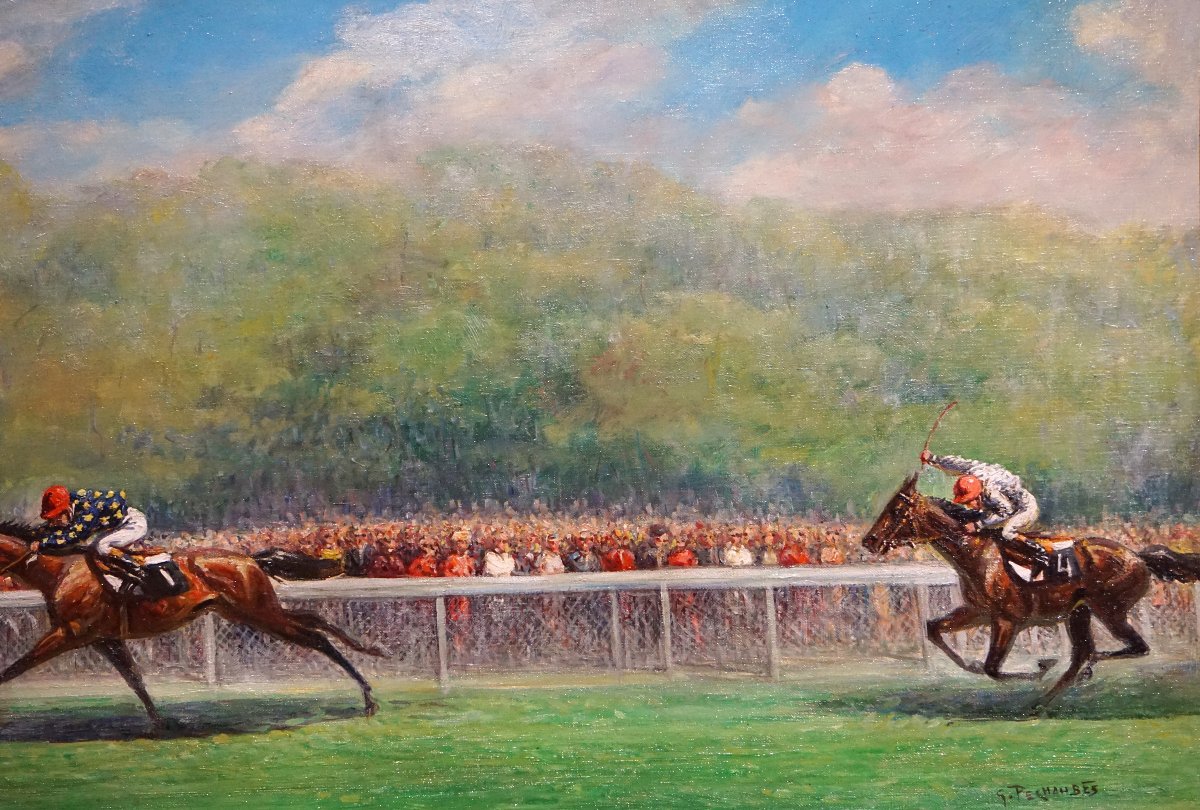


Longchamp 1968 / Major Horse Race – Poule d'Essai Des Pouliches / Pechaubes
Artist: Pechaubes
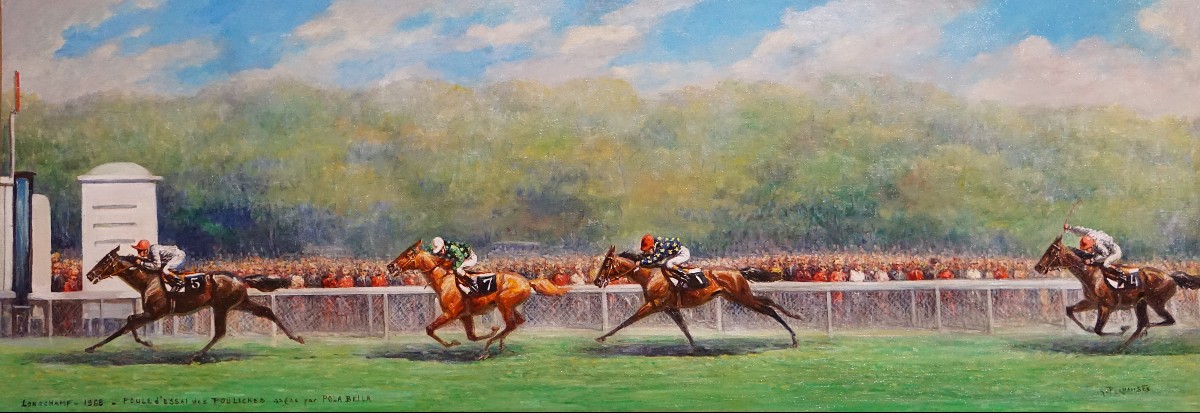
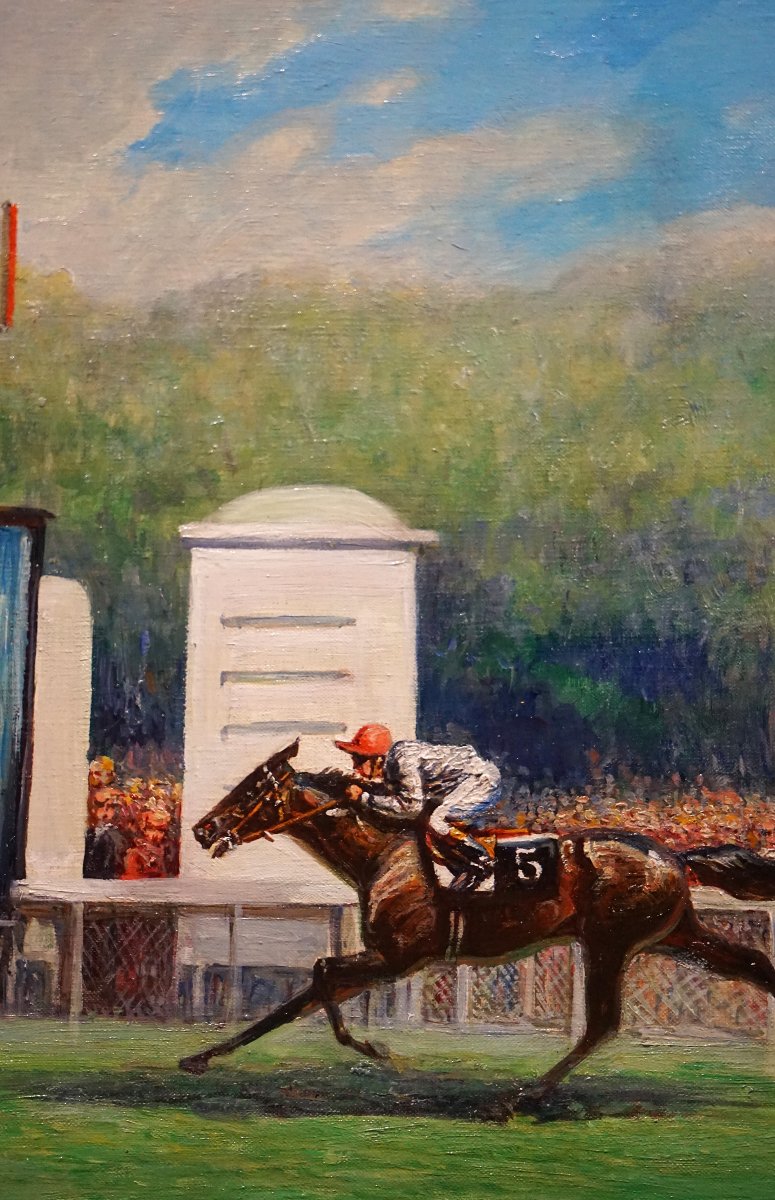
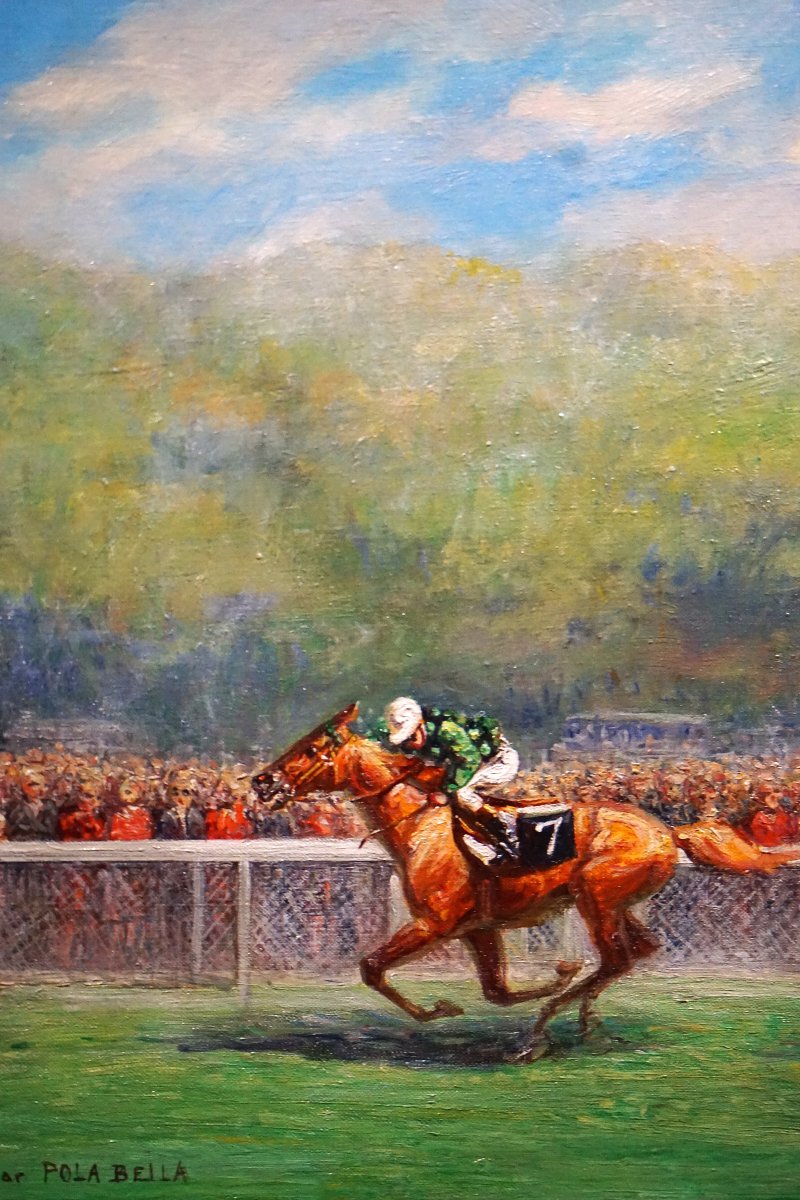
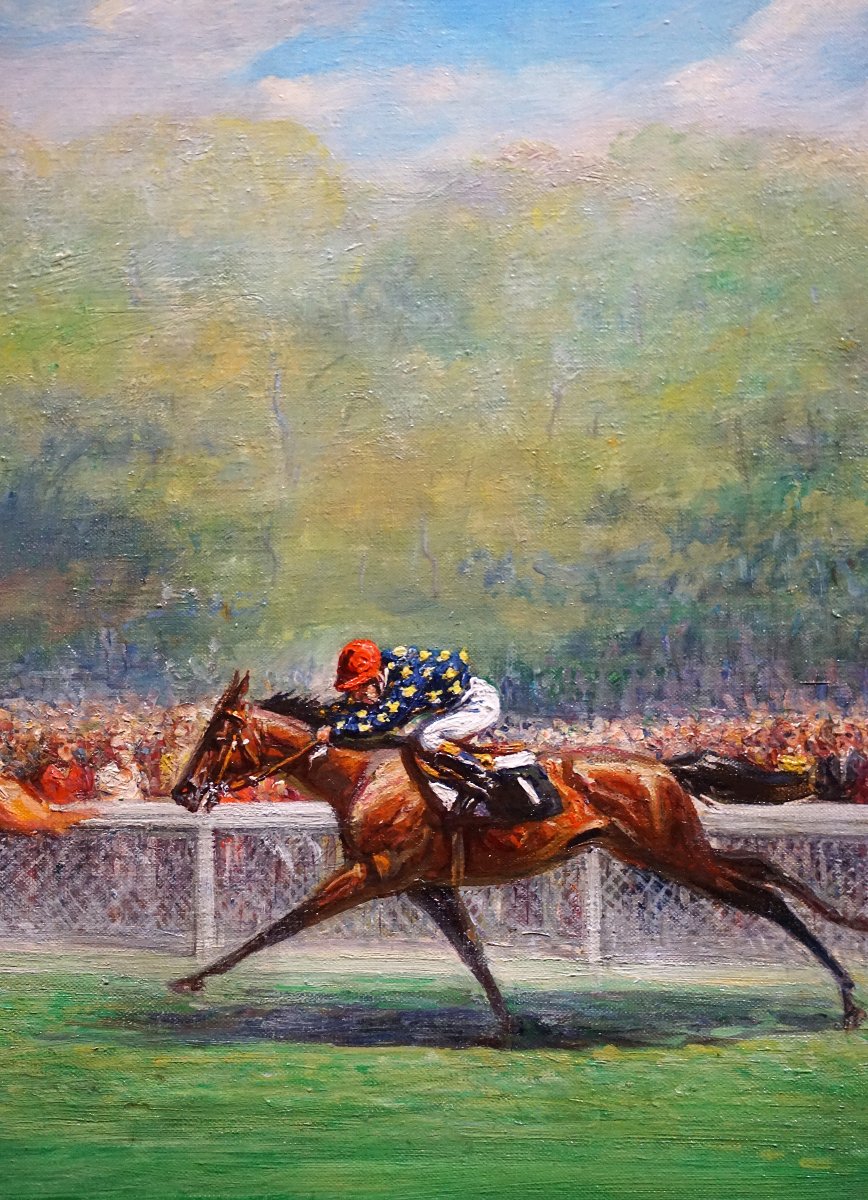
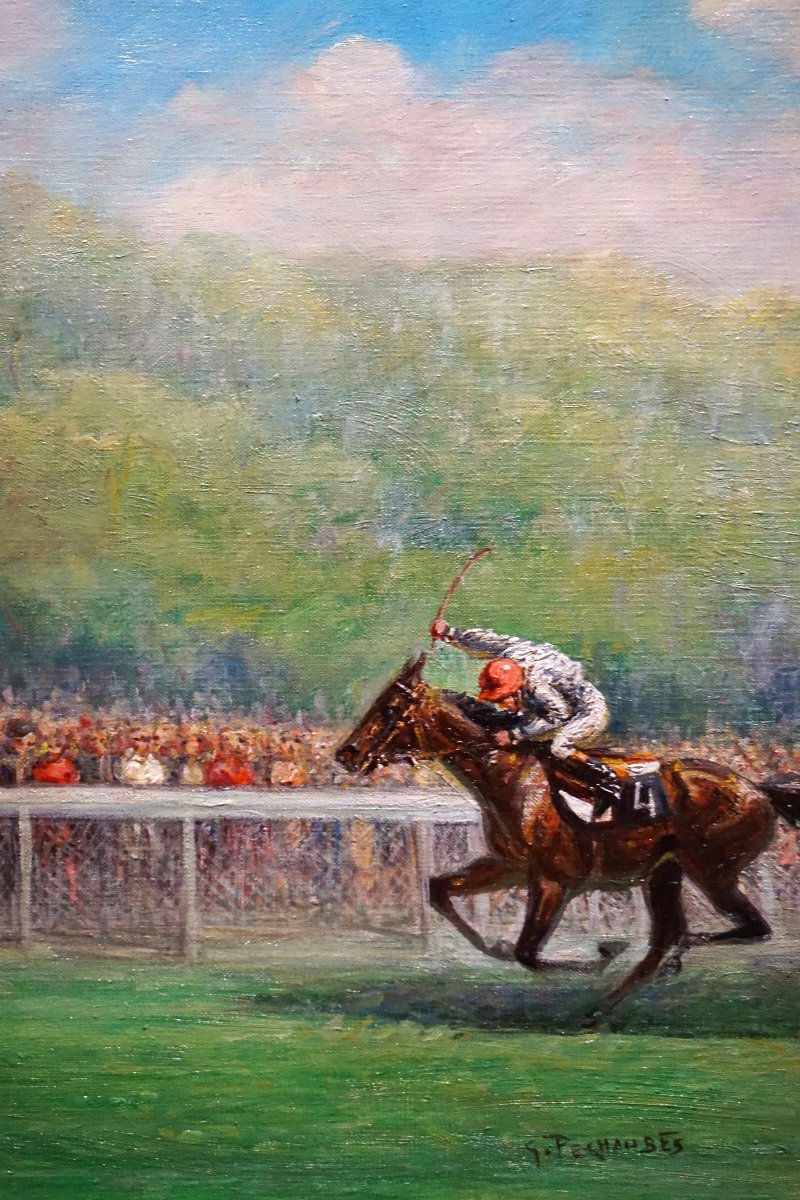
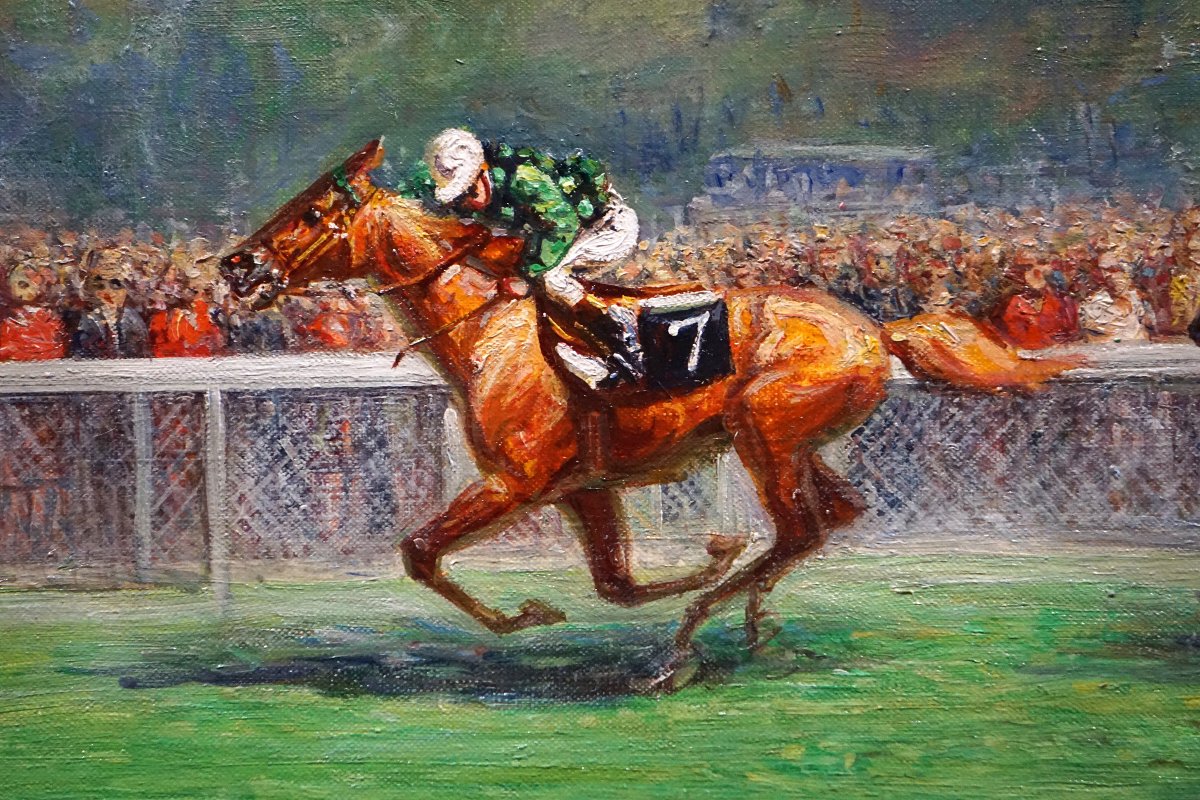
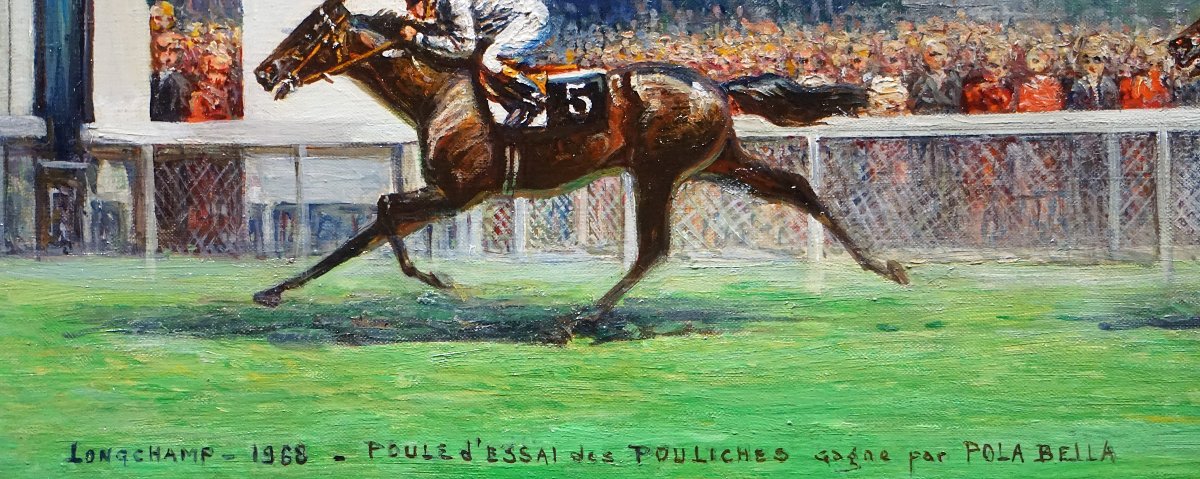
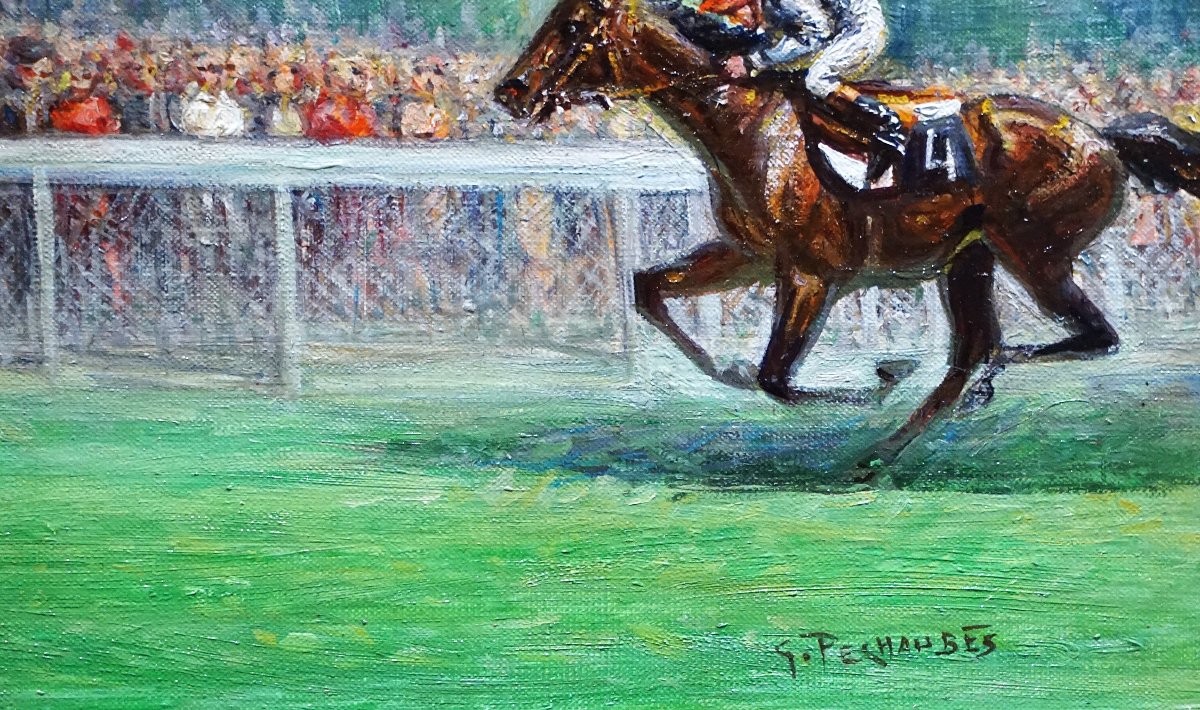
This work by Géna Péchaubés perfectly captures one of the most iconic moments in French horse racing: the 1968 Poule d'Essai des Pouliches, run at Longchamp Racecourse on May 5, 1968, and won by the remarkable Pola Bella, owned by Baron Guy de Rothschild, ridden by Yves Saint-Martin, and trained by François Mathet. It depicts a race in full action, the horses galloping at full speed, already engaged in the effort, their strides fully extended, conveying the speed and tension inherent in a major classic race. This choice demonstrates true artistic maturity: representing horses in full race requires a perfect mastery of equine anatomy, rhythm, and movement. The bodies are stretched, the necks taut, the jockeys leaning forward in a posture of total commitment, while the horizontal composition accentuates the sensation of speed and progress along the track. The setting is immediately recognizable: Longchamp, with its lively stands and the lush vegetation of the Bois de Boulogne in the background. The clear light of early May, rendered by a balanced palette of greens, blues, and earthy tones, places the scene within the distinctive atmosphere of the major Parisian spring meetings. The racing silks are rendered with remarkable accuracy, particularly that of the Rothschild stable, which allows for an immediate identification of the main protagonist, Pola Bella. From a historical perspective, the work possesses significant documentary value. The Poule d'Essai des Pouliches is a Group 1 race, the French equivalent of the 1,000 Guineas, designed to reveal the best three-year-old filly over a mile. The 1968 edition is remembered for the victory of Pola Bella, a future benchmark of her generation, partnered with one of the most prestigious duos in French racing: Guy de Rothschild, François Mathet, and Yves Saint-Martin. The precise date of the race, May 5, 1968, is confirmed by the archives, and the inscription on the canvas by the artist herself unambiguously authenticates the subject. From an artistic point of view, this work fits perfectly within the body of work of Géna Péchaubès, whose production is distinguished by a rigorous yet sensitive approach to equestrian painting. Her pictorial style, precise without being rigid, lends the scene a realistic and vibrant intensity, while maintaining a classical elegance.
33 x 92 cm (unframed),
signed lower right.
Géna Péchaubès (Geneviève Péchaubès, 1923–2019) was a French painter, engraver, and lithographer, renowned for her energetic figurative work, particularly in the field of equestrian painting. Born in Aubervilliers, she received her early training in the studio of her father, Eugène Péchaubès (1890–1967), a leading 20th-century animal painter, with whom she shared a studio space in the Cité du Palais-Royal housing project in Belleville. Growing up in an environment deeply rooted in the tradition of equestrian painting, Géna Péchaubès nevertheless developed a personal style, freer and more colorful, characterized by an expressive touch, a keen sensitivity to movement, and a strong pictorial presence. She signed her works simply "Péchaubès," thus asserting her artistic autonomy while remaining true to a demanding family legacy. Géna Péchaubès established a coherent and authentic body of work, encompassing equestrian scenes as well as landscapes and scenes of everyday life. Her work demonstrates a perfect mastery of equine anatomy and a keen sense of rhythm and composition. Her works now regularly appear on the art market and at auction, particularly during the dispersal of the family studio. She rests in Père-Lachaise Cemetery, alongside her father, thus sealing the history of an artistic lineage intimately linked to the equestrian world and French figurative painting.
33 x 92 cm (unframed),
signed lower right.
Géna Péchaubès (Geneviève Péchaubès, 1923–2019) was a French painter, engraver, and lithographer, renowned for her energetic figurative work, particularly in the field of equestrian painting. Born in Aubervilliers, she received her early training in the studio of her father, Eugène Péchaubès (1890–1967), a leading 20th-century animal painter, with whom she shared a studio space in the Cité du Palais-Royal housing project in Belleville. Growing up in an environment deeply rooted in the tradition of equestrian painting, Géna Péchaubès nevertheless developed a personal style, freer and more colorful, characterized by an expressive touch, a keen sensitivity to movement, and a strong pictorial presence. She signed her works simply "Péchaubès," thus asserting her artistic autonomy while remaining true to a demanding family legacy. Géna Péchaubès established a coherent and authentic body of work, encompassing equestrian scenes as well as landscapes and scenes of everyday life. Her work demonstrates a perfect mastery of equine anatomy and a keen sense of rhythm and composition. Her works now regularly appear on the art market and at auction, particularly during the dispersal of the family studio. She rests in Père-Lachaise Cemetery, alongside her father, thus sealing the history of an artistic lineage intimately linked to the equestrian world and French figurative painting.
780 €
Period: 20th century
Style: Other Style
Condition: Perfect condition
Material: Oil painting
Reference (ID): 1678196
Availability: In stock
Print