THIS OBJECT WAS SOLD
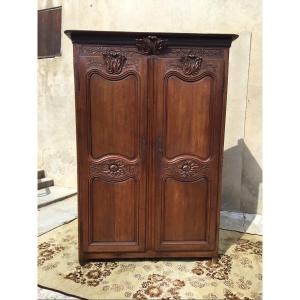
Carved And Painted Wooden Cabinet From The 18th Century.


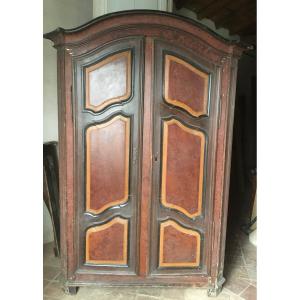
An authentic "wedding" armoire from the late 18th century, dated 1799 on the pediment, framing the names of the bride and groom.
The background color is a very pastel gray-green.
The doors are beautifully carved with a Baroque motif enhanced with a terracotta hue, framing raised Sacred Hearts of Mary and symbols of the Passion.
This Marian devotion is a classic theme of protection bestowed upon the young couple. The armoire has canted corners, featuring a column painted to resemble marble, around which garlands of flowers are entwined.
This same floral decoration is found on the four cartouches of the doors.
A cornice—also painted to resemble marble—features a deep molding with two central scrolls above the openwork top of the armoire.
A two-tone plinth highlights the base of the armoire.
The central section features a secret drawer with two compartments.
The unit rests on two flat feet at the front and two square feet at the back.
The interior layout makes it practical for domestic use: a wardrobe section (75cm wide x 124cm high x 41.3cm deep), two shelves, plus one running the entire width of the wardrobe above the hanging space.
Very few pieces of furniture from this period have survived in their original paint.
Provenance: Eastern Europe, Tyrol, or the Alps Pr Eastern France.
Some paint touch-ups from past centuries are present.
The lock is functional and comes with its key.
The background color is a very pastel gray-green.
The doors are beautifully carved with a Baroque motif enhanced with a terracotta hue, framing raised Sacred Hearts of Mary and symbols of the Passion.
This Marian devotion is a classic theme of protection bestowed upon the young couple. The armoire has canted corners, featuring a column painted to resemble marble, around which garlands of flowers are entwined.
This same floral decoration is found on the four cartouches of the doors.
A cornice—also painted to resemble marble—features a deep molding with two central scrolls above the openwork top of the armoire.
A two-tone plinth highlights the base of the armoire.
The central section features a secret drawer with two compartments.
The unit rests on two flat feet at the front and two square feet at the back.
The interior layout makes it practical for domestic use: a wardrobe section (75cm wide x 124cm high x 41.3cm deep), two shelves, plus one running the entire width of the wardrobe above the hanging space.
Very few pieces of furniture from this period have survived in their original paint.
Provenance: Eastern Europe, Tyrol, or the Alps Pr Eastern France.
Some paint touch-ups from past centuries are present.
The lock is functional and comes with its key.
Explore similar pieces and discover your ideal find:
Armoires, Wardrobes