THIS OBJECT WAS SOLD
Two-handed Sword Of The Guard Of Duke Julius Of Brunswick
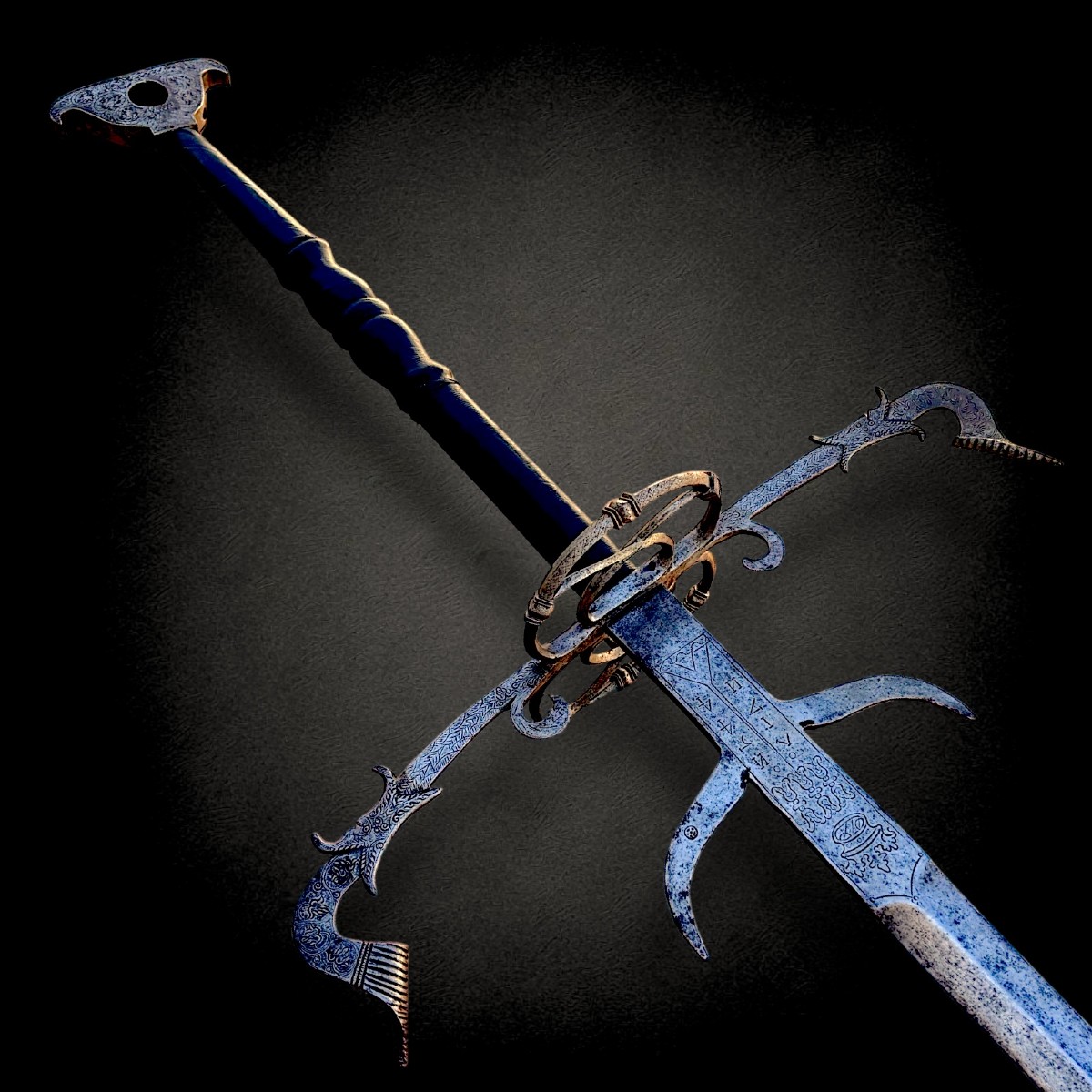




A STATE TWO-HANDED SWORD OF THE GUARD OF JULIUS DUKE
OF BRUNSWICK AND LÜNEBURG IN WOLFENBÜTTEL DATED 1574.
This impressive and massive sword forms part of the well documented group made for Duke Julius of
Brunswick-Wolfenbüttel (lived 1528-1589) in 1574. The sword type is the most impressive and
distinctive to emerge from the evolution of the two-handed sword in Europe. Duke Julius was the
ruler of one of the most important military principalities in the Germanic region at the time.
In 1573 he re-equipped his Guard and decided on a new type of two-handed sword intended mostly
for processional use. The prototype was made by Wolf Gabriel and delivered to the court in 1573. It
seems that around 300 were made in 1573 and a smaller unknown number in 1574. The 1573 design
was upgraded for the 1574 swords. There are slight variations between swords of the same year as the
armourers employed in different workshops expressed their own individual flourishes to their work. It
is not known how many of these swords have survived into modern times. A recent survey indicated
that 49 are present in various private and public collections.
The sword discussed here has a straight double-edged blade of flattened diamond section of the
highest quality. It has a rectangular ricasso boldly incised on each side with a linear rectangular frame
inside which the crowned Brunswick ducal monogram is present and the date 1574 plus the number 4
marking its place in the manufacturing sequence of these swords. The numbers are vertically divided
by a gibbet within the frame. The ricasso has a pair of slender pointed lugs which form a secondary
guard. One is stamped with the wheel mark of the blade maker.
The span of the cross guard is 22.5 inches (56.5 cm) and consists of a pair of flat quillons
sumptuously engraved with foliage and chevron-like lines, each length of design separated by a
dragon’s head. The quillons widen towards their terminals which are of flattened form and fluted in
decoration, point downwards, and are counter-curved at the extremes. A pair of small flat engraved
parrying hooks inclined towards the blade are present a short distance from the middle of the guard.
The secondary guard defense consists of well forged diamond section inner and outer guard
rings. The thicker, larger outer rings are engraved all over with a trellis of diamond shapes centered
with dots. Each outer ring is formed with three diamond shaped baluster moldings and joined with
the inner ring by two further bars of diamond shaped cross section. A thumb ring is present on one
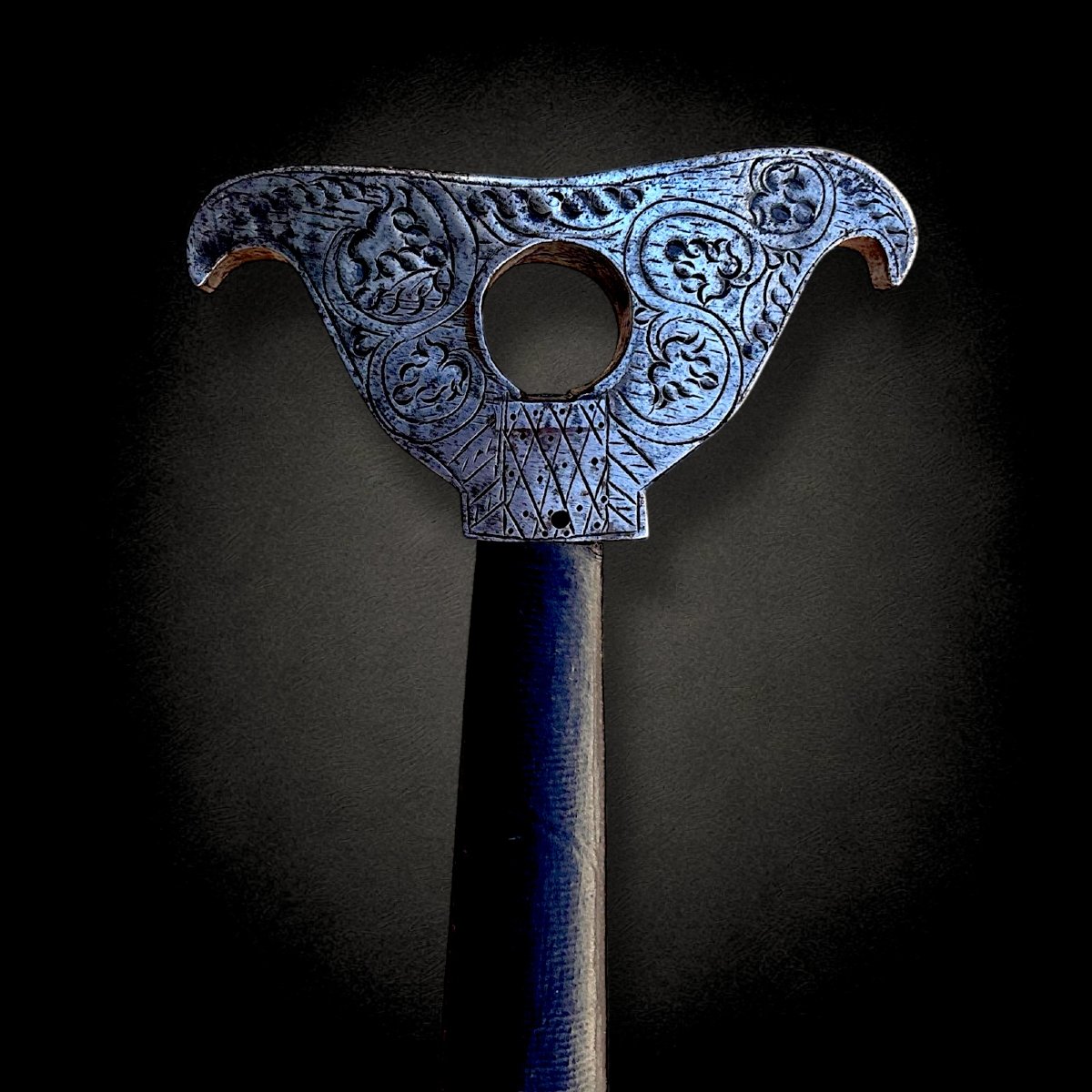
side. The thick crutch-shaped pommel is formed from flattened shaped iron plates brazed together
with latten centered with an open ring inside which the threaded tang end of the blade is visible. The
upper surface of the pommel is depressed in the middle with exaggerated downward drooping left and
right edges. The decorative style of the engraved foliage front and back is the same as that on the
cross guard. The sides of the pommel are profusely decorated with scales. The grip is of dark
hardwood
The sword is in very fine condition.
Specifications:
The blade length is 51.5 inches long (just over 130 cm) and the
overall length of the sword is 75.5 inches (just under 192 cm).
OF BRUNSWICK AND LÜNEBURG IN WOLFENBÜTTEL DATED 1574.
This impressive and massive sword forms part of the well documented group made for Duke Julius of
Brunswick-Wolfenbüttel (lived 1528-1589) in 1574. The sword type is the most impressive and
distinctive to emerge from the evolution of the two-handed sword in Europe. Duke Julius was the
ruler of one of the most important military principalities in the Germanic region at the time.
In 1573 he re-equipped his Guard and decided on a new type of two-handed sword intended mostly
for processional use. The prototype was made by Wolf Gabriel and delivered to the court in 1573. It
seems that around 300 were made in 1573 and a smaller unknown number in 1574. The 1573 design
was upgraded for the 1574 swords. There are slight variations between swords of the same year as the
armourers employed in different workshops expressed their own individual flourishes to their work. It
is not known how many of these swords have survived into modern times. A recent survey indicated
that 49 are present in various private and public collections.
The sword discussed here has a straight double-edged blade of flattened diamond section of the
highest quality. It has a rectangular ricasso boldly incised on each side with a linear rectangular frame
inside which the crowned Brunswick ducal monogram is present and the date 1574 plus the number 4
marking its place in the manufacturing sequence of these swords. The numbers are vertically divided
by a gibbet within the frame. The ricasso has a pair of slender pointed lugs which form a secondary
guard. One is stamped with the wheel mark of the blade maker.
The span of the cross guard is 22.5 inches (56.5 cm) and consists of a pair of flat quillons
sumptuously engraved with foliage and chevron-like lines, each length of design separated by a
dragon’s head. The quillons widen towards their terminals which are of flattened form and fluted in
decoration, point downwards, and are counter-curved at the extremes. A pair of small flat engraved
parrying hooks inclined towards the blade are present a short distance from the middle of the guard.
The secondary guard defense consists of well forged diamond section inner and outer guard
rings. The thicker, larger outer rings are engraved all over with a trellis of diamond shapes centered
with dots. Each outer ring is formed with three diamond shaped baluster moldings and joined with
the inner ring by two further bars of diamond shaped cross section. A thumb ring is present on one
side. The thick crutch-shaped pommel is formed from flattened shaped iron plates brazed together
with latten centered with an open ring inside which the threaded tang end of the blade is visible. The
upper surface of the pommel is depressed in the middle with exaggerated downward drooping left and
right edges. The decorative style of the engraved foliage front and back is the same as that on the
cross guard. The sides of the pommel are profusely decorated with scales. The grip is of dark
hardwood
The sword is in very fine condition.
Specifications:
The blade length is 51.5 inches long (just over 130 cm) and the
overall length of the sword is 75.5 inches (just under 192 cm).
Explore similar pieces and discover your ideal find:
Edged Weapons