

Cecil De Blaquière Howard, Known As Cecil Howard (1888 - 1956) Mistinguett At The Moulin Rouge, 1908
Artist: Cecil De Blaquière Howard, Dit Cecil Howard (clifton, Canada, 1888 - New York, 1956)
Cecil de Blaquière Howard, known as Cecil Howard (Clifton, Canada, 1888 - New York, 1956)
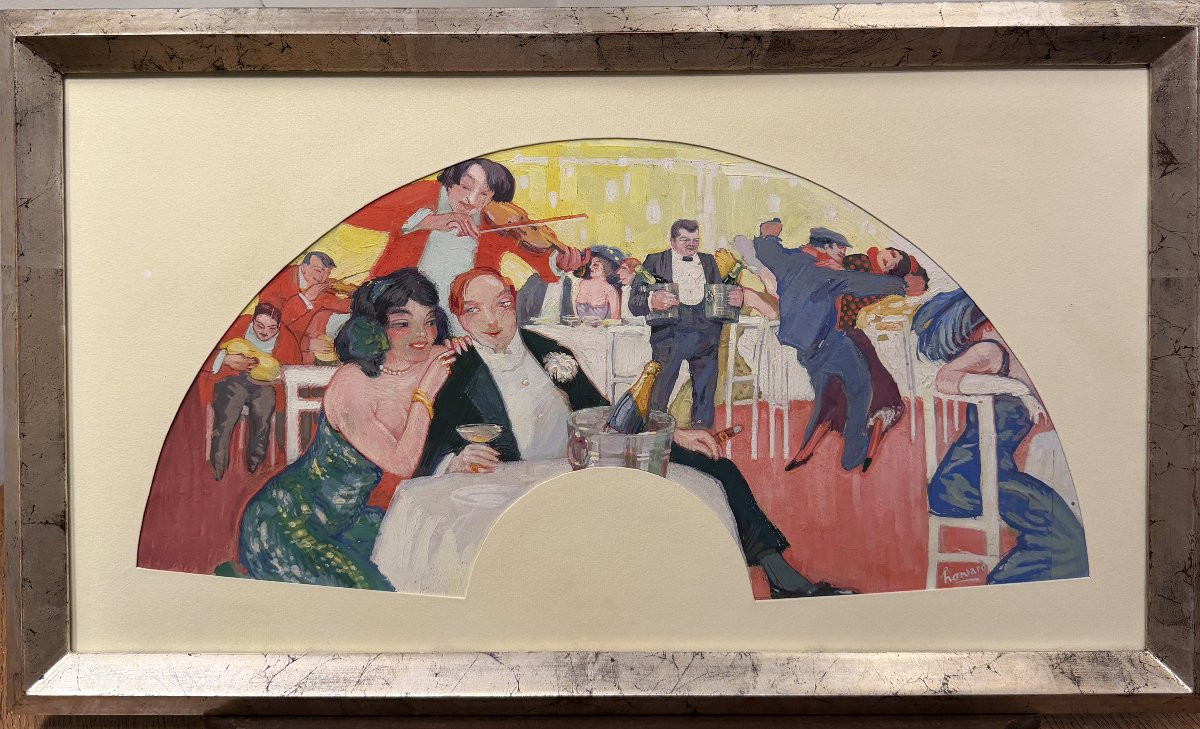
Mistinguett and Max Dearly dancing the waltz at the Moulin Rouge
Fan design Circa 1908
Gouache on paper
29.7 x 44.5 cm
34.5 x 58 cm with frame
Signed "Howard" lower right
Born in Clifton, Canada, Cecil Howard grew up in Buffalo, in upstate New York. He was only seventeen when he left the United States to settle in Paris, where he enrolled at the Académie Julian, hoping to dedicate himself to sculpture. Immediately captivated by the artistic life he encountered in Montparnasse, he would spend half his life there. Exhibiting at the Salon des Artistes Français from 1906, he subsequently favored the Salon de la Société Nationale des Beaux-Arts and the more liberal Salon d'Automne. Quickly becoming a member of both institutions, he presented, among other works, animal sculptures created at the Antwerp Zoo with his friend Rembrandt Bugatti during 1909. In 1913, Howard participated in the Armory Show in New York, Chicago, and Boston. For this major event, which marked the arrival of modern art in the United States, he exhibited a standing female nude modeled after Lucy Krohg. After experimenting with painted sculpture, particularly portraiture, Cecil Howard embraced Cubism, incorporating into his vibrant polychrome sculptures the movement of tango dancers, a practice he regularly enjoyed at the Bal Bullier. These highly personal works, of which only five examples are known to exist today, make Cecil Howard a pioneer of Cubist sculpture and place him at the forefront of the modernism of that period. Also embracing the vogue for African art, Howard caused a sensation in New York in 1916 with his beautiful Nubian woman with a fluid and stylized amphora. While he continued this aesthetic vein in the interwar period, particularly in response to commissions from Lord Howard of Walden, the sculptor subsequently produced numerous works inspired by his passion for sports, constantly depicting bodies in motion and imbuing his art with an irrepressible vital energy. Our elegant fan design on paper is related to Cecil Howard's graphic production of decorative arts, less well-known but just as avant-garde as his sculpture. Within the tight, constrained framing characteristic of the quintessential accessory of Belle Époque socialites, the artist masterfully captures the heady spirit of nocturnal Paris in the 1900s, through a dense and vibrant scene in tawny and variegated colors, a jubilant homage to the golden age of the Moulin Rouge. Under the dazzling light of electric lamps, a couple sits at a table in the foreground. Draped in a shimmering peacock-green dress, in a pose of light seduction and roguish elegance reminiscent of Van Dongen's prostitutes, the made-up woman leans towards the man in a tuxedo, holding a glass and cigar. With a touch of humor, the central point of the fan is occupied by the iced champagne bucket, an iconic element of Parisian parties. In the background, amidst a dynamic and sprawling choreography, a violinist in a red suit appears to be improvising a feverish solo, while the waitstaff, in black suits and starched collars, bustle about with fresh bottles. Slightly off-center to the right, a couple launches into a swaying waltz, their steps brisk, their dresses swirling, setting the visual rhythm for the entire composition. On June 15, 1908, the actor and director Max Dearly chose Mistinguett to perform this famous swaying waltz with him, also known as the Apache Dance or the Pavement Dance, which he created for the "Revue du Moulin" at the Moulin Rouge, based on themes from Jacques Offenbach's ballet "Le Papillon." The dance depicts a quarrel between an Apache thug and a prostitute. Violent, sporty and spectacular, it ends in a rhythmic waltz and immediately enjoys triumphant international success, encouraging the duo to repeat the experience at the Casino de Paris, and even contributing to the launch of Mistinguett's career.
Mistinguett and Max Dearly dancing the waltz at the Moulin Rouge
Fan design Circa 1908
Gouache on paper
29.7 x 44.5 cm
34.5 x 58 cm with frame
Signed "Howard" lower right
Born in Clifton, Canada, Cecil Howard grew up in Buffalo, in upstate New York. He was only seventeen when he left the United States to settle in Paris, where he enrolled at the Académie Julian, hoping to dedicate himself to sculpture. Immediately captivated by the artistic life he encountered in Montparnasse, he would spend half his life there. Exhibiting at the Salon des Artistes Français from 1906, he subsequently favored the Salon de la Société Nationale des Beaux-Arts and the more liberal Salon d'Automne. Quickly becoming a member of both institutions, he presented, among other works, animal sculptures created at the Antwerp Zoo with his friend Rembrandt Bugatti during 1909. In 1913, Howard participated in the Armory Show in New York, Chicago, and Boston. For this major event, which marked the arrival of modern art in the United States, he exhibited a standing female nude modeled after Lucy Krohg. After experimenting with painted sculpture, particularly portraiture, Cecil Howard embraced Cubism, incorporating into his vibrant polychrome sculptures the movement of tango dancers, a practice he regularly enjoyed at the Bal Bullier. These highly personal works, of which only five examples are known to exist today, make Cecil Howard a pioneer of Cubist sculpture and place him at the forefront of the modernism of that period. Also embracing the vogue for African art, Howard caused a sensation in New York in 1916 with his beautiful Nubian woman with a fluid and stylized amphora. While he continued this aesthetic vein in the interwar period, particularly in response to commissions from Lord Howard of Walden, the sculptor subsequently produced numerous works inspired by his passion for sports, constantly depicting bodies in motion and imbuing his art with an irrepressible vital energy. Our elegant fan design on paper is related to Cecil Howard's graphic production of decorative arts, less well-known but just as avant-garde as his sculpture. Within the tight, constrained framing characteristic of the quintessential accessory of Belle Époque socialites, the artist masterfully captures the heady spirit of nocturnal Paris in the 1900s, through a dense and vibrant scene in tawny and variegated colors, a jubilant homage to the golden age of the Moulin Rouge. Under the dazzling light of electric lamps, a couple sits at a table in the foreground. Draped in a shimmering peacock-green dress, in a pose of light seduction and roguish elegance reminiscent of Van Dongen's prostitutes, the made-up woman leans towards the man in a tuxedo, holding a glass and cigar. With a touch of humor, the central point of the fan is occupied by the iced champagne bucket, an iconic element of Parisian parties. In the background, amidst a dynamic and sprawling choreography, a violinist in a red suit appears to be improvising a feverish solo, while the waitstaff, in black suits and starched collars, bustle about with fresh bottles. Slightly off-center to the right, a couple launches into a swaying waltz, their steps brisk, their dresses swirling, setting the visual rhythm for the entire composition. On June 15, 1908, the actor and director Max Dearly chose Mistinguett to perform this famous swaying waltz with him, also known as the Apache Dance or the Pavement Dance, which he created for the "Revue du Moulin" at the Moulin Rouge, based on themes from Jacques Offenbach's ballet "Le Papillon." The dance depicts a quarrel between an Apache thug and a prostitute. Violent, sporty and spectacular, it ends in a rhythmic waltz and immediately enjoys triumphant international success, encouraging the duo to repeat the experience at the Casino de Paris, and even contributing to the launch of Mistinguett's career.
5 000 €
Period: 20th century
Style: Art Nouveau
Condition: Excellent condition
Material: Gouache
Length: 44,5 (58) cm
Height: 29,7 (34,5) cm
Reference (ID): 1672832
Availability: In stock
Print