


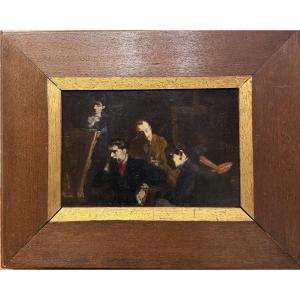


émile-artus Boeswillwald (paris, 1873 – 1935) - Around A Canvas, Sketch Circa 1904
Artist: émile-artus Boeswillwald (paris, 1873 – 1935)
Émile-Artus Boeswillwald (Paris, 1873–1935)
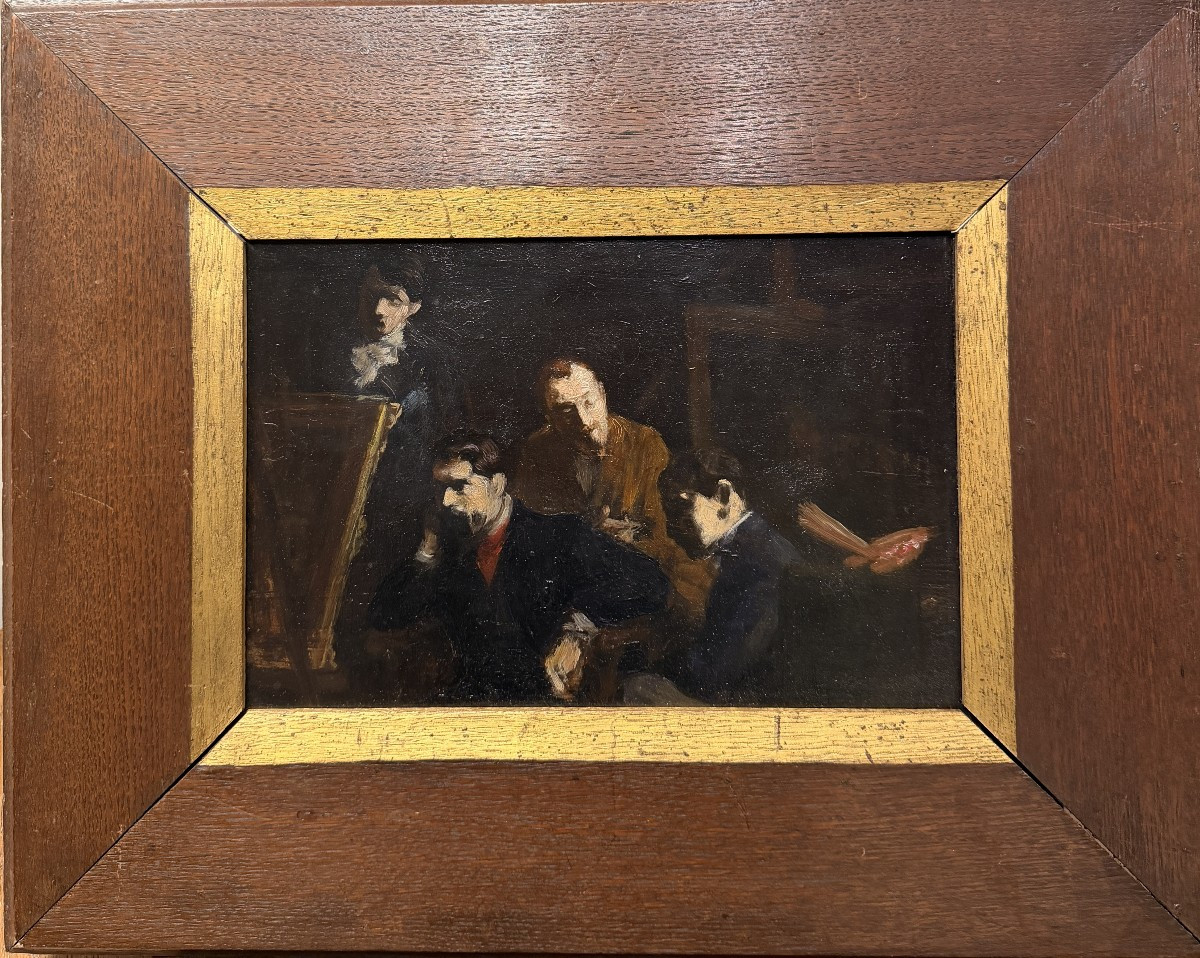
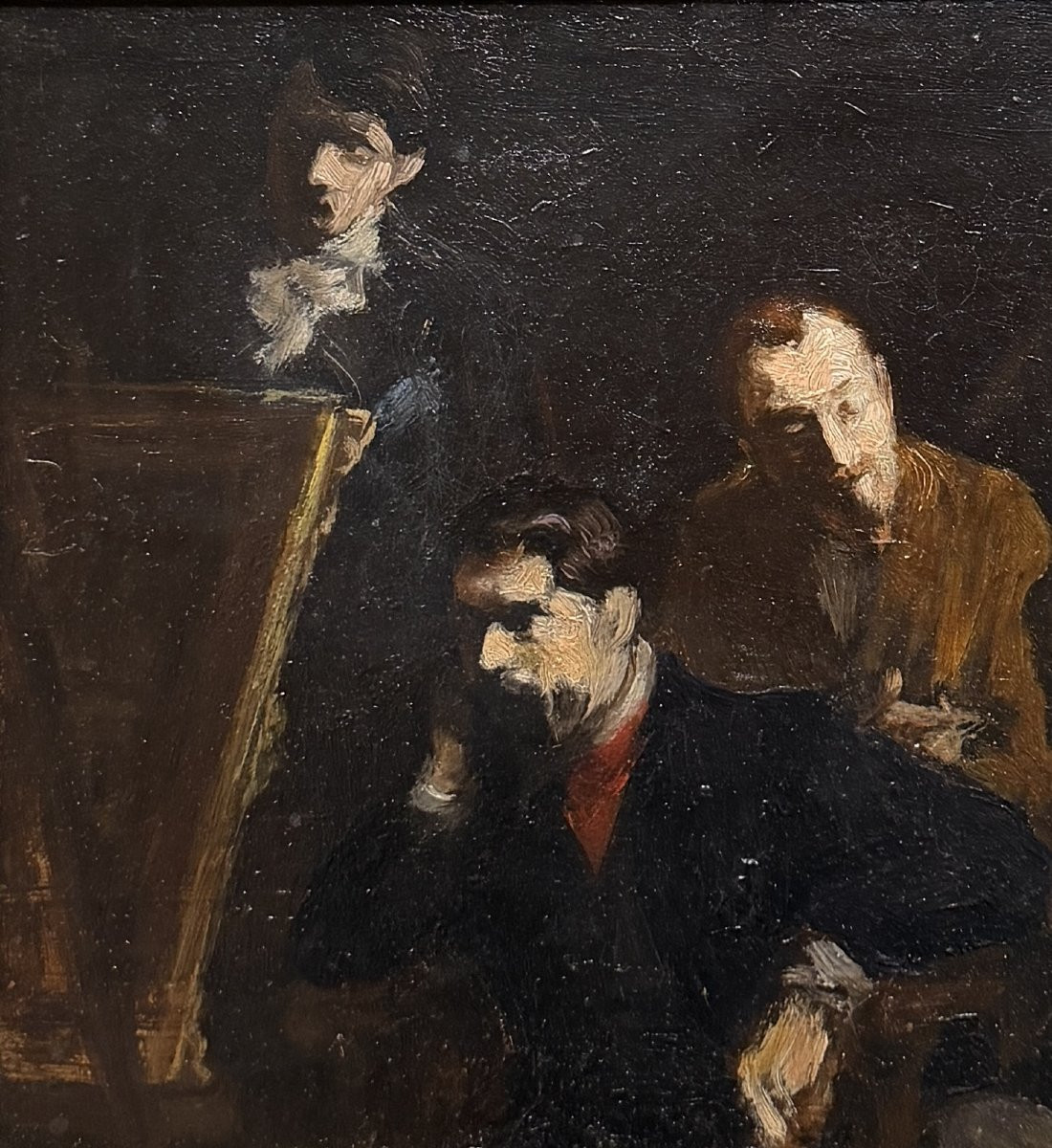
Around a Canvas, Sketch Circa 1904
Oil on panel
21.8 x 31.2 cm
42 x 53 cm with frame
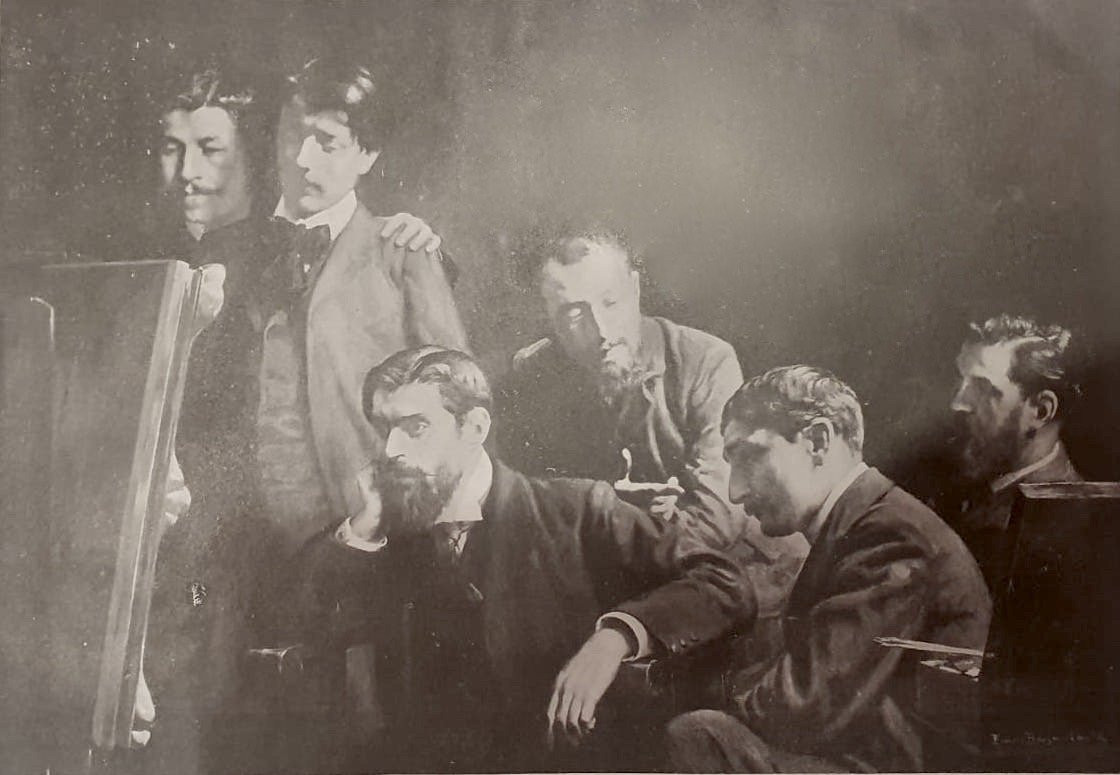
Preparatory sketch for the painting of the same name, now lost, 1904
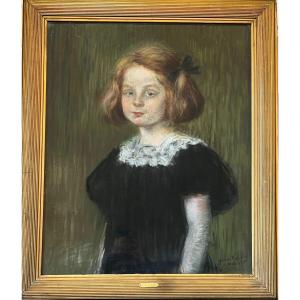
Born into a dynasty of architects of Alsatian origin, grandson of Émile Boeswillwald (1815–1896), himself a former collaborator of Eugène Viollet-le-Duc and successor to Prosper Mérimée as Inspector General of Historical Monuments, Émile-Artus Boeswillwald was introduced to drawing at a very young age. Initially destined for a career as an officer, he suffered a bad fall and developed a chronic bronchial illness, forcing him to abandon this plan. Encouraged by his family's artistic environment, he turned to painting and was admitted in 1895 to the École des Beaux-Arts in the studio of Léon Bonnat. That same year, he made his debut at the Salon des Artistes Français, where he enjoyed some success as a portraitist. In 1901, he exhibited there the tender portrait of his young fiancée, Marguerite Geoffroy (cat. no. 218), herself from a dynasty of sculptors, being the daughter of Adolphe Geoffroy and granddaughter of Victor Geoffroy-Dechaume. The marked intimacy of his works, influenced by the Spanish painting so dear to his master, earned him several official awards. He received the Medal of Honor at the Salon of 1905 and then the Gold Medal in 1926, before being awarded a prize outside the competition. Made a Knight of the Legion of Honour in 1928, he concluded his brilliant official career that same year by obtaining a position as professor of drawing at the École Polytechnique. His work, long overlooked, was the subject of a retrospective in 2004 at the Paul Dubois - Alfred Boucher Museum in Nogent-sur-Seine, the town where his family had settled.[1] Our charming little sketch on panel reveals the more modern character that Émile-Artus Boeswillwald's painting technique could take. It directly prepares a large composition exhibited at the Salon des Artistes Français in 1904 (cat. no. 192) entitled Around a Canvas (fig. 1). In the dim light of a studio, four men, artists or critics, stand around a painting with a gilt frame, placed on an easel partially out of frame on the left. Concentrated and almost silent, they seem almost frozen in the tension of suspended judgment. While the final version refines the features and clarifies the light, our sketch retains its raw power, revealing the initial choices of composition, mass, and shadow. Boeswillwald arranges his scene as a mise en abyme of painting itself, between its final submission to the gaze on the left and the abandoned brushes and palette on the right, the origin of its own creation. Through broad, rapidly brushed strokes and a chiaroscuro that owes much to Ribera, the painter establishes the attitudes of the various protagonists, guiding our gaze from left to right. A young man, standing absorbed in contemplation of the canvas, slightly dominates the scene. Before him, three male figures form an arc: one resting on his hand in a thoughtful pose, while the second, slightly inclined, appears to be in quiet conversation with the third, his face in shadow. As if to soften the dramatic tension of this intimate scene, reminiscent of a biblical narrative, Boeswillwald fills the gaps left by the black, muted, and dense backgrounds in his final painting by adding two more figures at the extremities. Familiar with these intellectual circles, the artist depicts here a professional ritual with its own codes, a ceremony imbued with fraternity and a certain inner discipline. By evoking the first silent judgment surrounding the emergence of a work, this scene, far more than a studio anecdote, becomes a discreet allegory of artistic creation.
[1] Karine Cornu and Jacques Piette, Émile-Artus Boeswillwald, L'émotion intimiste, peintures et dessins, exhibition catalogue, Musée Paul Dubois - Alfred Boucher, Nogent-sur-Seine, 2004.
Around a Canvas, Sketch Circa 1904
Oil on panel
21.8 x 31.2 cm
42 x 53 cm with frame
Preparatory sketch for the painting of the same name, now lost, 1904
Born into a dynasty of architects of Alsatian origin, grandson of Émile Boeswillwald (1815–1896), himself a former collaborator of Eugène Viollet-le-Duc and successor to Prosper Mérimée as Inspector General of Historical Monuments, Émile-Artus Boeswillwald was introduced to drawing at a very young age. Initially destined for a career as an officer, he suffered a bad fall and developed a chronic bronchial illness, forcing him to abandon this plan. Encouraged by his family's artistic environment, he turned to painting and was admitted in 1895 to the École des Beaux-Arts in the studio of Léon Bonnat. That same year, he made his debut at the Salon des Artistes Français, where he enjoyed some success as a portraitist. In 1901, he exhibited there the tender portrait of his young fiancée, Marguerite Geoffroy (cat. no. 218), herself from a dynasty of sculptors, being the daughter of Adolphe Geoffroy and granddaughter of Victor Geoffroy-Dechaume. The marked intimacy of his works, influenced by the Spanish painting so dear to his master, earned him several official awards. He received the Medal of Honor at the Salon of 1905 and then the Gold Medal in 1926, before being awarded a prize outside the competition. Made a Knight of the Legion of Honour in 1928, he concluded his brilliant official career that same year by obtaining a position as professor of drawing at the École Polytechnique. His work, long overlooked, was the subject of a retrospective in 2004 at the Paul Dubois - Alfred Boucher Museum in Nogent-sur-Seine, the town where his family had settled.[1] Our charming little sketch on panel reveals the more modern character that Émile-Artus Boeswillwald's painting technique could take. It directly prepares a large composition exhibited at the Salon des Artistes Français in 1904 (cat. no. 192) entitled Around a Canvas (fig. 1). In the dim light of a studio, four men, artists or critics, stand around a painting with a gilt frame, placed on an easel partially out of frame on the left. Concentrated and almost silent, they seem almost frozen in the tension of suspended judgment. While the final version refines the features and clarifies the light, our sketch retains its raw power, revealing the initial choices of composition, mass, and shadow. Boeswillwald arranges his scene as a mise en abyme of painting itself, between its final submission to the gaze on the left and the abandoned brushes and palette on the right, the origin of its own creation. Through broad, rapidly brushed strokes and a chiaroscuro that owes much to Ribera, the painter establishes the attitudes of the various protagonists, guiding our gaze from left to right. A young man, standing absorbed in contemplation of the canvas, slightly dominates the scene. Before him, three male figures form an arc: one resting on his hand in a thoughtful pose, while the second, slightly inclined, appears to be in quiet conversation with the third, his face in shadow. As if to soften the dramatic tension of this intimate scene, reminiscent of a biblical narrative, Boeswillwald fills the gaps left by the black, muted, and dense backgrounds in his final painting by adding two more figures at the extremities. Familiar with these intellectual circles, the artist depicts here a professional ritual with its own codes, a ceremony imbued with fraternity and a certain inner discipline. By evoking the first silent judgment surrounding the emergence of a work, this scene, far more than a studio anecdote, becomes a discreet allegory of artistic creation.
[1] Karine Cornu and Jacques Piette, Émile-Artus Boeswillwald, L'émotion intimiste, peintures et dessins, exhibition catalogue, Musée Paul Dubois - Alfred Boucher, Nogent-sur-Seine, 2004.
6 000 €
Period: 20th century
Style: Napoleon 3rd
Condition: Excellent condition
Material: Oil painting on wood
Length: 31,2 (53) cm
Height: 21,8 (42) cm
Reference (ID): 1672811
Availability: In stock
Print