THIS OBJECT WAS SOLD
Bronze Sculpture "dead Bird" By Jules Edmond Masson (1871-1932)


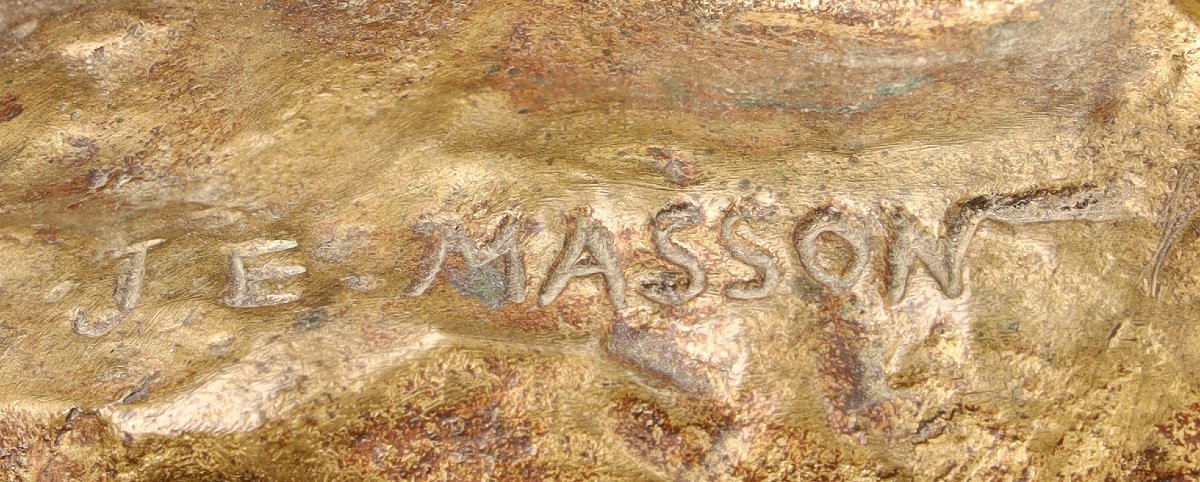


The sculpture is a small-format work executed in bronze, a material of choice for edition animal sculpture.
Subject and Composition: The work depicts a piece of feathered game—likely a pheasant or partridge—after the hunt. The bird is presented in a plain but highly realistic composition. The body is slightly twisted, the wings hang loosely, and the head is relaxed, suggesting the weight of the lifeless animal. The work is designed to be viewed from above or as a decorative element.
Technique and Finish:
Modeling: The artist, J.E. Masson, paid meticulous attention to the rendering of textures. The plumage is sculpted with great precision, capturing the different layers of feathers, from the body covering to the wing flight feathers.
Patina: The golden/yellowish color and the traces of patina (oxidation or applied finish) give the work a visual richness and highlight the quality of the bronze casting.
Decorative Nature: This type of sculpture is not merely a naturalistic study; it is also an object of interior decoration (often used as a paperweight or display item) that perfectly fits into the bourgeois interiors and cabinets of curiosities of the early 20th century.
Jules Edmond Masson (1871–1932) is undeniably positioned in the lineage of the Animalier movement, which dominated French sculpture from the 1830s until World War I, evolving towards a pronounced Realism at the turn of the century.
Family Connection (Genealogical Argument): J.E. Masson was the student and son of Clovis Masson (1838–1913), himself a renowned animal sculptor. He thus directly follows an inherited familial and stylistic tradition.
Specific Subject (Thematic Argument): The representation of dead game is an integral part of the classical repertoire of the Animaliers, from the initiator of the modern movement, Antoine-Louis Barye, to artists such as Pierre-Jules Mène and J.E. Masson himself. It is an exploration of nature, hunting, and anatomical realism.
Technique and Style (Stylistic Argument): The hyperrealism of anatomical details, feathers, and fidelity to living nature (even in death) are the hallmarks of the Animalier movement and Academic Realism of the late 19th century. Masson sought naturalistic accuracy, in contrast to Neoclassical idealization or the formal simplifications of nascent Art Deco.
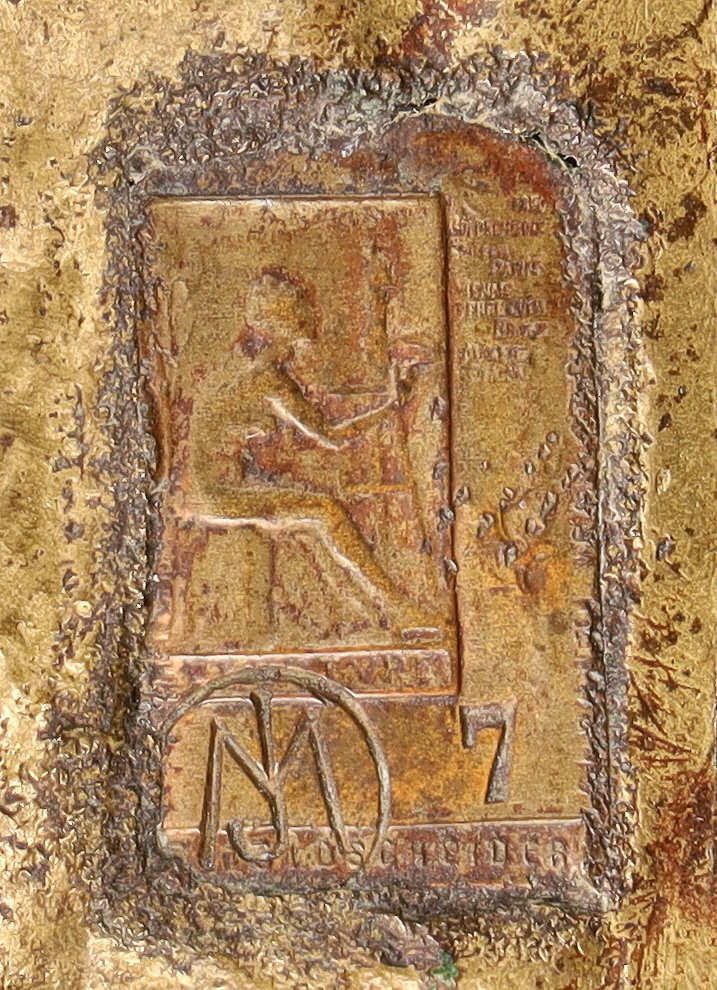
The hallmark visible is that of an editor or founder who commercialized the bronze sculpture from a model created by the artist.
Probable Decryption of the Hallmark:Mark of Guarantee and Prestige: The cartouche depicts a figure (likely allegorical) seated in a solemn pose, and the partially legible inscriptions refer to a "Médaille d'Or" (Gold Medal) won in Paris (probably at a Universal Exposition, such as those in 1878, 1889, or 1900).
Initials "MD" or "MV": The large stylized initials at the bottom of the cartouche are generally interpreted as the mark of an editor or art trading house. Although Masson worked with famous founders (Susse Frères, Société des Bronzes de Paris), this specific stamp is a commercial mark of recognition.
The hallmark (or foundry mark) is essential in the history of art bronze in France during this period:
Proof of Authenticity and Quality: It guarantees that the bronze was cast and chased in the founder's workshops, following a quality process. It distinguishes professional editions from counterfeits or later castings.
The Role of the Editor: From the mid-19th century onward, founders were no longer just craftsmen; they became art editors. They purchased the rights to the original model from the artist (the plaster or wax model), reproduced it in multiple copies, and managed the commercialization. The hallmark is their commercial signature.
Marketing and Guarantee: The mention of a Gold Medal is a powerful marketing strategy. It assures the buyer that the technical quality of the casting (though not necessarily the artwork itself) has been recognized and rewarded by an official jury, enhancing the perceived value of the object.
The Number (7-1596 S): As previously mentioned, this is the catalogue number of the founder/editor. It allowed the model to be traced in the publishing house's records for stock management and re-edition.
Jules Edmond Masson is a representative figure of the continuity of the French school of sculpture, specializing in animal statuary.
Born in 1871, J.E. Masson benefited from an exceptional artistic environment. He was the son of the sculptor Clovis Masson (1838–1913), himself a renowned Animalier, who became his first and principal master. This training under his father ensured him an early mastery of anatomy and animal modeling, which would become the cornerstone of his work.
Career and Themes:
Masson primarily devoted himself to animal sculpture, perpetuating the subjects dear to the 19th century: farm animals, hunting dogs, and game scenes.
He also excelled in the representation of Orientalist scenes, featuring figures of Arab men and horses, and military subjects (notably soldiers from the Napoleonic era), thereby expanding his repertoire compared to his father.
Institutional Recognition:
Like most artists of the academic school, Masson regularly exhibited at the prestigious Salon des Artistes Français in Paris, the essential venue for official art of the time.
He received formal recognition there, being awarded a medal on several occasions, notably in 1922 and 1928, which cemented his position in the French art world.
Legacy:
He worked mainly with renowned founders (potentially including the founder of your piece) for the edition of his bronze works, which were intended for wealthy and collecting clientele.
He died in 1932, leaving behind a considerable body of work that testifies to the apogee and final hours of the tradition of Realistic Animalier Art in France before the advent of modernist movements.
Explore similar pieces and discover your ideal find:
Bronze Animal Sculptures