

“the Bather” Or “the Nymph Taking Her Bath” (1757), étienne-maurice Falconet (1716-179)
Antique Bronze, Dated and Signed
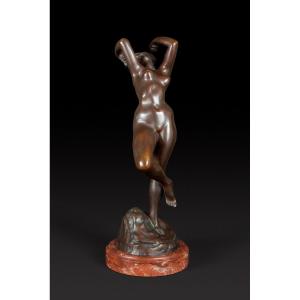
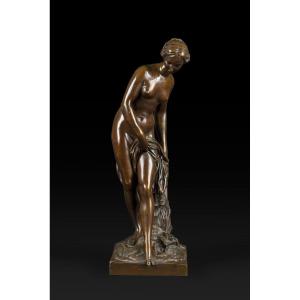
1. Artistic Explanation:The Bather (La Nymphe prenant son bain) is a masterful work of 18th-century French sculpture, created by Étienne-Maurice Falconet in 1757. This bronze statue represents a nude young woman in a graceful and natural posture, captured in an intimate moment as she steps into her bath.
Symbolism: The choice to represent a nymph, a mythological figure often associated with nature and water, reflects the influence of classical and mythological themes in 18th-century art. It testifies to the era's interest in antiquity and the ideals of classical beauty.
Posture and Expression: The nymph is depicted in a natural and fluid pose, slightly leaning forward, as if she were picking up or setting down a piece of cloth. This posture highlights the elegant curves and anatomical details of the female body, paying tribute to natural beauty and grace.
Details and Textures: The texture of the drapery and the subtle details of the hair and skin are beautifully rendered, demonstrating Falconet's mastery in working with bronze. The play of light on the polished surface of the bronze adds a lively and realistic dimension to the sculpture.
Period: The sculpture was created in 1757, a period when Rococo art was flourishing in France. This style is characterized by its elegance, refinement, and a penchant for graceful and delicate subjects.
Style: Although Falconet is often associated with the Rococo style, this work shows a transition toward a more Neoclassical style, with a simplicity and purity of form that foreshadow future artistic trends.
Patron: The work was commissioned by the financier and collector Ange Laurent Lalive de Jully, which shows the interest of the elite of the time in classical art and culture.
The exceptional quality of the casting of this sculpture is the result of the work of an expert bronze founder. At that time, founders often worked in close collaboration with sculptors to produce high-quality pieces. Renowned founders of this period included workshops such as those of Jean-Baptiste Claude Odiot or the Keller brothers, although specific documentation on the founder of this particular work is not always available.
4. Museum References:Copies of The Bather can be found in several prestigious museums, including:
The Louvre Museum in Paris, which holds a rich collection of 18th-century French sculptures.
The Musée des Beaux-Arts in Lyon, where other works by Falconet and his contemporaries can also be admired.
The State Hermitage Museum in SAINT PETERSBURG.
The Bather symbolizes the ideals of beauty and purity, the intimate relationship between human and nature, and the stylistic transitions in 18th-century art. It embodies the decorative and elegant elements of the Rococo while anticipating the simplicity and grandeur of Neoclassicism. The nymph represents the ideal of feminine beauty in the classical tradition, purity and innocence, as well as the connection to nature and mythological elements.
It is interesting to note that Falconet was supported by Mme de Pompadour, the mistress of Louis XV and a great patron of the arts. Mme de Pompadour's daughter, Alexandrine Le Normant d'Étiolles, died young, and Falconet may have found a certain inspiration in the youth and beauty of this child, as well as in the influence of her mother, to create works imbued with grace and tenderness.
7. Biography of Étienne-Maurice Falconet:Étienne-Maurice Falconet (1716-1791) is a French sculptor famous for his refined and elegant works. He was trained at the Royal Academy of Painting and Sculpture and worked under the direction of the famous sculptor Jean-Baptiste Lemoyne. Falconet quickly gained notoriety thanks to his graceful sculptures and portraits.
Career: In 1757, Falconet was appointed director of the sculpture workshop at the Sèvres Manufacture, where he influenced many young artists. In 1766, he was invited by Catherine II of Russia to work at the Imperial Court in Saint Petersburg, where he created his most famous work, The Bronze Horseman, a monumental equestrian statue of Peter the Great.
Style and Influence: Falconet was a pioneer in the transition from Rococo to Neoclassicism, combining decorative elegance with classical simplicity. His work had a lasting influence on European sculpture.
In summary, The Bather is an emblematic work that perfectly illustrates Falconet's talent and artistic vision, while reflecting the tastes and artistic trends of his era.
Period: 18th century
Style: Louis 15th - Transition
Condition: Excellent condition
Material: Bronze
Length: 18
Width: 17
Height: 49
Reference (ID): 1379773
Availability: In stock