




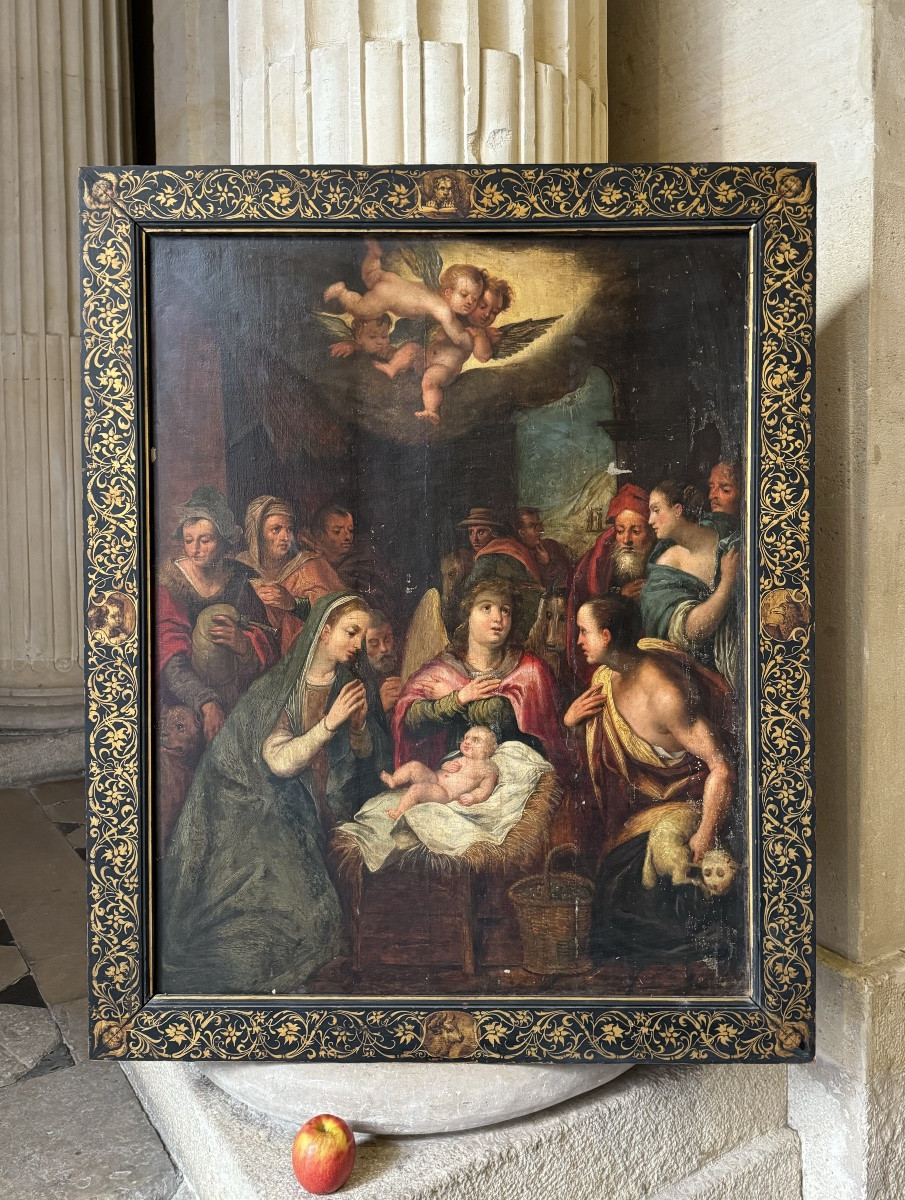


Adoration Of The Shepherds, Ambrosius Francken (in The Style Of), Late 16th Century
By a painter from the circle of the Antwerp painter Ambrosius Francken.
Oil on canvas. Painted dot frame.
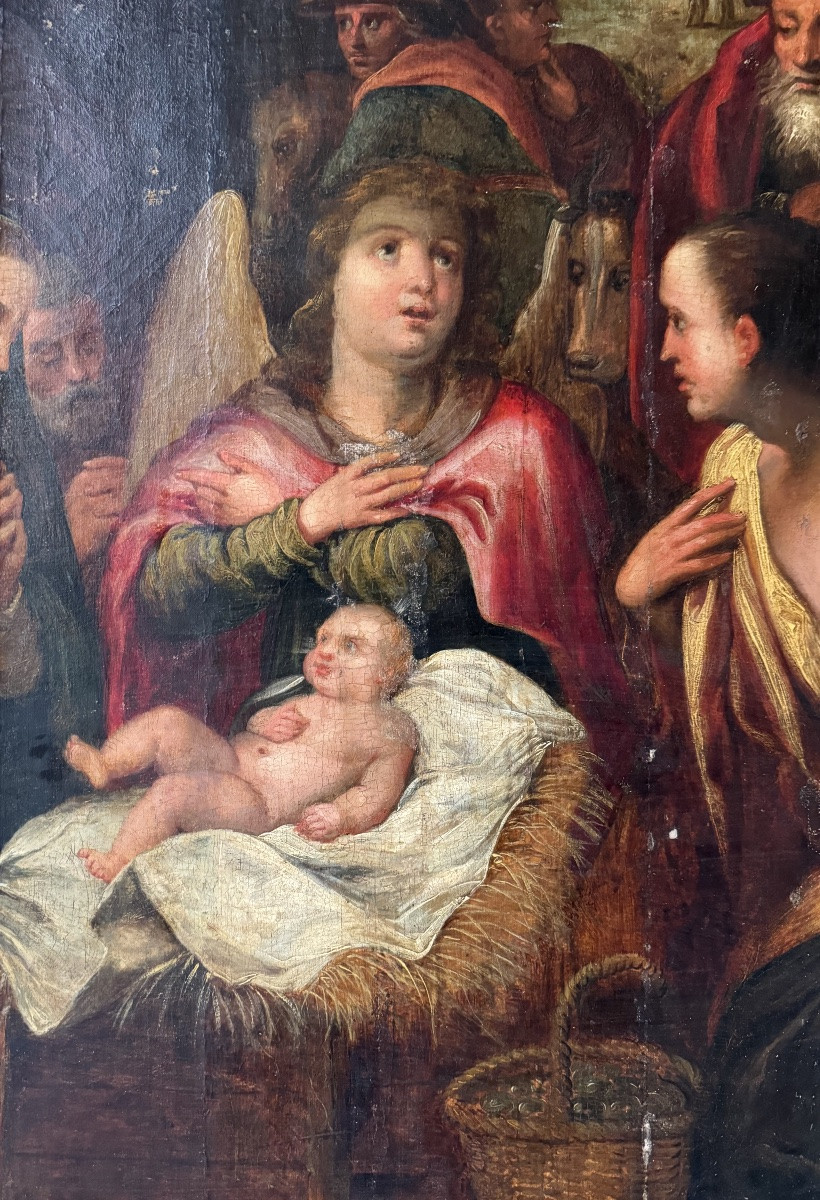
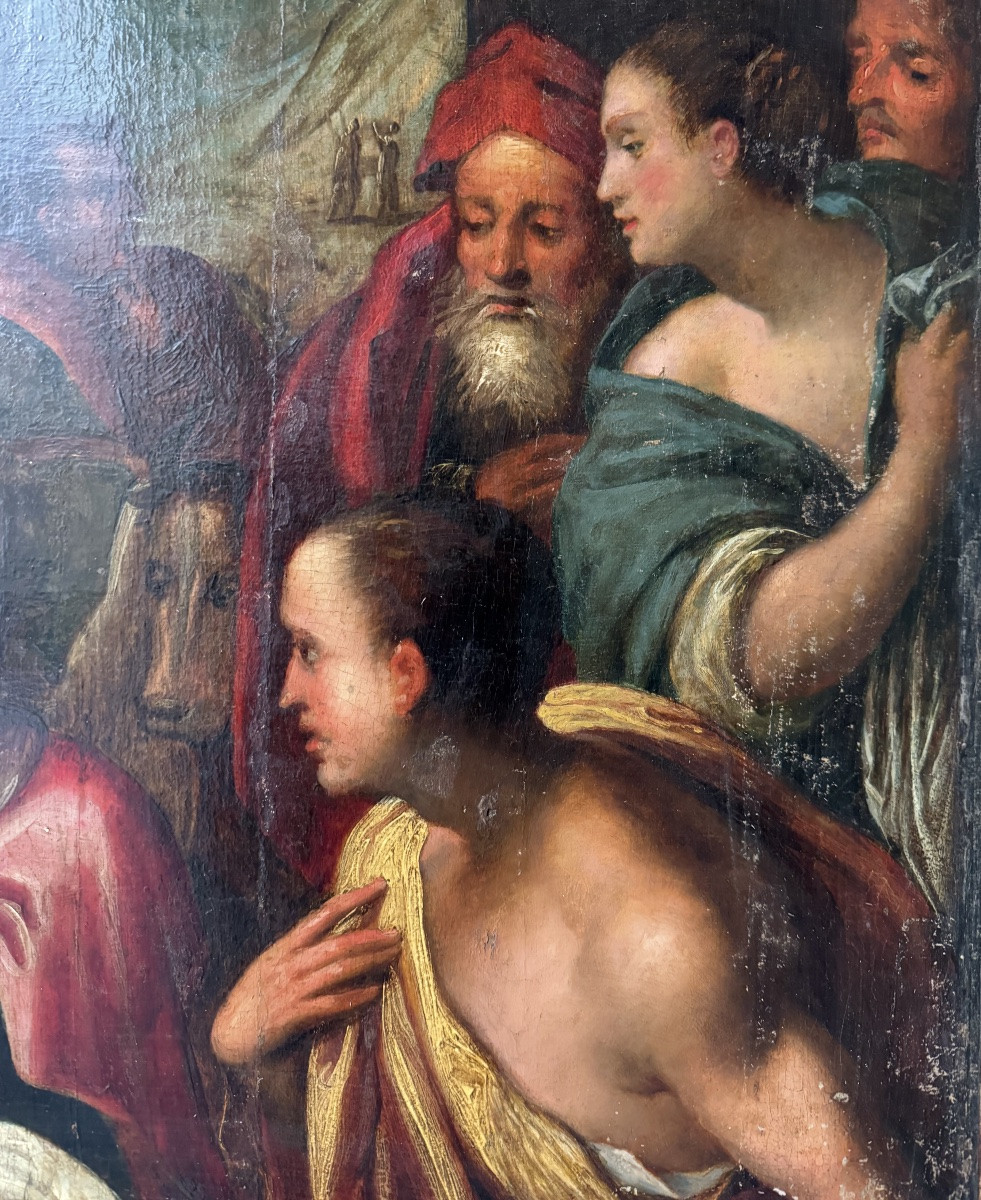
This large oil on canvas depicts an Adoration of the Shepherds, executed in a rich and narrative style characteristic of late 16th-century Flemish workshops. In the center, the Christ Child rests on a white cloth (a prefiguration of the Shroud) placed on a bed of straw, surrounded by the Virgin Mary and an angel who presents him in the light. Shepherds crowd around the scene, their faces animated by wonder, while two winged putti emerge from a golden cloud at the top of the composition. The diversity of expressions, the vibrancy of the colors—fiery reds, deep greens, luminous golds—and the abundance of figures attest to the work of an artist in the circle of Ambrosius Francken, also known as Ambrosius Francken the Elder, a major Antwerp painter of late Mannerism. The flowing drapery, rosy complexions, and soft modeling of the putti also reflect the aesthetic disseminated by the great Antwerp workshops during the Counter-Reformation.
This work is distinguished by its narrative density and its ascending pyramidal composition, typical of works intended for both churches and the Flemish or Iberian private market. These characteristics place this painting within the sphere of influence of the major Antwerp workshops active between 1580 and 1620.
At the end of the 16th century, Antwerp became one of the main centers for the production of religious paintings intended for export. Under the influence of Frans Floris, Marten de Vos, and the Francken family, artists developed a flamboyant Mannerist style, halfway between the Italian Renaissance and the Northern tradition. Ambrosius Francken the Elder, one of the leading figures of this generation, disseminated an immediately recognizable style: theatrical, colorful, and emphasized by a wide variety of expressions and gestures. Scenes of the Adoration of the Shepherds were among the most popular themes for Catholic patrons, as they symbolized humility, the Incarnation, and the spreading of divine light to ordinary humanity.
This painting belongs to this tradition and reflects the vitality of Antwerp painting at a time when it flourished throughout Europe.
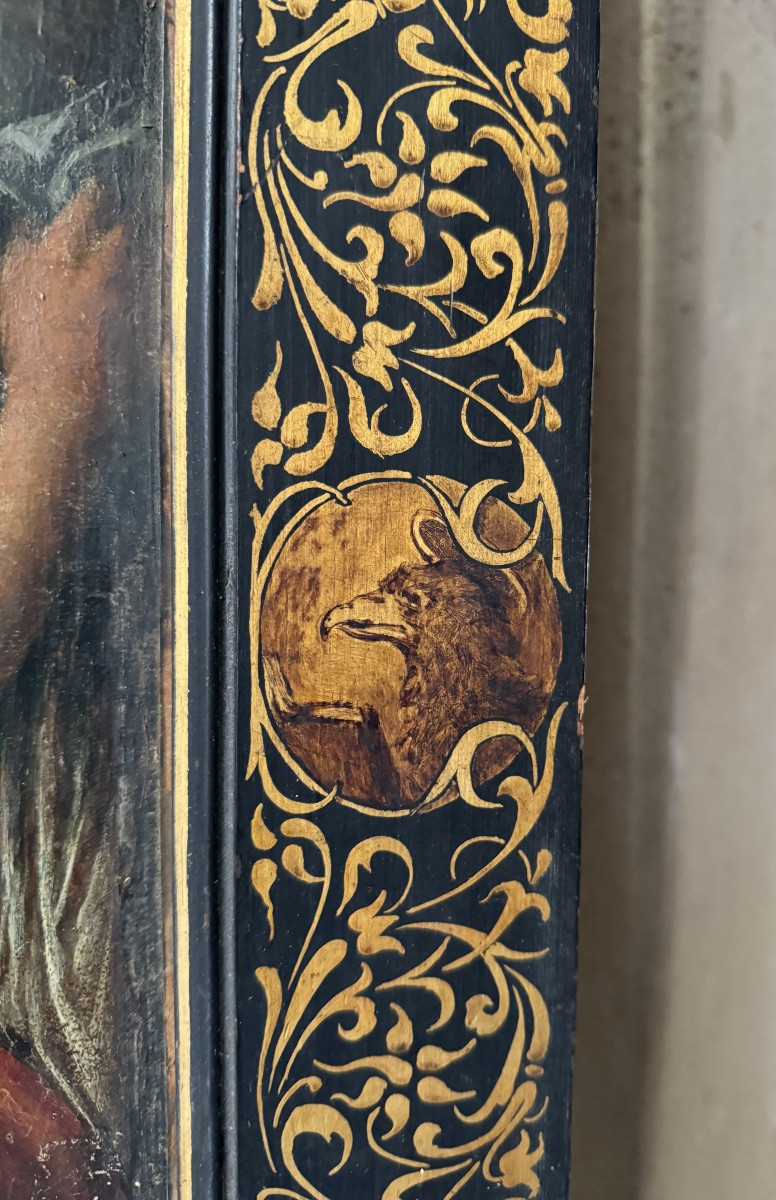
The canvas is in fairly good overall condition, with some losses and wear. The frame, likely later, is made of painted wood. It is decorated with scrolling foliage, with cartouches bearing the attribute of each of the Evangelists, even though the Adoration is only mentioned in Luke. The face of a cherub is painted in the corners.
Dimensions with frame: 90 x 110 cm.
????????
TRADUZIONE IN ITALIANO
Scuola fiamminga, fine XVI – inizio XVII secolo
Di un pittore dell’entourage del maestro fiammingo Ambrosius Francken
Olio su tela
Cornice in legno dipinto
Questa grande tela raffigura un’Adorazione dei Pastori eseguita nello stile ricco e narrativo tipico delle botteghe fiamminghe della fine del XVI secolo.
Al centro, il Bambino Gesù giace su un drappo bianco (prefigurazione della Sindone) posto su un letto di paglia, circondato dalla Vergine e da un angelo che lo presenta nella luce. I pastori si affollano attorno alla scena, i volti animati dallo stupore, mentre due putti alati emergono da una nube dorata nella parte superiore della composizione.
La varietà delle espressioni, la vivacità dei colori — rossi ardenti, verdi profondi, ori luminosi — e l’abbondanza di figure testimoniano l’opera di un artista dell’entourage di Ambrosius Francken (1544–1618), detto anche Ambrosius Francken il Vecchio, uno dei principali pittori anversesi del tardo manierismo. I drappeggi movimentati, le carnagioni rosate e il morbido modellato dei putti rimandano all’estetica diffusa dalle grandi botteghe di Anversa durante la Controriforma.
L’opera si distingue per la sua densità narrativa e per la composizione piramidale ascendente, tipica delle produzioni destinate sia alle chiese sia al mercato privato fiammingo e iberico. Queste caratteristiche collocano il dipinto nell’orbita dei grandi atelier anversesi attivi tra il 1580 e il 1620.
Alla fine del XVI secolo, Anversa divenne uno dei principali centri di produzione di pittura religiosa destinata all’esportazione. Sotto l’influenza di Frans Floris, Marten de Vos e della famiglia Francken, gli artisti svilupparono un linguaggio manierista sontuoso, a metà tra Rinascimento italiano e tradizione nordica.
Francken il Vecchio, figura di rilievo di questa generazione, diffuse uno stile immediatamente riconoscibile: teatrale, colorato, caratterizzato da una grande varietà di gesti ed espressioni. Le Adorazioni dei Pastori erano tra i soggetti più richiesti dalla committenza cattolica, poiché simboleggiavano l’umiltà, l’Incarnazione e la diffusione della luce divina all’umanità semplice.
Questo dipinto si inserisce pienamente in tale tradizione e riflette la vitalità della pittura anversese nel momento in cui irradiava in tutta Europa.
La tela è in condizioni complessivamente buone, con alcune mancanze e usure.
La cornice, probabilmente posteriore, è in legno dipinto, ornata da motivi a girali e da cartigli con gli attributi degli Evangelisti — benché l’Adorazione dei Pastori sia menzionata soltanto nel Vangelo di Luca. Negli angoli sono dipinti volti di angioletti.
Dimensioni con cornice: 90 × 110 cm
Period: 16th century
Style: Renaissance, Louis 13th
Condition: Good condition
Material: Oil painting
Length: 110
Width: 90
Reference (ID): 1668686
Availability: In stock