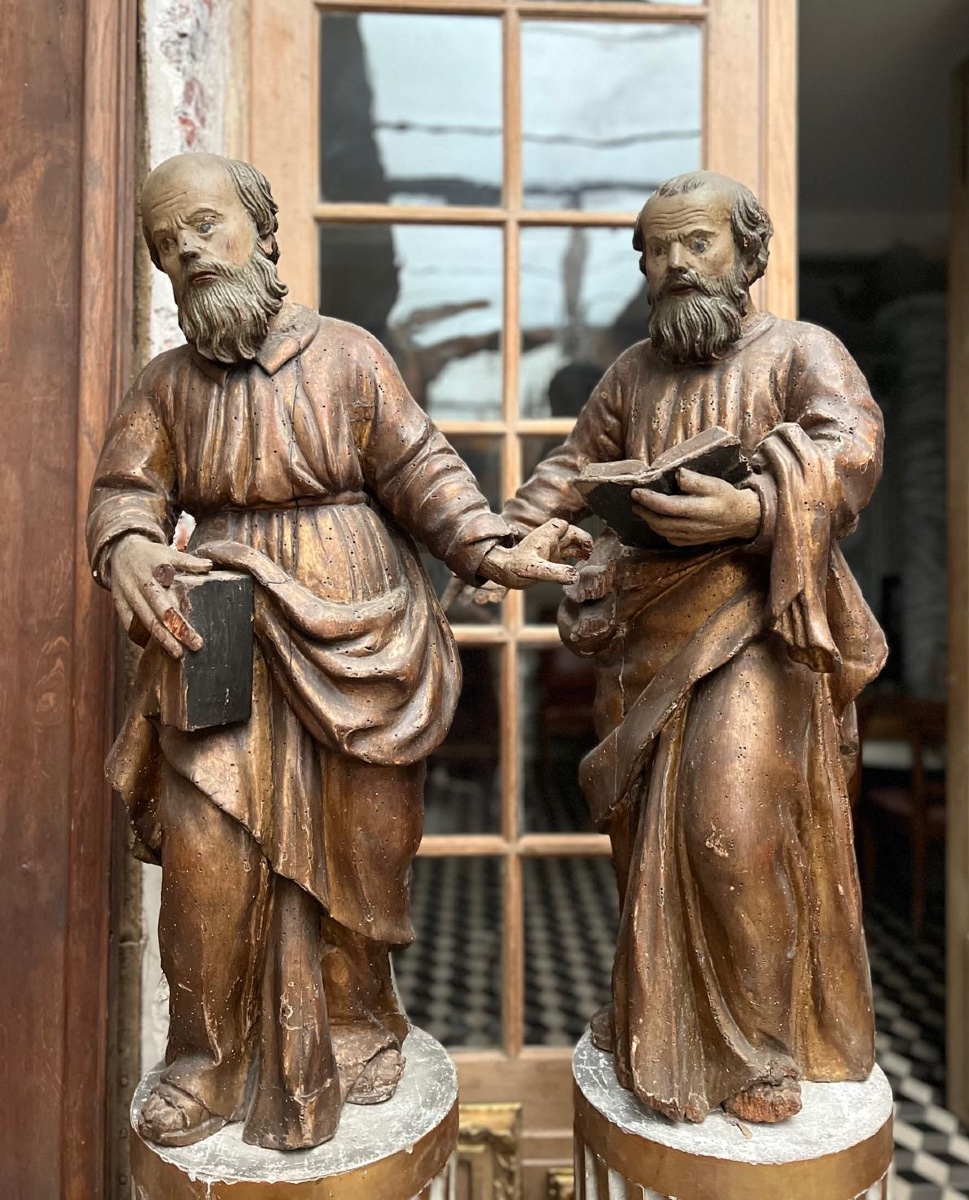
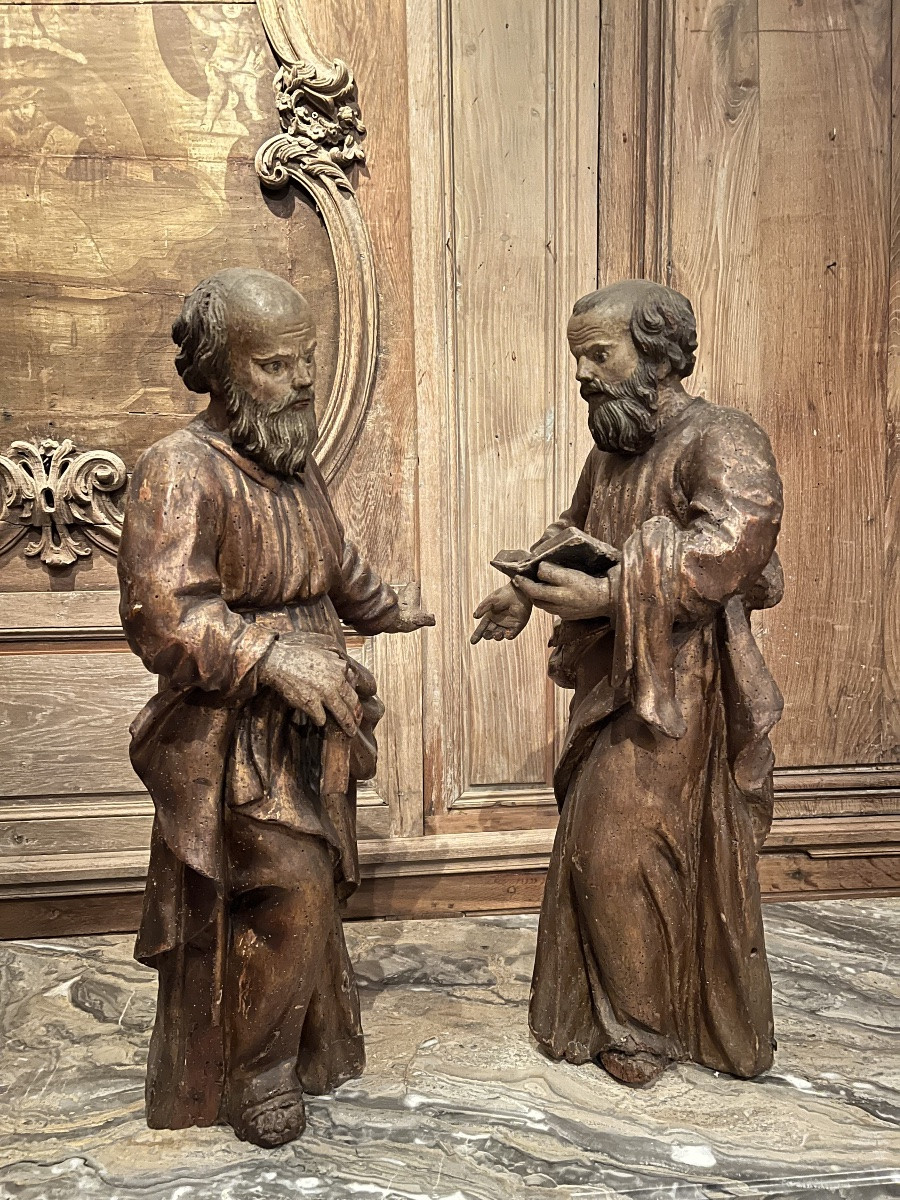
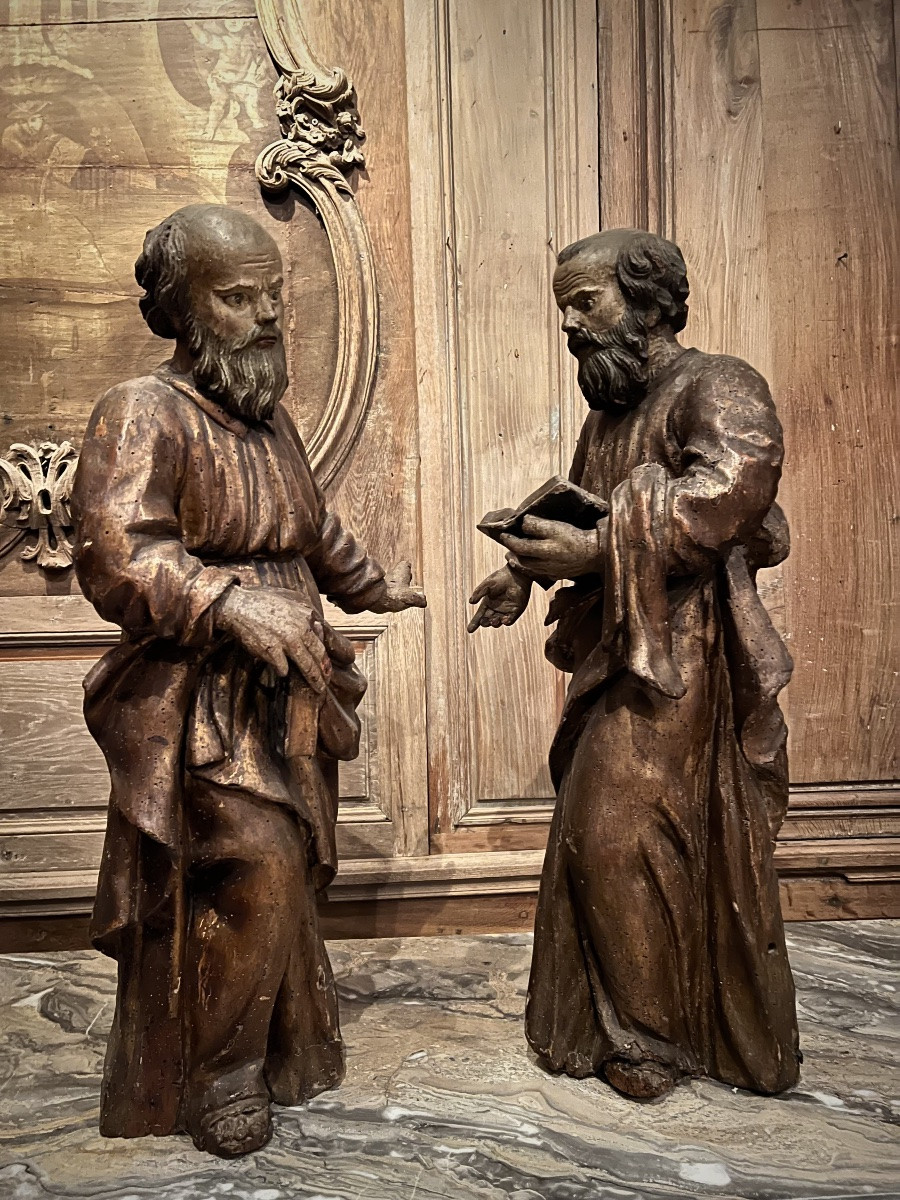

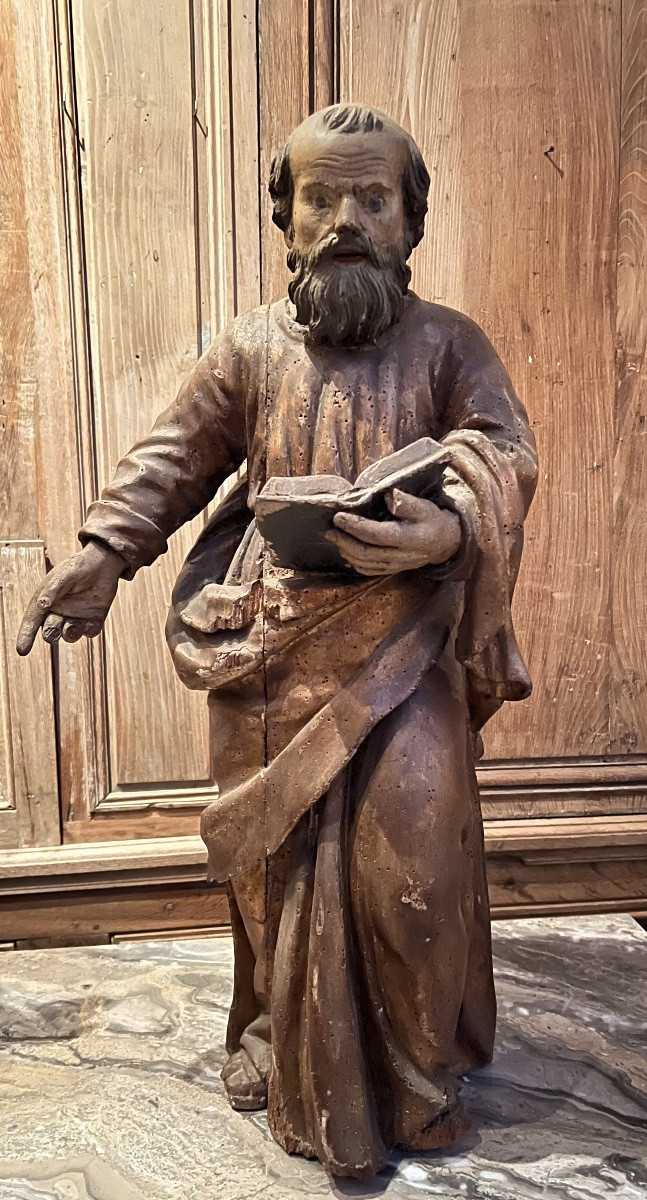
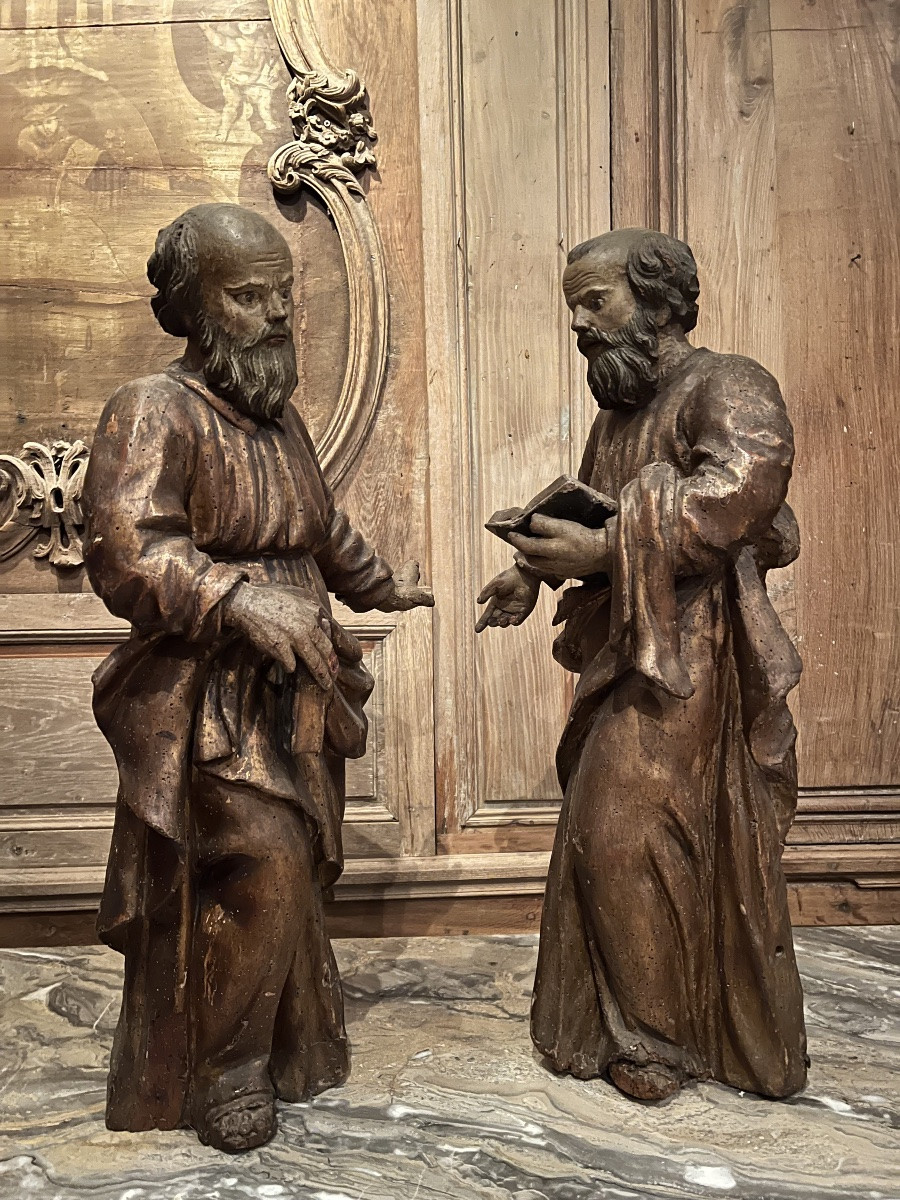


Pair of Apostles
Carved wood, polychromy and gilding; glass eyes
H. 92 cm and H. 94 cm
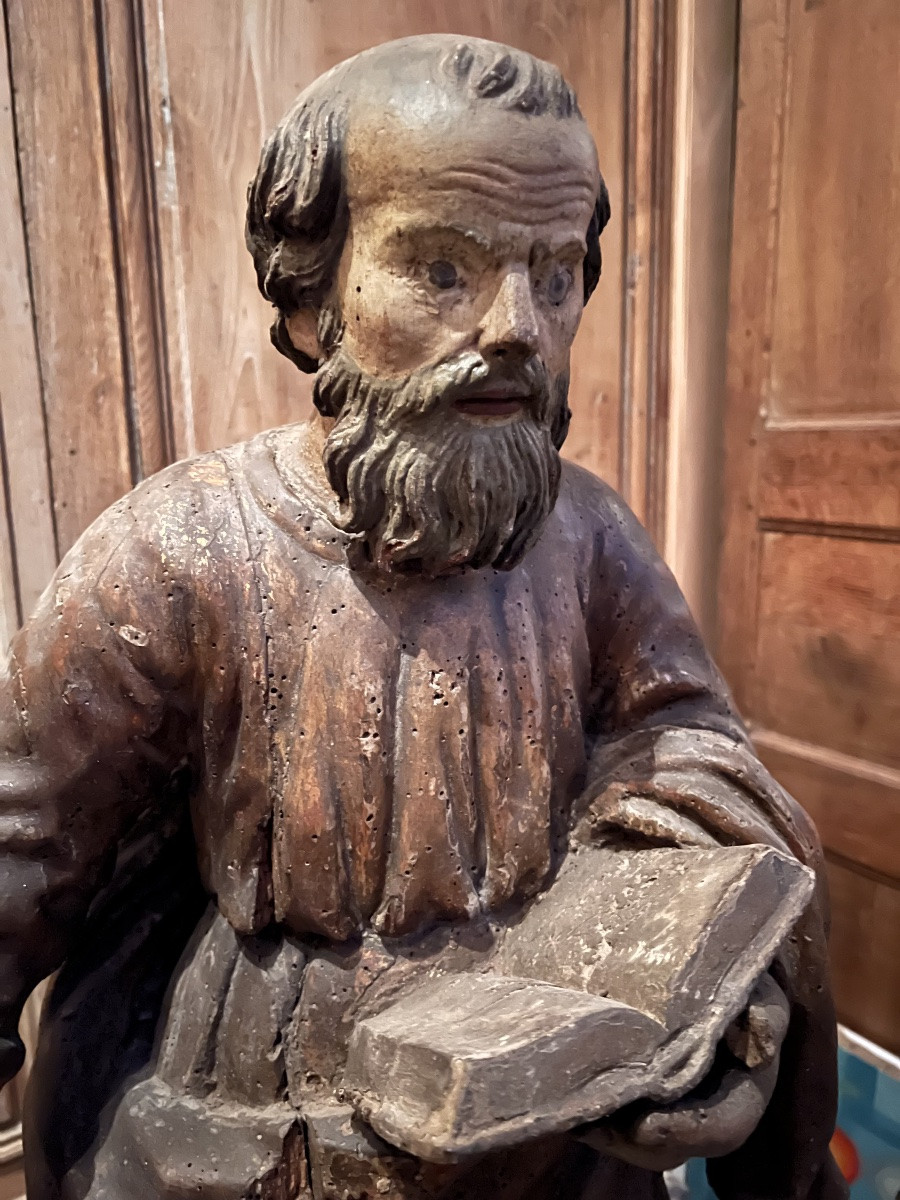
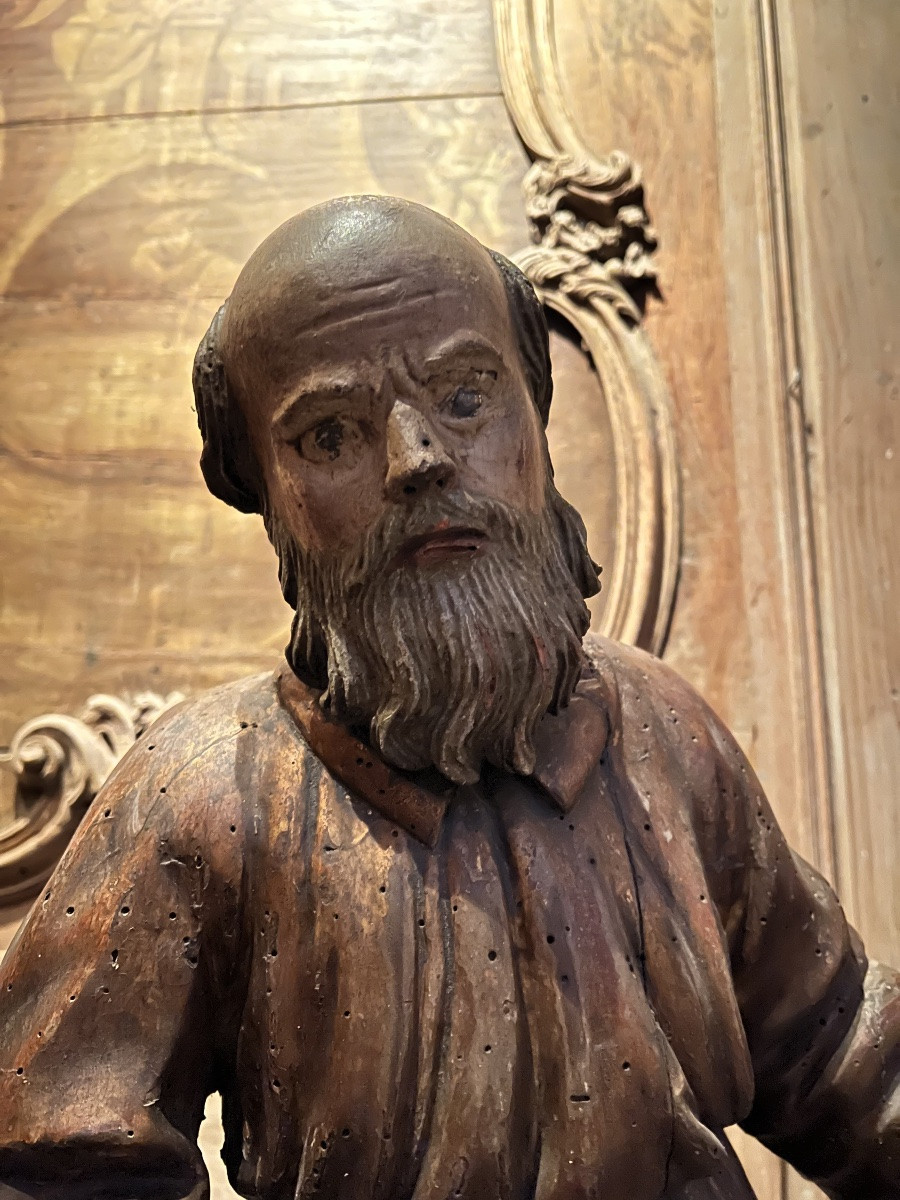
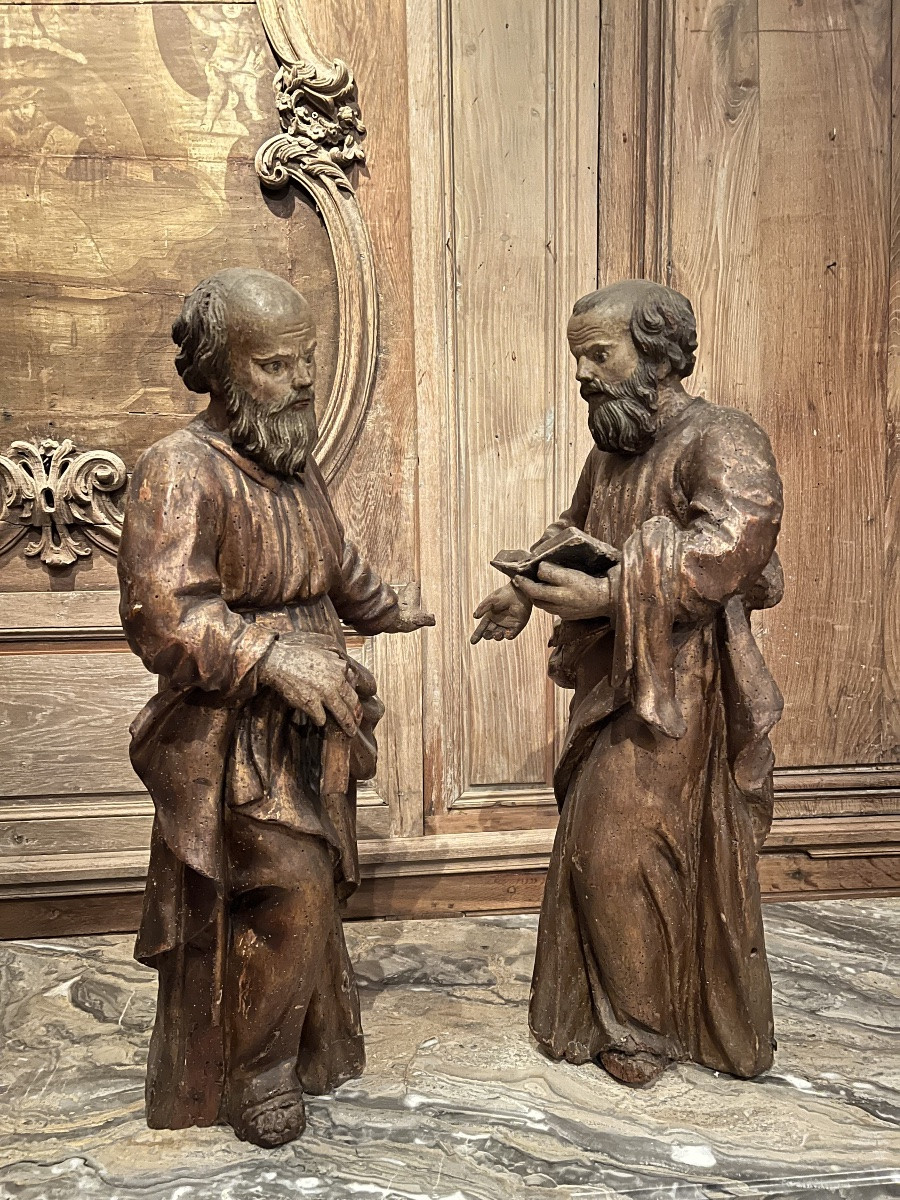
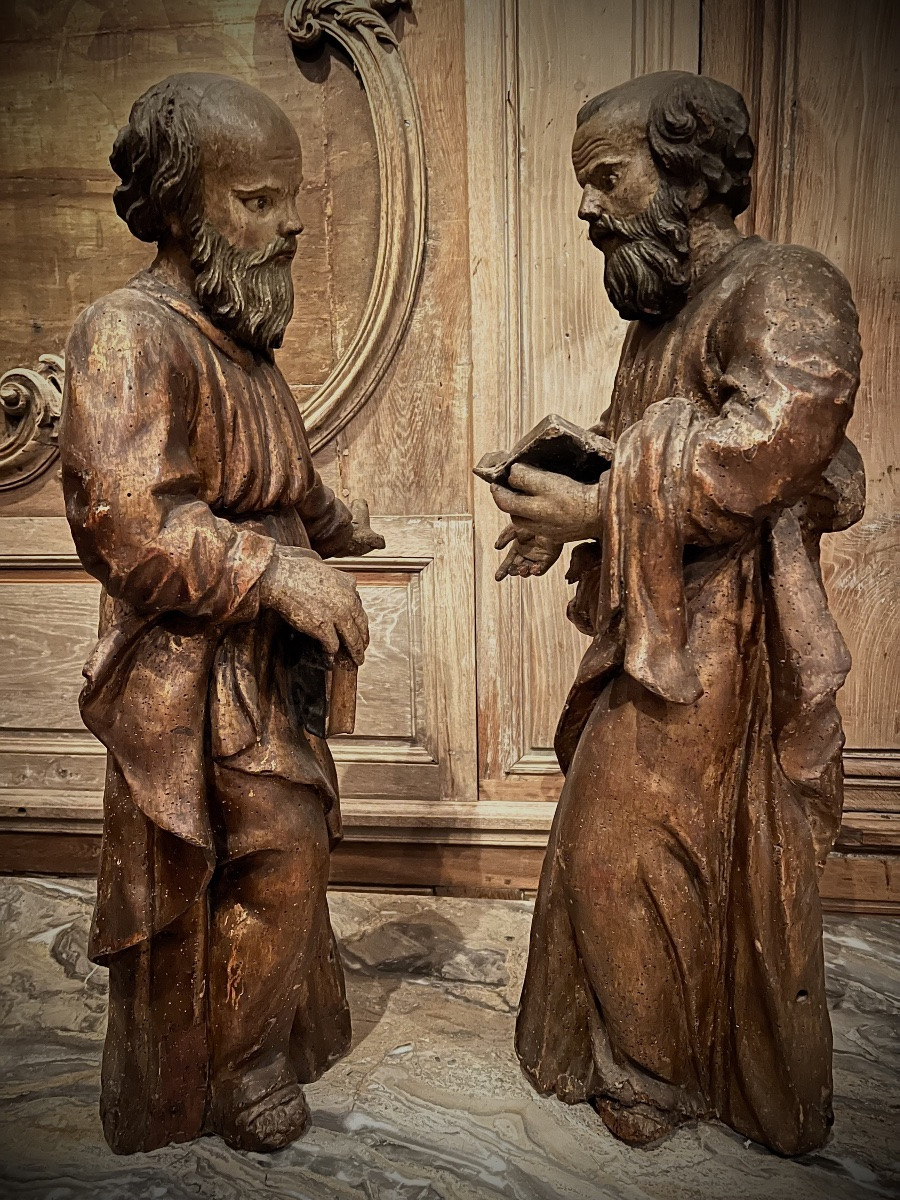
This imposing pair of high reliefs depicting two Apostles belongs to the late-medieval sculptural tradition of the Franco-Iberian sphere, where the art of polychromed wood sculpture—closely associated with the production of retables—reached a high degree of refinement during the 15th century. Their monumental presence, the firm vertical axis, and the survival of extensive original polychromy indicate that they once formed part of a larger iconographic program, likely the lateral tier or predella of a retable.
Stylistic and Typological Analysis
The chosen iconographic type—standing Apostles, emerging from but still integrally connected to an architectural framework—is consistent with the models developed in workshops of Southern France, Béarn, Navarre, and Northern Castile during the 15th century.
The elongated proportions, the linear and rhythmical treatment of the draperies, and the vertical “channel” folds point to an aesthetic still deeply indebted to the International Gothic, even as certain naturalistic tendencies begin to surface in the modelling of the faces.
Indeed, the softly modelled features, the carefully articulated cheekbones and jawline, and the desire for individual characterization place these works at the junction between late Gothic stylization and the early stirrings of a more humanistic sensibility.
Polychromy and Gilding: Technical Observations
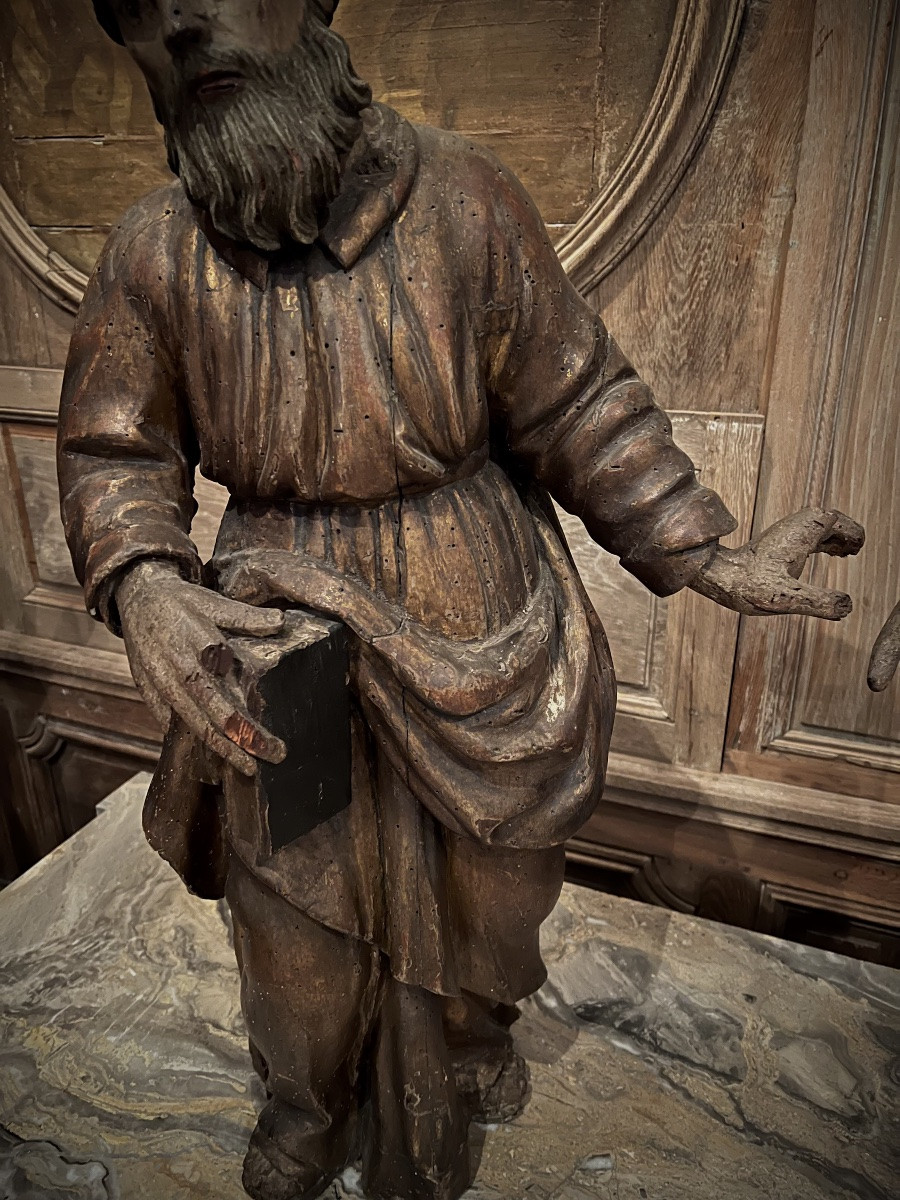
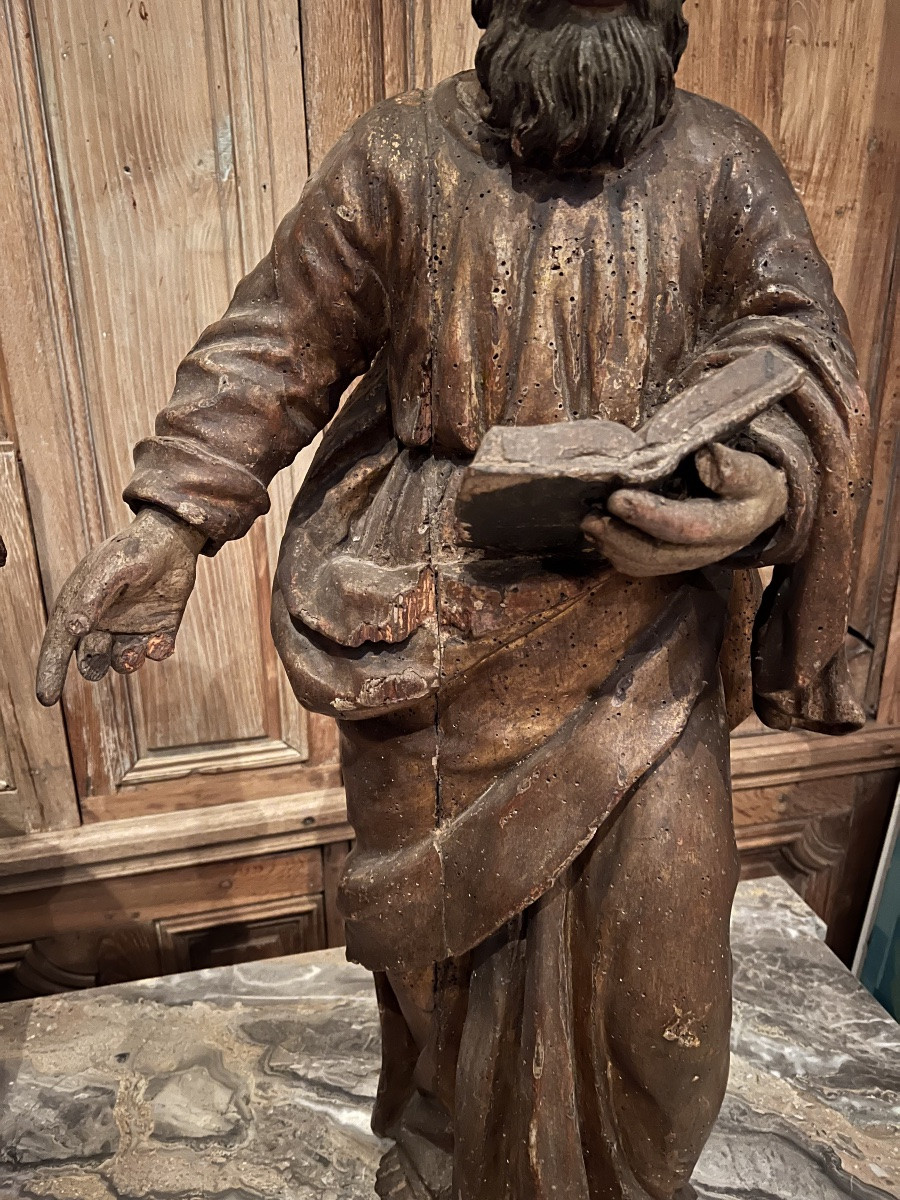
The polychromy, notable for its partial preservation, attests to a highly accomplished technique. Several stratigraphic elements may be identified:
- a finely polished gesso ground,
- gold leaf gilding applied over red bole, still visible in protected recesses,
- mineral pigments (ochres, red earths, copper-based greens),
- painted highlights intended to emphasize volumes and create luminous contrast, in accordance with methods widely practised in Iberian workshops.
The glass eyes, inserted into carved sockets, constitute a particularly striking feature. Although attested from the 14th century onward, their use became more widespread during the 16th and 17th centuries; their presence here, therefore, likely points to an early-modern intervention, further evidence of the sculptures’ long devotional life.
Carving Technique and Workshop Practices
The woodworking technique reveals the use of broad gouges for establishing the primary masses and finer chisels for:
- structuring the locks of hair,
- incising the beards into orderly striations,
- articulating the secondary folds of the draperies.
The depth of the relief—considerable for sculptures intended to be viewed from a moderate distance—suggests an original placement in a slightly elevated lateral position, where raking light would have enhanced the gilding and chromatic transitions.
Historical Context and Liturgical Function
Apostles, frequently represented in series in medieval retables, fulfilled both didactic and ecclesiological roles: they embodied the apostolic continuity of the Church and recalled the centrality of preaching.
In both the Iberian Peninsula and Southwestern France, their effigies often accompanied Christological or Marian narrative cycles.
This surviving pair may originally have belonged to:
- a full series of twelve,
- a smaller group occupying an upper register,
- or the lateral wings of a now-lost retable.
Condition
The sculptures exhibit:
- age-related wear consistent with 15th-century wooden polychromy,
- losses of paint layers on protruding surfaces,
- old accidents,
- several missing fingers, likely resulting from repeated handling or structural fragility in exposed areas of the wood.
Despite these alterations, the works retain exceptional legibility, and the surviving polychromy continues to convey much of their original visual impact and devotional power.












 Le Magazine de PROANTIC
 TRÉSORS Magazine
 Rivista Artiquariato