

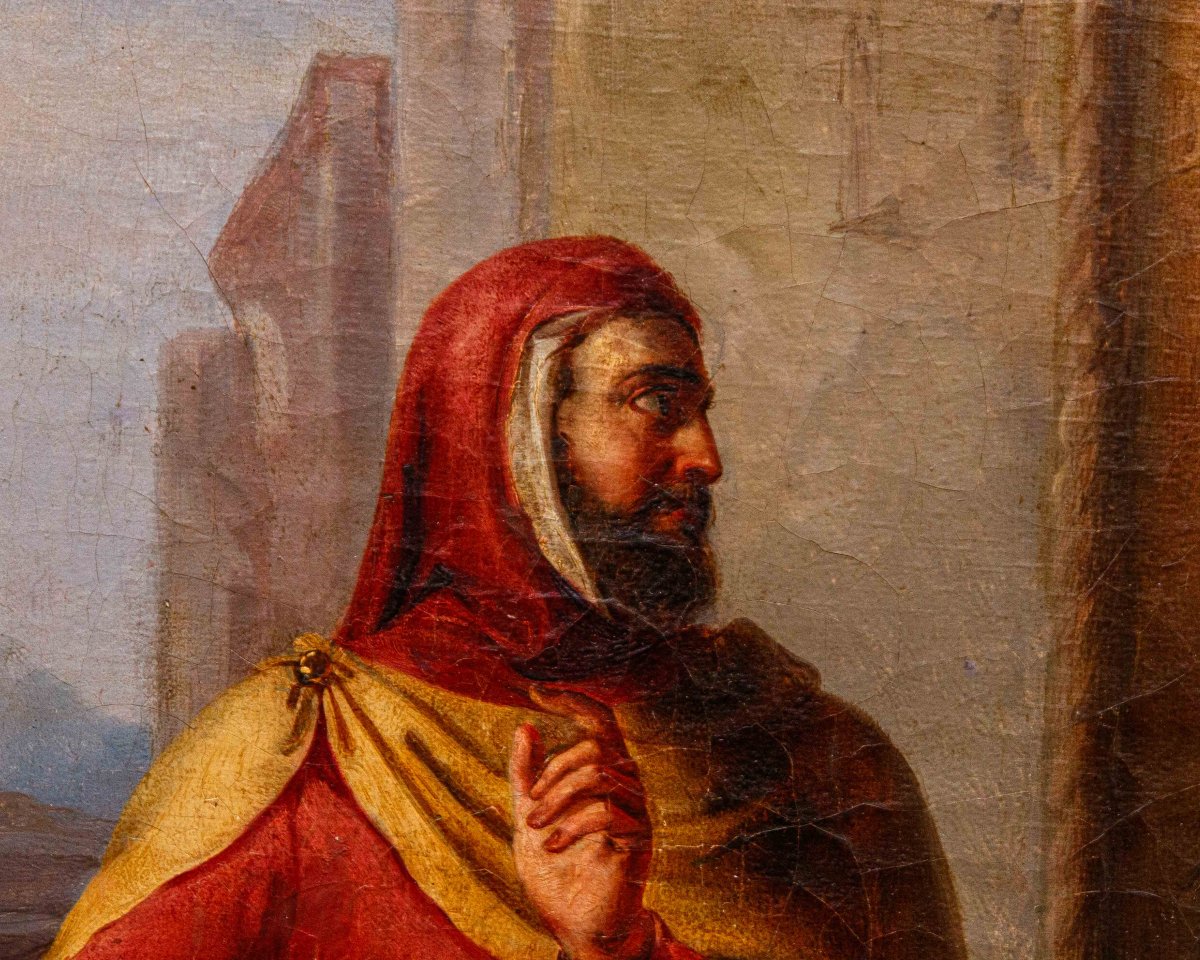


Vincenzo Giacomelli (grizzo, 1812 – Venice, 1890), The Meeting
Artist: Vincenzo Giacomelli (grizzo, 1812 - Venise, 1890)
Vincenzo Giacomelli (Grizzo, 1812 – Venice, 1890)
The meeting of Cangrande II della Scala with Princess Elisabeth of Bavaria (1350)
Oil on canvas, 79 x 60 cm
With frame, 95 x 78 cm
Signed lower right and dated 1845
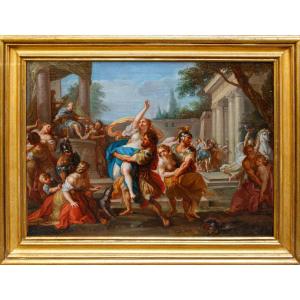
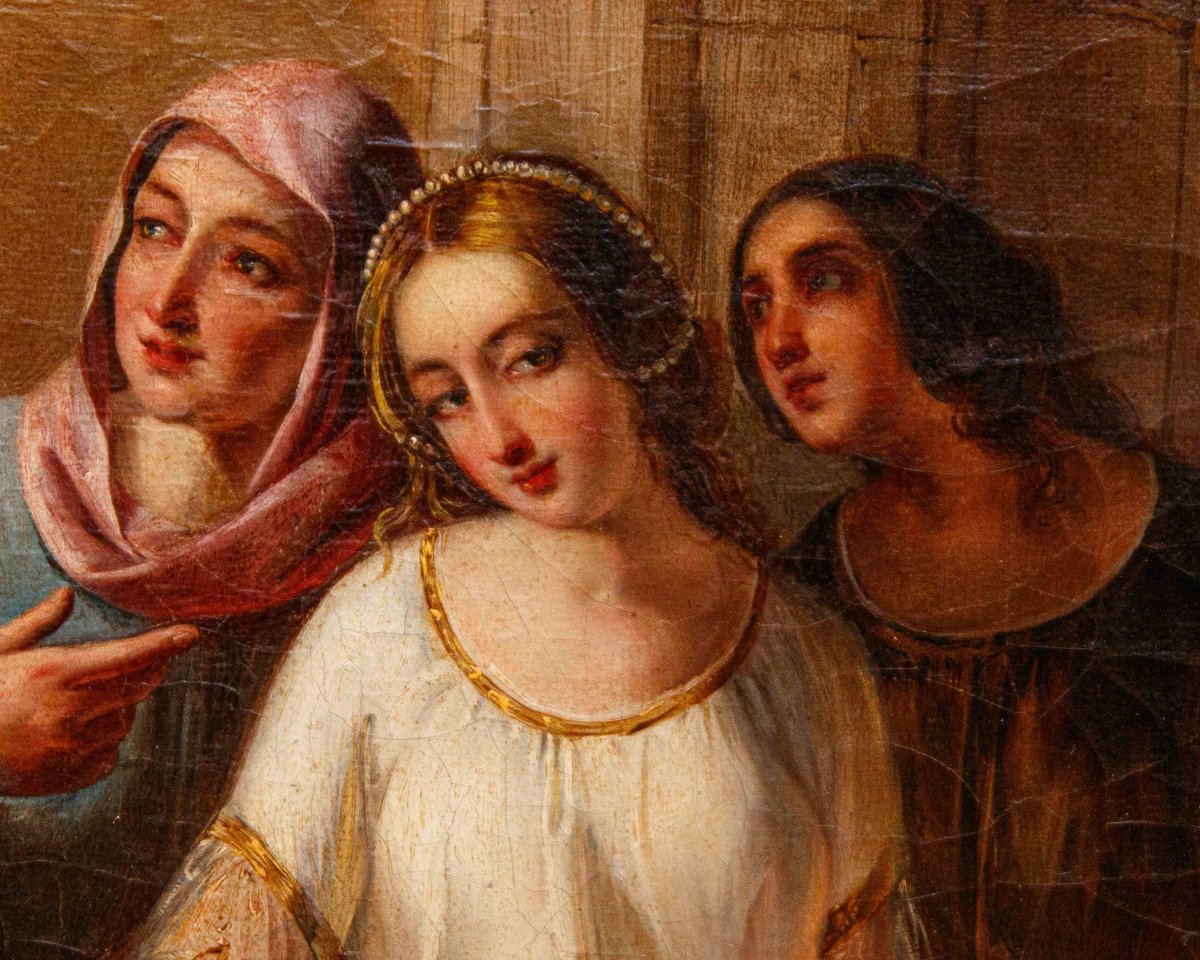
The work in question is ascribed to the pictorial corpus of Vincenzo Giacomelli, as attested by the signature placed by the artist himself at the bottom right, together with the date of execution, 1845 (at the time of its creation the painter was thirty-three years old). The work depicts the meeting between Prince Cangrande II della Scala, dressed in red in the centre, and Princess Elisabeth of Bavaria, daughter of Louis the Bavarian who later became Emperor of the Holy Roman Empire under the name Louis IV of Germany, which took place in 1350, the year in which they effectively married. Around the figures of the two protagonists are, in fact, the young woman's nurses and, in the foreground on the right, a squire, while in the background the city of Verona is visible. The following year Cangrande II della Scala became Lord of Verona and Vicenza (1351), and was renamed by the people “rabid dog”, due to his cruelty and his iron-stinged rule, which led to his assassination in 1359, leaving the baton to his son Cansignorio who, with the help of the princes of Carrara and Padua, became duke in his place. Vincenzo Giacomelli was born in Grizzo di Montereale Valcellina on April 3, 1812, son of Giuseppe Giacomelli and Osvalda Rafael, and died in Venice in 1890. His education took place at the Academy of Fine Arts in Venice, which he attended assiduously from 1830. His debut in the public art scene came in 1837, when he presented an altarpiece at an exhibition organized by the Venetian institute. The following year, in 1838, he achieved significant public and critical recognition thanks to a series of paintings focusing on the figure of Doge Marino Faliero. A further success was recorded in 1839, when he won the artistic competition organized by the well-known collector and patron Giacomo Treves. Starting in 1840, the Friulian painter undertook an intense exhibition activity, participating in the major artistic exhibitions of northern Italy, visiting cities such as Trieste, Venice, Milan and Turin. In particular, the period between 1839 and 1845 saw him particularly active in the Piedmontese city. In 1846, Giacomelli married the Parisian Vittoria Handin and opened his own well-established studio in Venice, near the Tolentini family at the Malcanton Bridge. From these years, the artist distinguished himself in the execution of episodes from ancient history, showing a marked predilection for Venice's glorious pasts. Among the works that confirmed his significant affirmation are, in particular, Diomedes Escapes by Hiding Palladio (1839, Venice, Gallerie dell'Accademia) and Antonio Loredan and the Siege of Scutari (1845, Treviso, Civic Museum), the latter created in the same year as the work considered here. Of fundamental historical-artistic importance was the cycle of six paintings dedicated to the siege of Venice (1848-1849), presented at the XVL edition of the Società Promotrice delle Belle Arti in Turin in 1866, to which he exhibited with a certain consistency over the years. This pictorial sequence —which includes titles such as The People Led by Daniele Manin Takes the Arsenal, Offers to the Fatherland, Battle at the Albergo della Campana in Mestre, The Heroic Death of Lieutenant Colonel Rossaroll, The Austrians Expelled from Fort Sant'Antonio and Bombing of Venice — is alongside other works of the same theme created by the artist, possessing a high iconographic value relating to the heroic defense of the city from the Austrian army. It is crucial to highlight that the creation of these paintings, which enjoyed a successful lithographic transposition at Lemercier in Paris, took place "live" by Giacomelli, who worked not only as a painter, but also as an officer of the Venetian Republic. He participated in the Exhibition of the Society for the Promotion of Fine Arts in Genoa, in the editions of 1856, 1858, 1862, 1865, 1868 and 1875, while in 1877 he exhibited at the National Exhibition of Fine Arts in Naples.
The work shows us Giacomelli's style, which reflects his training at the Venice Academy and the influences of historical Romanticism, with particular attention to the emotional and narrative rendering of the scenes. Giacomelli stands out for his ability to combine a formal rigor of academic origin, also visible in the precise and realistic brushstroke, with a romantic and narrative feeling, where light is used functionally to highlight the faces and bodies in the foreground, amplifying the pathos of the scene.
The meeting of Cangrande II della Scala with Princess Elisabeth of Bavaria (1350)
Oil on canvas, 79 x 60 cm
With frame, 95 x 78 cm
Signed lower right and dated 1845
The work in question is ascribed to the pictorial corpus of Vincenzo Giacomelli, as attested by the signature placed by the artist himself at the bottom right, together with the date of execution, 1845 (at the time of its creation the painter was thirty-three years old). The work depicts the meeting between Prince Cangrande II della Scala, dressed in red in the centre, and Princess Elisabeth of Bavaria, daughter of Louis the Bavarian who later became Emperor of the Holy Roman Empire under the name Louis IV of Germany, which took place in 1350, the year in which they effectively married. Around the figures of the two protagonists are, in fact, the young woman's nurses and, in the foreground on the right, a squire, while in the background the city of Verona is visible. The following year Cangrande II della Scala became Lord of Verona and Vicenza (1351), and was renamed by the people “rabid dog”, due to his cruelty and his iron-stinged rule, which led to his assassination in 1359, leaving the baton to his son Cansignorio who, with the help of the princes of Carrara and Padua, became duke in his place. Vincenzo Giacomelli was born in Grizzo di Montereale Valcellina on April 3, 1812, son of Giuseppe Giacomelli and Osvalda Rafael, and died in Venice in 1890. His education took place at the Academy of Fine Arts in Venice, which he attended assiduously from 1830. His debut in the public art scene came in 1837, when he presented an altarpiece at an exhibition organized by the Venetian institute. The following year, in 1838, he achieved significant public and critical recognition thanks to a series of paintings focusing on the figure of Doge Marino Faliero. A further success was recorded in 1839, when he won the artistic competition organized by the well-known collector and patron Giacomo Treves. Starting in 1840, the Friulian painter undertook an intense exhibition activity, participating in the major artistic exhibitions of northern Italy, visiting cities such as Trieste, Venice, Milan and Turin. In particular, the period between 1839 and 1845 saw him particularly active in the Piedmontese city. In 1846, Giacomelli married the Parisian Vittoria Handin and opened his own well-established studio in Venice, near the Tolentini family at the Malcanton Bridge. From these years, the artist distinguished himself in the execution of episodes from ancient history, showing a marked predilection for Venice's glorious pasts. Among the works that confirmed his significant affirmation are, in particular, Diomedes Escapes by Hiding Palladio (1839, Venice, Gallerie dell'Accademia) and Antonio Loredan and the Siege of Scutari (1845, Treviso, Civic Museum), the latter created in the same year as the work considered here. Of fundamental historical-artistic importance was the cycle of six paintings dedicated to the siege of Venice (1848-1849), presented at the XVL edition of the Società Promotrice delle Belle Arti in Turin in 1866, to which he exhibited with a certain consistency over the years. This pictorial sequence —which includes titles such as The People Led by Daniele Manin Takes the Arsenal, Offers to the Fatherland, Battle at the Albergo della Campana in Mestre, The Heroic Death of Lieutenant Colonel Rossaroll, The Austrians Expelled from Fort Sant'Antonio and Bombing of Venice — is alongside other works of the same theme created by the artist, possessing a high iconographic value relating to the heroic defense of the city from the Austrian army. It is crucial to highlight that the creation of these paintings, which enjoyed a successful lithographic transposition at Lemercier in Paris, took place "live" by Giacomelli, who worked not only as a painter, but also as an officer of the Venetian Republic. He participated in the Exhibition of the Society for the Promotion of Fine Arts in Genoa, in the editions of 1856, 1858, 1862, 1865, 1868 and 1875, while in 1877 he exhibited at the National Exhibition of Fine Arts in Naples.
The work shows us Giacomelli's style, which reflects his training at the Venice Academy and the influences of historical Romanticism, with particular attention to the emotional and narrative rendering of the scenes. Giacomelli stands out for his ability to combine a formal rigor of academic origin, also visible in the precise and realistic brushstroke, with a romantic and narrative feeling, where light is used functionally to highlight the faces and bodies in the foreground, amplifying the pathos of the scene.
3 600 €
Period: 19th century
Style: Other Style
Condition: Good condition
Material: Oil painting
Length: 60
Height: 79
Reference (ID): 1651581
Availability: In stock
Print