THIS OBJECT WAS SOLD
Ships In A Bay – Abraham Storck (1644 – 1708)
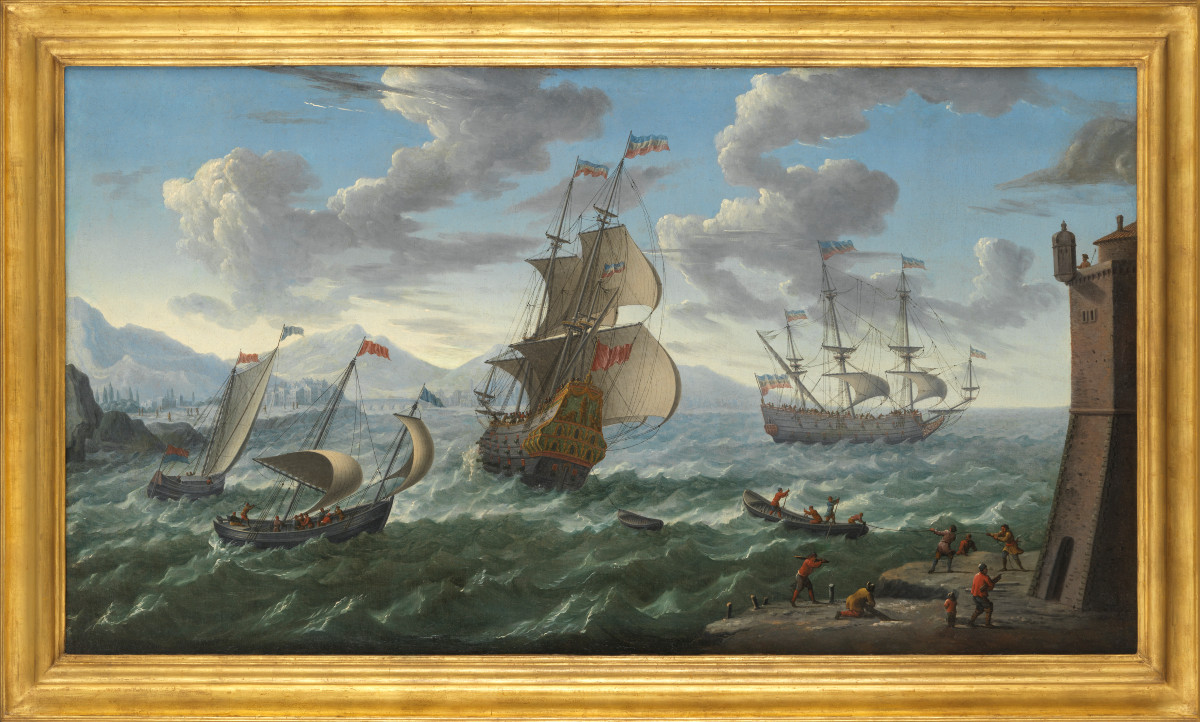
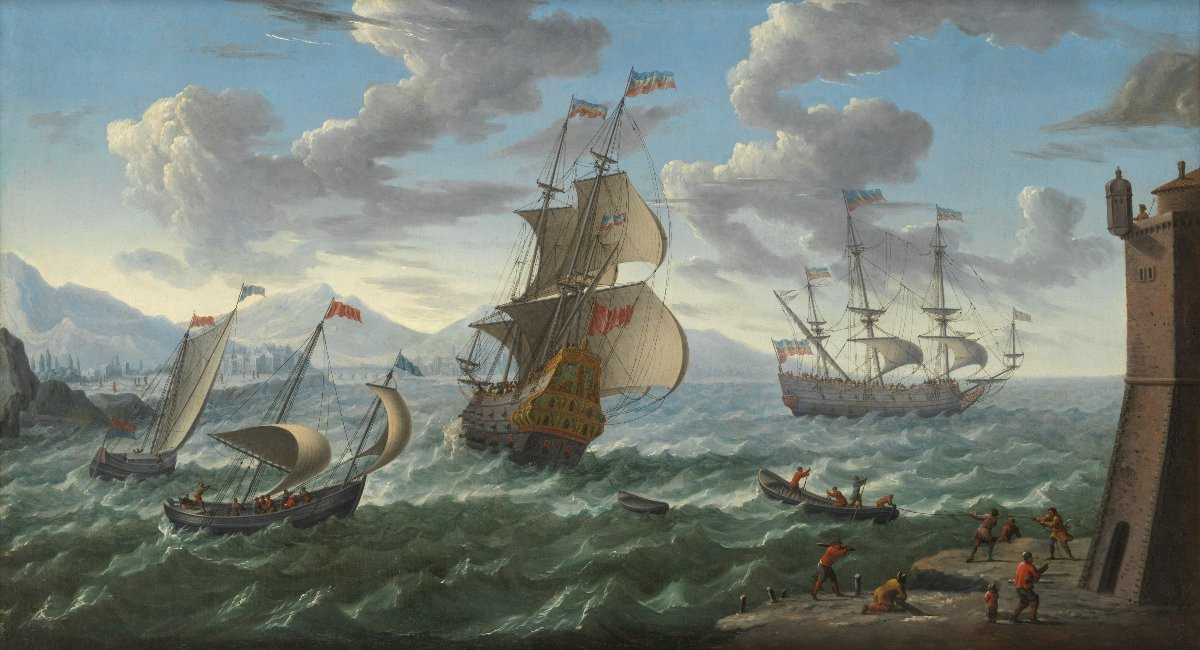



Oil on canvas. Late 17th-century Dutch School, attributed to Abraham Storck.
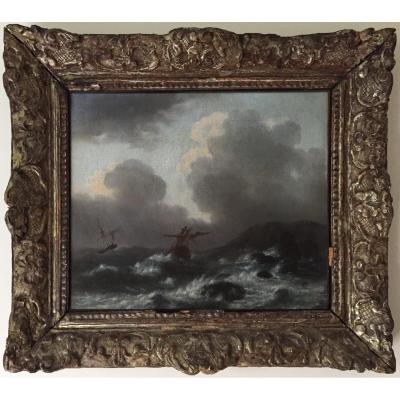
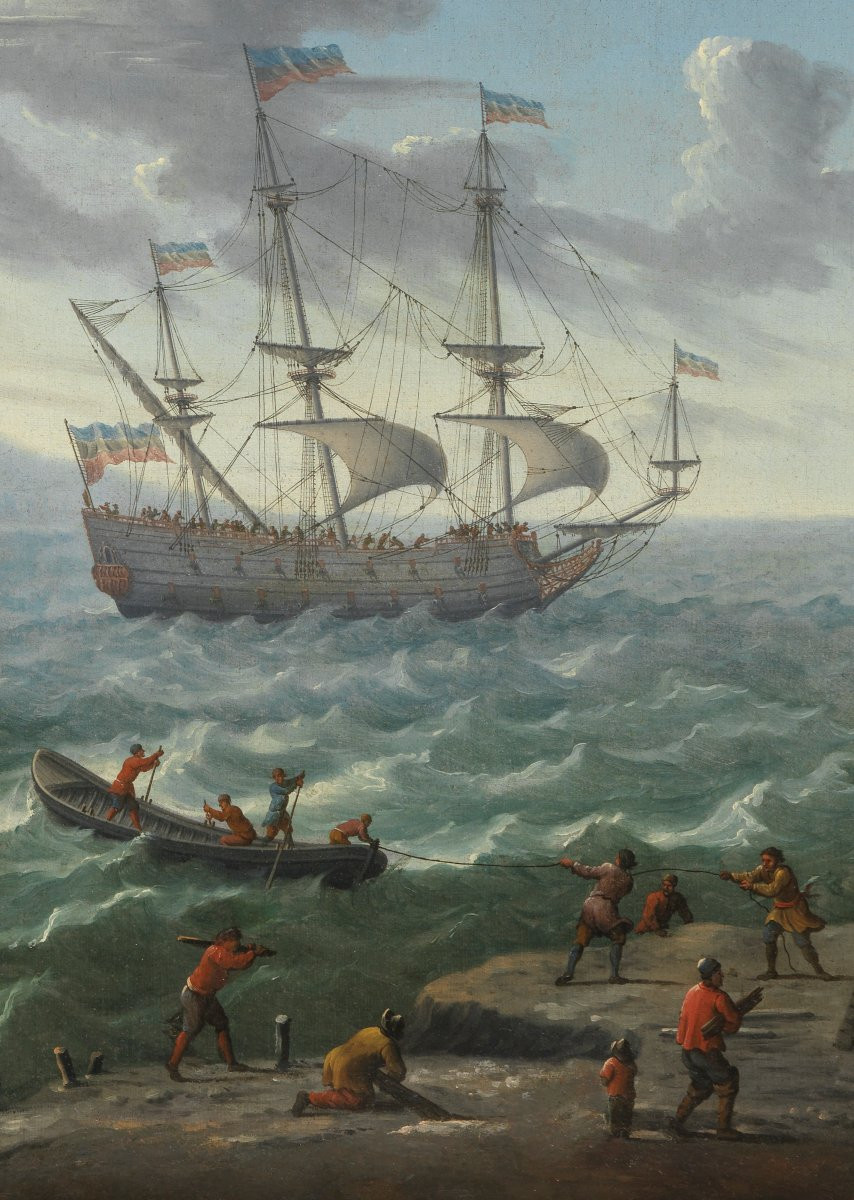
Our composition invites us to contemplate life in a bay from a shore defended by a powerful tower. There, on the quayside, sailors are busy bringing a longboat ashore after it left a warship flying the Dutch flag, all guns blazing. The maneuver is perilous in such a swell; the frail vessel could be wrecked on the rocks. In the background, on the opposite shore of the bay, a mountainous coastline and a large port city stretching across an estuary are visible, suggesting intense commercial and military activity.
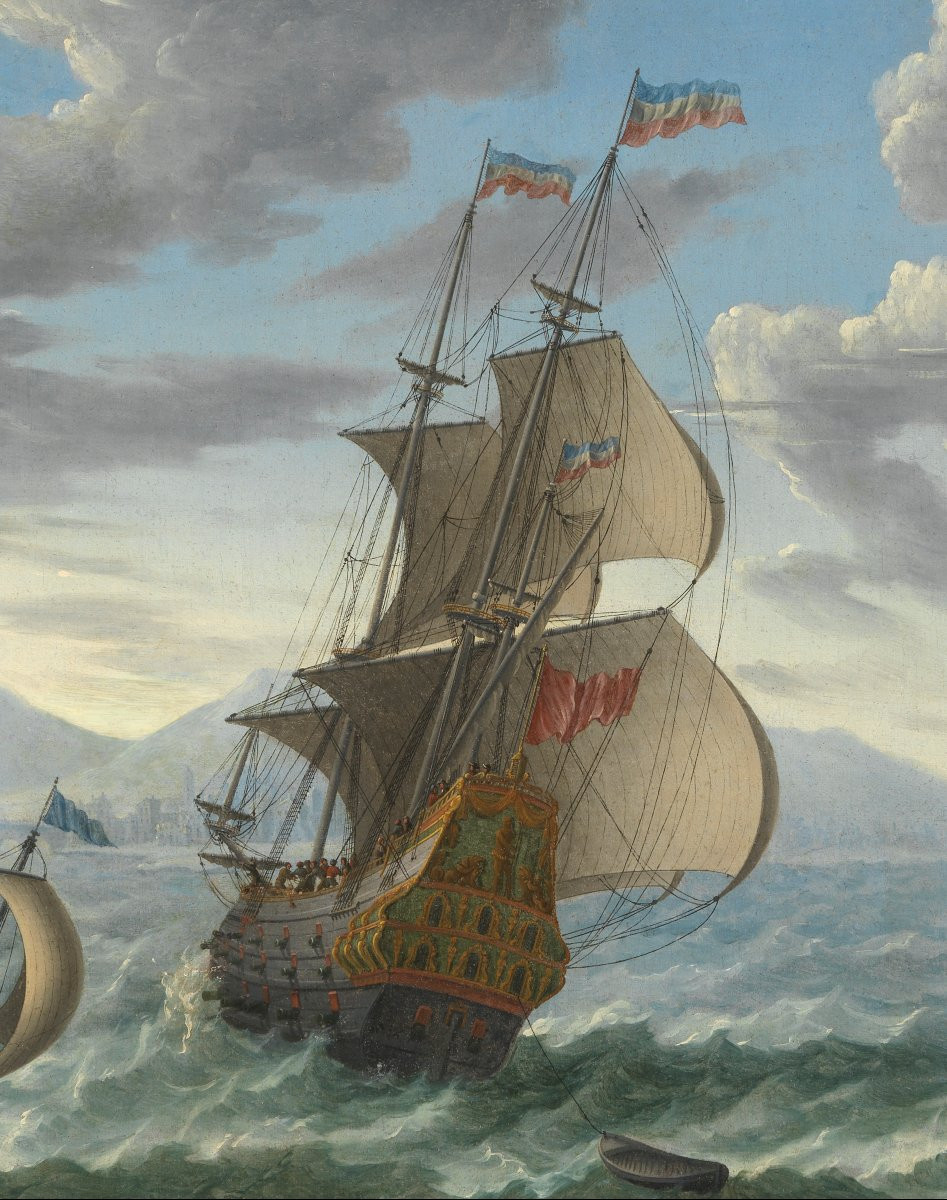
The work belongs to the Dutch tradition of maritime paintings that document port life, trade, and navigation during the time of the Dutch Republic. The interactions between the men on the coast and the large merchant ships, as well as the vivid depiction of the sky and sea, are typical of Abraham Storck's style. His taste for the sublime, for movement, and for contrasting light is evident, combining technical precision in the depiction of the buildings with an interest in atmospheric effects. The meticulous rendering of the rigging (even the smallest ropes are drawn), the decks, and the decoration of the central ship's stern (where a representation of Poseidon can be discerned) reflects a genuine documentary approach characteristic of Storck, influenced by the Van de Veldes family. Yet, his figures are sketched with economy of means, in order to reinforce the maritime narrative rather than individual anecdotes.
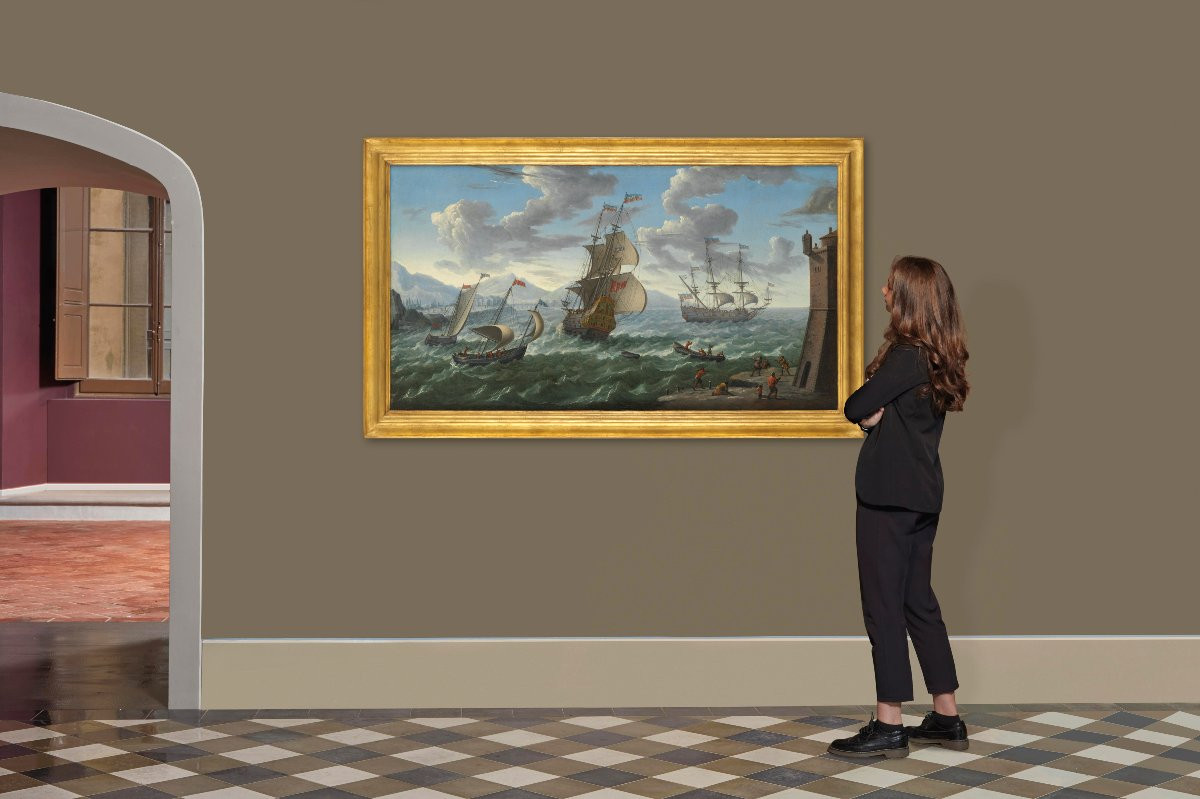
Dimensions: 75 x 135 cm – 90 x 152 cm with frame.
Biography:
Abraham Storck (Amsterdam 1644 – id. 1708) was the youngest son of the painter Jan Jansz Sturck (1603-1664/1670). His brothers Johannes and Jacobus were also painters, but Abraham was certainly the most gifted and renowned of the three. Nothing is known of his formal training, but it is known that he painted figures for some paintings by Frederik de Moucheron and Meindert Hobbema. He is particularly distinguished for his seascapes and Italian-inspired harbor scenes, a genre in which he excelled. His works are characterized by precise execution and a pleasing subtlety of tone within a colorful palette.
Bibliography:
- MULLENMEISTER, Kurt J., Meer und Land im Licht des 17. Jahrunderts, Bremen Verlag Schünemann, 1973.
- GOEDDE, Lawrence Otto, Tempest and Shipwreck in Dutch and Flemish Art: Convention, Rhetoric, and Interpretation, Park, Pennsylvania State University Press, 1989.
- RUPERT, Preston, The Seventeenth Century Marine Painters of the Netherlands, F. Lewis Publishers, Leigh-on-Sea, 1974.
- SCHEELE, Friedrich and Kanzenbach Annette, Ludolf Backhuysen: Emdem 1630 – Amsterdam 1708. Deutscher Kunstverlag 2008.
- SLIVE, Seymmour, Dutch painting 1600-1800, Yale University Press, 1998.
- CORDINGLY David, Westby Percival-Prescott, The Art Of The Van De Veldes, National Maritime Museum London, 1982
- BAARD Henricus Petrus, Willem van de Velde de Oude, Willem van de Velde de Jonge, Amsterdam Palet Serie, 1942
Our composition invites us to contemplate life in a bay from a shore defended by a powerful tower. There, on the quayside, sailors are busy bringing a longboat ashore after it left a warship flying the Dutch flag, all guns blazing. The maneuver is perilous in such a swell; the frail vessel could be wrecked on the rocks. In the background, on the opposite shore of the bay, a mountainous coastline and a large port city stretching across an estuary are visible, suggesting intense commercial and military activity.
The work belongs to the Dutch tradition of maritime paintings that document port life, trade, and navigation during the time of the Dutch Republic. The interactions between the men on the coast and the large merchant ships, as well as the vivid depiction of the sky and sea, are typical of Abraham Storck's style. His taste for the sublime, for movement, and for contrasting light is evident, combining technical precision in the depiction of the buildings with an interest in atmospheric effects. The meticulous rendering of the rigging (even the smallest ropes are drawn), the decks, and the decoration of the central ship's stern (where a representation of Poseidon can be discerned) reflects a genuine documentary approach characteristic of Storck, influenced by the Van de Veldes family. Yet, his figures are sketched with economy of means, in order to reinforce the maritime narrative rather than individual anecdotes.
Dimensions: 75 x 135 cm – 90 x 152 cm with frame.
Biography:
Abraham Storck (Amsterdam 1644 – id. 1708) was the youngest son of the painter Jan Jansz Sturck (1603-1664/1670). His brothers Johannes and Jacobus were also painters, but Abraham was certainly the most gifted and renowned of the three. Nothing is known of his formal training, but it is known that he painted figures for some paintings by Frederik de Moucheron and Meindert Hobbema. He is particularly distinguished for his seascapes and Italian-inspired harbor scenes, a genre in which he excelled. His works are characterized by precise execution and a pleasing subtlety of tone within a colorful palette.
Bibliography:
- MULLENMEISTER, Kurt J., Meer und Land im Licht des 17. Jahrunderts, Bremen Verlag Schünemann, 1973.
- GOEDDE, Lawrence Otto, Tempest and Shipwreck in Dutch and Flemish Art: Convention, Rhetoric, and Interpretation, Park, Pennsylvania State University Press, 1989.
- RUPERT, Preston, The Seventeenth Century Marine Painters of the Netherlands, F. Lewis Publishers, Leigh-on-Sea, 1974.
- SCHEELE, Friedrich and Kanzenbach Annette, Ludolf Backhuysen: Emdem 1630 – Amsterdam 1708. Deutscher Kunstverlag 2008.
- SLIVE, Seymmour, Dutch painting 1600-1800, Yale University Press, 1998.
- CORDINGLY David, Westby Percival-Prescott, The Art Of The Van De Veldes, National Maritime Museum London, 1982
- BAARD Henricus Petrus, Willem van de Velde de Oude, Willem van de Velde de Jonge, Amsterdam Palet Serie, 1942
Explore similar pieces and discover your ideal find:
Seascapes, Marine Paintings