THIS OBJECT WAS SOLD
Egyptian “anra” Steatite Scarab — Amulet With Certificate Of Authenticity
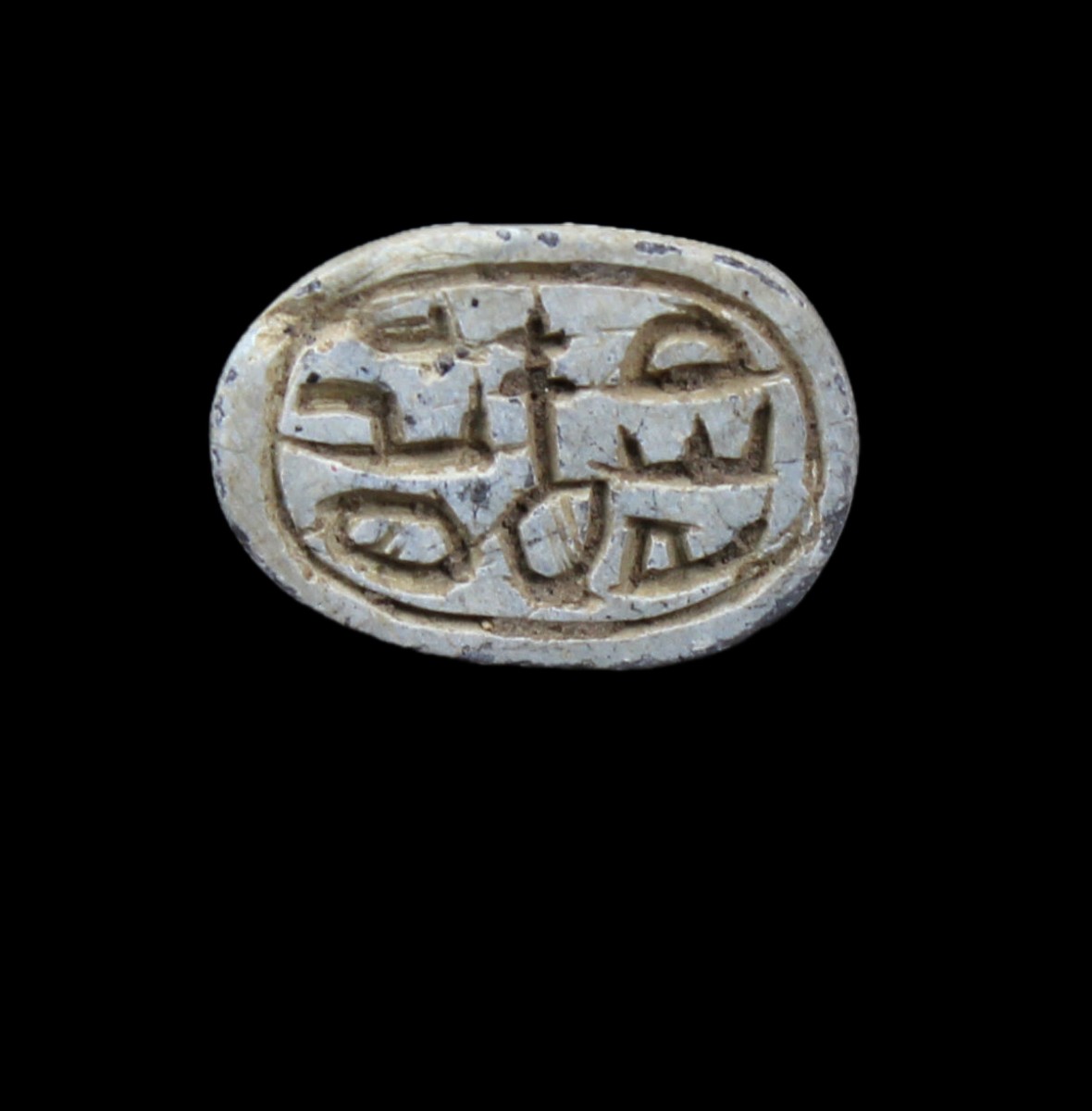
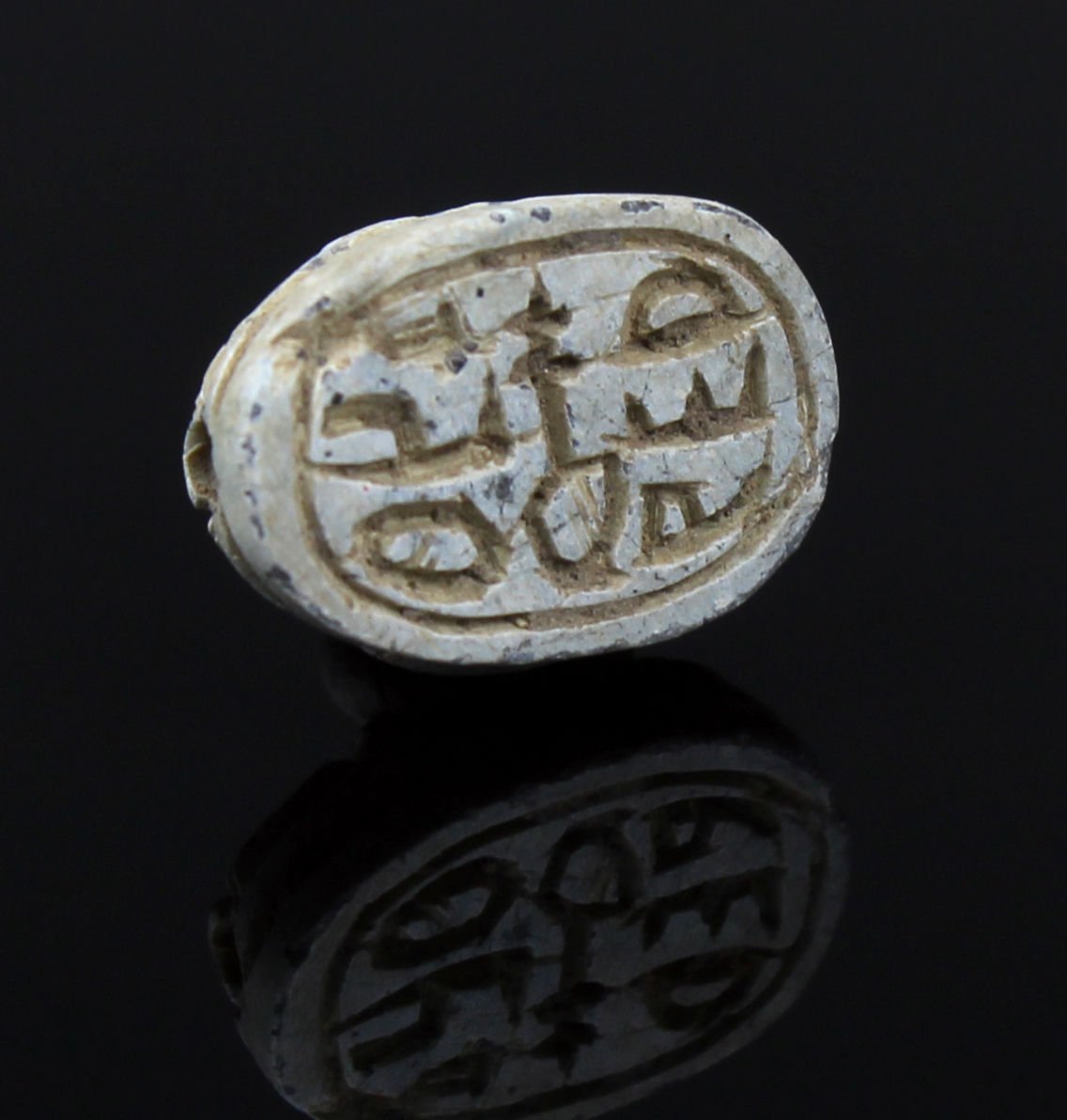
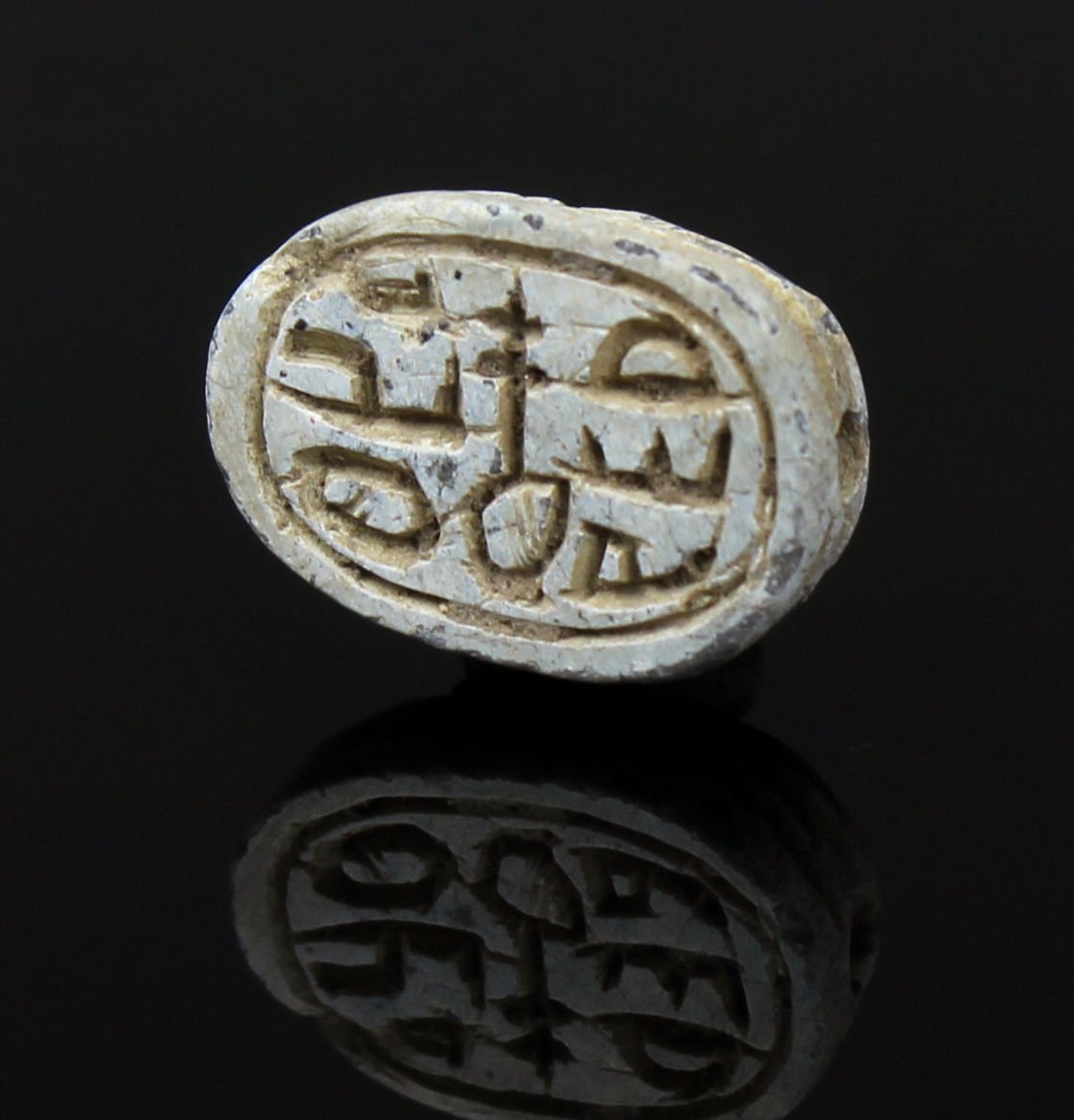



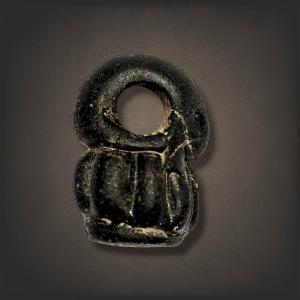
Small steatite seal-scarab, finely carved and engraved on the flat underside with a pseudo-hieroglyphic “Anra” motif, framed within an oval border. The engraving is crisp and balanced, showing refined craftsmanship: well-defined clypeus, distinct pronotal groove, elytra separated by a double line, and stylized legs carved in low relief. The axial biconical perforation, carefully drilled, indicates a functional amuletic use, allowing suspension as a pendant or mounting on a ring.
The surface displays a beautiful ivory-honey patina, softened by age, with minor edge wear, archaeological pitting, and light mineral deposits consistent with ancient burial. The marginal chipping around the engraved field is old and stable—authentic testimony to the scarab’s long life and circulation. The piece remains untouched, unrestored, and entirely genuine.
Object: Seal-scarab with pseudo-hieroglyphic “Anra” motif
Material: Steatite (chlorite schist), originally glazed, now aged to an ivory tone
Culture / Period: Egyptian – Second Intermediate Period
Date: Circa 1700–1550 B.C.
Dimensions: 15 × 10 mm (oval)
Condition: Excellent for its type; regular wear, minute edge bites, natural encrustations; original perforation intact
Mounting: Unmounted; ancient axial hole suitable for suspension or setting
Authenticity: Certificate of authenticity included
During the Second Intermediate Period, seal-scarabs became widespread throughout Egypt as symbols of devotion, protection, and personal identity.
Alongside royal names and votive inscriptions, artisans developed pseudo-hieroglyphic designs such as the so-called “Anra” group—a stylized sequence of vertical strokes, arcs, and semicircles—interpreted as a protective solar formula.
These scarabs were worn as amulets, used as seals, and served as tokens of solar piety. Their presence in both Egyptian and Hyksos contexts reflects a shared symbolic language, where divine protection and legitimacy converged in a single portable object.
Engraving (reverse): Clear “Anra” composition arranged in two registers divided by a central axis; characteristic V-shaped and semi-circular solar lines; enclosed within a double relief border.
Dorsal anatomy: Triangular clypeus, pronounced pronotal groove, paired elytra with central ridge, faint striations for legs; balanced proportions.
Perforation: Ancient biconical drilling, slightly flared at exits—typical of hand drilling in antiquity.
Surface and patina: Naturally faded glaze, micro-crackled surface, greyish oxidations in recesses, minor ancient chip at top; untouched, free of modern cleaning or reworking.
Technique: Soft steatite carved, fired, and glazed, then finely incised with a burin; uniform wear consistent with prolonged handling.
This “Anra” scarab epitomizes the religious syncretism and symbolic refinement of Middle to Late Middle Kingdom Egypt.
Its balanced engraving, fine state of preservation, and soft ancient patina make it a reference example of the type—illustrating the coexistence of protective magic, artistic mastery, and solar devotion.
It is an ideal piece for a specialized collection of Egyptian glyptic art, or as a didactic example of personal devotion in Pharaonic Egypt.
Provenance: From the collection of an American Egyptologist active in the early 20th century; passed by family descent in the United States in 1954.
Authenticity: Certified genuine; documentation provided.
Due diligence: Typological, material, and patina verifications completed; no signs of modern reworking or anomaly detected.
Explore similar pieces and discover your ideal find:
archeology