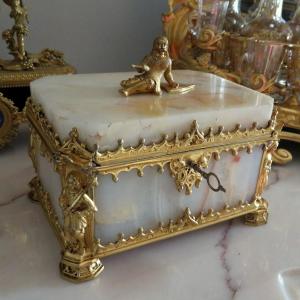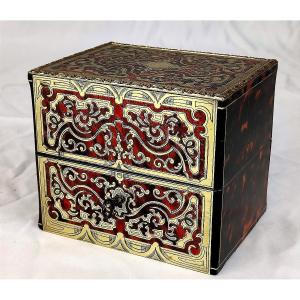


Tahan: Scent Box In Boulle Marquetry - Circa 1850
Artist: Jean-pierre-alexandre Tahan ( 1813 - 1892 )
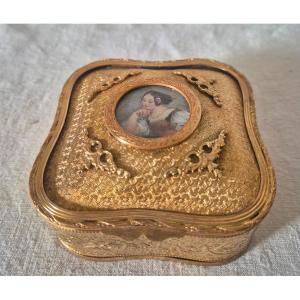
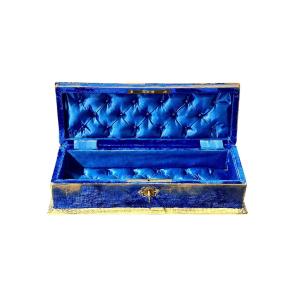
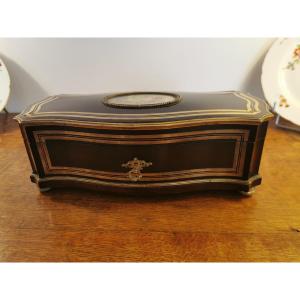
Jean-Pierre-Alexandre TAHAN (1813 - 1892) Exquisite perfume or scent box monogrammed "EG", from the Napoleon III period, in Boulle marquetry (tortoiseshell and brass inlay). Original key present. Functional lock. Perfect condition! Dimensions: 11.5 x 8.5 x 10 (H) cm. Signature on internal plaque: "Tahan, Supplier to the King, 30 rue de la Paix". This box can be dated with certainty between 1849, when Jean-Pierre-Alexandre Tahan established himself at 34 rue de la Paix, and 1855, when he added the new designation "Supplier to the Emperor" to his signatures. The quality of this object makes it a rare and precious piece, produced by the greatest French cabinetmaker of the 19th century. "A unique firm for its type of manufacture, which has established itself through the good taste of its designs. At Tahan's, they never consider the price: the important thing is that the Tahan name appears on the object" (Pierre Giffard, Les Fourchambault, 1878). "Prince of small cabinetmaking," Tahan left his mark on his era through the care he took in Each of his pieces was both an art object and a practical item. Generally small or medium-sized, these pieces of furniture became ubiquitous in bourgeois homes, so much so that, according to the Manual of Elegant Economy (1859), "they alone define the entire character of the era." It was in Spa, a small spa town in the Ardennes region of Belgium, that Pierre Lambert Tahan, a cabinetmaker by trade, began this business with its remarkable destiny. He left Spa for Paris in 1804 and established his factory of "boxes and dressing cases" in the Temple district. His son, Jean Pierre Alexandre (1813-1892), was born in Paris and assisted him from 1837, taking over the entire management of the company in 1844 when his father ceased all activity. Jean Pierre Alexandre then used his ingenuity to begin his great pioneering work. First, he separated the workshop on Rue de Quincampoix from the shop on Rue Basse du Rempart. He expanded his production to include boxes, but also created larger pieces of furniture, bonheur-du-jour desks, writing desks, and work tables. From 1845, he also began advertising in newspapers, a practice still relatively uncommon at the time. Appointed "Supplier to the King and Princes," he won a silver medal at the 1849 Exhibition of Industrial Products, earning him the title "Prince of Small Cabinetmaking." In 1855, he held the title of "Supplier to the Emperor" at the Universal Exhibition, where he exhibited an extraordinary sculpted aviary. The Court placed numerous orders with him, including rosewood planters, salon tables for the Tuileries Palace, and a mahogany and gilt-bronze shelf for Napoleon III's study. His shop moved to 34 rue de la Paix (1849-1866), then to 11 Boulevard des Italiens (1866-1878). In 1861, Tahan was described as "one of those manufacturers who anticipate fashion and set the tone instead of being influenced by it" (La Chronique des Arts et de la Curiosité). Indeed, he quickly collaborated with Julien-Nicolas Rivart to inlay his furniture with porcelain flowers, which would become a signature element of his work. This was a novel technique at the time, placing him at the forefront of modernity. Awarded a gold medal at the 1867 Universal Exhibition, Tahan employed over two hundred people in several workshops by the end of the Second Empire. Tahan, like Rivart, was a man enthusiastic about the inventions of the second half of the 19th century, and he himself filed a patent for the cylinder desk, as well as another for document holders with a translucent front in 1858. The Tahan company declined after the fall of the Empire, which had been such a strong supporter. Thus, in 1882, the factory ceased production and the store closed its doors.
950 €
Period: 19th century
Style: Napoleon 3rd
Condition: Perfect condition
Material: Marquetry
Reference (ID): 1643726
Availability: In stock
Print