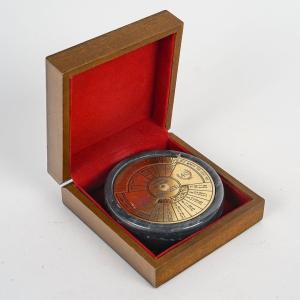
Planispheric Astrolabe, Equinoctial Clock, 16th-17th Centuries
Origin: Probably Southern Germany (Nuremberg or Augsburg) or Flanders (Leuven or Antwerp).Date: Circa 1580-1620Material: Finely engraved brassDiameter: 9 cmA beautifully crafted planispheric astrolabe or equinoctial sundial, dating from the scientific Renaissance. The instrument has a rotating needle and latitude circles engraved with major European cities, allowing for position-dependent adjustment. Main Latin inscription: “Ni certa solis lumina de vient” “Even the sun’s rays are uncertain [or unstable]”. A philosophical reflection on time and change, typical of scientific instruments of the German Renaissance, with moral inscriptions. Engraved cities and latitudes: Londini (London) – 52°30′ Colonia (Cologne) – 50° Aquisgrani (Aachen) – 50° Parisiis (Paris) – 48° Vienna – 48°22′ Ulysipona (Lisbon) – 38°40′ Matriti (Madrid) – 40°14′ Romae (Rome) – 41°51′ Pragae (Prague) – 50°4′This remarkable instrument likely originates from a German-Flemish workshop, probably Augsburg or Nuremberg, two renowned centers for precision instrument making during the late Renaissance. Its delicate engraving, philosophical motto, and geographical precision illustrate the humanist fusion of science, art, and moral thought. A rare and museum-worthy piece for collectors of antique scientific instruments.
62 450 €
Period: 16th century
Style: Other Style
Condition: Excellent condition
Material: Brass
Reference (ID): 1640201
Availability: In stock
Print