

Cycladic Leg Fragment
Cycladic Leg Fragment
Early Cycladic II Circa 2700 - 2300 century B.C.
Material
Marble
Dimensions
Height 17 cm
Provenance
– Private collection, Geneva, Switzerland, assembled in the 1990s.
– Michael Ward, New York, USA.
– RL Private Collection, Belgium.
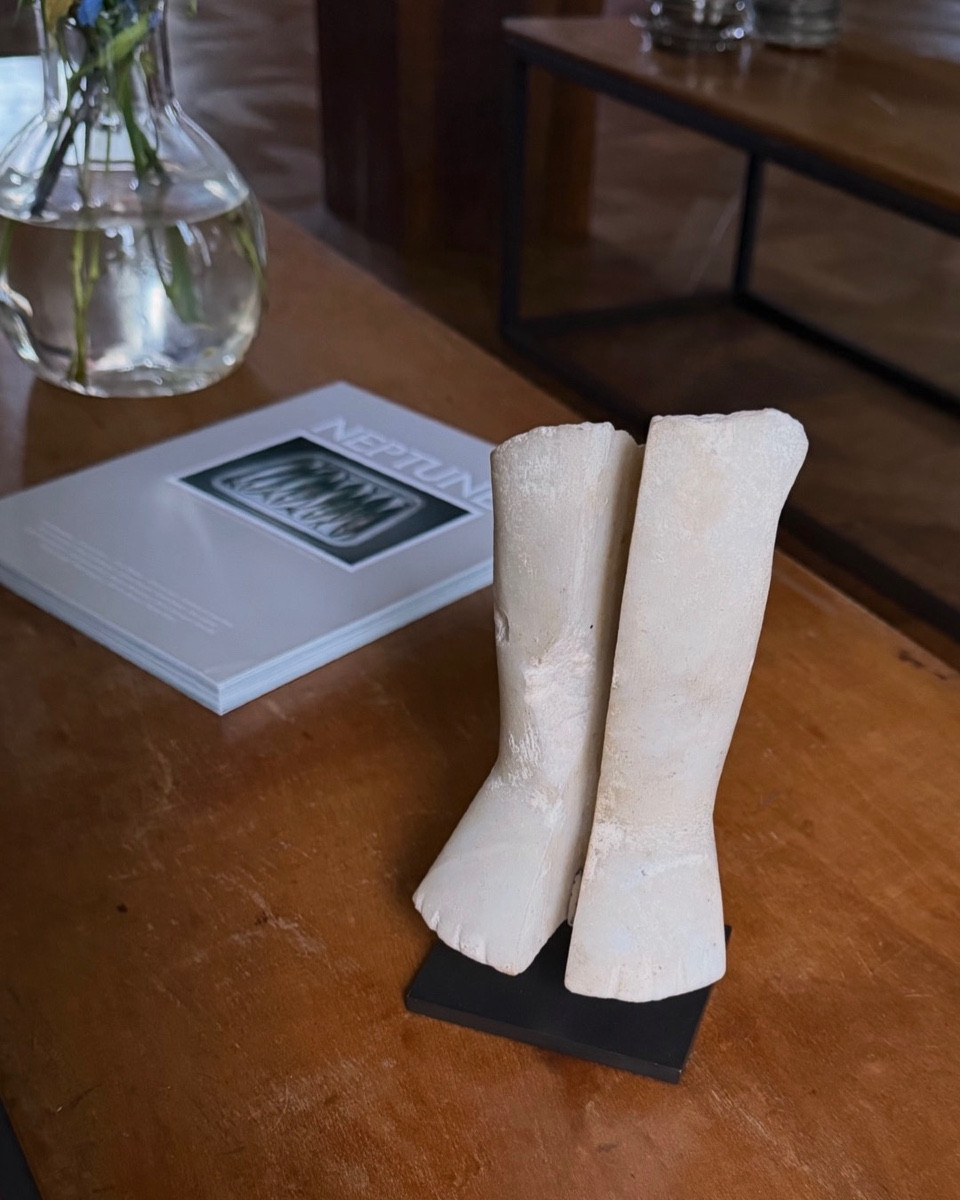
This fragment preserves the lower part of a Cycladic Cross-Armed Figurine (FAC), showing the feet and part of the legs. The legs are separated by a deep vertical groove, and the toes are carefully incised, a characteristic detail of the Spedos variety of the Early Cycladic II period.
The form is symmetrical and compact, with the feet aligned and angled slightly downward, suggesting that the figure was intended to be reclining rather than standing. The surface retains traces of the fine polishing typical of Cycladic marble sculpture, emphasizing the smooth, geometric abstraction that characterizes this artistic tradition.
The style of the fragment corresponds to the Spedos type, named after the cemetery on Naxos where similar examples were first identified. Spedos figurines are renowned for their elegant proportions, subtle modeling, and attention to anatomical detail, particularly in the rendering of the feet and legs.
Cycladic figurines were carved in the Cycladic islands during the Early Bronze Age, primarily for funerary or ritual purposes. Most have been found in graves, although examples also appear in domestic and sanctuary contexts. Their precise function remains uncertain, but they likely had symbolic or religious significance, perhaps representing fertility, life, or the deceased.
Early Cycladic II Circa 2700 - 2300 century B.C.
Material
Marble
Dimensions
Height 17 cm
Provenance
– Private collection, Geneva, Switzerland, assembled in the 1990s.
– Michael Ward, New York, USA.
– RL Private Collection, Belgium.
This fragment preserves the lower part of a Cycladic Cross-Armed Figurine (FAC), showing the feet and part of the legs. The legs are separated by a deep vertical groove, and the toes are carefully incised, a characteristic detail of the Spedos variety of the Early Cycladic II period.
The form is symmetrical and compact, with the feet aligned and angled slightly downward, suggesting that the figure was intended to be reclining rather than standing. The surface retains traces of the fine polishing typical of Cycladic marble sculpture, emphasizing the smooth, geometric abstraction that characterizes this artistic tradition.
The style of the fragment corresponds to the Spedos type, named after the cemetery on Naxos where similar examples were first identified. Spedos figurines are renowned for their elegant proportions, subtle modeling, and attention to anatomical detail, particularly in the rendering of the feet and legs.
Cycladic figurines were carved in the Cycladic islands during the Early Bronze Age, primarily for funerary or ritual purposes. Most have been found in graves, although examples also appear in domestic and sanctuary contexts. Their precise function remains uncertain, but they likely had symbolic or religious significance, perhaps representing fertility, life, or the deceased.
8 000 €
Period: Before 16th century
Style: Other Style
Condition: En l'etat
Material: Marble
Height: 17
Reference (ID): 1638396
Availability: In stock
Print