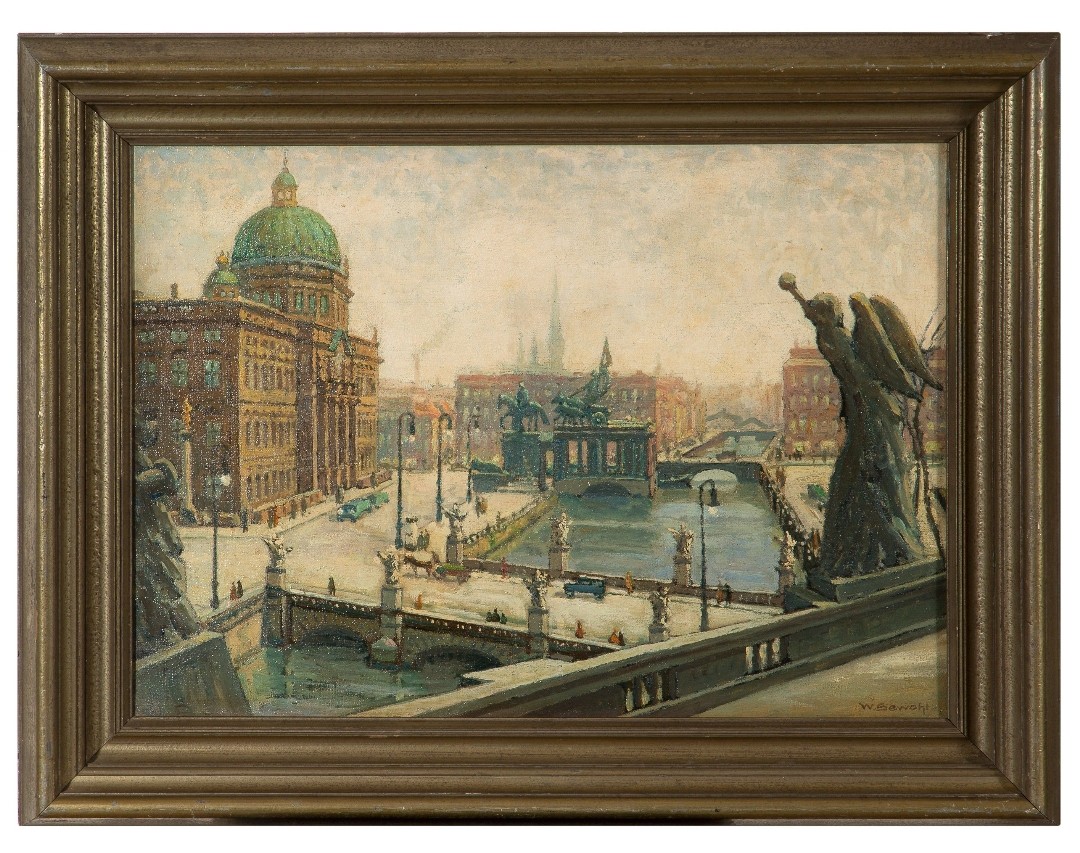


Waldemar Sewohl (1887-1967) - View Of Berlin Castle - Around 1930
Artist: Waldemar Sewohl
Born in 1887 in Rostock, Waldemar Sewohl was a German painter renowned for his urban views of Berlin and his landscapes of the Mecklenburg region. The son of a renowned photographer, he only moved to Berlin after 1905, where he studied under Wilhelm Blanke until 1913. From 1924 onwards, he made various study trips to Italy, Switzerland, Holland, Norway and Austria. He subsequently began working as a freelance painter in the Lichterfelde district, and later joined local artists' circles, even becoming a member of the Reich Artists' Association. He exhibited his paintings at the Gelb Gallery in Berlin in 1920, then participated in the Great Berlin Art Exhibition (GBK) from 1914 to 1930. After the bombing of Berlin in 1944, he took refuge in Teterow, then returned after the war in the 1950s.
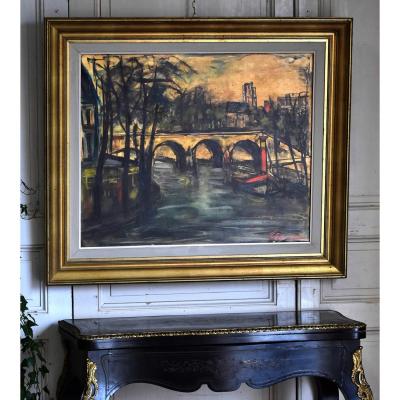
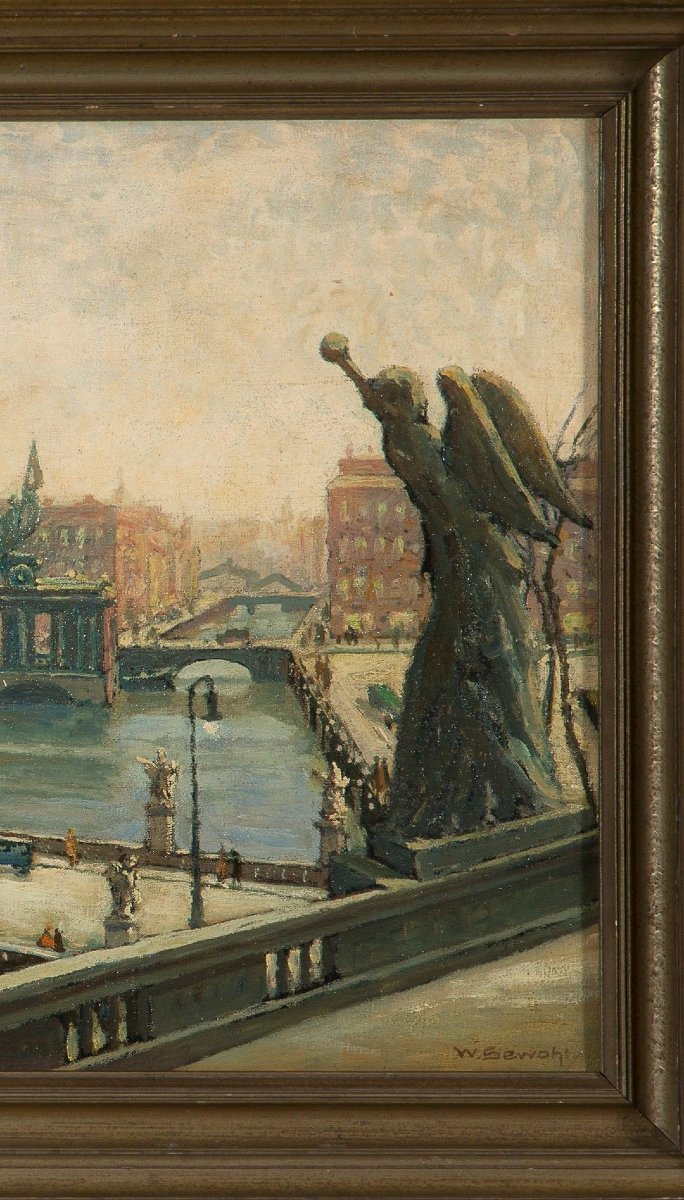
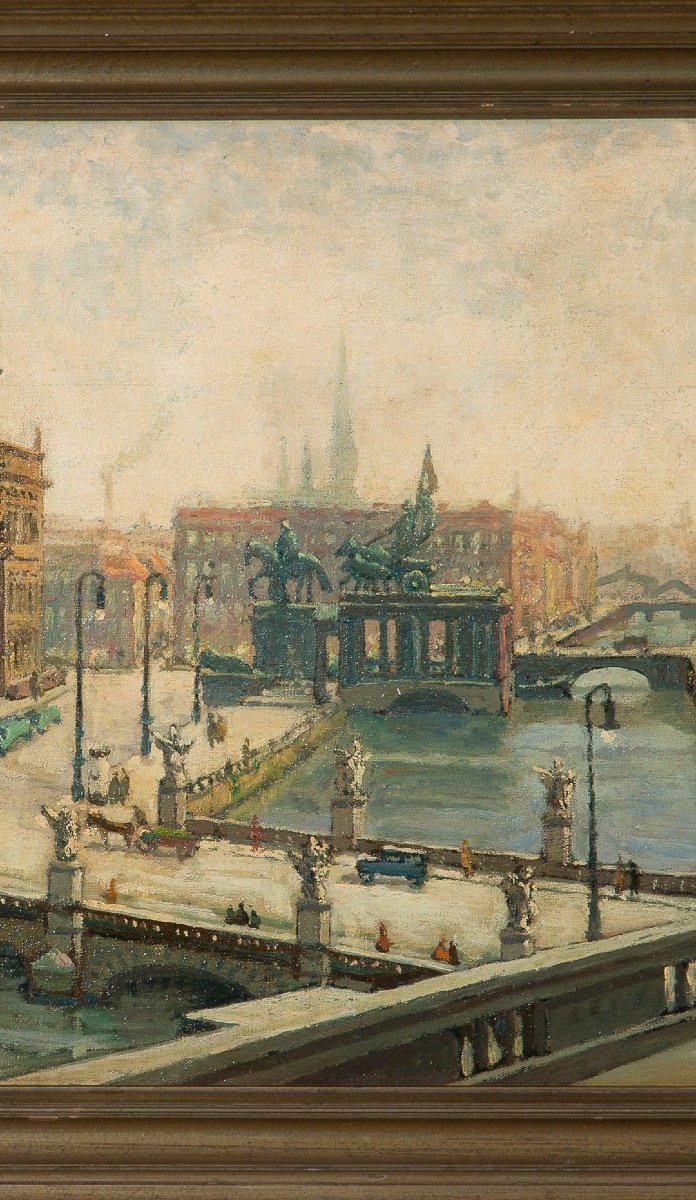
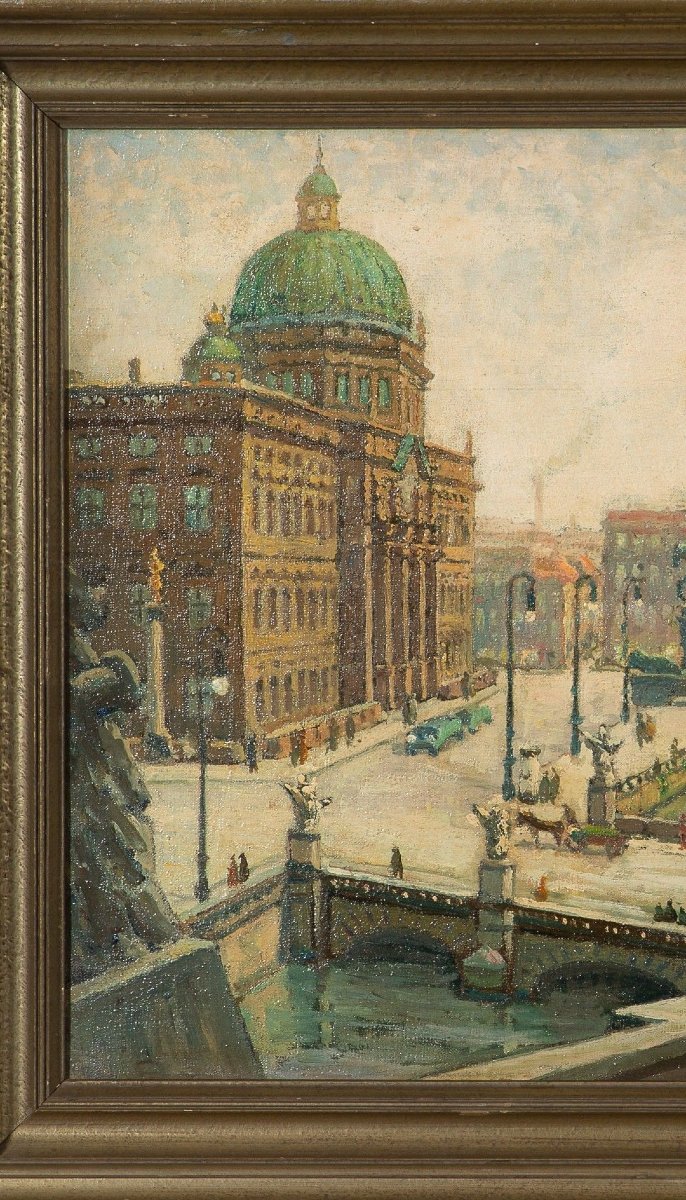
From the balustrade on the heights of the Arsenal, Sewohl painted the Berlin Castle, a great figure of Baroque architecture with a greenish copper dome. In the center, we notice the Schlossbrücke bridge displaying its statues to the glory of Athena, but also of winged Nike like the one in the foreground on the right, brandishing a globe in all power. The painting symbolizes the beating heart of the Weimar Republic, of a Germany reborn after a difficult period of world war. A misty church tower in the background, near a smoking factory chimney, both probably destroyed today, bascule bridges on the Spree, electric street lamps, Sedan cars and a billboard kiosk... Berlin is truly painted as a powerful economic, political, industrial and cultural capital. Thanks to these elements, we can place the oil on canvas around 1930. This oil painting gives a realistic and atmospheric, almost neo-impressionist approach to the center of Berlin. His style is fluid and colorful, without boldness in the brushstrokes.
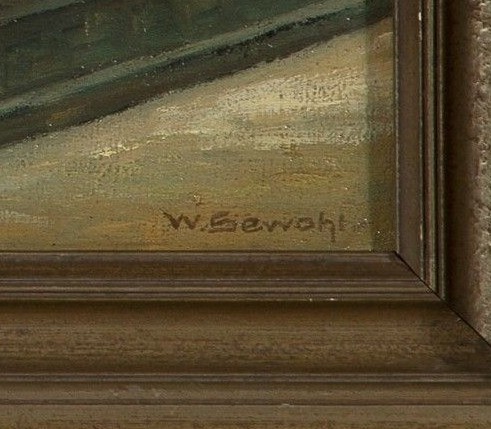
Signed W. SEWOHL lower right.
Sources:
Hans Vollmer (ed.), Allgemeines Lexikon der bildenden Künstler des XX. Jahrhunderts, Band 4, Leipzig, EA Seemann, 1958.
Grete Grewolls, Wer war wer in Mecklenburg und Vorpommern, Hinstorff Verlag, 2011.
From the balustrade on the heights of the Arsenal, Sewohl painted the Berlin Castle, a great figure of Baroque architecture with a greenish copper dome. In the center, we notice the Schlossbrücke bridge displaying its statues to the glory of Athena, but also of winged Nike like the one in the foreground on the right, brandishing a globe in all power. The painting symbolizes the beating heart of the Weimar Republic, of a Germany reborn after a difficult period of world war. A misty church tower in the background, near a smoking factory chimney, both probably destroyed today, bascule bridges on the Spree, electric street lamps, Sedan cars and a billboard kiosk... Berlin is truly painted as a powerful economic, political, industrial and cultural capital. Thanks to these elements, we can place the oil on canvas around 1930. This oil painting gives a realistic and atmospheric, almost neo-impressionist approach to the center of Berlin. His style is fluid and colorful, without boldness in the brushstrokes.
Signed W. SEWOHL lower right.
Sources:
Hans Vollmer (ed.), Allgemeines Lexikon der bildenden Künstler des XX. Jahrhunderts, Band 4, Leipzig, EA Seemann, 1958.
Grete Grewolls, Wer war wer in Mecklenburg und Vorpommern, Hinstorff Verlag, 2011.
2 450 €
Period: 20th century
Style: Other Style
Condition: Excellent condition
Material: Oil painting
Length: 70,5cm
Height: 51cm
Reference (ID): 1631143
Availability: In stock
Print