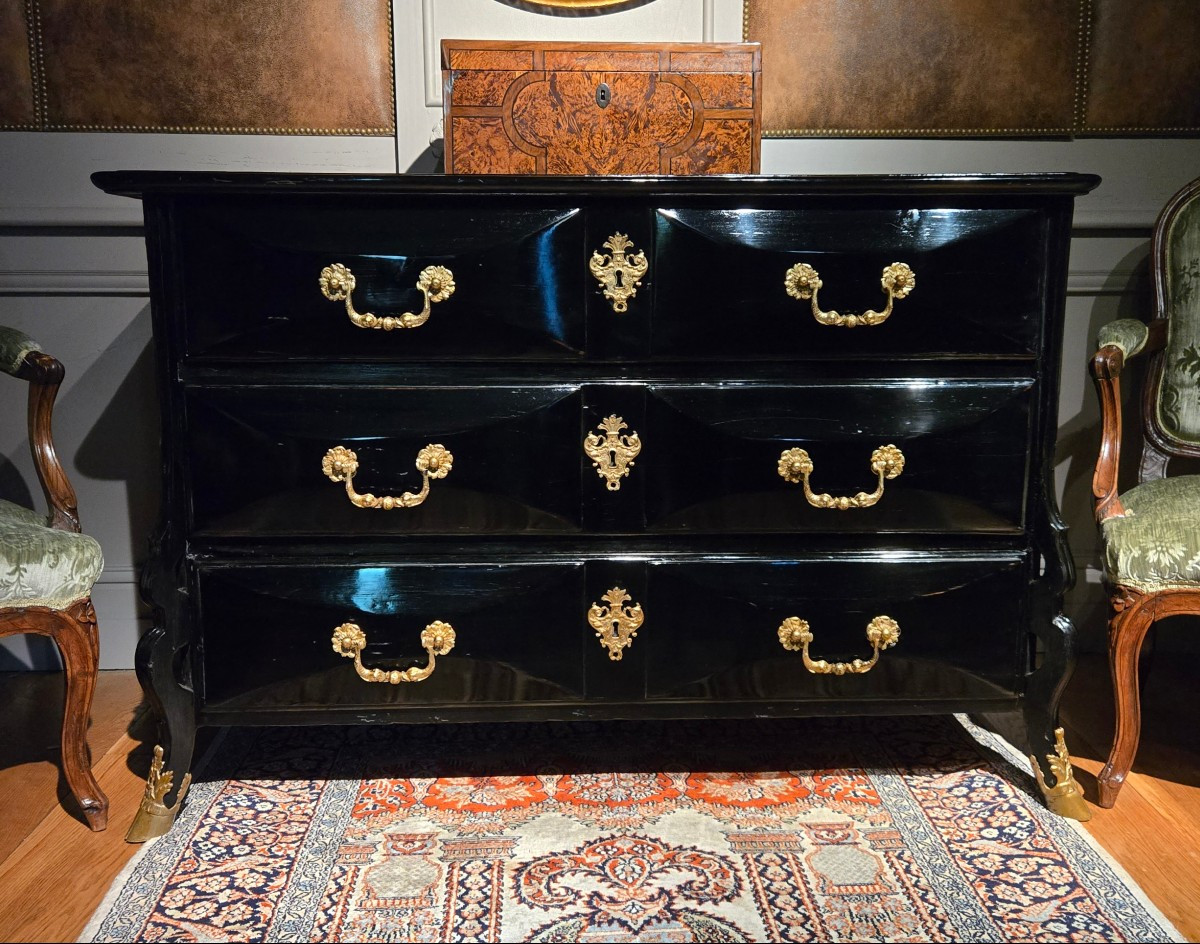


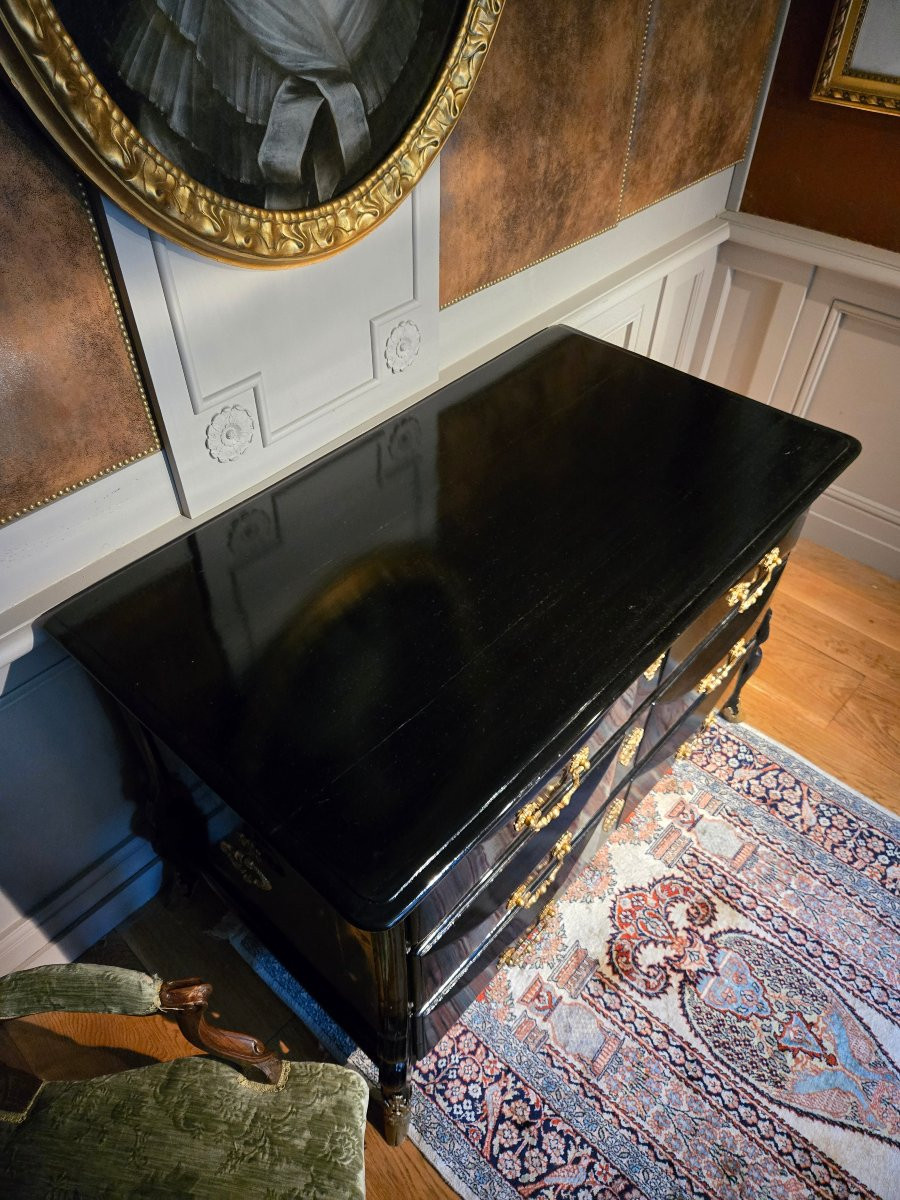
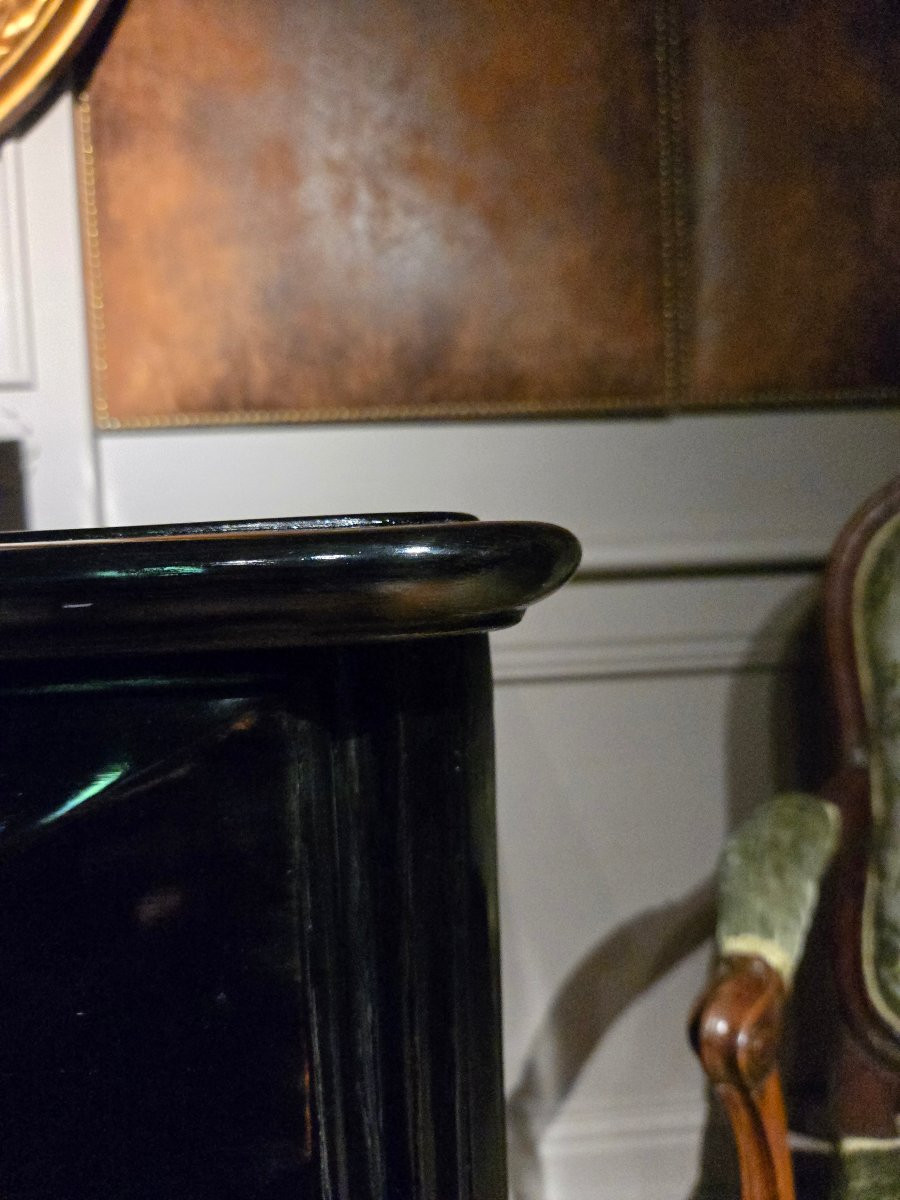
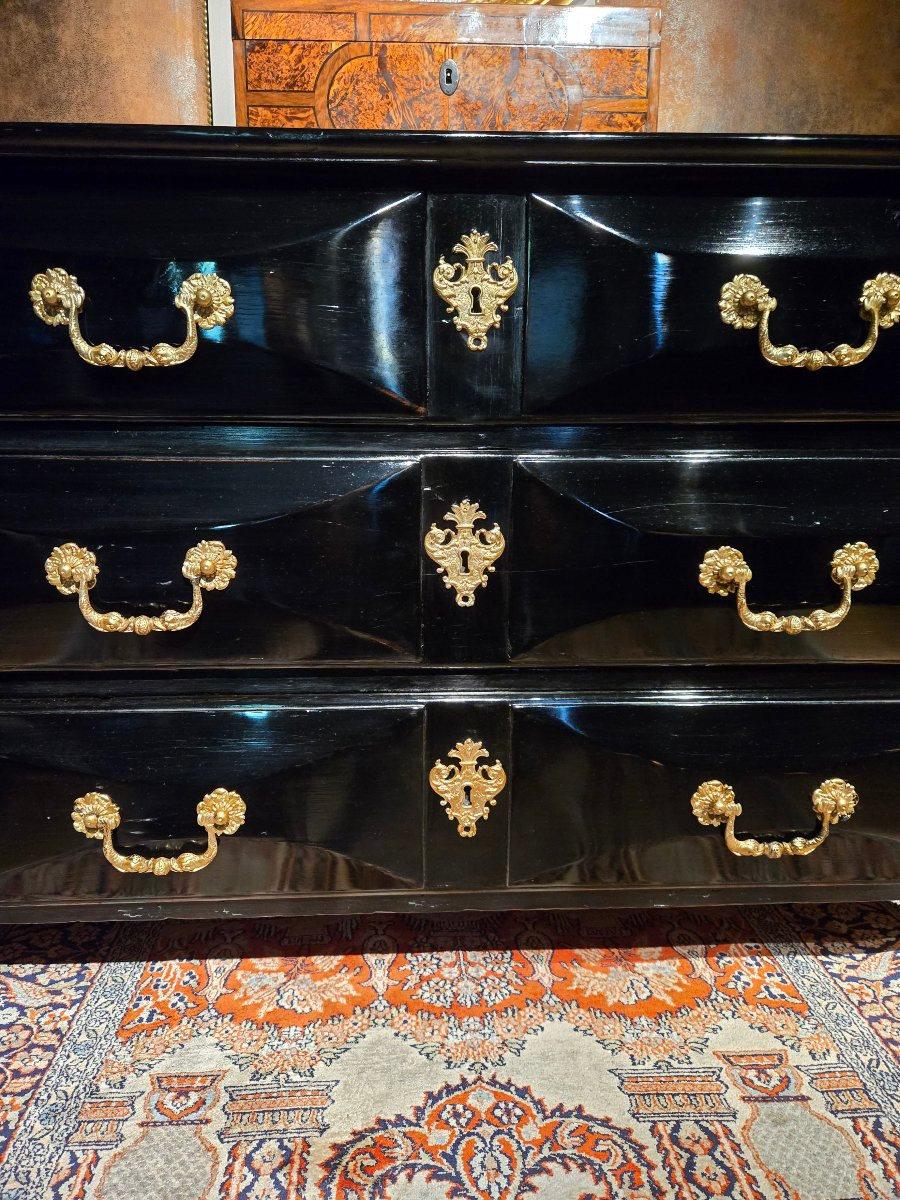


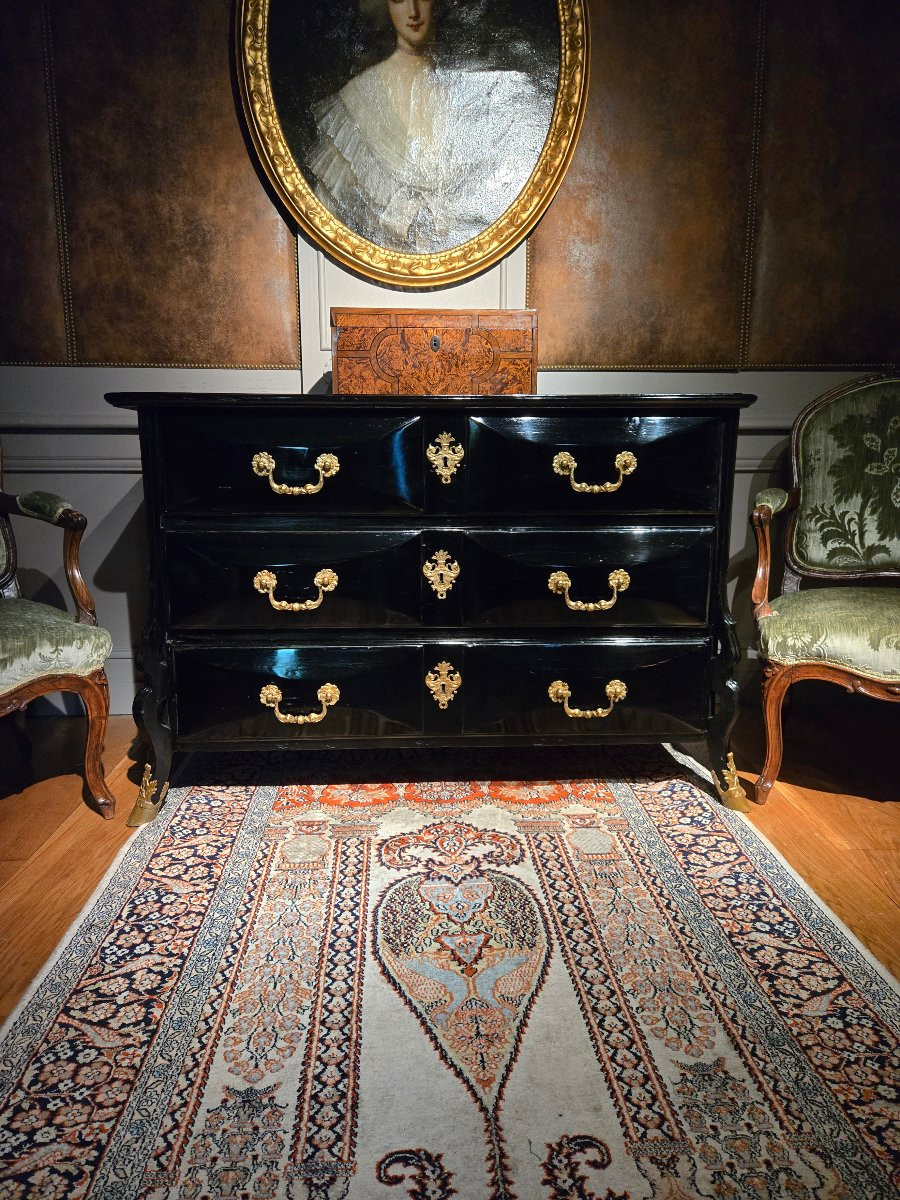
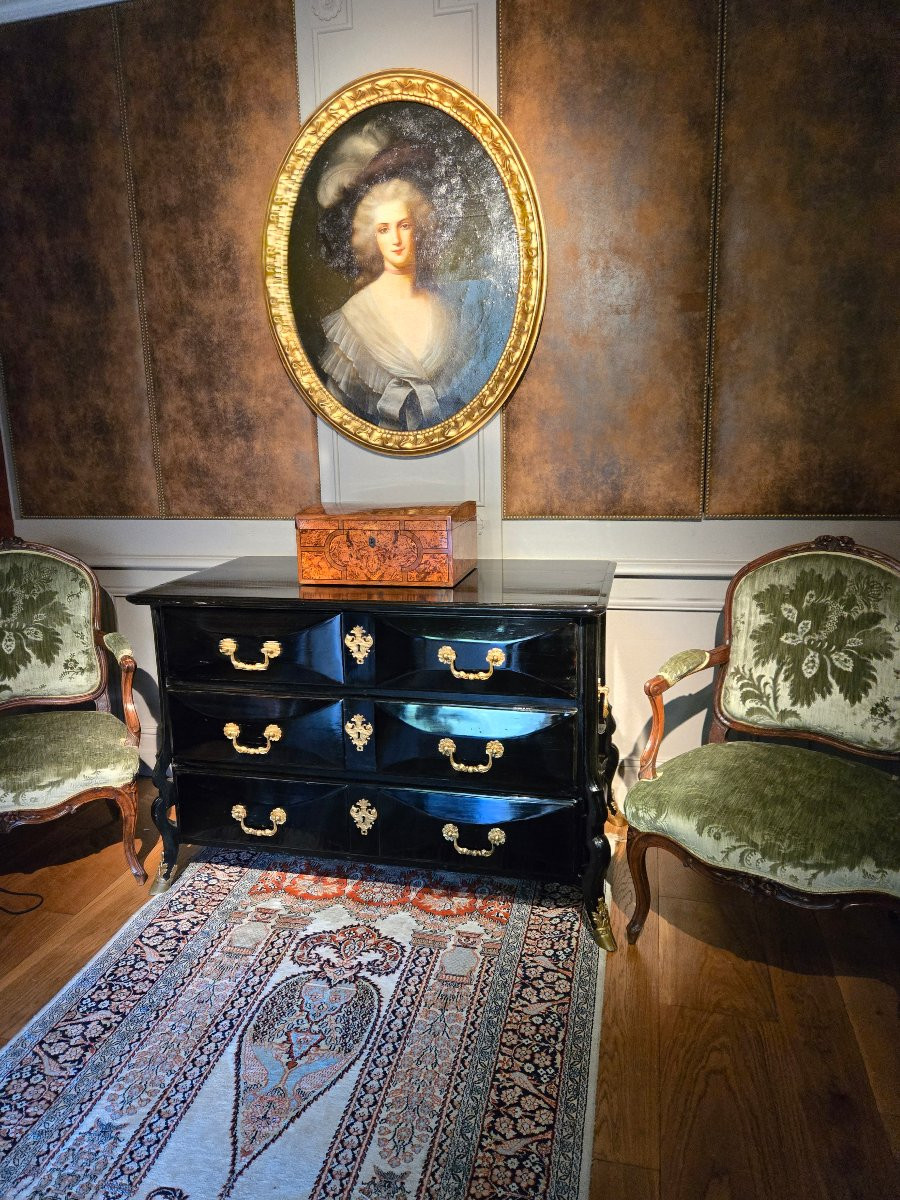
"Louis XIV Chest Of Drawers Known As “mazarine”, French Regional Work, Probably Dauphiné."
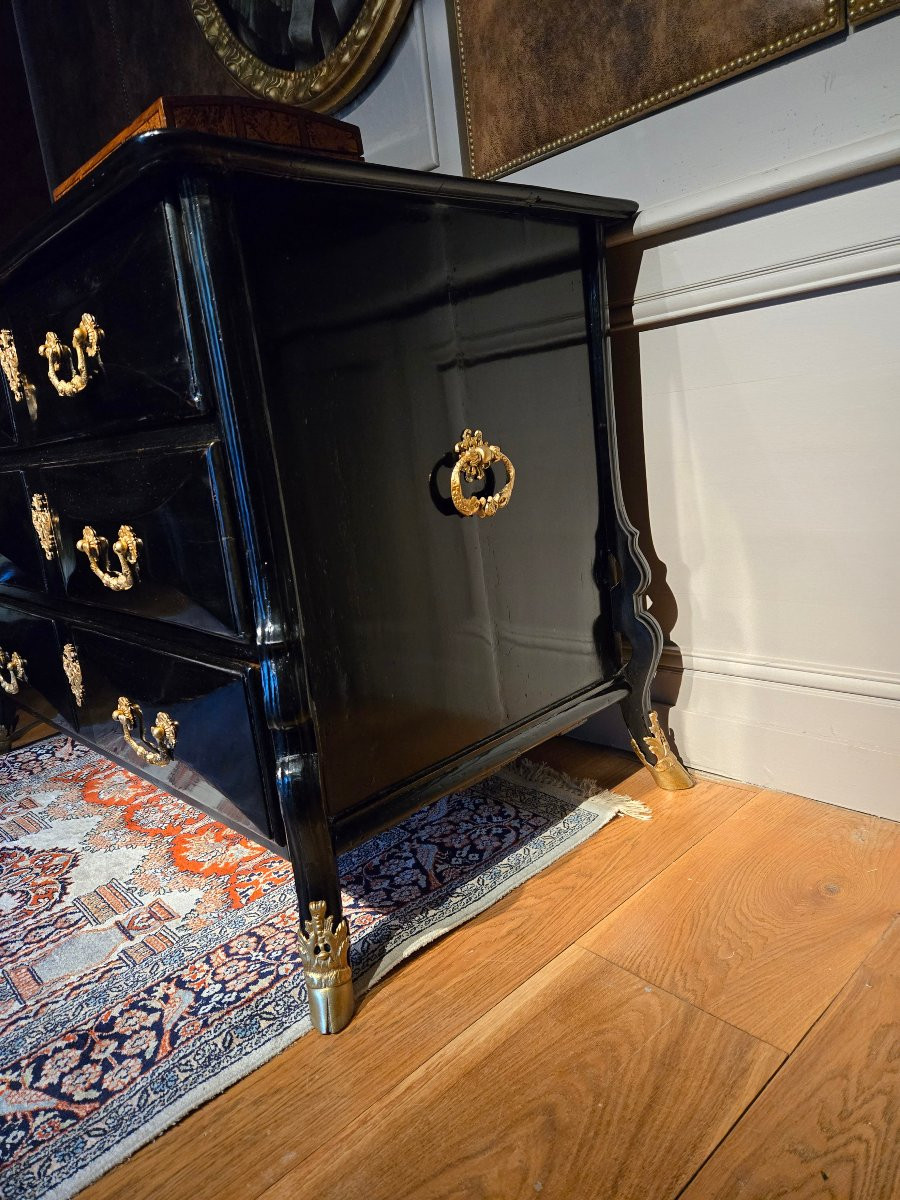
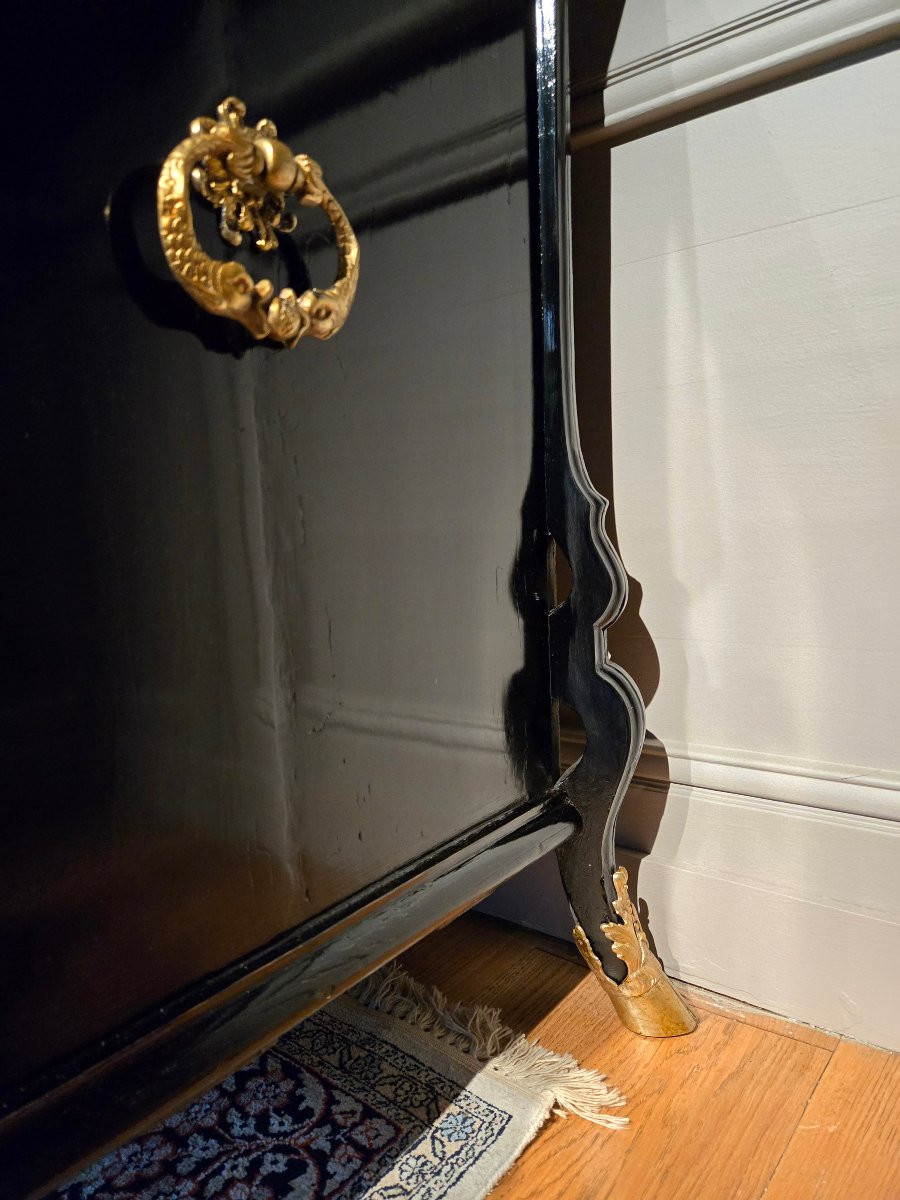
History and context: The commode appeared at the very end of the 17th century, succeeding chests and cabinets. Its first forms, still strongly influenced by the legacy of Louis XIV furniture and Mazarin desks, were characterized by a rigorous architecture: wooden top, corner uprights highlighted by inverted consoles and bronze ornamentation. These models, often called "Mazarin commodes", constitute the prototypes of modern storage furniture and herald the evolution of Regency furniture. The present example is part of this trend, but testifies to a production that was probably regional, probably Dauphiné. Description and manufacture: The commode opens with three rows of drawers without a top crosspiece, the first row abutting directly under the top, according to the oldest arrangement. The drawer fronts have a so-called cabochon curve, rounded in the center and caught by wide lateral chamfers: this is type Ib, as defined in the evolution of the first chests of drawers (see diagram p. 180) (the genius of the Hache, Françoise Rouge). This typology is characteristic of the years 1700–1720, before the appearance of crossbow fronts. The case is constructed of softwood and fruitwood (especially cherry), with beech used for the sides and backs of drawers, and fir for the bottoms. The drawers are assembled with dovetails at the four corners; their bottoms made of fir planks are placed perpendicular to the front, glued and nailed from below. The sides, made of fruitwood planks, are assembled to the floor with wide dovetails. The back is made of wide softwood planks, nailed in the rebate. The top, molded on the reverse side to visually lighten its thickness, is made of fruit wood nailed to the sides. The four inverted corner consoles pegged to the frame, a direct echo of the Mazarin desks, serve both as decoration and as a base, receiving bronze sabots at their base. Bronze ornamentation: The original varnished bronze ornamentation consists of: falling handles with facing dolphins, separated by a bursting fruit (probably a pomegranate, a symbol of abundance), coordinated side handles, larger in size but featuring the same facing dolphins decoration, reminiscent of chest handles, recalling the direct ancestor of the chest, a threading taken up later. original lock entries, finely chiseled, bronze foot slippers decorated with acanthus leaves and deer hooves. This decorative vocabulary, still inherited from the Grand Siècle, underlines the anchoring of the chest of drawers in the late Louis XIV style, while announcing the evolution towards the Régence models. State of conservation and restoration: The chest of drawers has benefited from a complete restoration respecting traditional techniques: filling of a right side crack with a wooden flipot, grafting of the two rear legs, worn by about 2 cm, in order to restore the seat of the piece of furniture, installation of reinforcements under the frame, restoration of an old iron lock on the lower drawer, in place of the missing lock, removal of later rods added in the 19th century, and restoration of the lower side moldings on both sides, complete refinishing: preparation with rabbit skin glue, natural pigments and shellac french polish. Thanks to this restoration, the piece of furniture has regained its structural balance and visual brilliance, while retaining the authenticity of its bronze decoration. Conclusion This blackened wood Mazarine chest of drawers, due to its regional construction and original ornamentation, constitutes a rare example of the very first generations of chests of drawers (circa 1700–1720). Its bronze decoration with facing dolphins, its inverted corner consoles and its type Ib cabochon drawers make it a particularly representative example of the transition from chest to modern furniture, between the reign of Louis XIV and the Regency. Dimensions: Height: 84.5 cm Width: 123.5 cm Depth: 67.5 cm 








 Le Magazine de PROANTIC
 TRÉSORS Magazine
 Rivista Artiquariato