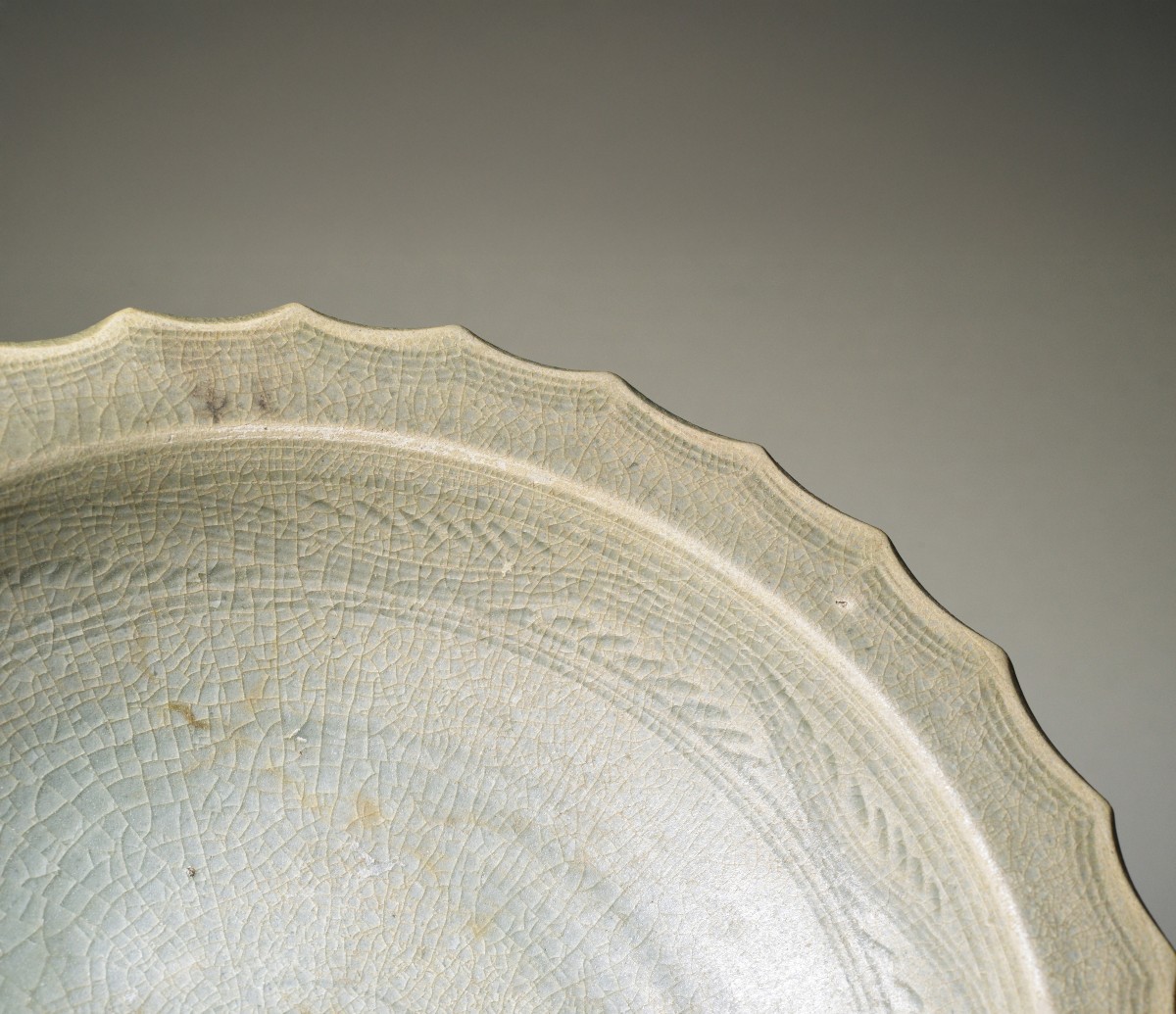

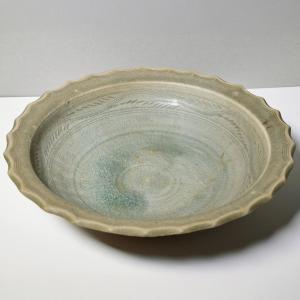


Rare Chinese Celadon Glaze Dish 14th Century Museum Quality Large Decorated
In China, the term qingci "青瓷" (literally meaning blue-green porcelain) is used to designate ceramic objects of gray-green color, with the first character representing blue or blue-green color "青". Various epithets were used to describe this color: "heavenly azure" "天青" (tian qing), "dusty blue" "粉青" (fen qing), or "after the rain passes, the sky becomes blue" - yu guo tian qing "雨過天青", which idiomatically means the arrival of good times after troubles.
The characteristic gray-green color is obtained by adding iron oxide to the glaze. During the chemical reaction in reduction firing (i.e., without oxygen access) of the ceramics, the iron contained in the glaze acquires a blue, gray, or greenish hue. During the Song (宋), Yuan (元), and Ming (明) dynasties, the art of Chinese celadon ceramics reached its peak. The most renowned were the products from the Yue (越) and Longquan (龙泉) kilns in the southeastern province of Zhejiang (浙江).
The high value that celadon possessed in Chinese culture could originally have been due to the similarity of the glaze color to jade, which was attributed various magical properties. Perhaps, precisely because of this similarity, it was believed that celadon also possesses supernatural qualities—for example, if poisoned food were placed in a celadon dish, it would change its color.
The change in fashion in the 18th–19th centuries led to a decline in production and the loss of many secrets of celadon manufacturing. The complex multi-stage technology for producing celadon, which has survived to this day in pottery workshops in Longquan "龙泉" (Zhejiang "浙江" Province), is included in the UNESCO List of Intangible Cultural Heritage of Humanity. This ceramic dish is an extremely rare museum-quality piece and will become the crown jewel of any exclusive collection.
DETAILS:
Artist: 14th century China
Medium: Ceramic dish with celadon glaze, hand-formed, hand-decorated with cutting tools in sgraffito technique or low relief
Size approximately: 30.2 cm diameter, 8.5 cm height (11.9 × 3.4 inches)
Condition: Overall in very good condition with minor age-related wear and glaze cracks
Provenance: Private collection
Notes: Kindly refer to the high-resolution photographs, which form part of the condition report. Color and tonal values may vary when viewed in person, depending on viewing conditions and ambient light
Shipping: Approx. weight 1.7 kg; packed approx. weight 3-4 kg. Secure, insured worldwide shipping.
The characteristic gray-green color is obtained by adding iron oxide to the glaze. During the chemical reaction in reduction firing (i.e., without oxygen access) of the ceramics, the iron contained in the glaze acquires a blue, gray, or greenish hue. During the Song (宋), Yuan (元), and Ming (明) dynasties, the art of Chinese celadon ceramics reached its peak. The most renowned were the products from the Yue (越) and Longquan (龙泉) kilns in the southeastern province of Zhejiang (浙江).
The high value that celadon possessed in Chinese culture could originally have been due to the similarity of the glaze color to jade, which was attributed various magical properties. Perhaps, precisely because of this similarity, it was believed that celadon also possesses supernatural qualities—for example, if poisoned food were placed in a celadon dish, it would change its color.
The change in fashion in the 18th–19th centuries led to a decline in production and the loss of many secrets of celadon manufacturing. The complex multi-stage technology for producing celadon, which has survived to this day in pottery workshops in Longquan "龙泉" (Zhejiang "浙江" Province), is included in the UNESCO List of Intangible Cultural Heritage of Humanity. This ceramic dish is an extremely rare museum-quality piece and will become the crown jewel of any exclusive collection.
DETAILS:
Artist: 14th century China
Medium: Ceramic dish with celadon glaze, hand-formed, hand-decorated with cutting tools in sgraffito technique or low relief
Size approximately: 30.2 cm diameter, 8.5 cm height (11.9 × 3.4 inches)
Condition: Overall in very good condition with minor age-related wear and glaze cracks
Provenance: Private collection
Notes: Kindly refer to the high-resolution photographs, which form part of the condition report. Color and tonal values may vary when viewed in person, depending on viewing conditions and ambient light
Shipping: Approx. weight 1.7 kg; packed approx. weight 3-4 kg. Secure, insured worldwide shipping.
3 100 €
Period: Before 16th century
Style: Other Style
Condition: Excellent condition
Material: Ceramic
Diameter: 30,2 cm
Height: 8,5 cm
Reference (ID): 1612263
Availability: In stock
Print