THIS OBJECT WAS SOLD
Saint Martin Standing, Painted And Chiseled Leather Called "guadamecil", Spain, 16th Century, Early 17th Century


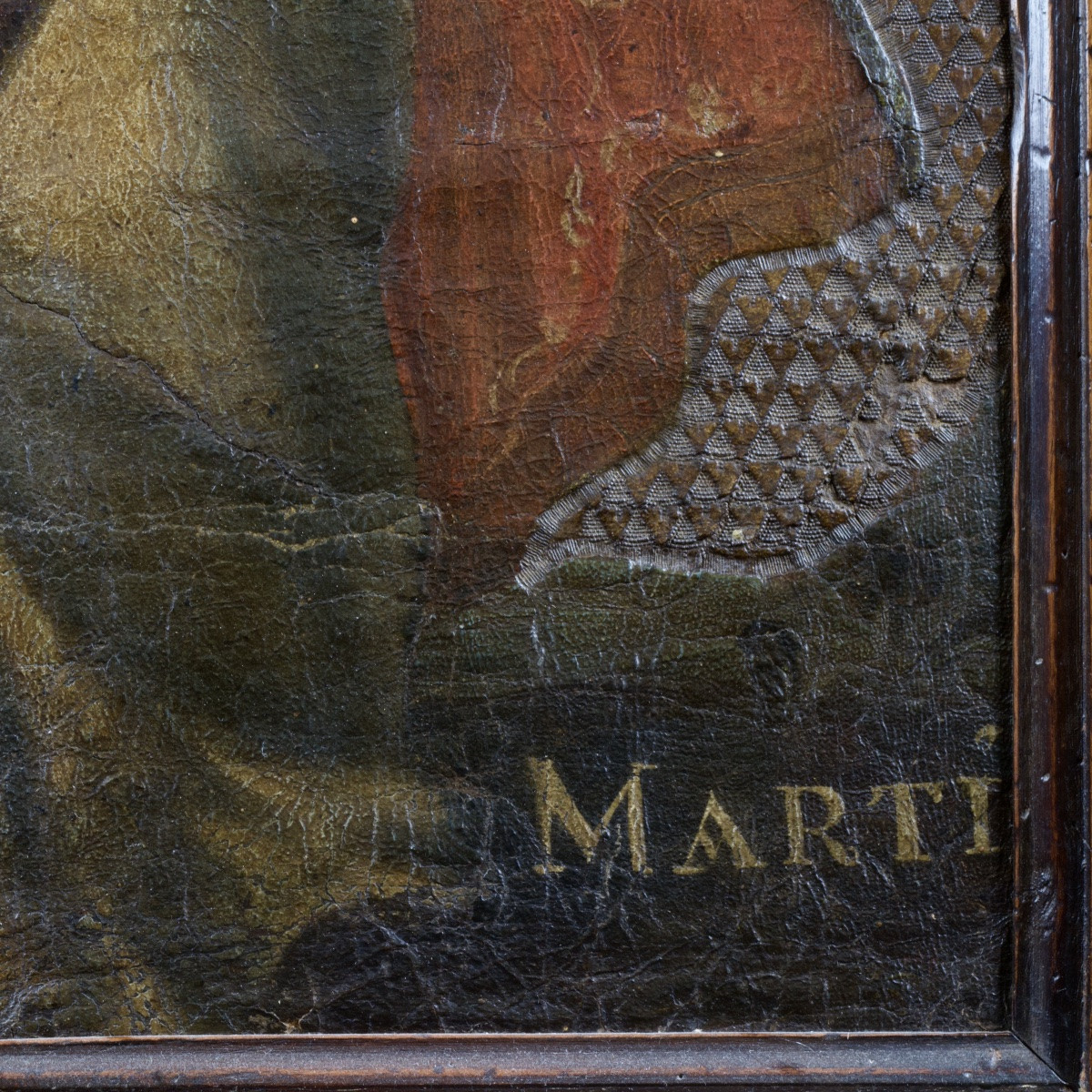

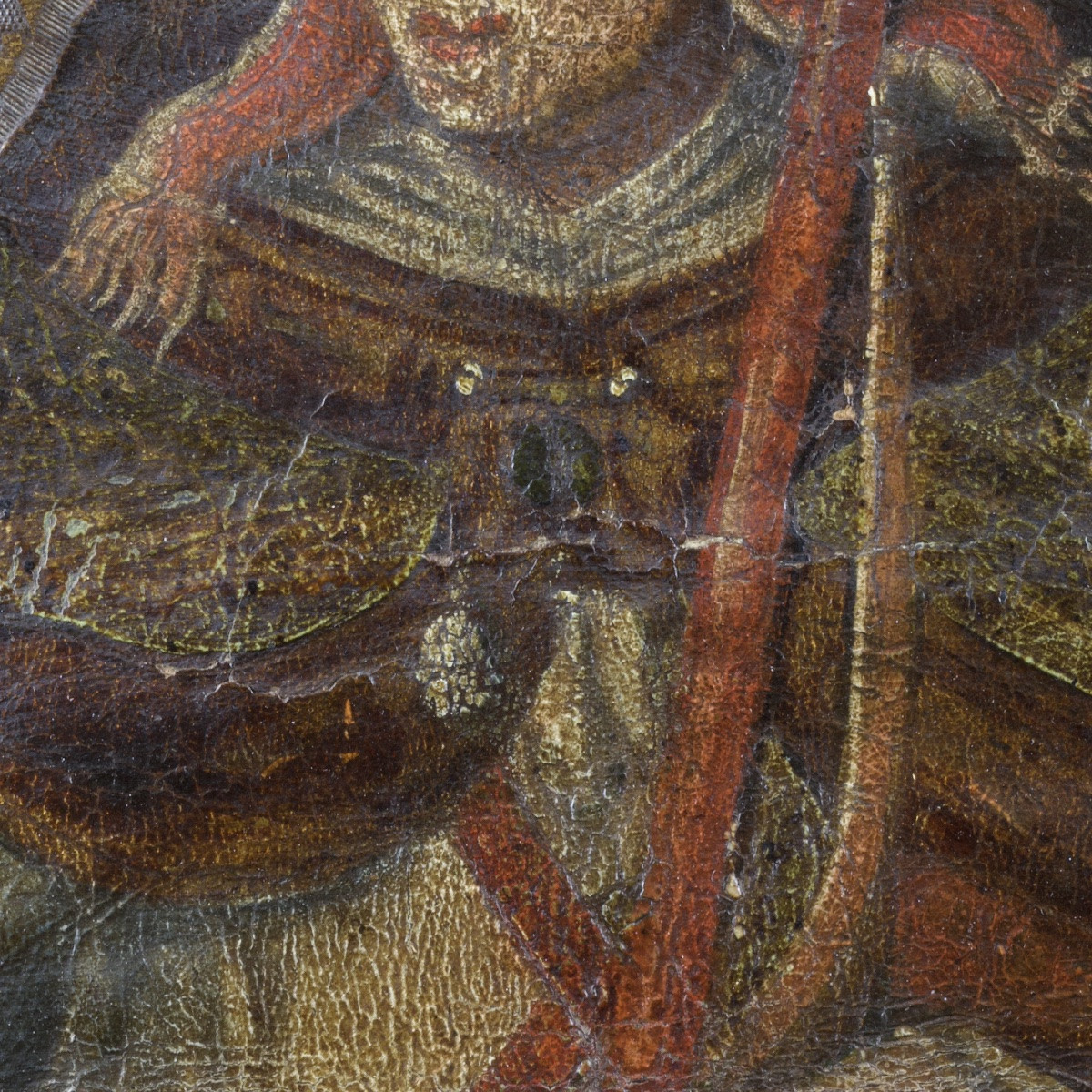
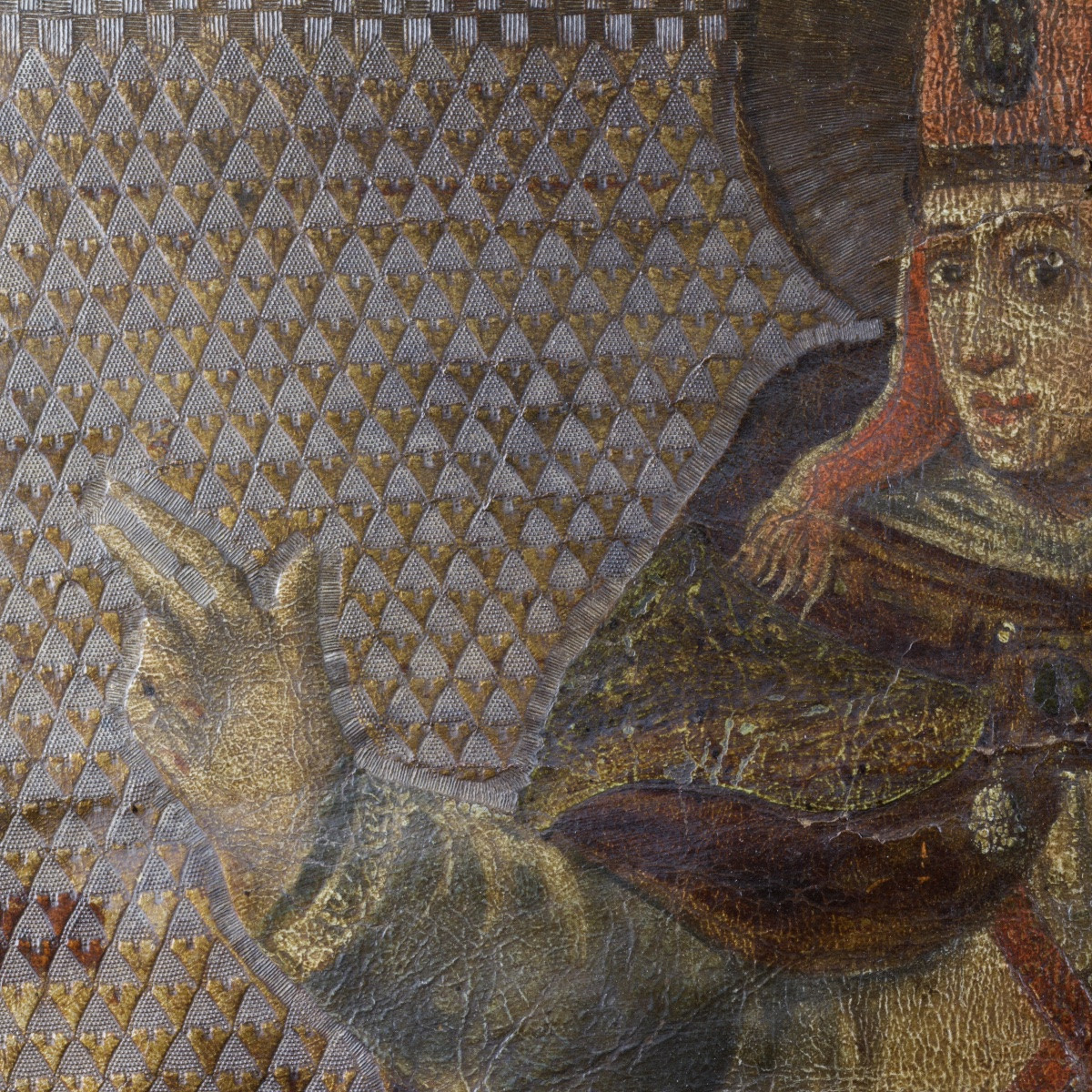


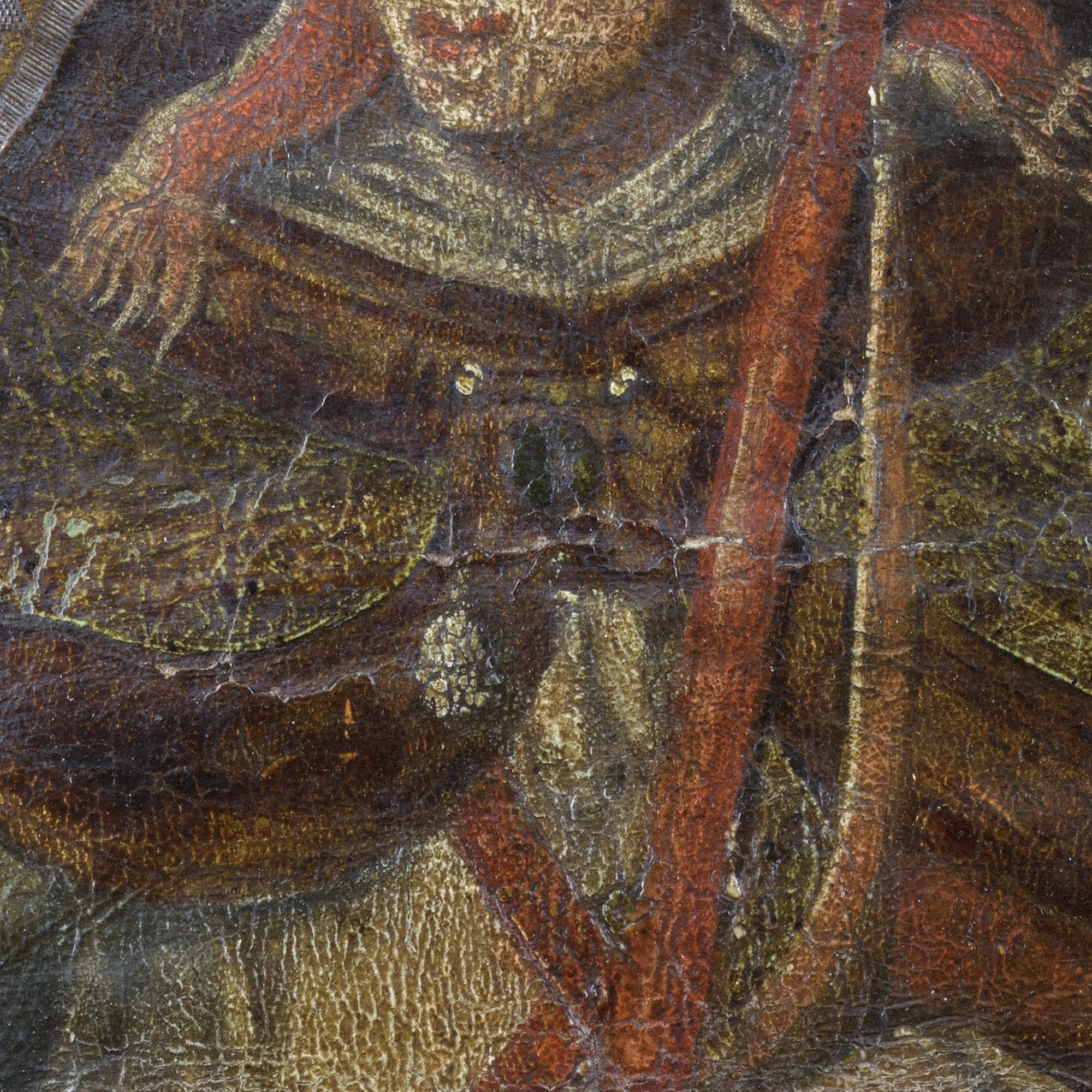


A rare quadrangular polychrome leather panel, chiseled with a small iron and painted in oils, depicting Saint Martin standing full-length in the robes of the Bishop of Tours, wearing a cloak, miter, and crozier.
This piece represents a particular moment in the history of the production of historiated leathers in Spain, before the triumph of these elements throughout Europe and their increasingly ornamental inflection, particularly from the second half of the 17th century. Italy, the Netherlands, France, and even England saw the emergence of important workshops specializing in the manufacture of these panels, which then adorned many aristocratic residences.
These leathers, intended for wall surfaces but also used in various objects (screens, decorative objects, antependiums, seat upholstery, etc.), are the heirs of a long artisanal tradition dating back to Antiquity (Cordovan “alum leathers”), revitalized by Moorish know-how from the Middle East and North Africa following the establishment of the caliphate in the Iberian Peninsula in 711.
After the Arab conquest, Córdoba became the main (but not the only) production center of al-Andalus and then of the restored Christian kingdom from 1492 onward. So much so that carved leathers, whether painted or gilded, were commonly referred to by metonymy as "leathers of Cordoba," a term attesting to the quantitative importance of this production and the high esteem in which connoisseurs held what would become known as "guadameciles." Great collectors and sovereigns of the Renaissance and modern eras were not mistaken, including Catherine de Medici, who commissioned a luxurious set of decorated leather hangings for her apartments at the Louvre, made by Cordoba workshops.
The golden age of Spanish leathers thus corresponds to the 16th century, with evidence prior to 1492 being extremely rare and less elaborate in their ornamental design. This heyday and monopoly were short-lived, however: the early 17th century marked the decline and then the disappearance of Spanish production, in favor of other European centers that appropriated and enriched the technique throughout the century. This was due to the expulsion of Muslims from Spain, ordered by Philip II by an ordinance of 1610. Formally, the decorated and painted leathers of the period are quite recognizable and distinguishable from later non-Iberian formal solutions. They are characterized by a flat surface, punctuated by chiseling applied with small irons, sometimes to enliven the backgrounds, sometimes to delineate motifs, details, and figures. These often take the form of regular hatching which follows the outline of the shape, while the backgrounds are punctuated by a repetitive pattern in the form of pearl triangles, which also recall the goldsmith work of granulation.
The subjects vary, and with them the style (Mudejar, Renaissance, Baroque, listed here chronologically); isolated depictions of holy figures appeared in the 16th century, often three-quarter length in a hieratic pose, the background devoid of any mimetic intent and preferably enlivened by an ornamental network of small iron motifs. This type of example, now very rare, is the one we present here. The preservation of this panel is very good, but the colors have faded somewhat with age. Please keep in mind that the photographs were taken under optimal lighting conditions, and that this panel requires special lighting or a very bright room. In any case, it remains an extremely rare example of the production of Spanish quadameciles in the 16th and early 17th centuries, and will appeal to discerning enthusiasts.
After the Arab conquest, Córdoba became the main (but not the only) production center of al-Andalus and then of the restored Christian kingdom from 1492 onward. So much so that carved leathers, whether painted or gilded, were commonly referred to by metonymy as "leathers of Cordoba," a term attesting to the quantitative importance of this production and the high esteem in which connoisseurs held what would become known as "guadameciles." Great collectors and sovereigns of the Renaissance and modern eras were not mistaken, including Catherine de Medici, who commissioned a luxurious set of decorated leather hangings for her apartments at the Louvre, made by Cordoba workshops.
The golden age of Spanish leathers thus corresponds to the 16th century, with evidence prior to 1492 being extremely rare and less elaborate in their ornamental design. This heyday and monopoly were short-lived, however: the early 17th century marked the decline and then the disappearance of Spanish production, in favor of other European centers that appropriated and enriched the technique throughout the century. This was due to the expulsion of Muslims from Spain, ordered by Philip II by an ordinance of 1610. Formally, the decorated and painted leathers of the period are quite recognizable and distinguishable from later non-Iberian formal solutions. They are characterized by a flat surface, punctuated by chiseling applied with small irons, sometimes to enliven the backgrounds, sometimes to delineate motifs, details, and figures. These often take the form of regular hatching which follows the outline of the shape, while the backgrounds are punctuated by a repetitive pattern in the form of pearl triangles, which also recall the goldsmith work of granulation.
The subjects vary, and with them the style (Mudejar, Renaissance, Baroque, listed here chronologically); isolated depictions of holy figures appeared in the 16th century, often three-quarter length in a hieratic pose, the background devoid of any mimetic intent and preferably enlivened by an ornamental network of small iron motifs. This type of example, now very rare, is the one we present here. The preservation of this panel is very good, but the colors have faded somewhat with age. Please keep in mind that the photographs were taken under optimal lighting conditions, and that this panel requires special lighting or a very bright room. In any case, it remains an extremely rare example of the production of Spanish quadameciles in the 16th and early 17th centuries, and will appeal to discerning enthusiasts.
Explore similar pieces and discover your ideal find:
Christian Art