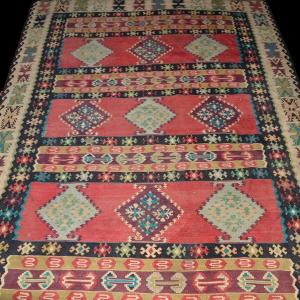
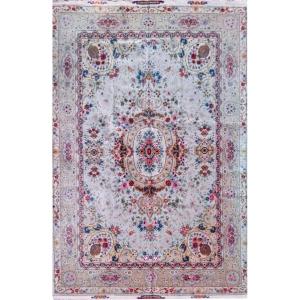
Samam Rug, 132 X 198 Cm, Hand-knotted Wool In Iran Circa 1920-1930, Little-known Rug Type
Rare and little-known Samam circa 1920/1930, carpet from the Bakthiar family,
originating from the region of Isfahan, Iran.
Samam and Chalchotor, often confused, are considered the best of the Bakhtiar.
They are very resistant and knotted firmly and very finely.
Our wool model is knotted for approximately 450,000 knots per m2.
It is not uncommon to find an addition of silk in these pieces.
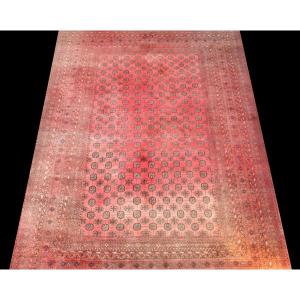
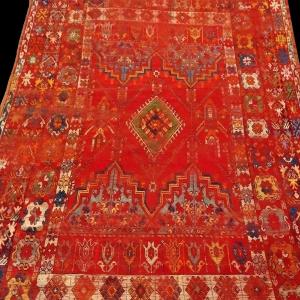
# Looking closely at the photos, we can discern a beautiful medallion accompanied by its two pendants.
We can also see the shape of the field surrounded by an ivory net, and its four spandrels.
These carpets are constructed like mille-fleurs of immense stylistic quality.
We find roses, inseparable from the history of Iran, "the Empire of roses", but also peonies, almond blossoms, carnations as well as weeping willows.
Four stylized willows surround the medallion.
The village of Samam near the Zayaudeh Roud River is located about 80 km from Isfahan.
This village is at the origin of these double-weave carpets totally different from the Bakthiars but from the same group.
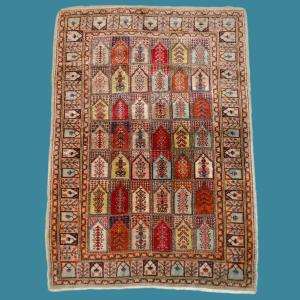
The field is divided into small squares like a chessboard, thus presenting a very stylized floral decoration typical and a central cross, its medallion.
The main wide border is decorated with floral arabesques and surrounded by two narrow bands decorated with flowers placed like precious stones.
The tones are rather dark with a beautiful shine of the wool used unlike the Bakthiars rather visually matte.
Their finish is always of an immense quality and their resistance is often comparable to that of the Bidjar.
It also happens very often that they are confused with the Djochégan, not divided into squares and having spandrels.
## You will find on our Proantic gallery a Djochégan.
Our model, old, from the first part of the 20th century, circa 1920/1930 has light wear, a beautiful shine and a very unusual decor.
This piece is in very good condition, and has been professionally and ecologically cleaned.
Dimensions: Width: 132 cm (52") x Length: 198 cm (78")
FREE DELIVERY FOR FRANCE as for all our rugs! FR 0€ / EUR 25€ / WORLD 50€
For any information or other photos, please call me at 06 13 36 09 30
or winsteinprovence@gmail.com.
www.winsteinprovence.com
originating from the region of Isfahan, Iran.
Samam and Chalchotor, often confused, are considered the best of the Bakhtiar.
They are very resistant and knotted firmly and very finely.
Our wool model is knotted for approximately 450,000 knots per m2.
It is not uncommon to find an addition of silk in these pieces.
# Looking closely at the photos, we can discern a beautiful medallion accompanied by its two pendants.
We can also see the shape of the field surrounded by an ivory net, and its four spandrels.
These carpets are constructed like mille-fleurs of immense stylistic quality.
We find roses, inseparable from the history of Iran, "the Empire of roses", but also peonies, almond blossoms, carnations as well as weeping willows.
Four stylized willows surround the medallion.
The village of Samam near the Zayaudeh Roud River is located about 80 km from Isfahan.
This village is at the origin of these double-weave carpets totally different from the Bakthiars but from the same group.
The field is divided into small squares like a chessboard, thus presenting a very stylized floral decoration typical and a central cross, its medallion.
The main wide border is decorated with floral arabesques and surrounded by two narrow bands decorated with flowers placed like precious stones.
The tones are rather dark with a beautiful shine of the wool used unlike the Bakthiars rather visually matte.
Their finish is always of an immense quality and their resistance is often comparable to that of the Bidjar.
It also happens very often that they are confused with the Djochégan, not divided into squares and having spandrels.
## You will find on our Proantic gallery a Djochégan.
Our model, old, from the first part of the 20th century, circa 1920/1930 has light wear, a beautiful shine and a very unusual decor.
This piece is in very good condition, and has been professionally and ecologically cleaned.
Dimensions: Width: 132 cm (52") x Length: 198 cm (78")
FREE DELIVERY FOR FRANCE as for all our rugs! FR 0€ / EUR 25€ / WORLD 50€
For any information or other photos, please call me at 06 13 36 09 30
or winsteinprovence@gmail.com.
www.winsteinprovence.com
1 360 €
Period: 20th century
Style: Orientalism
Condition: Good condition
Material: Wool
Length: 198 cm - 78"
Width: 132 cm - 52"
Reference (ID): 1588113
Availability: In stock
Print