



François Szulman (1931–2024) / The Red Sun / 1977 / Oil On Canvas
Artist: François Szulman (1931–2024)
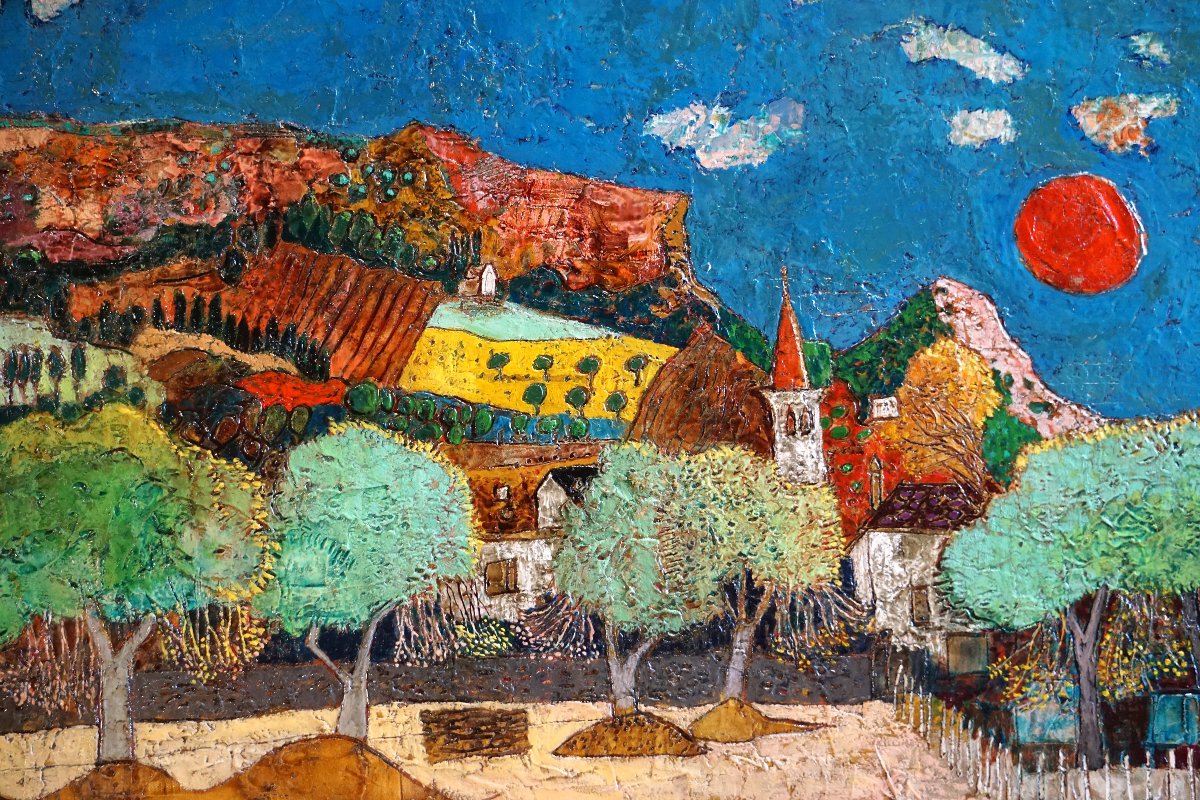
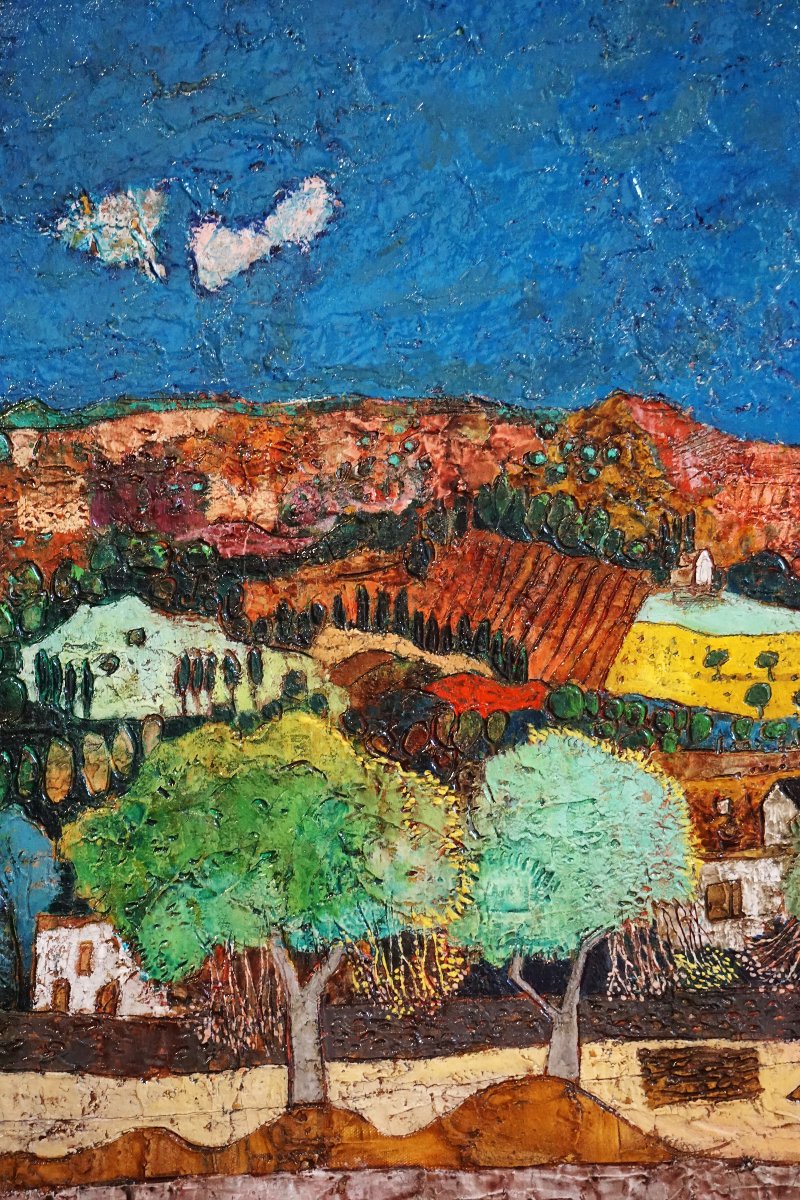
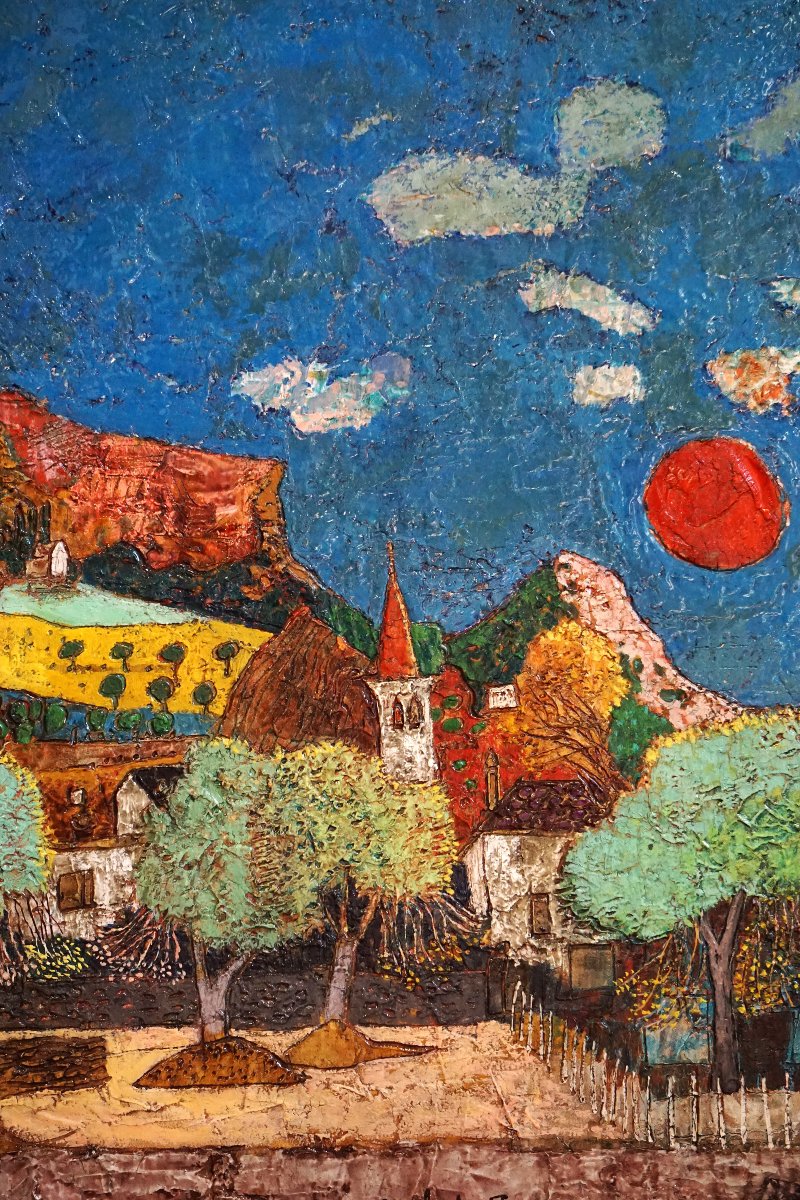
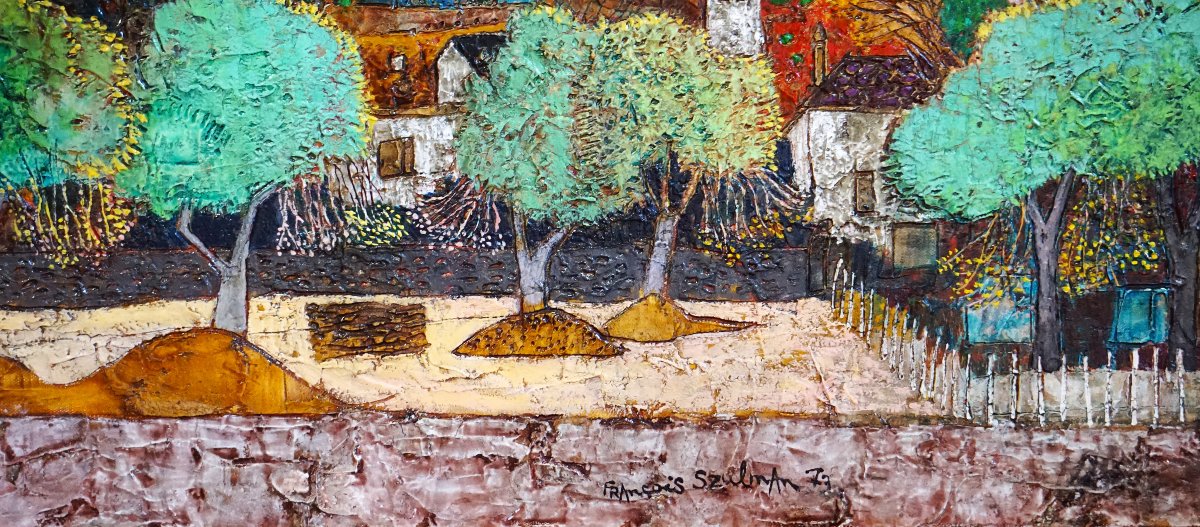
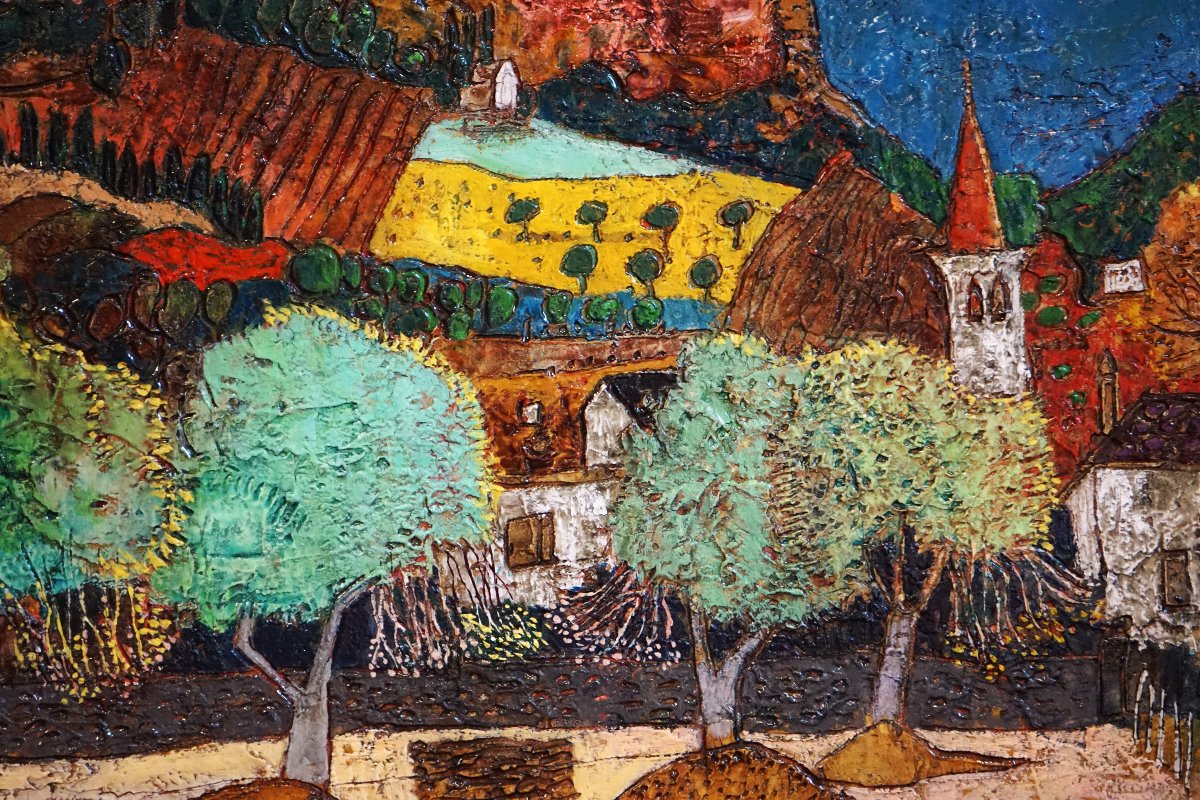
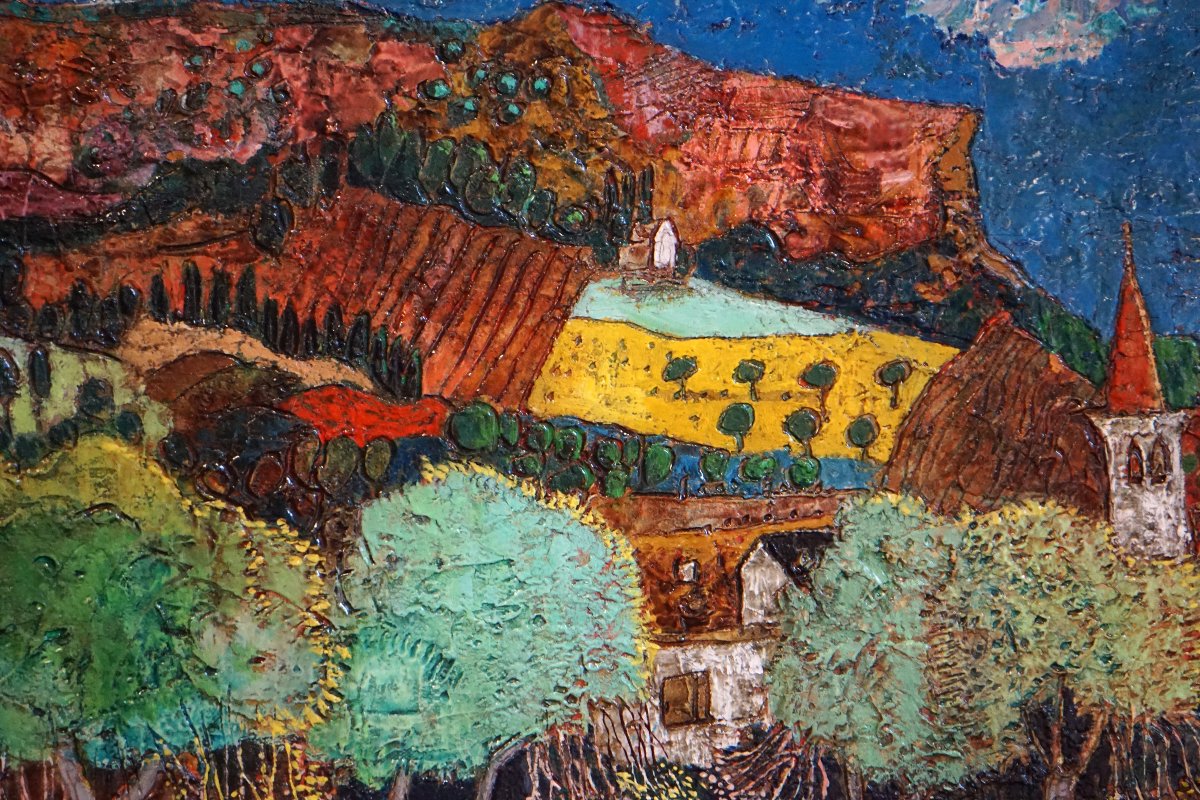
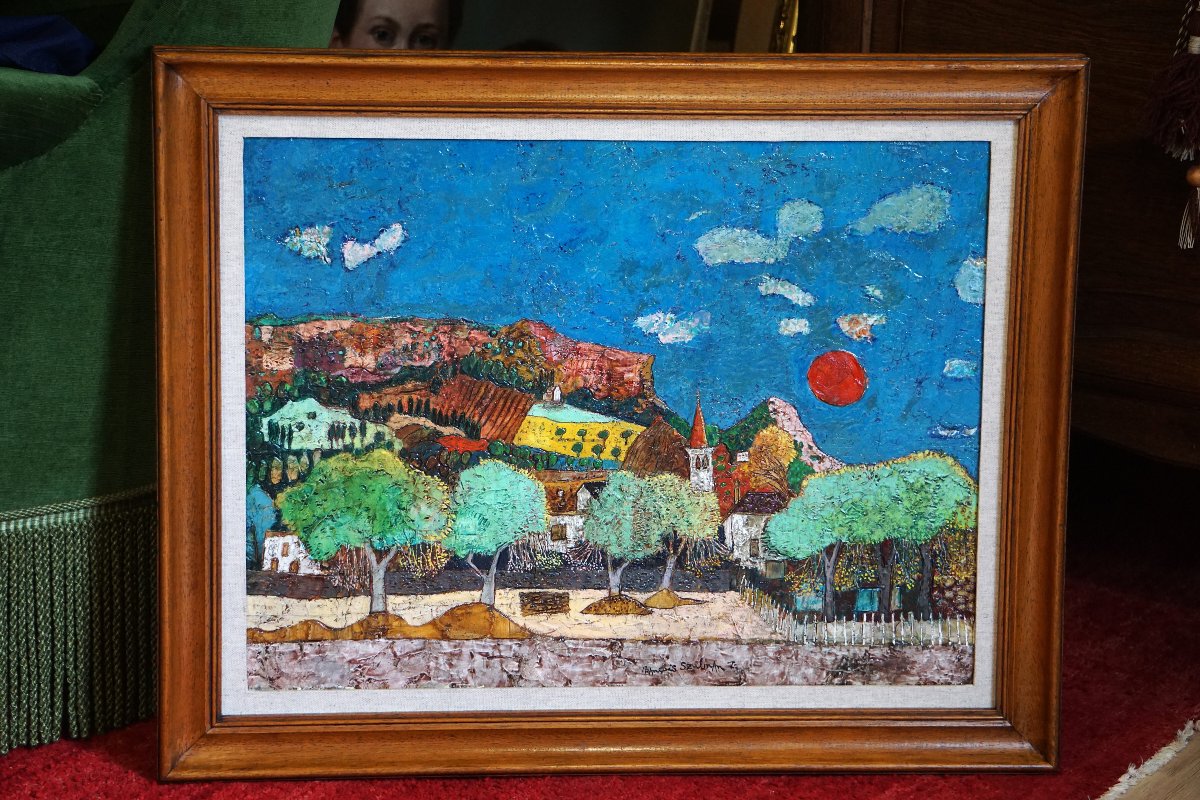
François Szulman (1931–2024) – The Red Sun, 1977 Oil on canvas signed, titled and dated. Listed under number 273/10 in the artist's personal repertoire In The Red Sun, François Szulman displays all the singularity of his pictorial universe, at once dreamlike, vibrant and profoundly human. Dated 1977, this oil on canvas is a work typical of his mature period, in which the artist asserts a style immediately recognizable by the vivacity of the color, the strength of the textures and an almost musical composition. At first glance, one is struck by the brilliance of this cherry-red sun, suspended in an azure sky dotted with fragmented clouds – an almost surreal touch, which gives the scene a rare poetic intensity. On the ground, a small village nestled at the foot of the hills unfolds its white houses, its red roofs, its pointed bell tower and its stylized trees. The perspective is deliberately flattened, the forms treated with a learned naivety that evokes both a child's dream and the memory of an idealized place. The pictorial material is rich, dense, almost tactile. Szulman works the surface of the canvas with an almost goldsmith's attention: the grain of the brush, the colored highlights and the light impasto give the whole a subtle vibration. This taste for texture, combined with a highly constructed composition, is a constant in his work. The artist does not imitate the world: he reinvents it. This painting is emblematic of Szulman's approach, which has always been at the crossroads of naive art, symbolism and a restrained expressionism. We find the vibrant palette, the festive landscapes, the trees with stylized foliage like crowns, and above all this inner light that emanates from each element of the painting. In Szulman's work, everything vibrates, everything seems animated by its own energy. The Red Sun is much more than a simple village scene: it is a vision. An imaginary, almost mythical world, where nature and architecture coexist in jubilant harmony.
46 x 62 without frame
59 x 73 with frame
François Szulman was born on June 5, 1931, in Paris, in the working-class Belleville district, into a Jewish family originally from Poland. At a very young age, he displayed a remarkable talent for drawing. During the Occupation, he lived in hiding with his family, a significant experience that would profoundly influence his artistic sensibility. After the war, he was admitted to the École des Arts Appliqués in Paris, but was forced to abandon his studies to support his family. He then painted as an autodidact, at night, tirelessly. In 1951, he exhibited for the first time at the Salon des Indépendants, then regularly participated in major Parisian exhibitions: Salon d'Automne, Nationale des Beaux-Arts, Peintres témoins de leur temps, Comparaisons. It was in 1967 that he had his first significant solo exhibition at the Galerie Régis Langlois in Paris, the starting point for a long series of individual presentations throughout France and internationally. He exhibited in particular in New York (Galerie Achard de Souza in 1965), Venice, Brussels, Nancy, Lyon, Metz, Orléans, Pont-Aven, Toulouse, and especially in Japan in the 1970s and 1980s, in prestigious venues such as the Galerie Yamoto, the Art Point Gallery and the Palace Art Corporation in Tokyo and Daimaru in Osaka. His instantly recognizable work combines poetic figuration with vivid colors, rich material, and a naive yet symbolic vision of the world, often inspired by childhood memories, idealized landscapes, or dreamlike villages. He has received numerous awards: the Gold Medal in Rome, the Grand Prix Alfred Sisley, the Eugène Boudin Prize, the Prix des Arts de Colombes, and the Prix Univers des Arts, among others. The City of Paris awarded him the Vermeil Medal. He was made a Knight of the Order of Public Encouragement and received the Silver Medal from the Salon des Artistes Français. From 1984 to 1991, he was treasurer of the Société Nationale des Beaux-Arts. His works are included in several public collections, including the Museum of Modern Art in Paris, the Lohamei Haghetaot Museum in Israel, and the Holocaust Museum in Washington. He continued his exhibitions until the 2010s, including a notable retrospective at La Maison près Bastille in 2015. He died in Paris on December 26, 2024, at the age of 93, leaving behind a very personal, poetic body of work, deeply attached to memory and light.
46 x 62 without frame
59 x 73 with frame
François Szulman was born on June 5, 1931, in Paris, in the working-class Belleville district, into a Jewish family originally from Poland. At a very young age, he displayed a remarkable talent for drawing. During the Occupation, he lived in hiding with his family, a significant experience that would profoundly influence his artistic sensibility. After the war, he was admitted to the École des Arts Appliqués in Paris, but was forced to abandon his studies to support his family. He then painted as an autodidact, at night, tirelessly. In 1951, he exhibited for the first time at the Salon des Indépendants, then regularly participated in major Parisian exhibitions: Salon d'Automne, Nationale des Beaux-Arts, Peintres témoins de leur temps, Comparaisons. It was in 1967 that he had his first significant solo exhibition at the Galerie Régis Langlois in Paris, the starting point for a long series of individual presentations throughout France and internationally. He exhibited in particular in New York (Galerie Achard de Souza in 1965), Venice, Brussels, Nancy, Lyon, Metz, Orléans, Pont-Aven, Toulouse, and especially in Japan in the 1970s and 1980s, in prestigious venues such as the Galerie Yamoto, the Art Point Gallery and the Palace Art Corporation in Tokyo and Daimaru in Osaka. His instantly recognizable work combines poetic figuration with vivid colors, rich material, and a naive yet symbolic vision of the world, often inspired by childhood memories, idealized landscapes, or dreamlike villages. He has received numerous awards: the Gold Medal in Rome, the Grand Prix Alfred Sisley, the Eugène Boudin Prize, the Prix des Arts de Colombes, and the Prix Univers des Arts, among others. The City of Paris awarded him the Vermeil Medal. He was made a Knight of the Order of Public Encouragement and received the Silver Medal from the Salon des Artistes Français. From 1984 to 1991, he was treasurer of the Société Nationale des Beaux-Arts. His works are included in several public collections, including the Museum of Modern Art in Paris, the Lohamei Haghetaot Museum in Israel, and the Holocaust Museum in Washington. He continued his exhibitions until the 2010s, including a notable retrospective at La Maison près Bastille in 2015. He died in Paris on December 26, 2024, at the age of 93, leaving behind a very personal, poetic body of work, deeply attached to memory and light.
1 150 €
Period: 20th century
Style: Modern Art
Condition: Perfect condition
Material: Oil painting
Reference (ID): 1587782
Availability: In stock
Print