THIS OBJECT WAS SOLD
Crown Of Laurel And Oak Leaves In Silver Gilt In Its Case By Robineau, Paris, 1865.
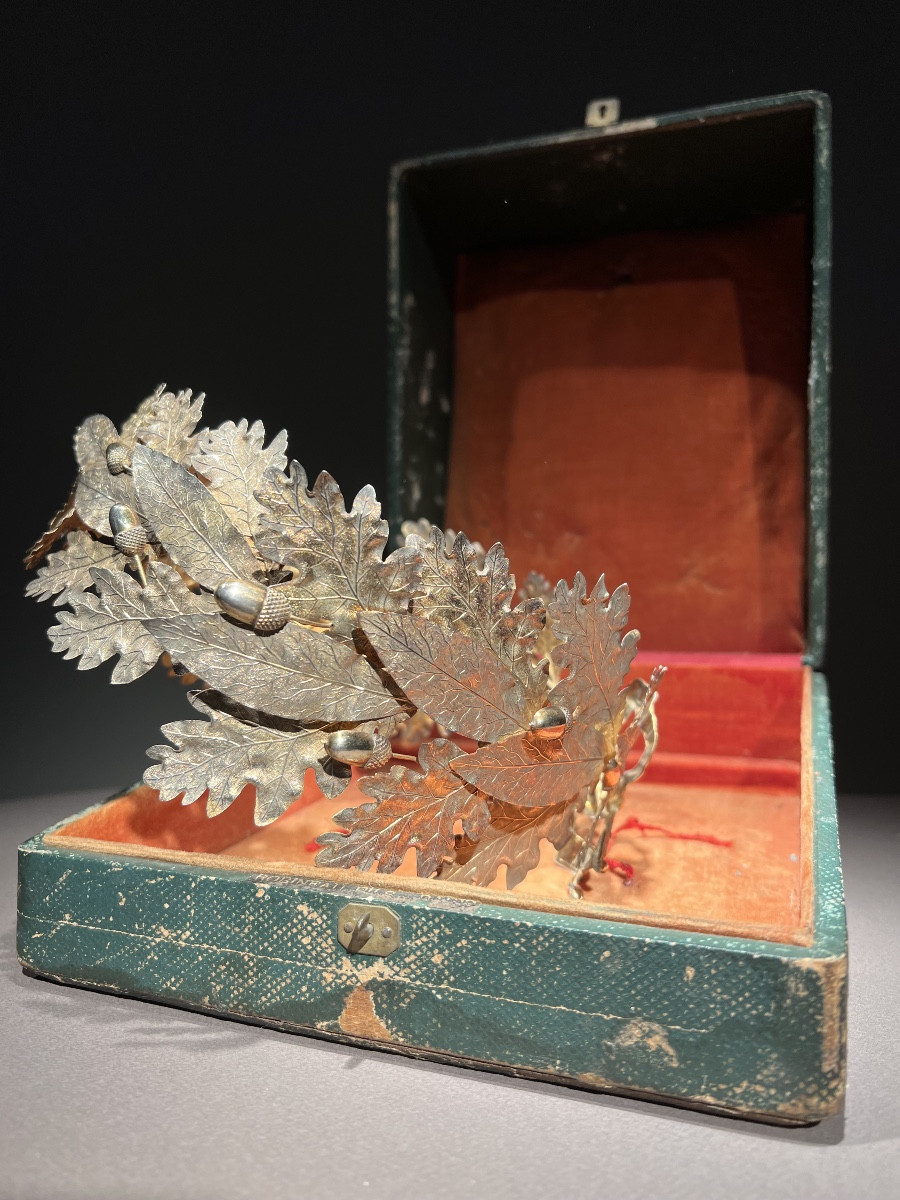

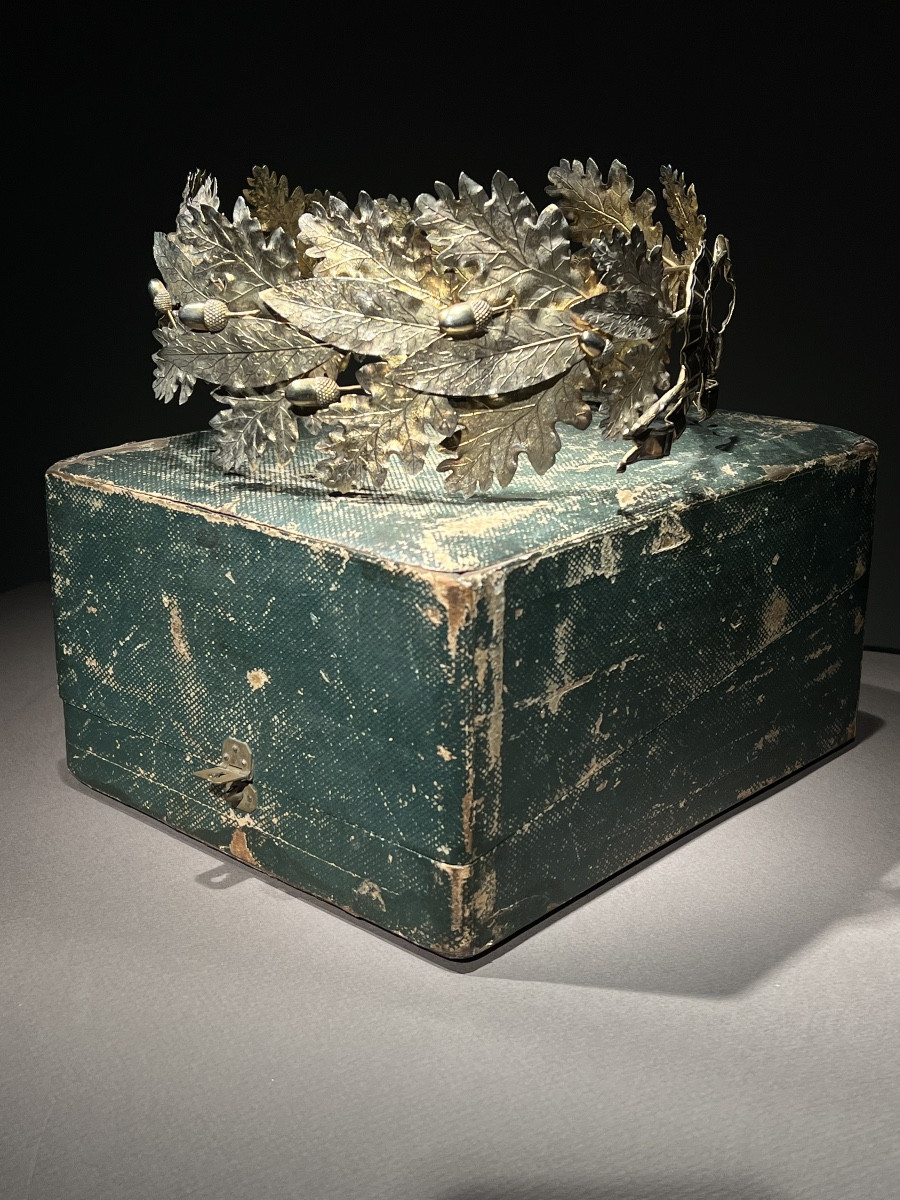


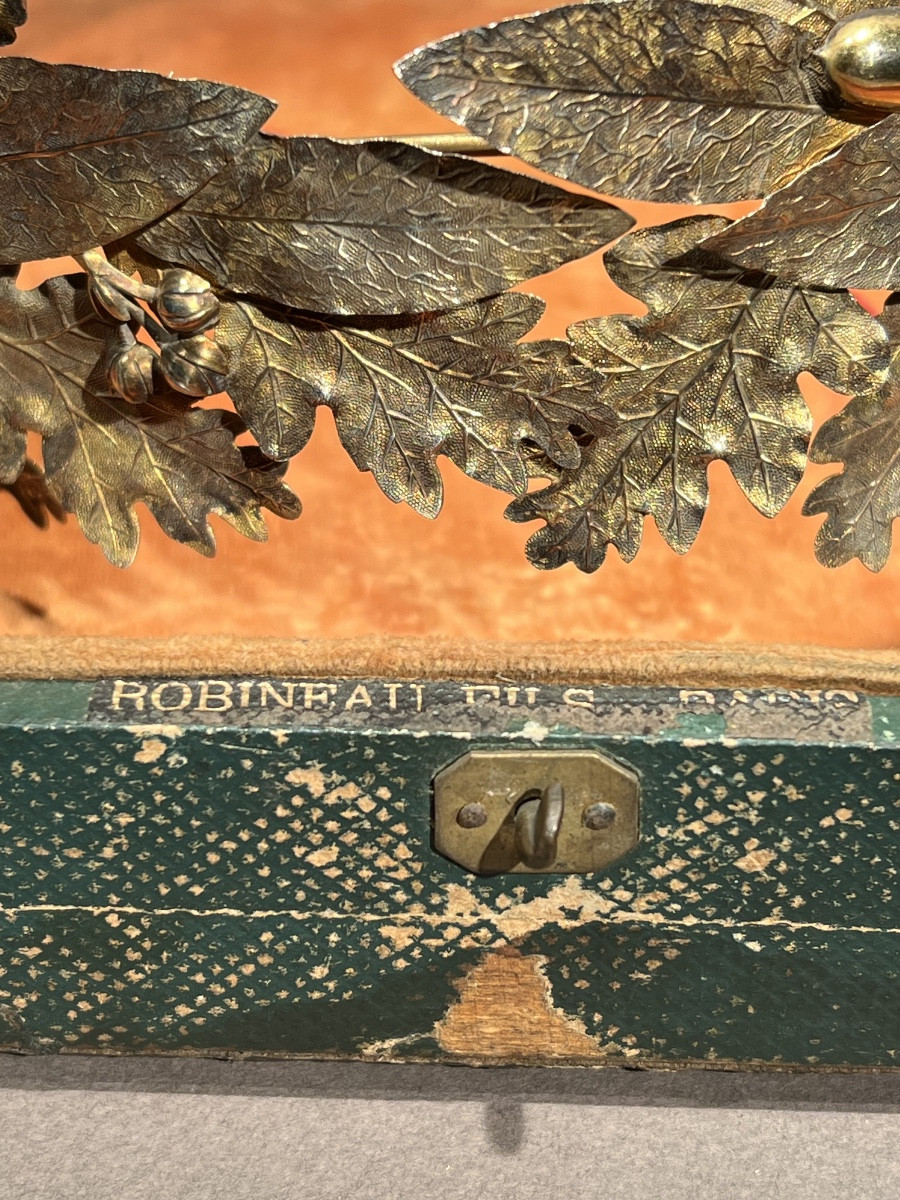


Silver-gilt crown in its case by Roubineau et fils in Paris, made of laurel and oak leaves, Napoleon III period, ca. 1865.
This silver-gilt crown, a remarkable work by the Parisian goldsmith Robineau et Fils, was made in the 19th century. It is composed of finely chiseled oak leaves, arranged in a continuous garland, accompanied by meticulously detailed acorns. The whole is executed in silver-gilt, a silver alloy covered with gold, probably gilded with mercury using the traditional techniques of the time.
The naturalism of the composition testifies to the 19th-century taste for the faithful representation of nature, characteristic of the Romantic style and civil ceremonial objects. By its form, this crown directly evokes the triumphal crowns of Antiquity, notably the Roman corona civica, a symbol of virtue, merit and civic commitment. It was undoubtedly intended for an honorary ceremony, awarded during an academic, republican or commemorative event. Goldwork of this type occupied an important place in the symbolism of official awards in post-revolutionary and republican France, where laurels and oak replaced royal crowns as emblems of merit. The object is preserved in an original box, covered in textured green canvas and lined inside with orange-red velvet. The worn condition of the box underlines its age and the ritual or institutional use of the crown. The brass clasp and the shape of the box are typical of presentations of prestige objects in the 19th century. The inscription of the name Robineau et Fils, located at 129 rue de Turenne in Paris, allows us to link this work to a renowned goldsmith house, successor to Robineau Sorin Frères, specialized in the manufacture of pieces of distinction, medals and honorary crowns.
This masterpiece of civil goldsmithing thus embodies, through its technical refinement and its symbolism, the excellence of 19th century Parisian art.
This silver-gilt crown, a remarkable work by the Parisian goldsmith Robineau et Fils, was made in the 19th century. It is composed of finely chiseled oak leaves, arranged in a continuous garland, accompanied by meticulously detailed acorns. The whole is executed in silver-gilt, a silver alloy covered with gold, probably gilded with mercury using the traditional techniques of the time.
The naturalism of the composition testifies to the 19th-century taste for the faithful representation of nature, characteristic of the Romantic style and civil ceremonial objects. By its form, this crown directly evokes the triumphal crowns of Antiquity, notably the Roman corona civica, a symbol of virtue, merit and civic commitment. It was undoubtedly intended for an honorary ceremony, awarded during an academic, republican or commemorative event. Goldwork of this type occupied an important place in the symbolism of official awards in post-revolutionary and republican France, where laurels and oak replaced royal crowns as emblems of merit. The object is preserved in an original box, covered in textured green canvas and lined inside with orange-red velvet. The worn condition of the box underlines its age and the ritual or institutional use of the crown. The brass clasp and the shape of the box are typical of presentations of prestige objects in the 19th century. The inscription of the name Robineau et Fils, located at 129 rue de Turenne in Paris, allows us to link this work to a renowned goldsmith house, successor to Robineau Sorin Frères, specialized in the manufacture of pieces of distinction, medals and honorary crowns.
This masterpiece of civil goldsmithing thus embodies, through its technical refinement and its symbolism, the excellence of 19th century Parisian art.
Explore similar pieces and discover your ideal find:
Serveware