
Riders On A Stroll - Bernard Boutet De Monvel
Artist: Bernard Boutet De Monvel
Riders on a Stroll - Bernard Boutet De Monvel (1881-1949)
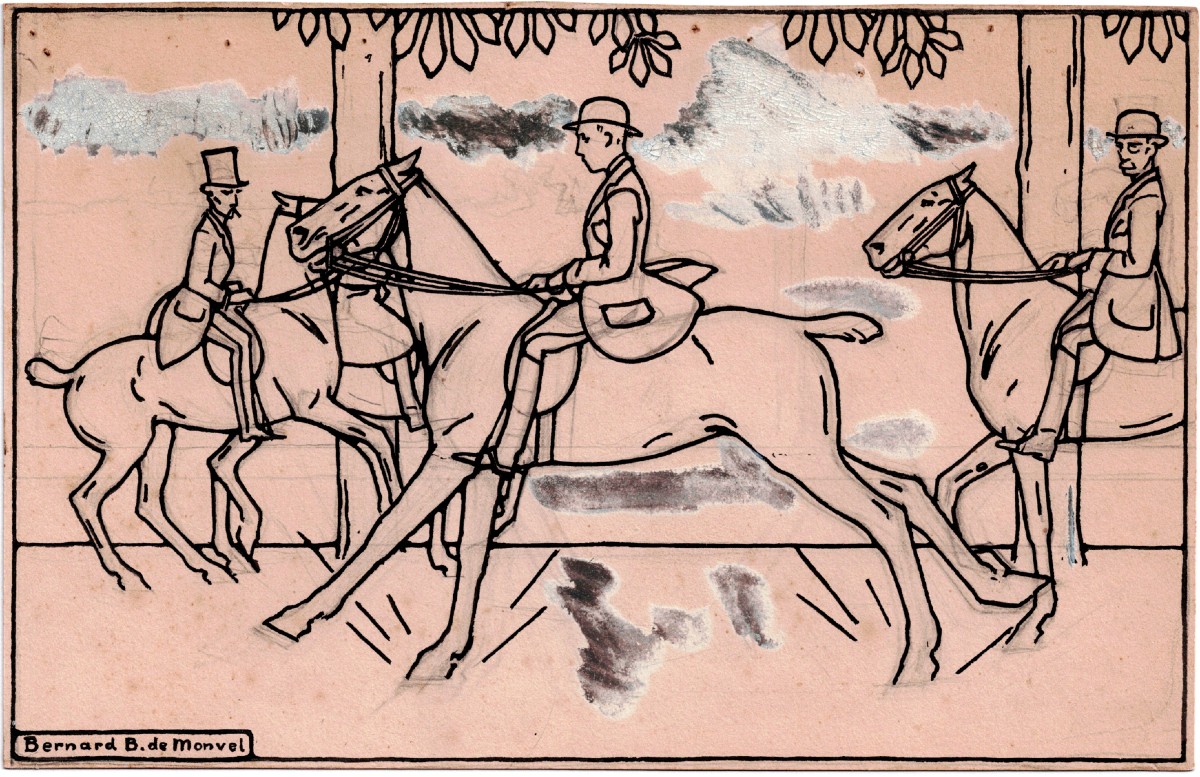
This felt-tip pen drawing, delicately enhanced with touches of watercolor, is the work of Bernard Boutet de Monvel, a leading figure in French Art Deco and a recognized master of refined lines. The scene depicts three elegantly dressed riders mounted on stylized horses, strolling through a park structured by trees with finely suggested foliage.
The artist uses a bold and confident black outline to outline his figures, giving the drawing great graphic clarity. The riders' postures, the tension of the reins, and the dynamics of the horses' legs subtly convey a moment of movement and equestrian discipline. Each character is individualized by their costume: a frock coat and top hat for one, riding jackets and round hats for the others, signs of a high-society scene characteristic of the early 20th century.
The light watercolor highlights, mainly in the foliage and clouds sketched in the background, bring a discreet vibrancy to the composition while preserving its formal rigor. The material effects, achieved through subtle washes, add atmospheric depth without ever weighing down the readability of the whole. Boutet de Monvel's style is recognized here by its extreme linear precision, his taste for stylized detail, and his ability to evoke the elegance of an era with a minimum of effects.
This drawing perfectly illustrates his talent for combining worldly sophistication and modernist purity, qualities that made his reputation both in Europe and the United States. This work directly dialogues with several other equestrian works by Bernard Boutet de Monvel, notably his famous compositions for La Vie élégant (1902-1903) where he already explores, with sober lines and stylized silhouettes, the aristocratic world of the horse. It can also be compared to his major project Le Bois de Boulogne (1910), in which he painted riders and amazons with the same search for graphic rhythm and geometric purity. Finally, this drawing announces, through its formal rigor, the society portraits he would produce after 1920, such as his representations of American aristocrats and financiers, in which he retained this taste for exact detail, taut lines and refined stylization.
This felt-tip pen drawing, delicately enhanced with touches of watercolor, is the work of Bernard Boutet de Monvel, a leading figure in French Art Deco and a recognized master of refined lines. The scene depicts three elegantly dressed riders mounted on stylized horses, strolling through a park structured by trees with finely suggested foliage.
The artist uses a bold and confident black outline to outline his figures, giving the drawing great graphic clarity. The riders' postures, the tension of the reins, and the dynamics of the horses' legs subtly convey a moment of movement and equestrian discipline. Each character is individualized by their costume: a frock coat and top hat for one, riding jackets and round hats for the others, signs of a high-society scene characteristic of the early 20th century.
The light watercolor highlights, mainly in the foliage and clouds sketched in the background, bring a discreet vibrancy to the composition while preserving its formal rigor. The material effects, achieved through subtle washes, add atmospheric depth without ever weighing down the readability of the whole. Boutet de Monvel's style is recognized here by its extreme linear precision, his taste for stylized detail, and his ability to evoke the elegance of an era with a minimum of effects.
This drawing perfectly illustrates his talent for combining worldly sophistication and modernist purity, qualities that made his reputation both in Europe and the United States. This work directly dialogues with several other equestrian works by Bernard Boutet de Monvel, notably his famous compositions for La Vie élégant (1902-1903) where he already explores, with sober lines and stylized silhouettes, the aristocratic world of the horse. It can also be compared to his major project Le Bois de Boulogne (1910), in which he painted riders and amazons with the same search for graphic rhythm and geometric purity. Finally, this drawing announces, through its formal rigor, the society portraits he would produce after 1920, such as his representations of American aristocrats and financiers, in which he retained this taste for exact detail, taut lines and refined stylization.
1 200 €
Period: 20th century
Style: Art Deco
Condition: Good condition
Material: Paper
Width: 26cm
Height: 17cm
Reference (ID): 1544879
Availability: In stock
Print