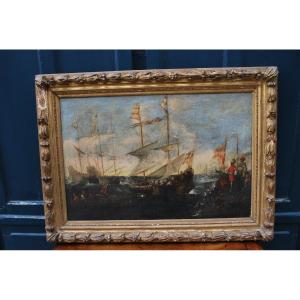
Peter II Casteel (1650; 1701) Attributed. Animated Port Scene
Artist: Peter Ii Casteel (1650 ; 1701) Attribué.
Peter II Casteel (1650–1701) and workshop. Lively harbor scene
Canvas, relined, 42.5 cm x 30 cm
Very fine antique carved frame, 54 cm x 41.5 cm
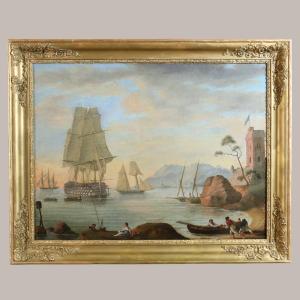
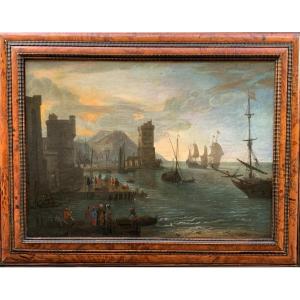
Our painting is a small gem of finesse. The artist presents us with a view of a port, certainly imaginary, with a large number of meticulously depicted figures.
We thank Professor Jan de Maere for confirming that this work is by Peter II Casteel and his workshop, after examining a photograph.
This composition represents a vast maritime capriccio, a genre particularly popular in Flemish painting of the late 17th century. The artist depicts an imaginary city opening onto a wide body of water, where port and commercial activity constitutes the true subject of the work. Numerous boats—barges, rowboats, and cargo ships—animate the river, while a crowd of figures bustle about on the quays, around a drawbridge and the port facilities.
The city taking shape in the background does not seem to correspond to any precise topography. Towers, steeples, gabled houses, and monumental buildings compose an idealized urban silhouette, inspired by the great trading cities of the former Low Countries. The tall buildings that frame the scene enhance the sense of depth and lead the eye toward the horizon, where the architecture blends into an atmospheric light dominated by a vast sky with monumental clouds.
The work displays all the characteristics of the style of Pieter Casteels II, an Antwerp painter specializing in landscapes, harbors, and cityscapes. His art is distinguished by the balance
of its compositions, the meticulous attention paid to the figures, the richness of its animation
and a harmonious palette of greens, browns, and bluish grays,
punctuated by touches of color in the characters' costumes.
Rather than a faithful representation of an identifiable city,
this painting is a capriccio, in which the artist freely combines different architectural and port elements to create an
idealized vision of a large river metropolis. This freedom of composition,
very fashionable among 17th-century European collectors, allowed him to prioritize
the picturesque effect, the depth of space, and the animation of the scene
over topographical accuracy.
Through the quality of its execution, the subtlety of its atmosphere, and the importance given to port life, this work fits perfectly within the production of Pieter Casteels II and testifies to his talent for large maritime and urban compositions, where imagination, a sense of perspective, and careful observation of the merchant world of his time are combined.
Canvas, relined, 42.5 cm x 30 cm
Very fine antique carved frame, 54 cm x 41.5 cm
Our painting is a small gem of finesse. The artist presents us with a view of a port, certainly imaginary, with a large number of meticulously depicted figures.
We thank Professor Jan de Maere for confirming that this work is by Peter II Casteel and his workshop, after examining a photograph.
This composition represents a vast maritime capriccio, a genre particularly popular in Flemish painting of the late 17th century. The artist depicts an imaginary city opening onto a wide body of water, where port and commercial activity constitutes the true subject of the work. Numerous boats—barges, rowboats, and cargo ships—animate the river, while a crowd of figures bustle about on the quays, around a drawbridge and the port facilities.
The city taking shape in the background does not seem to correspond to any precise topography. Towers, steeples, gabled houses, and monumental buildings compose an idealized urban silhouette, inspired by the great trading cities of the former Low Countries. The tall buildings that frame the scene enhance the sense of depth and lead the eye toward the horizon, where the architecture blends into an atmospheric light dominated by a vast sky with monumental clouds.
The work displays all the characteristics of the style of Pieter Casteels II, an Antwerp painter specializing in landscapes, harbors, and cityscapes. His art is distinguished by the balance
of its compositions, the meticulous attention paid to the figures, the richness of its animation
and a harmonious palette of greens, browns, and bluish grays,
punctuated by touches of color in the characters' costumes.
Rather than a faithful representation of an identifiable city,
this painting is a capriccio, in which the artist freely combines different architectural and port elements to create an
idealized vision of a large river metropolis. This freedom of composition,
very fashionable among 17th-century European collectors, allowed him to prioritize
the picturesque effect, the depth of space, and the animation of the scene
over topographical accuracy.
Through the quality of its execution, the subtlety of its atmosphere, and the importance given to port life, this work fits perfectly within the production of Pieter Casteels II and testifies to his talent for large maritime and urban compositions, where imagination, a sense of perspective, and careful observation of the merchant world of his time are combined.
3 850 €
Period: 17th century
Style: Louis 14th, Regency
Condition: Excellent condition
Material: Oil painting
Length: 42 cm, 54 cm avec le cadre
Width: 30 cm, 41 cm avec le cadre
Reference (ID): 1533133
Availability: In stock
Print