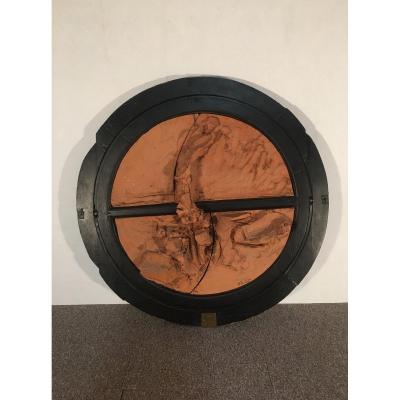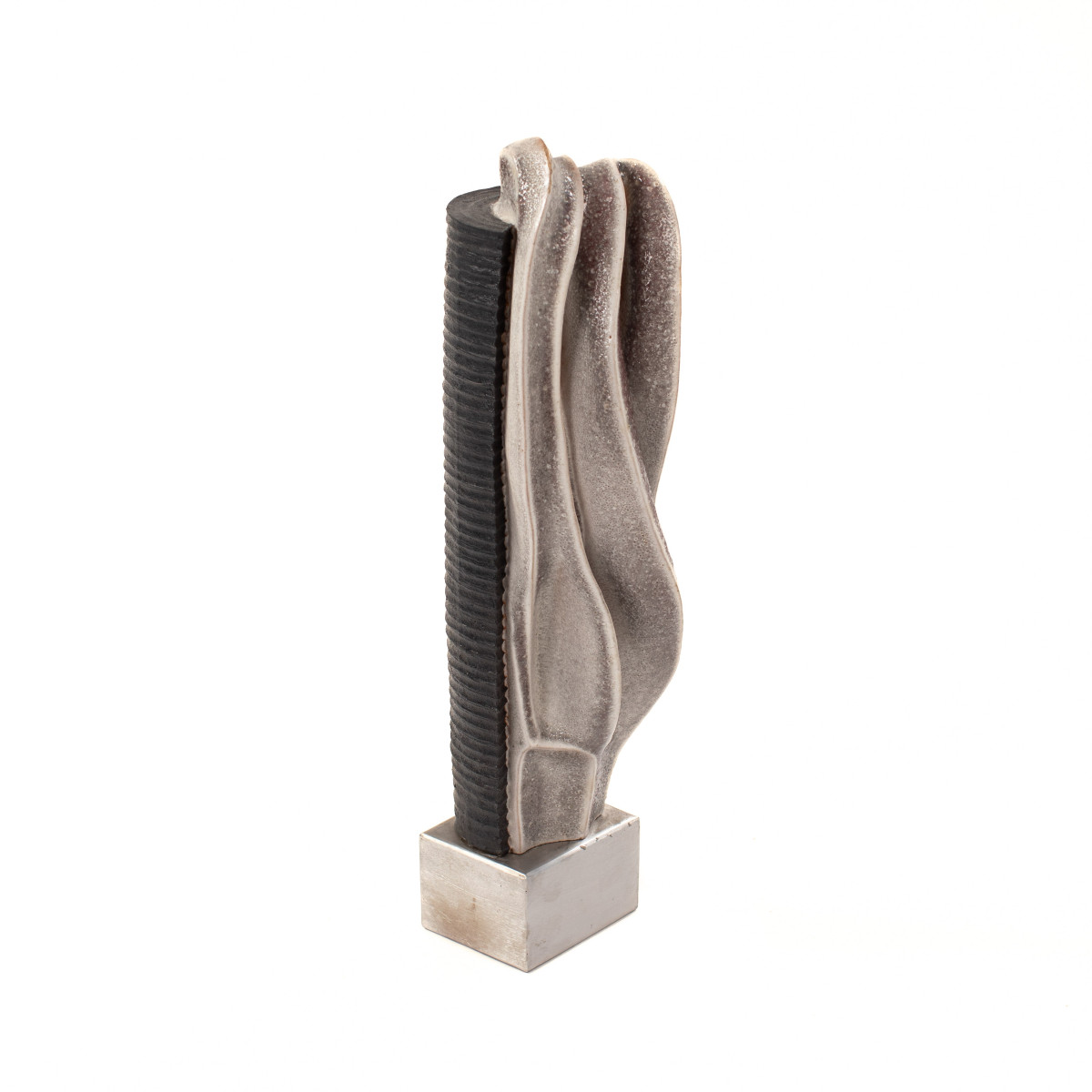




Stoneware Sculpture On Steel Base With Glaze In Grey-white-black, Signed Zauli
Artist: Carlo Zauli
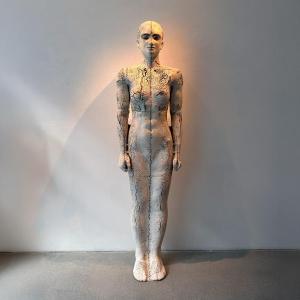
Turned stoneware sculpture on a steel base with iridescent glaze in grey-white-black.
Lively object with different structures and glazes, signed Zauli
Carlo Zauli was born in Fenza in 1926 and died there in 2002.
1937-1948 technical and artistic training at the Institut Statale d'arte per la ceramica in Faenza. Since 1950 own studio in Faenza, since 1975 second studio in Milan. 1958-1978 Teaching at the Institut Statale d'Arte per la ceramica in Faenza. 1970 Member of the AIC Geneva. From 1973 teaching throughout Europe, including Germany, Spain, Canada and Japan.
1979 Collaboration with Rosenthal, Selb Germany.
1980-1984 Director of the Institut Superiore Industrie Artistiche in Faenza.
Vessels, vessel objects, later mainly sculpture in majolica, stoneware and porcelain - initially turned vases and vessels, through moulded vessel shapes and adaptations of turned moulds to the development of sculptures.
Objects such as wavy stripes, joined and moving forms and steles, also in large formats with characteristic monochrome but changing white glass, use of metal overlays, since 1973 works in bronze and marble, large-scale wall designs, works in public spaces.
Carlo Zauli is indisputably considered one of the most important sculptural ceramists of the 20th century.
After winning the main awards dedicated to ceramic art in the 1950s, the early 1960s saw him evolve towards a markedly sculptural interpretation of his craft. In these years he matured his own artistic language, imbued with informal atmospheres intertwined with a harmonious yet disruptive 'naturalness': these were the years of his growing international success. From 1958, the year in which the large high-reliefs for the palace in Baghdad and the Kuwait State Printing House were realised, he saw his fame grow steadily, until, in the 1970s and 1980s, he travelled throughout Europe, Japan and North America, where he realised expositions and places works permanently.
Carlo Zauli was born in 1926 in Faenza, where he passed away in 2002.
His works have changed over time:
About a vase (from 1950 to 1967)
The vase, the archetype of every ceramist, is at the centre of the research of Carlo Zauli's early period. After leaving the Art Institute in Faenza, he immediately dedicated himself to contemporary production, innovating techniques, shapes and decorative choices within a few years.
Natural vibrations (from 1967 to 1993)
At the end of the 1960s, Carlo Zauli deepened his most accomplished research, starting from primary forms furrowed by the vitalistic and material tremor that became the centre of his artistic career. The geometric solids seem to naturalise and pervade with intense sensuality thanks to endogenous movements that reveal themselves on gently moving and sinuous surfaces. The perennially fragile balance between these formal opposites becomes the key to the strong interest in Zauli's work on the part of distant cultures, especially the Japanese, in whose philosophical dialogue between ying and yang, by his own admission, the artist perfectly recognises himself. This dynamism, continually reshaped in the years to follow, sometimes goes so far as to lacerate these forms, allowing their rough inner material to be glimpsed and unleashed.
Geometric research (from 1966 to 1987)
It is through research in the field of ceramics in industrial design and the creation of increasingly regular and perfect vases that Carlo Zauli deepens his distinctly geometric sculptural research. From the high reliefs of 1966 to the sculptures of the late 1980s, geometry continuously becomes the main theme linking the artist to his own material sensitivity.
The Distorted (1976 to 1987)
Even after reaching full sculptural maturity, Zauli does not abandon the first object of observation – the vase – breaking it, tearing it, turning it upside down, and including it in the same metamorphosis of his primary geometric shapes. Thus came to be, in 1976, the Distorted Vases, torn or bent by a violent gesture, and in 1987 the Distorted Sensualities, vases that close up to become modules for a final, dramatic sculptural evolution of the artist.
The clods (from 1972 to 1987)
It is especially when Zauli deals with the theme of the clods (of clay) that he explicitly conveys the intimate symbiosis of his work with the earth. Earth, thus, is considered both a sensitive material and the starting point for all ceramic and non-ceramic works, as well as an actual geographical root. Works such as le Arate (the ploughs) or le Zolle (the clods), are created with an assembly of real clods of clay taken from the mixer and directly applied to geometric supports. Through their irregular morphology, they express the primordial strength and rough consistency of the material.
Lively object with different structures and glazes, signed Zauli
Carlo Zauli was born in Fenza in 1926 and died there in 2002.
1937-1948 technical and artistic training at the Institut Statale d'arte per la ceramica in Faenza. Since 1950 own studio in Faenza, since 1975 second studio in Milan. 1958-1978 Teaching at the Institut Statale d'Arte per la ceramica in Faenza. 1970 Member of the AIC Geneva. From 1973 teaching throughout Europe, including Germany, Spain, Canada and Japan.
1979 Collaboration with Rosenthal, Selb Germany.
1980-1984 Director of the Institut Superiore Industrie Artistiche in Faenza.
Vessels, vessel objects, later mainly sculpture in majolica, stoneware and porcelain - initially turned vases and vessels, through moulded vessel shapes and adaptations of turned moulds to the development of sculptures.
Objects such as wavy stripes, joined and moving forms and steles, also in large formats with characteristic monochrome but changing white glass, use of metal overlays, since 1973 works in bronze and marble, large-scale wall designs, works in public spaces.
Carlo Zauli is indisputably considered one of the most important sculptural ceramists of the 20th century.
After winning the main awards dedicated to ceramic art in the 1950s, the early 1960s saw him evolve towards a markedly sculptural interpretation of his craft. In these years he matured his own artistic language, imbued with informal atmospheres intertwined with a harmonious yet disruptive 'naturalness': these were the years of his growing international success. From 1958, the year in which the large high-reliefs for the palace in Baghdad and the Kuwait State Printing House were realised, he saw his fame grow steadily, until, in the 1970s and 1980s, he travelled throughout Europe, Japan and North America, where he realised expositions and places works permanently.
Carlo Zauli was born in 1926 in Faenza, where he passed away in 2002.
His works have changed over time:
About a vase (from 1950 to 1967)
The vase, the archetype of every ceramist, is at the centre of the research of Carlo Zauli's early period. After leaving the Art Institute in Faenza, he immediately dedicated himself to contemporary production, innovating techniques, shapes and decorative choices within a few years.
Natural vibrations (from 1967 to 1993)
At the end of the 1960s, Carlo Zauli deepened his most accomplished research, starting from primary forms furrowed by the vitalistic and material tremor that became the centre of his artistic career. The geometric solids seem to naturalise and pervade with intense sensuality thanks to endogenous movements that reveal themselves on gently moving and sinuous surfaces. The perennially fragile balance between these formal opposites becomes the key to the strong interest in Zauli's work on the part of distant cultures, especially the Japanese, in whose philosophical dialogue between ying and yang, by his own admission, the artist perfectly recognises himself. This dynamism, continually reshaped in the years to follow, sometimes goes so far as to lacerate these forms, allowing their rough inner material to be glimpsed and unleashed.
Geometric research (from 1966 to 1987)
It is through research in the field of ceramics in industrial design and the creation of increasingly regular and perfect vases that Carlo Zauli deepens his distinctly geometric sculptural research. From the high reliefs of 1966 to the sculptures of the late 1980s, geometry continuously becomes the main theme linking the artist to his own material sensitivity.
The Distorted (1976 to 1987)
Even after reaching full sculptural maturity, Zauli does not abandon the first object of observation – the vase – breaking it, tearing it, turning it upside down, and including it in the same metamorphosis of his primary geometric shapes. Thus came to be, in 1976, the Distorted Vases, torn or bent by a violent gesture, and in 1987 the Distorted Sensualities, vases that close up to become modules for a final, dramatic sculptural evolution of the artist.
The clods (from 1972 to 1987)
It is especially when Zauli deals with the theme of the clods (of clay) that he explicitly conveys the intimate symbiosis of his work with the earth. Earth, thus, is considered both a sensitive material and the starting point for all ceramic and non-ceramic works, as well as an actual geographical root. Works such as le Arate (the ploughs) or le Zolle (the clods), are created with an assembly of real clods of clay taken from the mixer and directly applied to geometric supports. Through their irregular morphology, they express the primordial strength and rough consistency of the material.
6 400 €
Period: 20th century
Style: Modern Art
Condition: Excellent condition
Material: Ceramic
Width: 12.5
Height: 45
Depth: 12.5
Reference (ID): 1529535
Availability: In stock
Print