



XIX° Romantic School On The Theme Of Diogenes 39 X 31
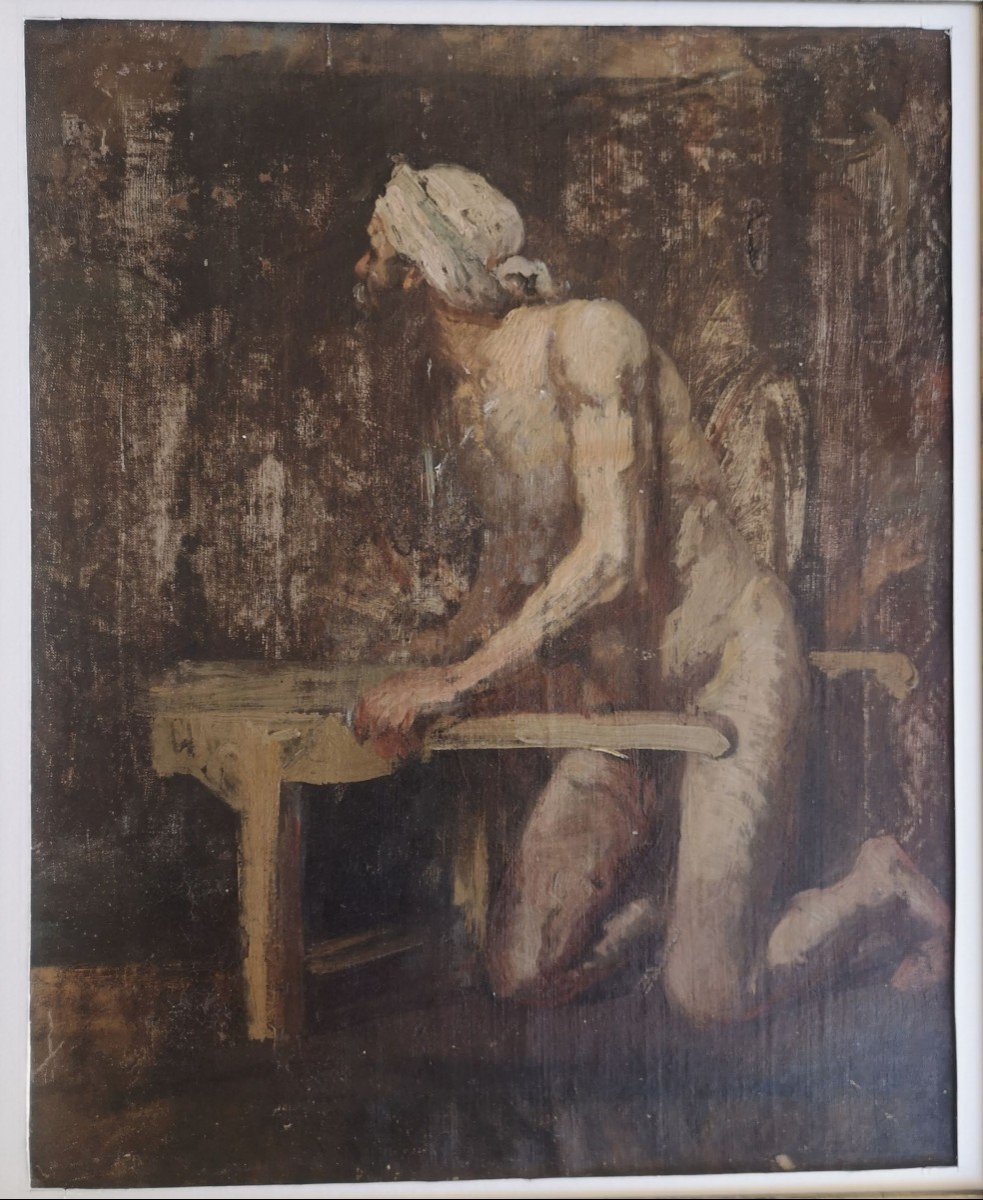
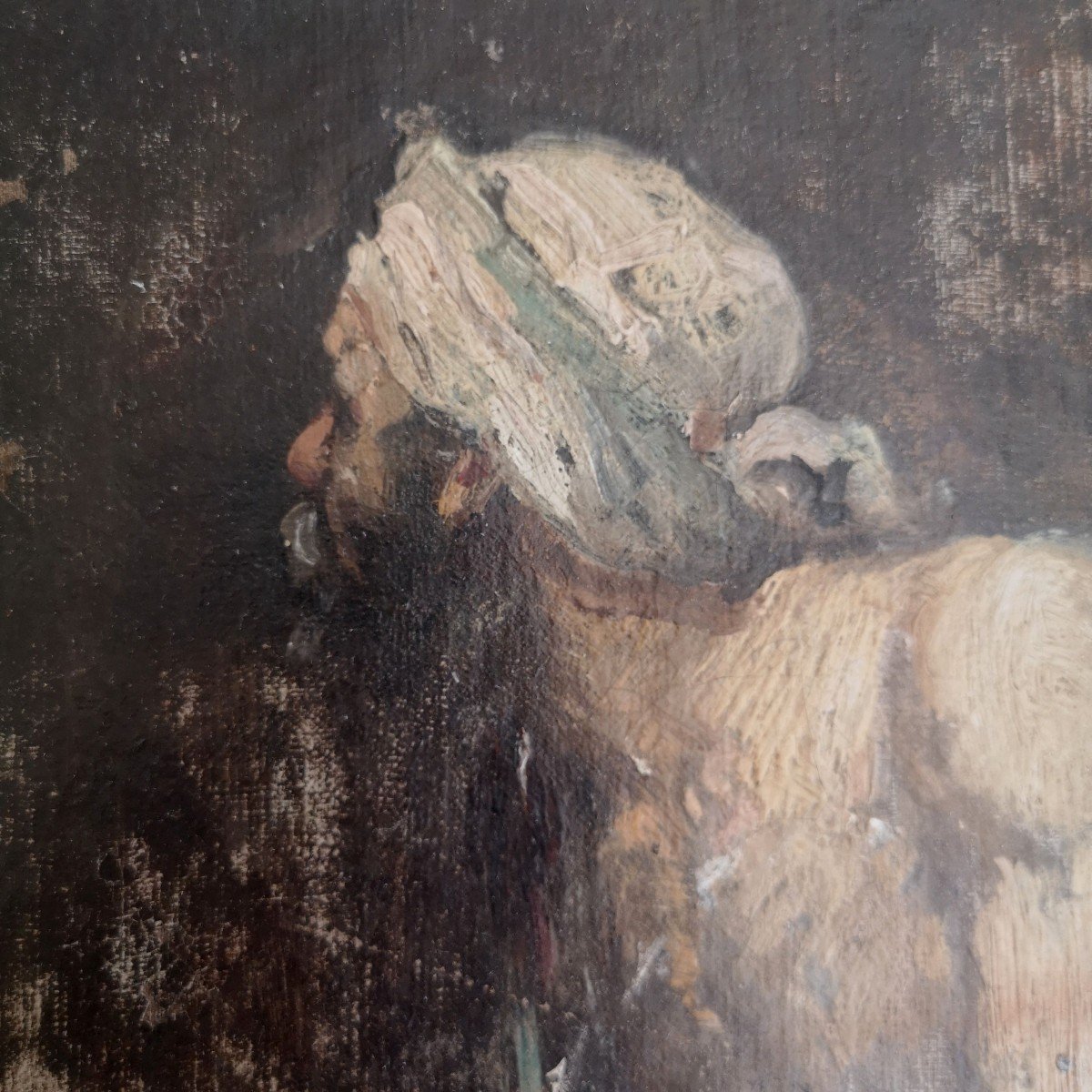
French School circa 1840–1880. Influence: Dark Romanticism & Orientalism, in the tradition of Delacroix, Decamps, and Gérôme. Technique: Oil on canvas. Dimensions: 39 × 31 cm. High-quality Napoleon III period frame. This striking work depicts a scene from an oriental dungeon, illuminated by a raking light that starkly delineates the forms in the darkness.
A turbaned man, kneeling, leans over a torture rack, an instrument used to immobilize, stretch, or break a prisoner's body. This figure is not the victim, but rather the executioner or jailer. His active posture and the way he concentrates on the device indicate that he is preparing the torture. The victim is deliberately concealed: barely perceptible in the shadows, spectral forms can be discerned beyond the table. No fewer than five figures seem to await their fate in the darkness of this dungeon. This technique, typical of Romanticism, leaves the viewer to imagine the suffering, making the scene all the more disturbing. The depicted space evokes a prison cell or dungeon in the Orientalist imagination of the 19th century: bare walls, heavy darkness, a stifling atmosphere. In the Western imagination, these scenes were often set in the prisons of the Ottoman Empire, the Maghreb, or the Near East, perceived as places of arbitrary power, violence, and secrecy.
Artistic Significance: The painting belongs to the dark Romantic Orientalist movement, a genre that fascinated 19th-century painters and collectors: not the decorative Orient of harems, but the dark, cruel, secretive Orient inherited from Goya, Rembrandt, and travelers' accounts. The pictorial treatment—thick impasto, brown tones, dramatic lighting—reinforces the impression of a theater of cruelty, where man is reduced to a body manipulated by power. This type of scene was sought after by 19th-century bourgeois collectors for its narrative, moral, and emotional force. Stylistic attribution (probable) Without a visible signature, the work can be linked to the French Orientalist school of the second half of the 19th century, in the orbit of painters such as: Alexandre-Gabriel Decamps Jean-Léon Gérôme Horace Vernet or some students and followers of Delacroix The intimate format (39 × 31 cm) corresponds to cabinet scenes, intended for a cultivated collector rather than a large official commission.
A turbaned man, kneeling, leans over a torture rack, an instrument used to immobilize, stretch, or break a prisoner's body. This figure is not the victim, but rather the executioner or jailer. His active posture and the way he concentrates on the device indicate that he is preparing the torture. The victim is deliberately concealed: barely perceptible in the shadows, spectral forms can be discerned beyond the table. No fewer than five figures seem to await their fate in the darkness of this dungeon. This technique, typical of Romanticism, leaves the viewer to imagine the suffering, making the scene all the more disturbing. The depicted space evokes a prison cell or dungeon in the Orientalist imagination of the 19th century: bare walls, heavy darkness, a stifling atmosphere. In the Western imagination, these scenes were often set in the prisons of the Ottoman Empire, the Maghreb, or the Near East, perceived as places of arbitrary power, violence, and secrecy.
Artistic Significance: The painting belongs to the dark Romantic Orientalist movement, a genre that fascinated 19th-century painters and collectors: not the decorative Orient of harems, but the dark, cruel, secretive Orient inherited from Goya, Rembrandt, and travelers' accounts. The pictorial treatment—thick impasto, brown tones, dramatic lighting—reinforces the impression of a theater of cruelty, where man is reduced to a body manipulated by power. This type of scene was sought after by 19th-century bourgeois collectors for its narrative, moral, and emotional force. Stylistic attribution (probable) Without a visible signature, the work can be linked to the French Orientalist school of the second half of the 19th century, in the orbit of painters such as: Alexandre-Gabriel Decamps Jean-Léon Gérôme Horace Vernet or some students and followers of Delacroix The intimate format (39 × 31 cm) corresponds to cabinet scenes, intended for a cultivated collector rather than a large official commission.
900 €
Period: 19th century
Style: Napoleon 3rd
Condition: En l'etat
Material: Oil painting
Reference (ID): 1469042
Availability: In stock
Print