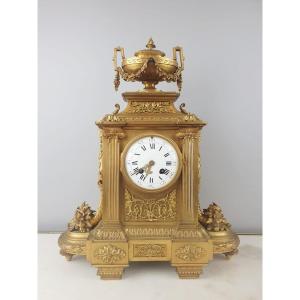
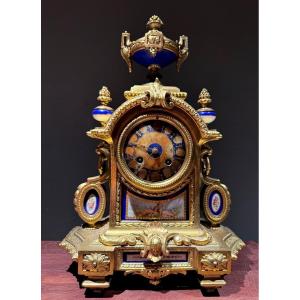
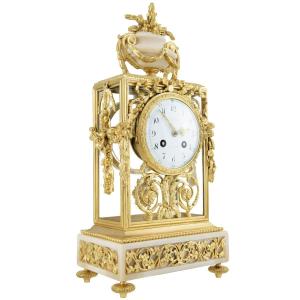
Breguet Clock Circa 1795 Number 282
Artist: Breguet
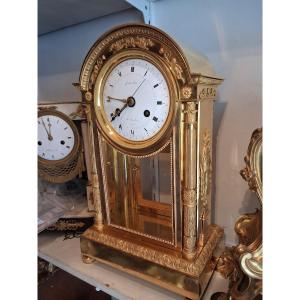
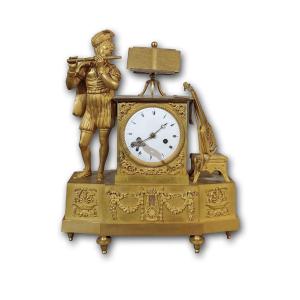
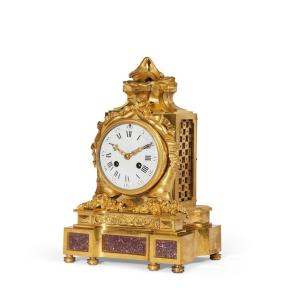
Directoire period pendulum clock, number 282, dial marked Breguet in patinated and gilded bronze
Abraham Louis Breguet was born on January 10, 1747, in Neufchâtel (Switzerland). He arrived in Versailles at the age of 15 in 1762 to be an apprentice. In 1771, he invented a system of winding and setting the time “by the pendant”. Several watchmakers took out patents on this subject in the 19th century, but this system did not become established until the end of the century (the manufacture of key watches stopped around 1890-1900).
He set up on his own on the Île de la Cité in 1775. He is also the author of a very large number of inventions which brought watchmaking to the highest level of perfection. He invented the “Breguet” hairspring, the tourbillon, the bumper, the perpetual calendar, the double-barrel mechanism and the double-seconds stopwatch. He creates friendly clocks which wind up and set the time on a watch placed on a cradle placed above them.
In 1815, he was appointed watchmaker to the Royal Navy. Then he became a member of the Academy of Sciences. His works are distinguished by the perfection of their execution, their originality and their functional elegance. He is one of the greatest watchmakers of all time. Abraham Louis Bréguet died on September 7, 1823, in Paris. He rests at Père Lachaise.
Abraham Louis Breguet was born on January 10, 1747, in Neufchâtel (Switzerland). He arrived in Versailles at the age of 15 in 1762 to be an apprentice. In 1771, he invented a system of winding and setting the time “by the pendant”. Several watchmakers took out patents on this subject in the 19th century, but this system did not become established until the end of the century (the manufacture of key watches stopped around 1890-1900).
He set up on his own on the Île de la Cité in 1775. He is also the author of a very large number of inventions which brought watchmaking to the highest level of perfection. He invented the “Breguet” hairspring, the tourbillon, the bumper, the perpetual calendar, the double-barrel mechanism and the double-seconds stopwatch. He creates friendly clocks which wind up and set the time on a watch placed on a cradle placed above them.
In 1815, he was appointed watchmaker to the Royal Navy. Then he became a member of the Academy of Sciences. His works are distinguished by the perfection of their execution, their originality and their functional elegance. He is one of the greatest watchmakers of all time. Abraham Louis Bréguet died on September 7, 1823, in Paris. He rests at Père Lachaise.
7 500 €
Period: 18th century
Style: Louis 16th, Directory
Condition: Good condition
Material: Bronze
Reference (ID): 1458444
Availability: In stock
Print