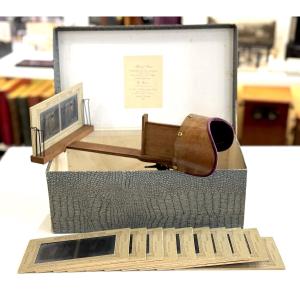


Mono And Stereo Graphoscope In Thuja Burl
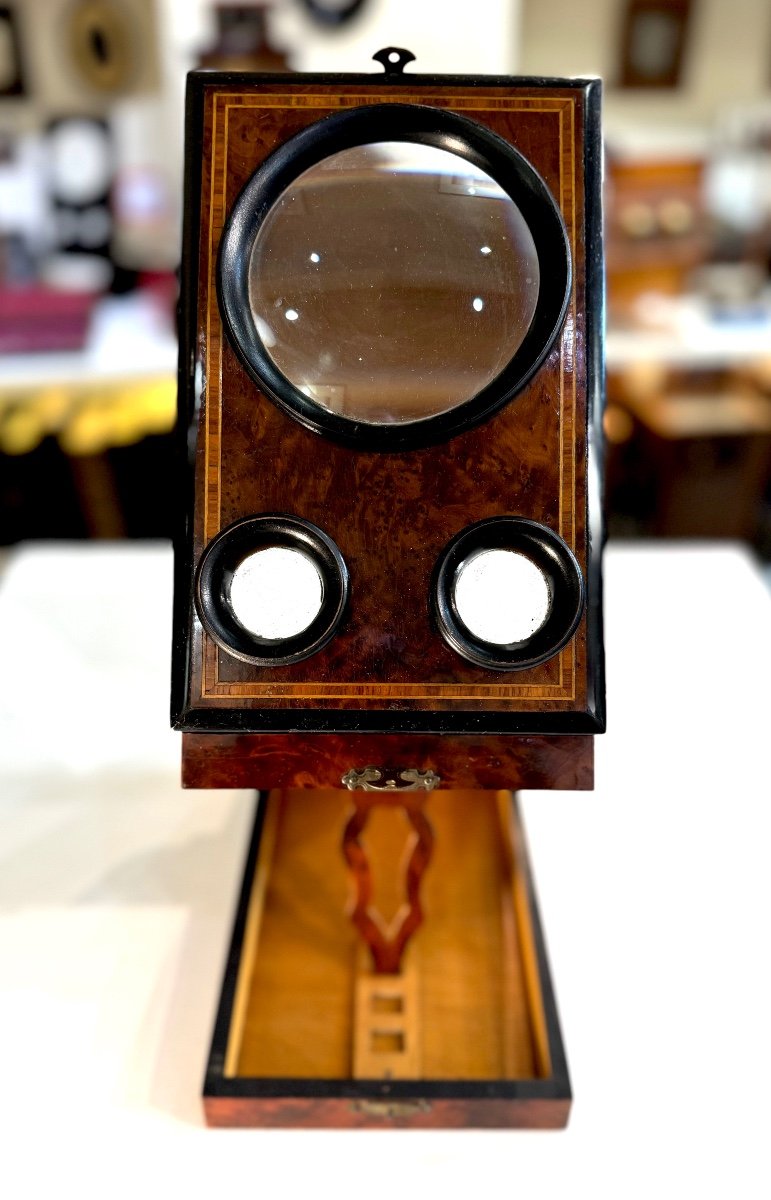
Beautiful mono and stereo Graphoscope in burr walnut. Size 22.5 x 14.7 x 7 cm. The first Graphoscopes appeared in the middle of the 19th century. They were equipped with a large magnifying lens for viewing photographs on paper, and two smaller ones for stereoscopic views. These objects were made as much to see better as to be seen. Mahogany, ebony, rosewood, fine marquetry, foliage... nothing is too beautiful to give these objects the elegance and refinement that suits the bourgeois interiors of this period. Relief photography is as old as "flat" photography (photography as it is widespread today). The invention of the relief image even predates that of photography, since in 1838, Wheatstone, member of the Royal Society of London, invented a mirror device restoring relief (as a reminder, the official date of the invention of photography is 1839). Moreover, the principle of obtaining a relief image had already been established in Antiquity by Euclid and taken up by Leonardo da Vinci in 1484. https://www.lavalisearlesienne.com/product-page/graphoscope-mono-et-st%C3%A9r%C3%A9o-en-ronce-de-noyer
500 €
Period: 19th century
Style: Napoleon 3rd
Condition: Excellent condition
Material: Wood marquetry
Length: 22,5cm
Width: 14,7 cm
Height: 7cm
Reference (ID): 1451775
Availability: In stock
Print