Cabochon Tile, XV To XVIII Th Century
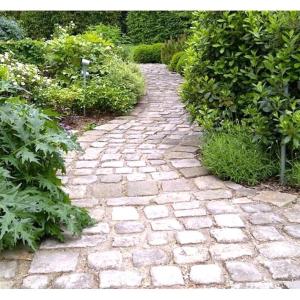
STONE FLOORING WITH INSETS (CABOCHONS)
16th–18th Centuries.
Origin: Burgundy and Lower Champagne.
Sources: Small townhouses or bourgeois homes undergoing renovation.
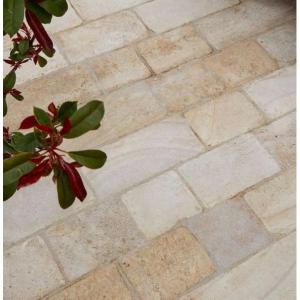
Typically dating from the 16th to the 18th century,
these stone tiles—cut into squares ranging from 18x18 cm to 33x33 cm—
feature slate insets (cabochons) at their corners.
These insets are generally square, diamond-shaped, or sometimes round, and occasionally take the form of stylized cloverleaves.
The stone is usually an ochre, beige, or cream-colored limestone sourced
from the numerous quarries in Burgundy or the Loire Valley (for areas north of the Loire).
Flooring with insets can also be found in "Blue Stone of the North" (such as Sainte-Anne)
or Belgian "Petit Granit" (Hainaut stone)—a black stone with slight beige fossil inclusions.
These floors are often found in smaller spaces like entryways, corridors, and small sitting rooms,
and more rarely in large living areas or dining rooms.
Thickness varies from 8 to 15 cm for the oldest flooring.
In the 17th and 18th centuries, mechanical sawing allowed for thicknesses ranging from 2 to 4 cm.
Older, thicker stones can be re-cut to a thickness compatible with modern construction methods.
This type of flooring is ideal for installation over underfloor heating systems. T
he quoted price of €320 per m² (incl. tax) for materials is an average that does not include the cost of re-cutting for thickness;
A specific quote for this work, based on the required surface area, will be provided upon request.
Installation requires meticulous care.
We can provide a team of specialized installers who work exclusively using traditional lime-based methods;
we do not add a markup to their labor costs.
Delivery can be arranged via our carrier upon request for a quote.
Highly fluctuating stock ranging from approximately 20 to 150 m² (across all sizes).
Please feel free to contact us for any further information.
16th–18th Centuries.
Origin: Burgundy and Lower Champagne.
Sources: Small townhouses or bourgeois homes undergoing renovation.
Typically dating from the 16th to the 18th century,
these stone tiles—cut into squares ranging from 18x18 cm to 33x33 cm—
feature slate insets (cabochons) at their corners.
These insets are generally square, diamond-shaped, or sometimes round, and occasionally take the form of stylized cloverleaves.
The stone is usually an ochre, beige, or cream-colored limestone sourced
from the numerous quarries in Burgundy or the Loire Valley (for areas north of the Loire).
Flooring with insets can also be found in "Blue Stone of the North" (such as Sainte-Anne)
or Belgian "Petit Granit" (Hainaut stone)—a black stone with slight beige fossil inclusions.
These floors are often found in smaller spaces like entryways, corridors, and small sitting rooms,
and more rarely in large living areas or dining rooms.
Thickness varies from 8 to 15 cm for the oldest flooring.
In the 17th and 18th centuries, mechanical sawing allowed for thicknesses ranging from 2 to 4 cm.
Older, thicker stones can be re-cut to a thickness compatible with modern construction methods.
This type of flooring is ideal for installation over underfloor heating systems. T
he quoted price of €320 per m² (incl. tax) for materials is an average that does not include the cost of re-cutting for thickness;
A specific quote for this work, based on the required surface area, will be provided upon request.
Installation requires meticulous care.
We can provide a team of specialized installers who work exclusively using traditional lime-based methods;
we do not add a markup to their labor costs.
Delivery can be arranged via our carrier upon request for a quote.
Highly fluctuating stock ranging from approximately 20 to 150 m² (across all sizes).
Please feel free to contact us for any further information.
320 €
Period: 17th century
Style: Louis 14th, Regency
Condition: Good condition
Material: Stone
Reference (ID): 1181426
Availability: In stock
Print