THIS OBJECT WAS SOLD
Pair Of Sculptures By Moreau, Circa 1890


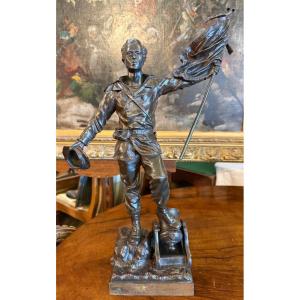
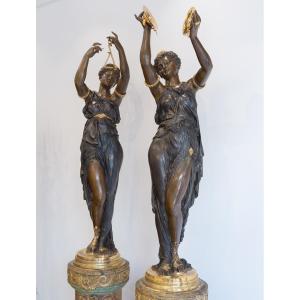
2 sculptures executed by the two famous sculptors, the MOREAU brothers forming a counterpart: La Brise by Auguste MOREAU awarded the gold medal at the exhibition and La Rosée by Mathurin MOREAU awarded the medal of honor at the show. Each bears the signature of its creator and rests on a polygonal base with a cartridge on which is inscribed the subject and the award at the Salon.
French work
Circa 1890
Biography Auguste MOREAU (1834-1917)
Auguste-Louis Mathurin Moreau was a French sculptor born on 22 February 1834 in Dijon and died on 11 November 1917 in Malesherbes. He belonged to a family of artists that was particularly active in the 19th century and was part of what is known as the Moreau dynasty, one of the most important families of sculptors of that period.
He was the son of the sculptor and painter Jean-Baptiste-Louis-Joseph Moreau. He grew up in an environment entirely devoted to artistic practice. His father’s workshop was his first place of training, where he learned drawing, modelling and the handling of form at an early age, following a traditional method of transmission based on observation and repetition. This artisanal and artistic education had a lasting influence on his approach to sculpture.
From a very young age, Auguste-Louis Mathurin Moreau devoted himself to sculpture and completed his training through academic study. Like many artists of his generation, he moved to Paris to refine his skills and to enter the official artistic circles. He adopted the visual language of 19th-century academic sculpture, inherited from Neoclassicism and adapted to the tastes of the Second Empire and later the Third Republic.
He began exhibiting at the Salon des artistes français in 1861. He presented his works there regularly for more than fifty years, until 1913. Unlike some members of his family, he neither sought major monumental commissions nor official distinctions. His career was marked by steady production rather than spectacular success.
His work consists mainly of decorative sculpture, primarily in bronze, but also in plaster and terracotta. He explored subjects that were highly appreciated in the 19th century: genre scenes, female figures, allegories, children, putti and pastoral themes. His style is characterised by clear compositions, elegant poses and careful attention to detail and finish.
Auguste-Louis Mathurin Moreau fully embraced the tradition of edition sculpture. Many of his works were cast in multiple examples and distributed to a bourgeois clientele, which contributed to the wide circulation of his work, but also to later confusion regarding his identity, as his name was often shortened to “Auguste Moreau”.
He worked in the shadow of his brothers, notably Mathurin Moreau and Hippolyte Moreau, who enjoyed greater fame and received official commissions. This family proximity partly explains why his work, although abundant, was long less studied and sometimes imprecisely attributed.
Nevertheless, his sculptures entered several French public collections, particularly in regional museums, and continue to appear regularly on the art market today. They are appreciated for their quality of execution and for their representative character within late 19th-century French decorative sculpture.
Auguste-Louis Mathurin Moreau ended his life far from the bustle of Paris. He died in Malesherbes on 11 November 1917, during the First World War. His death marked the end of a long and discreet career, firmly rooted in the French academic tradition.
Biography Mathurin MOREAU (1822-1912)
Mathurin Moreau, who owes his first name to his paternal grandfather, a locksmith in Dijon, was born at 7, rue Monge (then still called rue Saint-Jean) from the marriage of the sculptor Jean-Baptiste-Louis -Joseph Moreau and Anne Marianne Richer, originally from Besançon where his father, Mathieu Richer, is also a sculptor1. His brothers Hippolyte and Auguste are also sculptors. He was admitted to the School of Fine Arts in Paris in 1841 in the workshops of Jules Ramey and Auguste Dumont2. He won the second Prix de Rome in 1842 with Diodème removing the Palladium. He made his debut at the Salon des artistes français in 1848 and stood out there with the statue L'Élégie. He obtained a second class medal at the Universal Exhibition of 1855 in Paris, then a first class medal in 1878. In 1897, he was crowned with a medal of honor at the Salon2 of which he became a member of the jury during the Exhibition Universal of 1900 in Paris. He then exhibited a white marble bust representing Ishmael, son of Abraham and Hagar (after his bust in Carrara marble and bronze from 1875, entitled: Ishmael, candor). Between 1849 and 1879, Mathurin Moreau collaborated with the Val d'Osne art foundry and, as a shareholder, became one of its administrators, but, observes Pierre Kjellberg, "the reign of Napoleon III is also that of mantelpieces , and these hitherto very rare sets are multiplying and often feature in the catalogs of bronze publishers”: Mathurin Moreau's Reader is part of this craze3. The artist also provided models to the Compagnie des bronzes de Bruxelles and exhibited at the Central Union of Fine Arts Applied to Industry in the 1880s. In 1880, the artist received a bonus in the competition for the erection of an allegorical monument of La Défense de Paris at the Courbevoie roundabout (the roundabout at the origin of the La Défense district), but it is to Louis-Ernest Barrias that the commission is attributed. From 1879 and until his death, Mathurin Moreau was elected mayor of the 19th arrondissement of Paris — created in 1860 after the annexation of the municipalities of Belleville and La Villette — where rue Priestley took the name of avenue Mathurin-Moreau under of the decree of July 16, 1912. The satirical magazine Les Hommes d'Aujourd'hui devotes its n°183 to him, the portrait-charge drawn by Henri Demare on the cover showing him wearing the tricolor scarf and pointing to an allegorical statue of the law whose base crushes the clergy, "alluding to his liberal socialist opinions turned towards free-thinking". He celebrated many marriages: the painting painted by Henri Gervex in 1884 and hung in the marriage hall of the town hall represents Mathurin Moreau celebrating the civil marriage of his son. He was named Knight of the Legion of Honor in 1865 and promoted to officer of the same order in 18852. He died on February 14, 1912 in his home at 15 Passage du Montenegro in the 19th arrondissement of Paris. His funeral took place at the Saint-Jean-Baptiste church in Belleville and he was buried in the Lilas cemetery.
French work
Circa 1890
Biography Auguste MOREAU (1834-1917)
Auguste-Louis Mathurin Moreau was a French sculptor born on 22 February 1834 in Dijon and died on 11 November 1917 in Malesherbes. He belonged to a family of artists that was particularly active in the 19th century and was part of what is known as the Moreau dynasty, one of the most important families of sculptors of that period.
He was the son of the sculptor and painter Jean-Baptiste-Louis-Joseph Moreau. He grew up in an environment entirely devoted to artistic practice. His father’s workshop was his first place of training, where he learned drawing, modelling and the handling of form at an early age, following a traditional method of transmission based on observation and repetition. This artisanal and artistic education had a lasting influence on his approach to sculpture.
From a very young age, Auguste-Louis Mathurin Moreau devoted himself to sculpture and completed his training through academic study. Like many artists of his generation, he moved to Paris to refine his skills and to enter the official artistic circles. He adopted the visual language of 19th-century academic sculpture, inherited from Neoclassicism and adapted to the tastes of the Second Empire and later the Third Republic.
He began exhibiting at the Salon des artistes français in 1861. He presented his works there regularly for more than fifty years, until 1913. Unlike some members of his family, he neither sought major monumental commissions nor official distinctions. His career was marked by steady production rather than spectacular success.
His work consists mainly of decorative sculpture, primarily in bronze, but also in plaster and terracotta. He explored subjects that were highly appreciated in the 19th century: genre scenes, female figures, allegories, children, putti and pastoral themes. His style is characterised by clear compositions, elegant poses and careful attention to detail and finish.
Auguste-Louis Mathurin Moreau fully embraced the tradition of edition sculpture. Many of his works were cast in multiple examples and distributed to a bourgeois clientele, which contributed to the wide circulation of his work, but also to later confusion regarding his identity, as his name was often shortened to “Auguste Moreau”.
He worked in the shadow of his brothers, notably Mathurin Moreau and Hippolyte Moreau, who enjoyed greater fame and received official commissions. This family proximity partly explains why his work, although abundant, was long less studied and sometimes imprecisely attributed.
Nevertheless, his sculptures entered several French public collections, particularly in regional museums, and continue to appear regularly on the art market today. They are appreciated for their quality of execution and for their representative character within late 19th-century French decorative sculpture.
Auguste-Louis Mathurin Moreau ended his life far from the bustle of Paris. He died in Malesherbes on 11 November 1917, during the First World War. His death marked the end of a long and discreet career, firmly rooted in the French academic tradition.
Biography Mathurin MOREAU (1822-1912)
Mathurin Moreau, who owes his first name to his paternal grandfather, a locksmith in Dijon, was born at 7, rue Monge (then still called rue Saint-Jean) from the marriage of the sculptor Jean-Baptiste-Louis -Joseph Moreau and Anne Marianne Richer, originally from Besançon where his father, Mathieu Richer, is also a sculptor1. His brothers Hippolyte and Auguste are also sculptors. He was admitted to the School of Fine Arts in Paris in 1841 in the workshops of Jules Ramey and Auguste Dumont2. He won the second Prix de Rome in 1842 with Diodème removing the Palladium. He made his debut at the Salon des artistes français in 1848 and stood out there with the statue L'Élégie. He obtained a second class medal at the Universal Exhibition of 1855 in Paris, then a first class medal in 1878. In 1897, he was crowned with a medal of honor at the Salon2 of which he became a member of the jury during the Exhibition Universal of 1900 in Paris. He then exhibited a white marble bust representing Ishmael, son of Abraham and Hagar (after his bust in Carrara marble and bronze from 1875, entitled: Ishmael, candor). Between 1849 and 1879, Mathurin Moreau collaborated with the Val d'Osne art foundry and, as a shareholder, became one of its administrators, but, observes Pierre Kjellberg, "the reign of Napoleon III is also that of mantelpieces , and these hitherto very rare sets are multiplying and often feature in the catalogs of bronze publishers”: Mathurin Moreau's Reader is part of this craze3. The artist also provided models to the Compagnie des bronzes de Bruxelles and exhibited at the Central Union of Fine Arts Applied to Industry in the 1880s. In 1880, the artist received a bonus in the competition for the erection of an allegorical monument of La Défense de Paris at the Courbevoie roundabout (the roundabout at the origin of the La Défense district), but it is to Louis-Ernest Barrias that the commission is attributed. From 1879 and until his death, Mathurin Moreau was elected mayor of the 19th arrondissement of Paris — created in 1860 after the annexation of the municipalities of Belleville and La Villette — where rue Priestley took the name of avenue Mathurin-Moreau under of the decree of July 16, 1912. The satirical magazine Les Hommes d'Aujourd'hui devotes its n°183 to him, the portrait-charge drawn by Henri Demare on the cover showing him wearing the tricolor scarf and pointing to an allegorical statue of the law whose base crushes the clergy, "alluding to his liberal socialist opinions turned towards free-thinking". He celebrated many marriages: the painting painted by Henri Gervex in 1884 and hung in the marriage hall of the town hall represents Mathurin Moreau celebrating the civil marriage of his son. He was named Knight of the Legion of Honor in 1865 and promoted to officer of the same order in 18852. He died on February 14, 1912 in his home at 15 Passage du Montenegro in the 19th arrondissement of Paris. His funeral took place at the Saint-Jean-Baptiste church in Belleville and he was buried in the Lilas cemetery.
Explore similar pieces and discover your ideal find:
bronze sculptures