A candlestick known as a "moustache candlestick" without its moustaches. France, probably Normandy, 14th century. Superb patina, hexagonal base (unpublished).
This Gothic candlestick was made around the end of the 15th century in Central Europe, a region renowned for its production of objects in copper alloys, particularly brass and bronze. From the 14th ce[...]
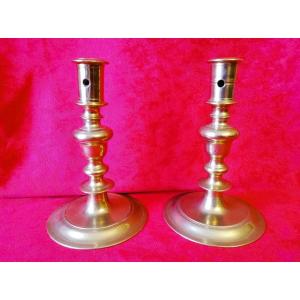
This charming pair of gilt bronze candlesticks is a Central European production. With their iron pike and the original wax cup. The base is round and the turning of the shafts is cylindrical and has t[...]
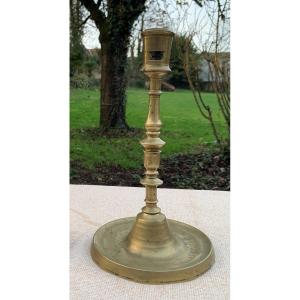
MY PRICES INCLUDE SHIPPING FOR METROPOLITAN FRANCE*********************Very rare TORCH in cast and turned brass, with a wide foot widening towards the shaft composed of two small molded balusters and [...]
HAUTE EPOQUE,15th centuryLate XVth cty lovely and heavy turned bronze or brass candlestickBinet with 2 square and rectangular lights,shaft with 3 balls including the central one wider.The base, presen[...]
We present this pair of high period candlesticks, very early 17th century around 1600 because we find there still reminiscences of candlesticks of the 16th century, a very wide base, very deep sockets[...]
Haute EpoqueFlanders XVe sVery large cast and turned brass / bronze candlestick or torch (height 29.5cm),composed of a large circular base (diameter 17cm) with an oblique rim, and raised in the hollow[...]
Important bronze candlestick from the end of the 15th or beginning of the 16th century, probably German or Flemish. The turned barrel, on a circular base. The large navel cup riveted to the barrel, fi[...]
Magnificent Gothic candlestick, Germany. The candle holder is melted in two parts; the base then was. Extremely elegant in proportion, much less massive than usual. An old repair below the base. Very [...]
Proantic uses a cookie to analyze traffic and improve its service by using Google Analytics. Data sent to Google Analytics (frequency of visits to the site and pages visited) are anonymous. No other cookie tracks your activity, your personal data is not collected. Thank you for helping us to have better understanding how Proantic is used.














 Le Magazine de PROANTIC
 TRÉSORS Magazine
 Rivista Artiquariato