THIS OBJECT WAS SOLD
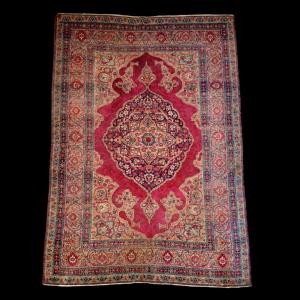
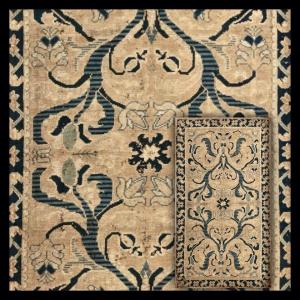
Tapestry / Carpet With Points On Canvas Late XVII Century Arraiolos, Portugal.




Arraiolos rugs represent the quintessence of the Portuguese textile industry, but their origin dates back to a place far from their namesake. To understand what makes these sought-after rugs so special, we need to look back at their rich and interesting history.
During the era of Moorish rule, culture from the Middle East, including Persian textile techniques, traveled easily to the Iberian Peninsula. It is speculated that this is partly because Moorish nobility often traveled with skilled carpet makers in their circles. These nobles and their craftsmen lived in the city of Evora for over 400 years, and during this time these textile masters are said to have taught their skills to local artisans.
In 1492 Queen Isabella expelled the Moors from Spain, and some of them fled west to Portugal, settling in the town of Arraiolos. In 1511, Portugal also expelled the Moors, but the locals had already absorbed the knowledge of embroidery and carpet making.
The essence of Arraiolos weaving : The Arraiolos stitch is an oblique cross stitch comprising two half crosses, one of which is twice the length of the other. The rule recommends three phases: Embroider the frame, shade, fill the background.
This carpet can be compared to other carpets of the same taste kept at the José Relvas Museum (Portugal), Museum Nacional de Arte Antigua in Lisbon (Portugal), Museum Nacional de Machado de Castro de Coîmbra Metropolitan Museum of Art in New York. Interpretive center of Arraiolos Carpet Museum Évora.
Arraiolos Rugs. Fundo Vip.p.46 C. Galea White. Carpets in Spain and Portugal,
Carpets in the World. Menges 1996.p.343
Size : 223x123 cm
Condition : Wear, holes and small restoration in the center.
The rug is not lined, it was hanging on the wall (hangs on the back)
Additional pictures on request.
During the era of Moorish rule, culture from the Middle East, including Persian textile techniques, traveled easily to the Iberian Peninsula. It is speculated that this is partly because Moorish nobility often traveled with skilled carpet makers in their circles. These nobles and their craftsmen lived in the city of Evora for over 400 years, and during this time these textile masters are said to have taught their skills to local artisans.
In 1492 Queen Isabella expelled the Moors from Spain, and some of them fled west to Portugal, settling in the town of Arraiolos. In 1511, Portugal also expelled the Moors, but the locals had already absorbed the knowledge of embroidery and carpet making.
The essence of Arraiolos weaving : The Arraiolos stitch is an oblique cross stitch comprising two half crosses, one of which is twice the length of the other. The rule recommends three phases: Embroider the frame, shade, fill the background.
This carpet can be compared to other carpets of the same taste kept at the José Relvas Museum (Portugal), Museum Nacional de Arte Antigua in Lisbon (Portugal), Museum Nacional de Machado de Castro de Coîmbra Metropolitan Museum of Art in New York. Interpretive center of Arraiolos Carpet Museum Évora.
Arraiolos Rugs. Fundo Vip.p.46 C. Galea White. Carpets in Spain and Portugal,
Carpets in the World. Menges 1996.p.343
Size : 223x123 cm
Condition : Wear, holes and small restoration in the center.
The rug is not lined, it was hanging on the wall (hangs on the back)
Additional pictures on request.
Explore similar pieces and discover your ideal find:
Rugs, Carpets