THIS OBJECT WAS SOLD
Siebe Johannes Ten Cate (1858-1908), Bruges La Morte, 1894, Symbolist Pastel, Signed (provenance Vollard)






Siebe Johannes Ten Cate (1858-1908)
Bruges, 1894
41 x 33 cm / 16 x 13 inches
Pastel on paper laid down on canvas
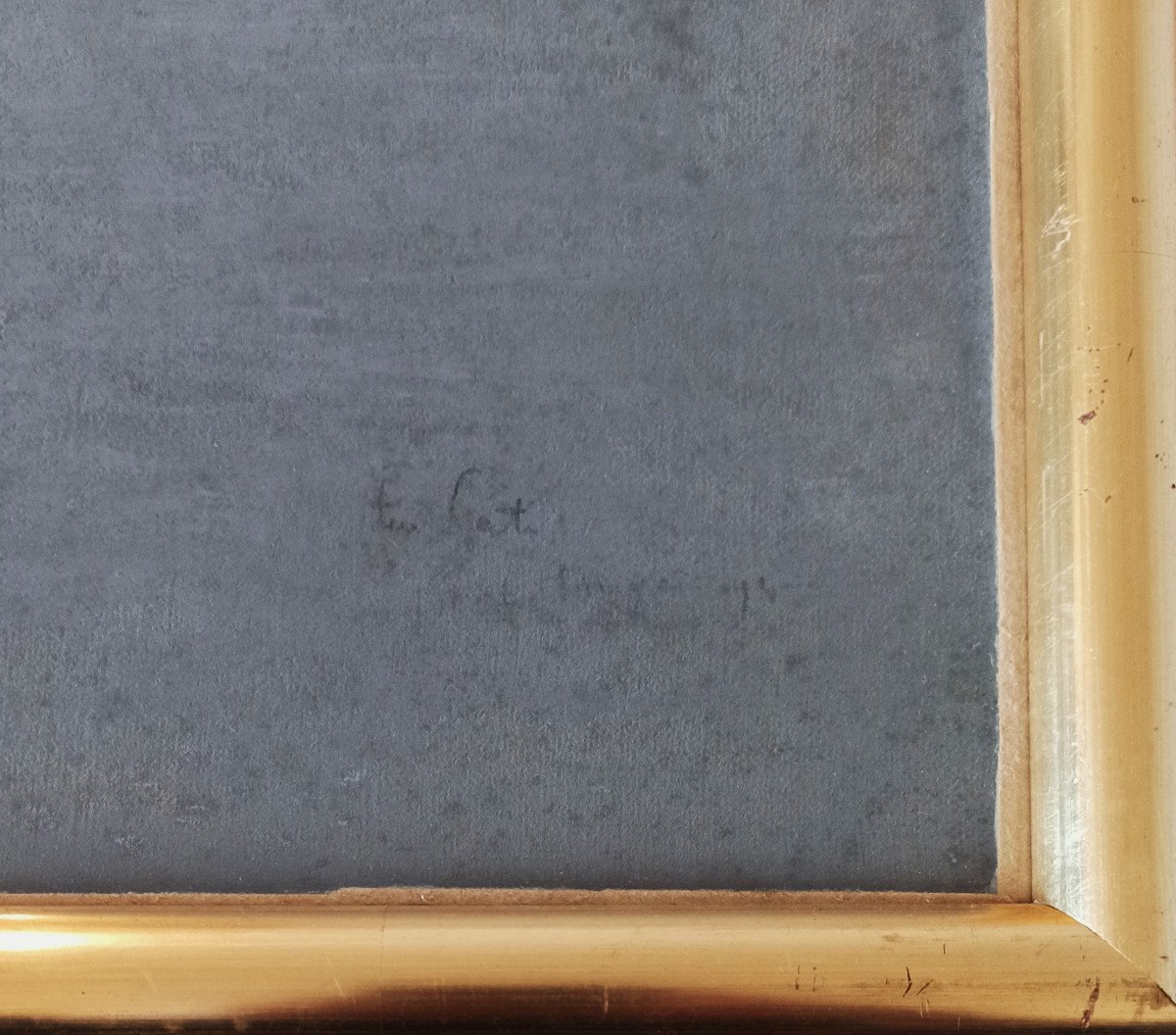
Signed and dated lower right "Ten Cate / Brugge 94" (difficult to read)
Very good condition, framed under glass
Dimensions with frame: 44 x 36 cm / 17,5 x 14 inches
On a day of 1894, this Dutch artist who had come to France to find the inspiration and influence of some of the most innovative painters of his time, traveled back across Flanders to compose this fascinating vision, exploring the rather limited palette of the powdery colors he had brought with him. The pastels he uses bring out the poetry of the work, its composition and its overall harmony, which vibrates differently along the day and the seasons.
Coming from the Ambroise Vollard collection, this pastel appaears with the magnetism of an artwork that was in the hands of this man who theorized and organized the transition between Impressionism and Modern Art.
Siebe Johannes Ten Cate (1858-1908) was a Dutch painter and draughtsman, close to his compatriots Anthon van Rappard, Vincent Van Gogh and, later, Kees Van Dongen. After his formative years, notably in Antwerp and The Hague, Ten Cate moved to Paris in 1883. His artistic encounters as well as his travels through Europe and Northern Africa inspired him a unique sense of composition and harmony that this pastel bears witness to.
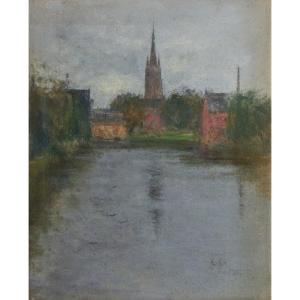
In the eyes of Ten Cate, this landscape in Bruges somehow feels more like a meditation on pastel, the technique that the artist has favored during his career. Exploring the work in detail, we admire the reflections in the water of the Minnewater which so much fascinate the artist, which wave the silhouettes of the birds, the trees and the monuments. Our gaze travels along the colorful architectures, one feels the radiance of the Notre-Dame church, which is here another motif in the landscape much more than a place of worship (the cross on top of the spire is not even sketched).
To some extent, this 1894 work evokes, by its subject and its technique, the powerful harmonies of some of the finest Symbolist artists and the novel Bruges-la-Morte by Georges Rodenbach, published in 1892, a prose poem illustrated with photographs of a town invaded by silence and mystery, by water and absence. Leafing through this book, we can find a photograph showing a view which is close to Ten Cate's composition. A masterpiece of Symbolist literature inspired a very fine artist to travel and see the Venice of the North with his own eyes, his heart submerged by poetry.
According to the provenance, this pastel comes from the Ambroise Vollard stock, who represented Ten Cate starting from 1900. Once hung on the walls of one of the greatest art dealers of his time, this landscape still vibrates with light and mystery today.
The work is very well preserved, as is its frame. The pastel (the pictorial material) has most probably been fixed, which allows the work to be transported without risk of alteration.
August 2022 (see picture) : The discovery of a lithography by Ten Cate, kept in the Rijksmuseum in Amsterdam, which is signed, dated and located by the artist "Ten Cate / 2 october 94 / Brugge", brings the confirmation that he indeed traveled to this town and worked there. Therefore it is highly probable that our pastel was created around this same date, in the Autumn of 1894.
Bruges, 1894
41 x 33 cm / 16 x 13 inches
Pastel on paper laid down on canvas
Signed and dated lower right "Ten Cate / Brugge 94" (difficult to read)
Very good condition, framed under glass
Dimensions with frame: 44 x 36 cm / 17,5 x 14 inches
On a day of 1894, this Dutch artist who had come to France to find the inspiration and influence of some of the most innovative painters of his time, traveled back across Flanders to compose this fascinating vision, exploring the rather limited palette of the powdery colors he had brought with him. The pastels he uses bring out the poetry of the work, its composition and its overall harmony, which vibrates differently along the day and the seasons.
Coming from the Ambroise Vollard collection, this pastel appaears with the magnetism of an artwork that was in the hands of this man who theorized and organized the transition between Impressionism and Modern Art.
Siebe Johannes Ten Cate (1858-1908) was a Dutch painter and draughtsman, close to his compatriots Anthon van Rappard, Vincent Van Gogh and, later, Kees Van Dongen. After his formative years, notably in Antwerp and The Hague, Ten Cate moved to Paris in 1883. His artistic encounters as well as his travels through Europe and Northern Africa inspired him a unique sense of composition and harmony that this pastel bears witness to.
In the eyes of Ten Cate, this landscape in Bruges somehow feels more like a meditation on pastel, the technique that the artist has favored during his career. Exploring the work in detail, we admire the reflections in the water of the Minnewater which so much fascinate the artist, which wave the silhouettes of the birds, the trees and the monuments. Our gaze travels along the colorful architectures, one feels the radiance of the Notre-Dame church, which is here another motif in the landscape much more than a place of worship (the cross on top of the spire is not even sketched).
To some extent, this 1894 work evokes, by its subject and its technique, the powerful harmonies of some of the finest Symbolist artists and the novel Bruges-la-Morte by Georges Rodenbach, published in 1892, a prose poem illustrated with photographs of a town invaded by silence and mystery, by water and absence. Leafing through this book, we can find a photograph showing a view which is close to Ten Cate's composition. A masterpiece of Symbolist literature inspired a very fine artist to travel and see the Venice of the North with his own eyes, his heart submerged by poetry.
According to the provenance, this pastel comes from the Ambroise Vollard stock, who represented Ten Cate starting from 1900. Once hung on the walls of one of the greatest art dealers of his time, this landscape still vibrates with light and mystery today.
The work is very well preserved, as is its frame. The pastel (the pictorial material) has most probably been fixed, which allows the work to be transported without risk of alteration.
August 2022 (see picture) : The discovery of a lithography by Ten Cate, kept in the Rijksmuseum in Amsterdam, which is signed, dated and located by the artist "Ten Cate / 2 october 94 / Brugge", brings the confirmation that he indeed traveled to this town and worked there. Therefore it is highly probable that our pastel was created around this same date, in the Autumn of 1894.
Explore similar pieces and discover your ideal find:
Pastel Art