Mossi Biga, Burkina Faso
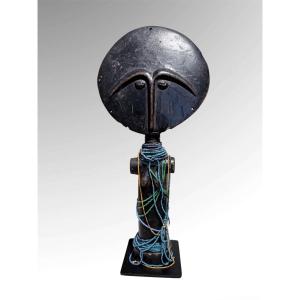
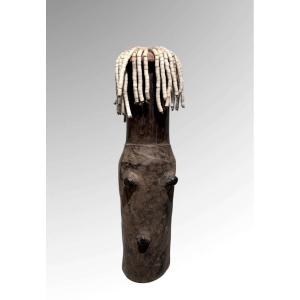
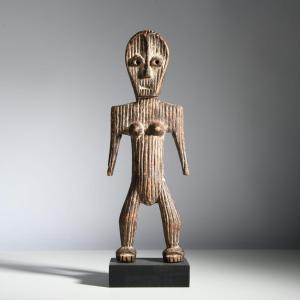
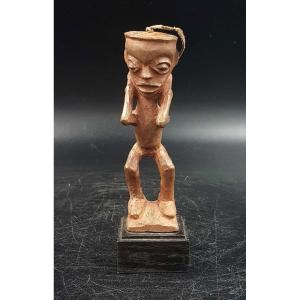
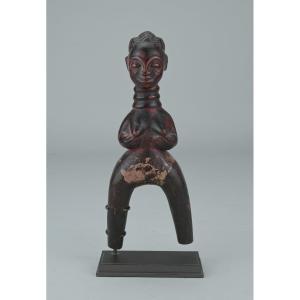
This isa “fertility doll” called Biga or “raog’biga”(child of wood, or in the Mossi language in the Boulsa style
The Boulsa style has these characteristics: long neck, very stylized feminine shapes, and a less voluminous bust than in some other styles.
the loop in front of the face corresponds to the headdress of young girls
The central crest (Kouka / Gyongo). This traditional hairstyle emblematic of the Mossi people (Burkina Faso) is characterized by a high braided crest in the middle of the head,
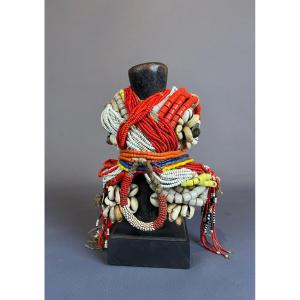
it is completely encased in a well-weathered leather mesh
from a german collection
the front appendice of the face corresponds to the headdress worn by young girls. Biga dolls were given to little girls to bring themhappiness, prosperity, and fertility.These small sculptures were cared for with great attention. They wereadorned with beaded necklaces and bracelets, and were symbolicallyfed and washed.As noted by the Smithsonian National Museum of African Art, thesestylized female figures were carved by Mossi blacksmiths. Parentsgave them to their daughters, who used them not only for play but also tolearn how to care for children. Later, the biga could play a rolein initiation rites and during childbirth. If a woman haddifficulty conceiving, she could request that anenlarged version of her childhood doll be made. “ "Biiga" means, in Mooré—the language of the Mossi—"child" in the senseof an "individual who has not reached physiological maturity" or "descendant."The Biga is treated as a child’s doll by little girls.
Thesefigurines depict a woman on a small scale, with the features of a younggirl—as seen in her hair and abdominal scarifications—but also as awife and a nursing mother through the depiction of breasts that arenever upright but rather pendulous. These figures are therefore as much arepresentation of the child as of the woman she will become.Although the biiga depict women, the children give them the first name—boy or girl’s name, dress them, bathe them, feed them, carry themon their backs, bounce them on their knees… just like a real baby.Sometimes given as a gift by one of the parents, the biiga—which is then carefully preservedcarefully, is taken by the young bride to her husband’s home because it isconsidered to promote pregnancy. If pregnancy does not occur,the infertile wife will acquire another one as a source of fertility.According to Suzanne Lallemand, the biiga—as the baby’s dual protector—receives the first care: once the umbilical cord is cut, thenewborn’s bathing comes after that of the wooden child, as does the massage withshea butter. The figurine is then laid down next to the mother beforeher infant is placed there. As for the first drop of breast milk, it isreserved for the statuette before the child nurses from its mother. Later, thestatuette will be carried one last time on the mother’s back.From “Biga, Mossi Fertility Dolls,” a book published in conjunction withthe exhibition at the Galerie Flak in Paris in December 2007.
550 €
Period: 20th century
Style: Tribal Art
Condition: Good condition
Material: Solid wood
Height: 27 cm
Reference (ID): 1865117
Availability: In stock
Print