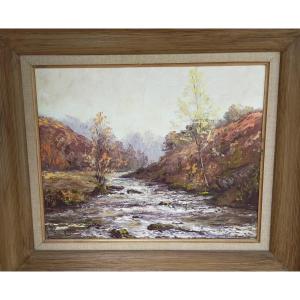
Raphaël Ponson (1835–1904) The Entrance To A Peasant's House
Artist: Luc Raphaël Ponson (1835-1904)
The contrast between the very dark interior and the sun-dappled white stucco creates a genuine sense of southern warmth in this entrance to a peasant’s house in Provence.
A “corner of the house” captured on the spot with a solid composition, featuring a large, dark arch at the center; the two light-colored steps draw the eye toward it, and the mass of foliage on the right balances the wall bathed in light on the left.
The carefully chosen vertical format reinforces the effect of an entrance, a threshold.
A deliberately restrained color palette makes the red and white accents of the flowers on the right stand out all the more—a small, lively touch that draws the eye without over whelming it.
The work is in good condition and is presented in a simple frame measuring 38 cm by 32 cm, with the cardboard panel alone measuring 29 cm by 23.5 cm.
Note a slight chip in the gilding in the upper right corner of the frame, which can be restored or replaced.
In good condition, it depicts a half-open arched doorway topped by a trellis, with shadows cast on the wall that lend depth to the facade.
It is signed in the lower left corner, countersigned, and titled “Maison de paysan” on the back.
A charming and sincere work, whose appeal lies in the accuracy of the lighting and its spontaneity; it is more beautiful in person than in a photograph, as it is difficult to photograph.
Renowned for his landscapes of the Provençal coast, Raphaël Ponson is the son of a theater designer who taught him the basics of painting. He then attended the practical drawing school in Marseille, where he was a student of Émile Loubon, who taught him to paint landscapes in keeping with the local tone. He went to Paris in 1855 and 1856, then to Italy, where he completed his training. He then settled permanently in Marseille. He made his debut at the Marseille Salon in 1852 and at the Paris Salon in 1861 with La Châtaigneraie aux environs de Chevreuse and Le Château d'If dans la rade de Marseille. Works In 1863, he decorated the gallery of the private apartments of the new prefecture of Marseille. For the decoration of the rooms on the first floor of the Natural History Museum at the Palais Longchamp, Henri-Jacques Espérandieu called upon Raphaël Ponson, whose flexible and brilliant talent would be perfectly suited to the execution of this work, according to the architect's words when presenting the letter of submission to the municipal council. In 1867, he decorated the three rooms on the first floor where he painted spectacular natural sites: Niagara Falls, the Sea of Ice, the Amazon rainforest and the basalt caves of Fingal in one of the Hebrides. The most famous room is that of Provence, where Ponson represents different landscapes for each of the small regions of Provence: cork oaks, chestnut trees and strawberry trees for the Var, olive trees and oleanders for the Bouches-du-Rhône, and mulberry trees, almond trees and melons for the Vaucluse. He also decorated the Rigaud café and the Plauchut pastry shop at the top of the Canebière in Marseille. He specialized in depicting the beaches, coves, and seashores around Marseille. To distinguish himself from his younger brother, Étienne Aimé Ponson, a still life painter, he added his first name to his surname. Present in numerous regional exhibitions, he received several awards.
Works in public collections Aix-en-Provence,
Granet Museum: Gulf of Bandol. Avignon,
Calvet Museum: Anse de la Couronne near Martigues.
Béziers, Museum of Fine Arts: Calanque de Port Pin near Cassis; Evening in the Gulf of Bandol.
Carcassonne, Museum of Fine Arts: Seaside in Bandol.
Cassis, Mediterranean Municipal Museum: Italian Brick in the Port of Cassis.
Digne-les-Bains, Gassendi Museum: The Calanque de Sormiou.
Dijon, Museum of Fine Arts: The Château d'If: Morning Effect.
Hyères: Coastline in Hyères.
The Rue de la République, Marseille, prefecture of the Bouches-du-Rhône.
Marseille: Museum of Fine Arts: Morning at Sausset; Cotes de Sormiou;
Navy. Maritime Museum: Coal Ships in the National Basin, 1890.
Prefecture of the Bouches-du-Rhône, private apartments: four circular paintings, commissioned on May 23, 1866 by the prefect Charlemagne de Maupas to decorate a gallery in his apartments, depicting districts of Marseille: The Palais Longchamp;
The Rue de la République; Borély Park;
The Pharo. Narbonne, Museum of Art and History: View of Endoume; Seagulls' Nest at the Calanque de Port-Miou.
Toulon, Art Museum: Undergrowth at Sainte-Marguerite.
Tours, Museum of Fine Arts: Rocks at Cassis.
1 500 €
Period: 19th century
Style: Other Style
Condition: Good condition
Material: Oil painting on cardboard
Length: 23,5 cm
Height: 29 cm
Reference (ID): 1859292
Availability: In stock
Print