




Ghent, 1798–1809, Pair Of Candlesticks, Pieter II Colle, Solid Silver Directoire-style Candlesticks
Pair of neoclassical solid silver candlesticks – Ghent, 1798–1802 – Pieter II Colle
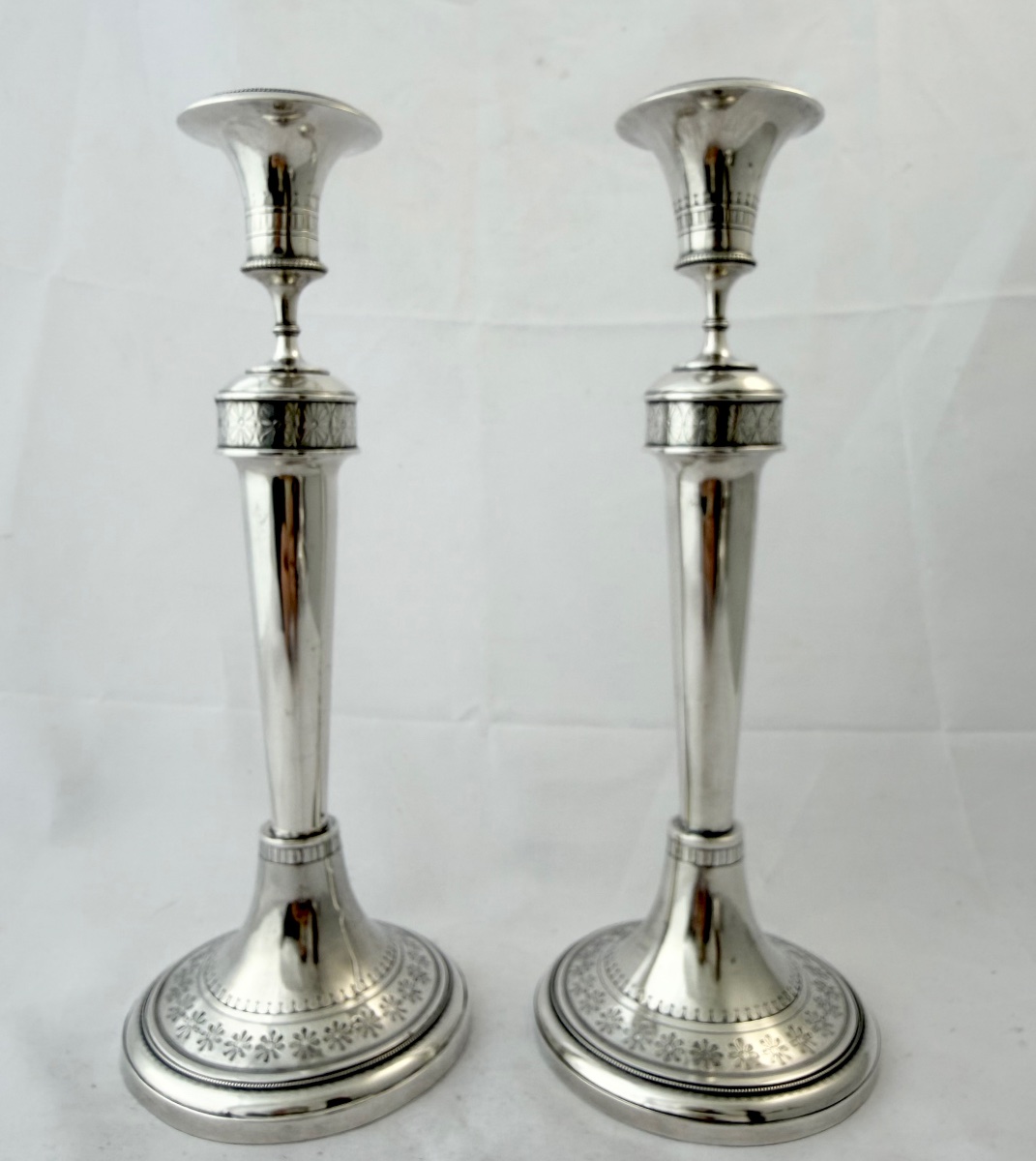
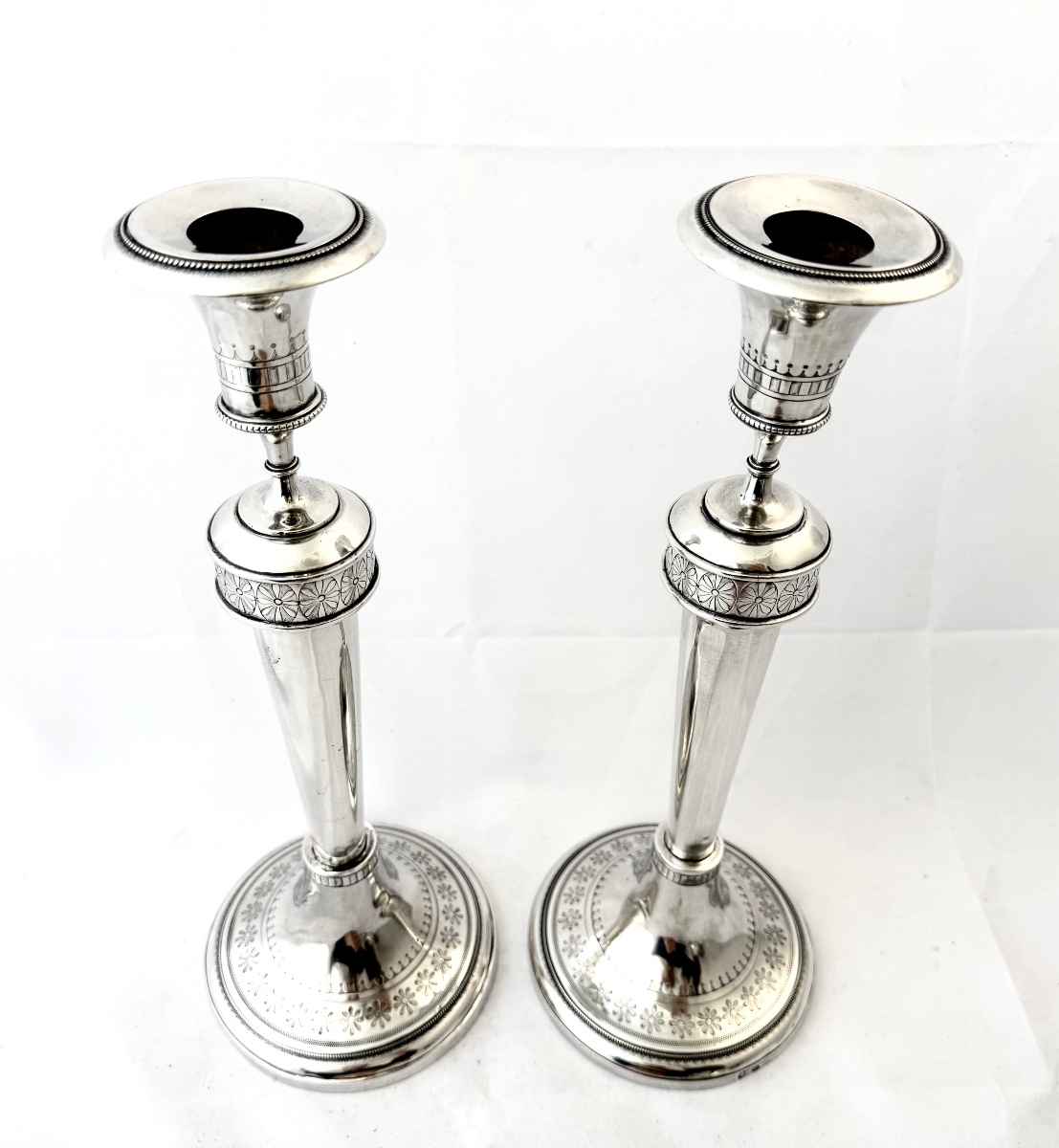
An elegant pair of large solid silver candlesticks, made in Ghent at the very end of the 18th century or in the very early years of the 19th century, during the French period.
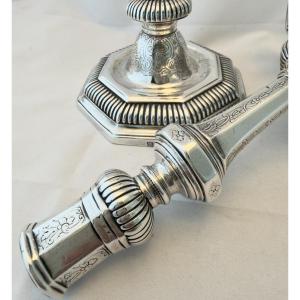
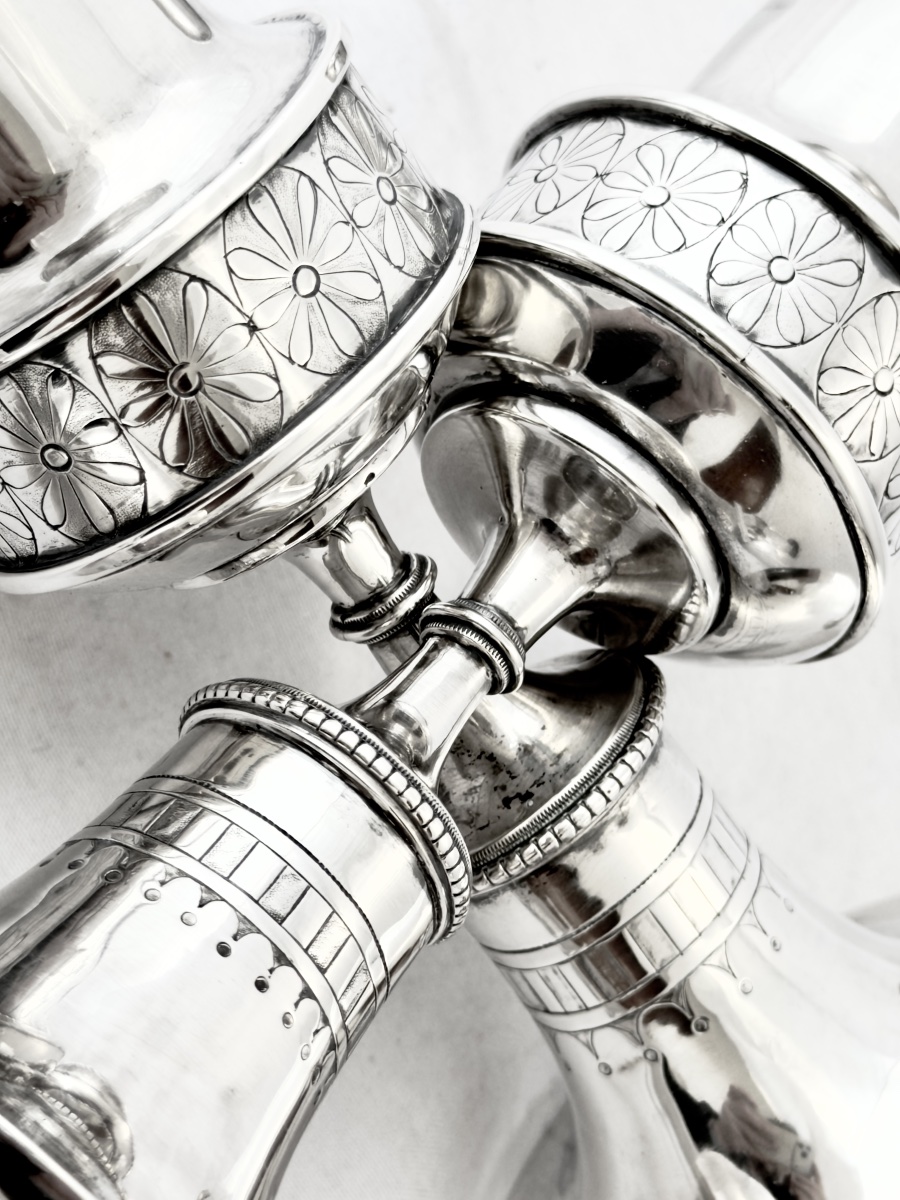
They rest on a circular, ogee-shaped base, adorned with a frieze of eight-petaled rosettes, accented by several rows of pearls, stylized plant motifs, and delicate geometric borders. The foot rises in a flared curve to meet a long, smooth truncated conical shaft, crowned by a cylindrical capital that echoes the floral decoration of the base. An elegant constriction supports the cup, shaped like a flared chalice, which ends in a cup-shaped bowl with a beaded border.
As was often the case in Ghent goldsmithing of this period, the richness of the decoration stems from the combination of several ornamental techniques. The motifs delicately hand-engraved on the base, capital, and cup are complemented by designs executed with a graver, as well as ornamental friezes created by stamping.
The alternation of smooth surfaces and finely decorated bands, the precision of the composition, and the slender proportions lend these candlesticks a distinctly neoclassical elegance, foreshadowing the Empire style.
The silversmith Pieter II Colle
The master’s hallmark is attributed to Pieter II Colle, whose name also appears in the archives as Collée and Coles. The second silversmith to bear this name, he ranks among the leading figures in Ghent silversmithing during the second half of the 18th century.
The son of Dionysius Collée and Marie van de Velde, he began his apprenticeship in 1747 with Jacobus Schanfeler, then with Pieter I Colle. He completed his training on December 21, 1752, and was admitted as a master goldsmith on September 1, 1757.
Throughout his long career, he held numerous positions within the Ghent Goldsmiths’ Guild, notably those of appraiser and juror, before becoming its senior member in 1790–1791.
His particularly diverse body of work includes both secular and religious goldsmith pieces. Among his cataloged works are a chocolate pot from 1767, a pair of candlesticks from 1768, an oil and vinegar set from 1770, as well as several ciboria, mustard pots, and salt shakers.
On June 24, 1798, Pieter II Colle is still listed as a silversmith. He continued his work until 1802, having weathered the political and institutional upheavals of the late 18th century.
Hallmarks and Dating
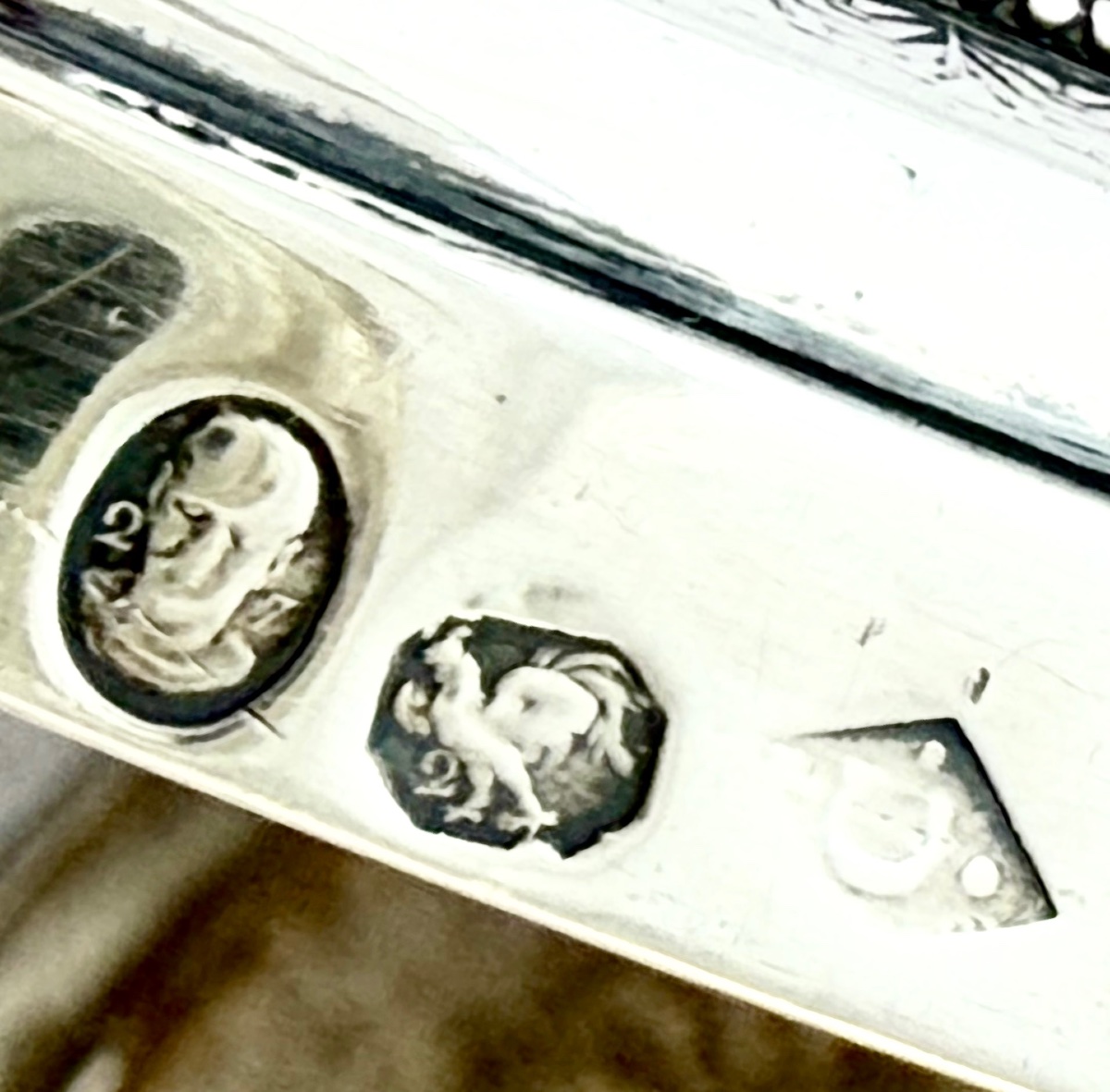
The candlesticks bear the French hallmarks known as the “first rooster,” used between 1798 and 1809, as well as the hallmark of the Scheldt department, identified by the number 27, whose inspection office was located in Ghent.
The attribution to Pieter II Colle allows us to narrow the dating of this pair to between 1798 and 1802, the goldsmith’s last known year of activity.
A remarkable capacity for stylistic adaptation
The significance of these candlesticks also lies in the extraordinary capacity for stylistic adaptation demonstrated by their creator at the end of a career spanning nearly half a century.
Trained around 1750, at a time when the Rocaille style still largely dominated goldsmithing in the Southern Netherlands, Pieter II Colle witnessed, in succession, the flourishing of the Louis XV style, the return to Antiquity under Louis XVI, and then the more refined Neoclassicism of the Directory and the Consulate, which heralded the Empire style.
The contrast between the works from the early part of his career and these candlesticks—whose lines were decidedly modern for their time—illustrates the extent of the aesthetic renewal that took place during the second half of the 18th century. Far from remaining attached to the forms and ornamental repertoire of his youth, this silversmith was able to profoundly renew his artistic language and assimilate new trends right up until the final years of his career.
A very beautiful pair of candlesticks, remarkable for the delicacy of their ornamentation, the elegance of their proportions, and their perfect state of preservation.
Origin: Ghent, Department of the Scheldt
Date: 1798–1802
Silversmith: Pieter II Colle, attributed
Material: solid silver, 800/1000
Height: 31 cm
Base diameter: 11.8 cm
Total weight: 815 g
Period: 18th century
Style: Louis 16th, Directory
Condition: Excellent condition
Material: Sterling silver
Height: 31 cm
Reference (ID): 1858705
Availability: In stock