Vintage Three-tiered Table From The Restoration Period
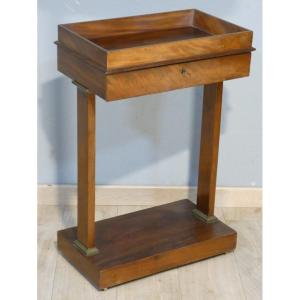
An elegant and refined French three-tier knitting table from the Restauration period, dating to the first half of the 19th century, beautifully crafted in contrasting lemonwood and amaranth, with delicate brass inlays and decorative gilt bronze mounts.
This sophisticated piece of French cabinetmaking combines the graceful proportions of the Restauration style with an unusual architectural arrangement of three concave tiers, creating a distinctive and highly decorative silhouette.
Elegant Three-Tier Construction
The table is composed of three superimposed concave shelves, each carefully designed to create a harmonious and balanced composition.
The lower tier is supported by four beautifully turned baluster legs embellished with fine brass inlays. These support the intermediate tier, which is connected to the upper level by a further set of four similarly turned baluster supports, also enriched with decorative brass inlay.
The repetition of these slender architectural elements gives the table a remarkable sense of lightness and vertical rhythm.
Each tier is further distinguished by elegant gilt bronze framing along its sides, adding a subtle touch of luxury and emphasizing the refined geometry of the construction.
Fine Lemonwood and Amaranth Cabinetmaking
The combination of lemonwood and amaranth is particularly attractive, bringing together the warm, luminous tones of lemonwood with the rich, darker coloration of amaranth.
This contrast was highly appreciated in fine French furniture of the early 19th century, particularly in pieces intended for elegant domestic interiors.
The carefully executed brass inlays on the turned baluster supports introduce an additional decorative element, demonstrating the attention to detail characteristic of quality French cabinetmaking.
Protective Glass Shelves
An especially practical feature of this table is the presence of custom-cut protective glass panels on all three tiers.
Each glass panel follows the shape of its respective shelf, protecting the wooden surfaces while allowing the beauty of the original veneers and decorative details to remain visible.
These protective glass elements make the table particularly suitable for contemporary use without compromising its historical appearance.
French Restauration Period Elegance
During the French Restauration period (1814–1830), furniture design evolved toward a more intimate and refined interpretation of the classical tradition.
Smaller pieces of furniture, including knitting tables, worktables and occasional tables, became important elements of fashionable domestic interiors.
These objects combined practical functionality with elegant proportions, carefully selected woods and sophisticated decorative details.
The present table is a particularly attractive example of this tradition, distinguished by its unusual three-tier construction, contrasting veneers, gilt bronze decoration and finely inlaid turned supports.
A Versatile Decorative Antique
Originally conceived as a knitting or worktable, this piece is equally suitable for use as an occasional table, display stand or decorative furnishing.
Its three levels provide ample space for displaying books, small sculptures, porcelain, decorative objects or other collectibles.
The elegant proportions and refined materials make it particularly well suited to both classical interiors and sophisticated contemporary settings.
A beautiful example of early 19th-century French Restauration furniture, combining exceptional decorative appeal, fine cabinetmaking and practical versatility.
Details
Origin: France
Period: First half of the 19th century, Restauration period, circa 1820–1830
Style: French Restauration / Early 19th-Century Neoclassical
Type: Knitting Table / Three-Tier Occasional Table / Étagère
Materials: Lemonwood, Amaranth, Brass Inlays, Gilt Bronze Mounts and Protective Glass Panels
Construction: Three concave tiers supported by turned baluster legs with decorative brass inlays
Decorative Elements: Gilt bronze side framing and contrasting wood veneers
Dimensions
Height: 75 cm (29.5 in)
Width: 38 cm (15.0 in)
Length: 71 cm (28.0 in)
Condition
Antique condition. The three tiers are fitted with custom-cut protective glass panels. Please refer to the photographs for a detailed assessment of the surfaces and any signs of age or use.
Keywords: French Restauration Table, Restauration Period Furniture, Antique French Knitting Table, French Worktable, Three-Tier Table, Lemonwood Furniture, Amaranth Wood, Brass Inlay, Gilt Bronze, French Étagère, 19th Century French Furniture, Neoclassical Occasional Table, French Antique Furniture, Decorative Arts, Florin Antiques.
6 550 €
Period: 19th century
Style: Louis Philippe, Charles 10th
Condition: Excellent condition
Material: Solid wood
Reference (ID): 1855373
Availability: In stock
Print