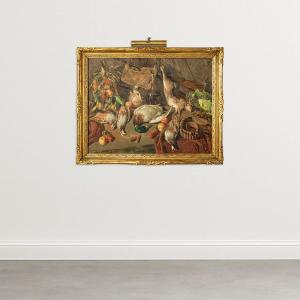
Painting, Still Life With Fruit, Signed T. Bale
T.Bale
Signedlower left “T. Bale”
Late19th century.
“StillLife with Fruit”
Canvaswith its original frame:68 x 94 cm.
Provenance:private collection.
Condition:Very good condition
Thissumptuous still life, executed with remarkable precision,attests to the virtuosity of a 19th-century artist, attributedto Thomas Bale,a painter working in the English realist tradition. The composition,classically balanced, brings together an abundance of ripefruit,white,a wickerbasket, anda vasemade of glazed ceramic,all arranged on a stone table.
The light caresses each element, revealing arich palette of warm, natural tones, with a dark background thatevokes the great 17th-century Flemish still lifes. Butbeyond mere representation, each element evokesa symbolic languagethat is subtle yet powerful,typical of allegorical painting.
Symbolic interpretation:
The grapes (white and black), associated with wine, vitality, and also Christian passion, evoke the duality of earthly and spiritual life.
The peach, a fleshy and sweet fruit, embodies the fleeting nature of pleasure, sensuality, but also purity when it is intact.
The plum, with its dark, sweet center, is often associated with abundance but also with the transition between seasons.
The melon or the kohlrabi in the center symbolizes fertility, opulence, and the nourishing world of nature.
The dead birds (probably snow grouse), often found in vanitas paintings, serve as a reminder of the fragility of life and the inevitability of death.
The terracotta pot, with its harmonious curves, can be seen as a symbol of the hearth, the feminine vessel, or more simply of domestic craftsmanship.
The wicker basket, hand-woven, evokes human labor and the connection between nature and culture.
Together, these elements form an allegoryof abundance, the fleeting beauty of life, and thetension between nature and culture,pleasure and mortality—a central theme in European art from the17th to the 19th century.
The work is attributed to ThomasBale,a 19th-century English painter whose works occasionally appearin specialized auctions of realist and academic art, as well as in theBénézit. This painting illustrates the Victorian-era tastefor detailed compositions, inspired by the old masters,with a valuethat is as decorative as it is allegorical.
Price:3,900 euros
Period: 19th century
Style: English Style
Condition: Excellent condition
Material: Oil painting
Width: 94
Height: 68
Reference (ID): 1854944
Availability: In stock