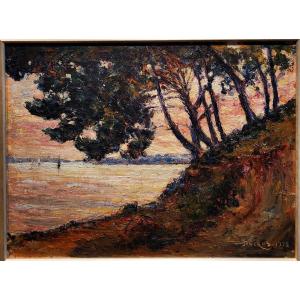
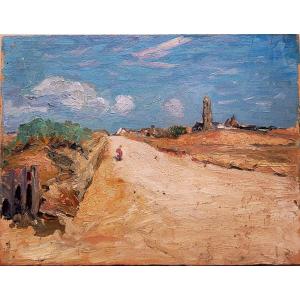
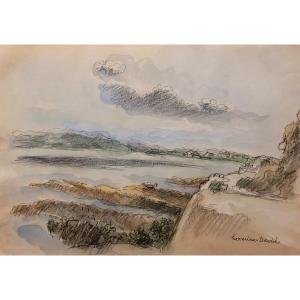
Alexandre Zinoview, Known As Zino (1889–1977) Ancient Ruins
Small pinholes along the edges.
Alexandre Zinoview, known as Zino, was a Russian and French painter of the first half of the 20th century, as well as a secret agent for the Okhrana from 1908 to 1917.
His eclectic body of work, which can be admired notably at the Historial de la Grande Guerre in Péronne, the Musée des Années Trente, the Manufacture de Roubaix [archive], and at the Musée de la Grande Guerre [archive] in Meaux, takes the form of numerous paintings and engravings, as well as drawings, theater sets, and fashion illustrations.
Known in particular for his work as an illustrator and set designer during the Roaring Twenties, he has recently been rediscovered as a unique figure in the Montparnasse art scene of the 1910s and an original war painter of the Great War.
Zinoview was indeed one of many foreign artists who answered Blaise Cendrars’ call to join the Foreign Legion to defend their adopted homeland.
After the war, he resumed his life as an artist in Montparnasse, which was becoming increasingly interested in the performing arts and the decorative arts. His Slavic style and imagination ensured his great success. He became “Zino,” one of the most sought-after designers of costumes and sets for music hall shows at the Folies Bergère and the Casino de Paris. Moving in the circles of haute couture and luxury, he also created numerous fashion illustrations.
After World War II, he moved away from realistic themes as well as from the worlds of entertainment and fashion, and his painting became increasingly introspective. Figures became scarce, and objects from the artist’s studio—trinkets, mannequins, statues—became elements of a deserted theatrical set.
Around 1950, he settled in the south of France and continued to paint until the end of his life, further developing his original and eclectic artistic journey—one that had seen him employ a wide variety of techniques in very different contexts, while constantly reinventing himself around a few constants: highly expressive drawing and a well-established penchant for theatrical staging.
Period: 20th century
Style: Modern Art
Condition: Good condition
Material: Gouache
Width: 50
Height: 41
Reference (ID): 1851967
Availability: In stock